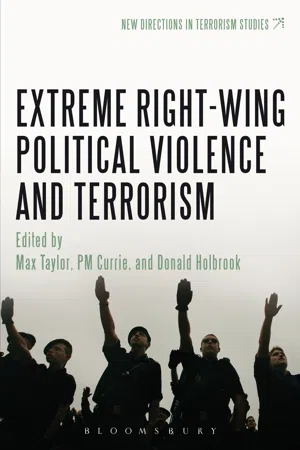
In this collection, senior experts explore all aspects of extreme right wing political violence, from the nature of the threat, processes of engagement, and ideology to the lessons that can be drawn from exiting such engagement. Further, right wing activism and political violence are compared with Jihadi violence and engagement. Also, the European experience is placed within a greater framework, including that of the United States and the Arab Spring.
The book opens with an essay on U.S. far right groups, investigating their origins and processes of recruitment. It then delves into violence against UK Mosques and Islamic centers, the relationship between Ulster loyalism and far right extremism, the Dutch extremist landscape, and the July 2011 Norway attacks. Also discussed are how narratives of violence are built and justified, at what point do individuals join into violence, and how differently states respond to left-wing vs. right-wing extremism.
This comparative work offers a unique look into the very nature of right wing extremism and will be a must-read for anyone studying political violence and terrorism
eBook - ePub
Extreme Right Wing Political Violence and Terrorism
- 208 pages
- English
- ePUB (mobile friendly)
- Available on iOS & Android
eBook - ePub
Extreme Right Wing Political Violence and Terrorism
About this book
Information
1
Introduction
Donald Holbrook and Max Taylor
Three plagues, three contagions, threaten the world.
The first is the plague of nationalism.
The second is the plague of racism.
The third is the plague of religious fundamentalism. […]
A mind touched by such a contagion is a closed mind, one-dimensional, monothematic, spinning round one subject only – its enemy.
RYSZARD KAPUŚCIŃSKI (1992) IMPERIUM
The political extreme right wing: dissecting conceptual ambiguities
The extreme right political milieu is not a holistic entity. As with all generalizations, this descriptive label ties together a host of heterogeneous strands of diffuse political activities and divergent justificatory narratives. Moreover, people who are attracted to movements and political discourse associated with the extreme right (as might equally be said of the extreme left) do not share common or universal identities, cultures and grievances. ‘Right-wing extremism’, as Knoope (unpublished) noted, ‘is a moving target. It is ever changing and evolving whilst being studied.’
The terms right and left wing are generally identified as having their origins in late eighteenth-century France and the early stages of the French Revolution, where they referred to the seating order of the French legislature. In the 1789 National Assembly, the ‘President’ or chairman of the legislature had on his right in the position of honour the representatives of the aristocracy and the church (the First Estate), whereas on his left sat the commoners (the Third Estate). Sitting on the right therefore broadly implied support for the aristocratic and royal interests, whereas the left implied republicanism, civil liberties and secularism. This broad sense of usage has persisted, in the sense that right-wing views are still generally associated with being socially conservative and holding on to the status quo, where as left-wing views are frequently characterised as embracing change and novelty. However, in the contemporary world the legacy of the Second World War, and the Nazi atrocities, further colour our view of extreme right-wing views, and complicate our analysis.
As a broad generalization, we might say that extreme right-wing political violence and terrorism constitutes an umbrella term that is applied to cluster together extremist and violent political activity that targets specific communities and actors who are blamed for the failed aspirations and grievances of belligerents. These targets can include Jews and the ‘ZOG’ (Zionist Occupation Government), Muslims, ‘elites’ and government or law-enforcement officials, non-white races, left-wing and liberal political activists and proponents of multiculturalism, immigrants, gays and ‘traitors’ (potential constituents who have failed to support the particular ‘vanguard’ in question). Belligerents, meanwhile, include diffuse youth gangs, nationalist movements, religious and millenarian movements, racist, neo-Nazi and anti-Semitic groups and other activist groups.
Some far-right extremist groups purport to adhere to religious doctrine and principles, including those that advocate vehemently millenarian goals and worldviews. Others are non-religious or even anti-religious. Elements of the far-right extremist fringe, meanwhile, continue to identify with historical fascist or Nazi traditions, whilst other strands dismiss or condemn this legacy (Bjørgo 1995). Furthermore, levels of organization, control and cohesion differ from case to case. Some forms of extreme right-wing violence might include isolated individuals acting on behalf of perceived common beliefs and sources of identity whilst other types of violent activity could be carried out by hierarchical groups seeking to emulate the rigid command and control structures of the Third Reich.
By extension, membership of far-right extremist groups is not uniform. As this volume explores, the English Defence League, for instance, purports to welcome non-whites and Jews even though these constitute targets in the actions and discourse of more ‘traditional’ extreme right-wing operatives. As Archer explores in Chapter Nine of this volume, moreover, Anders Behring Breivik’s ‘European Declaration of Independence’ and his ‘Vienna School’ of thought did not condone racism, fascism or Nazi totalitarianism. Indeed, the logo Breivik devised for the ‘Justiciar Knights’ depicted a red cross piercing through a skull bearing the symbols of the Islamic half-crescent, a Swastika and a hammer and sickle.
Membership of other groups, movements and ideational strands associated with the extreme right may be more rigid. Many neo-Nazi and white supremacist groups, for example, include only a handful of activists united in their common goal of defending the white race against ‘Zionist’ and government conspiracies. Indeed, many of these groupings see their membership numbers dwindle as mutual distrust and paranoia cause groups to split, fragment and implode.
Conceptual ambiguities and definitional conundrums are exacerbated by the fact that extreme right-wing activists rarely recognise or operate under this label that has been defined by others to describe their activities. Unlike Islamist militants and ‘jihadists’, for example, far-right violent extremists tend not to describe their efforts and methods of political involvement as extreme. Rather than members of the ‘extreme right’, activists will refer to themselves as Aryans, Creators, white patriots, ‘Justiciar knights’ and ‘cultural conservatives’, members of the ‘counter-jihad’, specific militia members, national defenders, national socialists, racial holy warriors, racial volunteers, Klansmen or any other names linking them to their particular gangs, movements and ideational strands.
Activists may indeed all be intolerant and ignorant of that which they hate, but no common political denominator unites them all. There is no single common enemy amongst those we label as right wing, although many diverse groupings will share similar hierarchies of enmity. ‘The enemy of my enemy is not my friend’ (Weinberg, Chapter 2 in this volume) seems appropriate when it comes to extreme right-wing political violence.
Furthermore, it is unclear where distinctions should be drawn between extreme, violent manifestations of the far-right and more moderate political platforms that sometimes espouse similar rhetoric. Explaining how these latter groupings emerged and operate can provide valuable context that shows how more extreme right-wing political activism and violence has evolved in a particular geographical setting. Several contributions in this volume explore this wider political context in relation to the development of more violent and terrorist strands of the extreme right.
The heterogeneity of our focus of analysis, however, means that groupings under review are not only disunited when it comes to identifying enemies. Many, as the earlier noted examples from Breivik’s manifesto and the English Defence League (EDL) illustrate, are in clear opposition to each other. One prominent white-supremacist group, for example, declared EDL activists to be traitors and disseminated buttons that read ‘EDL GO–2-ELL 14 WORDS.’1
In psychological terms, many of the qualities we might identify as characterizing right-wing views have been associated with the authoritarian personality type. Exaggerated submission to authority, extreme levels of conformity to conventional standards of behaviour, self-righteousness associated with aggression, and punitive approaches to minorities and deviant groups (Adorno et al. 1950) all tend to be associated with both authoritarian and right-wing views. Adorno’s early work had its origins in the post-Second World War period, and particularly focused on Nazi and anti-Semitic views as exemplars. Early approaches tended to locate the origins of these kinds of views in psychopathy, but more recent understanding emphasises the role of social learning from family and friends, and also on a lack of experience of groups against whom prejudice is shown.
In ideological terms, extreme right-wing views are often contrasted with extreme left-wing views, where the former tend to focus on support for social order, in contrast to challenge to authority rather than social stability predominantly found in the latter. However, in psychological terms there are grounds for supposing that there may be critical common links between right and left effects on behaviour that lie not in contrasting qualities of ideologies, but in the role of extremism. Both Eysenck (1954) and Rokeach (1960) were early researchers who pointed to commonalities in personality and cognitive qualities between extreme right and left-wing activists. If this is the case, then engagement with ‘the extreme per se’ rather than ‘engagement with extreme qualities of ideology’ may be the critical variable. However, this is further complicated by the way we label someone as ‘extreme right wing’ which tends to be not just a description of political perspective, but also a pejorative and condemnatory term (in much the same way left-wing extremist is used). It seems likely that what we are referring to (at least in psychological terms) are complex clusters of attitudes rather than specific qualities. The views of the contributors to this book seem to largely take this perspective.
The pejorative nature of the term ‘extreme right wing’ can be understood in relation to Goffman’s (1986) notion of ‘spoiled identity’, when political positions are spoiled or have become politically incorrect or unacceptable following certain historic events. Knoope (unpublished) developed these ideas further in relation to far-right extremism and the role of violence:
This phenomenon can be characterised by the changing attitudes towards anti-Semitic groups after the Second World War. The societal/political position of individuals or groups that still adhered to anti-Semitic ideology changed dramatically due to events in World War II and became socially unacceptable.
Similarly, after the fall of the Berlin Wall in 1989 all those who admired or supported Communism suddenly became outcasts. Marxist intellectuals in Western Europe were suddenly on the defensive and needed to deny their past sympathies. One could argue that a similar development occurred in the aftermath of 9/11 in relation to political Islamists and perhaps even to Muslims in Western society at large. A conflict arose in contemporary societies between the ideas within a certain group (Islamists and their communities) and the environment that deemed these ideas as totally unacceptable (society at large).
Spoiled identity has the potential to lead to alienation and even exclusion – both in the individual and collective sense. In a rather complex and unpredictable way, this development underpins violent action.
The conflict between one’s ideological, personal and moral convictions on the one hand and the political acceptance of these positions on the other determines the, what could be called, ‘potential-for-violence-factor’. The attractiveness of this exclusion, however, is determined by other factors: one being the societal position of the individual. The risk of being maneuvered into the ‘outsider’ position should not be underestimated. Here the ‘spoiled identity’ plays an important role. If it leads to (known) followers of that identity being excluded from job opportunities or careers, he or she can channel this grievance in several ways, based on the individual’s own calculation.
The aims of this book
The purpose of this volume is to highlight and explore different strands of violent political activity, attitudes and related discourses and contexts that have been grouped under ‘extreme right wing’ banner. This is done in recognition of the fact that many of these strands are contradictory and that the label applied is awkward, at times inconsistent and ambiguous.
For this reason, the contributors to this volume have all explored the specific ideational, definitional and political contexts from their own perspective. This is not to suggest that ideas, movements and events do not transcend temporal and geographical boundaries. Indeed, movements such as the English Defence League have influenced debates on Islam in the United States, as well as elsewhere in Europe. The Dutch politician Geert Wilders has become almost a global celebrity and spokesperson for anti-Islamic far right political discourse. Yet more extremist movements, such as British neo-Nazi groups and the US Creativity Church seek to expand their reach and influence through online forums, websites and regional ‘representatives’ or ‘chapters.’
The contributions in this volume explore these linkages and influences whilst describing the ways in which the extreme right-wing label has been applied within the specific context and for the particular case under review. Given the ambiguity of the concept of extreme right-wing terrorism and political violence and the extent to which it is applied broadly, to describe diffuse movements and activities, the contributions in this volume thus collectively emphasise the importance of understanding context and the formative evolution of the phenomenon under review.
The chapters in this volume therefore explore the development of extreme right-wing discourses and movements within specific geographical settings. The emergence of new strands is compared with the type of activities that were traditionally categorized as extreme right-wing and different types of movements and discourses are compared and contrasted. The editors hope that through this, the reader will appreciate the complexity of the phenomenon, the importance of context and the variety of dispositions, ideas and motivations that inform extremist political activity that is often labelled ‘extreme right-wing’ in the public discourse.
In addition to exploring specific cases in their historic context, this volume has sought to be sensitive to what appears to be a more recent dynamic that has become increasingly prominent among movements associated with the extreme right. This pertains particularly to the identification of Muslim culture and immigration and the concept and manifestation of multicultural policies as a source of grievance. Traditional elements of the extreme right have altered or rearranged enemy hierarchies, focusing increasingly on the perceived threat to their core interests from Islam and multiculturalism. At the same time, new single-issue clusters and movements have emerged that have been grouped (rightly or wrongly) under the far-right banner. The majority of these channel their animosity squarely towards Islamist ideological strands, or Islamic culture more generally, as well as aspects of modern political representation and participation that are seen to facilitate the spread of such ‘alien’ cultures. The English Defence League (Chapter 4 in this volume), the ‘counter-jihad’ (Chapter 9 in this volume) and violence focused against Islamic centres and mosques (see Chapters 3 and 7 in this volume) form part of this on-going development.
Hostility towards immigrants and asylum-seekers is not, of course, a new or recent addition to the far-right extremist milieu. Nor is the greater mobilizing potential and appeal of such movements – compared to most other strands of the extreme far right – unprecedented. Willems, for instance, warned in 1995 of the
emergence of new ethnic conflicts and […] of xenophobic nationalist movements which reach far beyond the right-wing political margin into the centre of society as a whole. The conflict about asylum is only the prelude to a new fundamental conflict: the conflict over immigration and by extension over the future definition of our society as a multicultural and multi-ethnic society. (Willems 1995: 180–1)
‘For the first time,’ Willems argued, ‘these groups can experience a new self-definition and collective meaning as representatives of general interests through the unspoken or open support of parts of the population’ (ibid: 180). Nascent movements on the far-right targeting Islam, Islamism or multiculturalism do not, as noted above, always fit the conventional mould of ethno-nationalistic anti-immigrant groups. They do, however, provoke similar emotions relating to the protection of ‘indigenous’ cultures and sources of identity and have greater potential for garnering popular support than other more rigid and isolated elements such as neo-Nazi and millenarian groups.
These anti-Islamic/Islamist and counter-multiculturalist movements and groups convey threat perceptions that may have greater resonance than those ...
Table of contents
- FC
- New Directions in Terrorism Studies
- Title
- Copyright
- Contents
- Contributors
- Acknowledgements
- 1 Introduction
- 2 Violence by the Far Right: The American Experience
- 3 Anti-Muslim Violence in the UK: Extremist Nationalist Involvement and Influence
- 4 Grassroots Activism in the English Defence League: Discourse and Public (Dis)order
- 5 Ulster Loyalism and Extreme Right Wing Politics
- 6 The Dutch Far Right: From ‘Classical Outsiders’ to ‘Modern Insiders’
- 7 Youth Engagement in Right Wing Extremism: Comparative Cases from the Netherlands
- 8 Right Wing Political Violence in France: Stock Take and Perspectives
- 9 Breivik’s Mindset: The Counterjihad and the New Transatlantic Anti-Muslim Right
- 10 Still Blind in the Right Eye? A Comparison of German Responses to Political Violence from the Extreme Left and the Extreme Right
- 11 Far Right and Islamist Extremist Discourses: Shifting Patterns of Enmity
- 12 Conclusion
- Bibliography
- Index
Trusted by 375,005 students
Access to over 1.5 million titles for a fair monthly price.
Study more efficiently using our study tools.
Frequently asked questions
Yes, you can cancel anytime from the Subscription tab in your account settings on the Perlego website. Your subscription will stay active until the end of your current billing period. Learn how to cancel your subscription
No, books cannot be downloaded as external files, such as PDFs, for use outside of Perlego. However, you can download books within the Perlego app for offline reading on mobile or tablet. Learn how to download books offline
Perlego offers two plans: Essential and Complete
- Essential is ideal for learners and professionals who enjoy exploring a wide range of subjects. Access the Essential Library with 800,000+ trusted titles and best-sellers across business, personal growth, and the humanities. Includes unlimited reading time and Standard Read Aloud voice.
- Complete: Perfect for advanced learners and researchers needing full, unrestricted access. Unlock 1.5M+ books across hundreds of subjects, including academic and specialized titles. The Complete Plan also includes advanced features like Premium Read Aloud and Research Assistant.
We are an online textbook subscription service, where you can get access to an entire online library for less than the price of a single book per month. With over 1.5 million books across 990+ topics, we’ve got you covered! Learn about our mission
Look out for the read-aloud symbol on your next book to see if you can listen to it. The read-aloud tool reads text aloud for you, highlighting the text as it is being read. You can pause it, speed it up and slow it down. Learn more about Read Aloud
Yes! You can use the Perlego app on both iOS and Android devices to read anytime, anywhere — even offline. Perfect for commutes or when you’re on the go.
Please note we cannot support devices running on iOS 13 and Android 7 or earlier. Learn more about using the app
Please note we cannot support devices running on iOS 13 and Android 7 or earlier. Learn more about using the app
Yes, you can access Extreme Right Wing Political Violence and Terrorism by Max Taylor, P.M. Currie, Donald Holbrook, Max Taylor,P.M. Currie,Donald Holbrook in PDF and/or ePUB format, as well as other popular books in Politica e relazioni internazionali & Relazioni internazionali. We have over 1.5 million books available in our catalogue for you to explore.