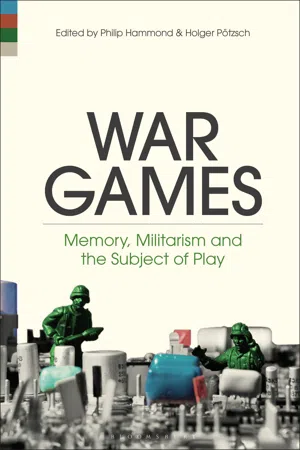
Many of today's most commercially successful videogames, from Call of Duty to Company of Heroes, are war-themed titles that play out in what are framed as authentic real-world settings inspired by recent news headlines or drawn from history. While such games are marketed as authentic representations of war, they often provide a selective form of realism that eschews problematic, yet salient aspects of war. In addition, changes in the way Western states wage and frame actual wars makes contemporary conflicts increasingly resemble videogames when perceived from the vantage point of Western audiences.
This interdisciplinary volume brings together scholars from games studies, media and cultural studies, politics and international relations, and related fields to examine the complex relationships between military-themed videogames and real-world conflict, and to consider how videogames might deal with history, memory, and conflict in alternative ways. It asks: What is the role of videogames in the formation and negotiation of cultural memory of past wars? How do game narratives and designs position the gaming subject in relation to history, war and militarism? And how far do critical, anti-war/peace games offer an alternative or challenge to mainstream commercial titles?
eBook - ePub
War Games
Memory, Militarism and the Subject of Play
- 288 pages
- English
- ePUB (mobile friendly)
- Available on iOS & Android
eBook - ePub
War Games
Memory, Militarism and the Subject of Play
About this book
Information
1
Introduction: Studying War and Games
This volume engages with the nexus between war, games and play from various disciplinary standpoints, bringing together perspectives from game studies, media studies, memory studies, history, sociology, political science, literary theory and more. The chapters assembled here are inspired by work presented in earlier collections that have addressed similar themes and that still stand as seminal publications in the field – Nina Huntemann and Matthew Thomas Payne’s Joystick Soldiers (2010), Gerald Voorhees, Joshua Call and Katie Whitlock’s Guns, Grenades and Grunts (2012), and Pat Harrigan and Matthew Kirschenbaum’s Zones of Control (2016). To build on these important contributions, our anthology pays particular attention to areas of inquiry that, so far, have not been sufficiently explored. We focus on both digital and analogue games; critically assess the interplay and contingent relations between the military, militarism, players and politics; investigate the potential of war games as media of history and cultural memory; and look at predominantly European titles and themes.
Our inquiries are underpinned by the conviction that games and play matter – that how we represent and playfully re-enact past and present wars has implications for how we see these wars, how we perceive our own role in them, how we remember them – and how we might react to future military engagements. We subscribe to Matthew Thomas Payne’s (2016: 11, 4) view that ‘the act of gaming is always inextricably connected to extant material forces’, and that a ‘complex but co-evolving dialectic’ connects the physical world and virtual realm of play.
The chapters in this volume adopt three distinct but interrelated vantage points. Firstly, attention is directed to connections between militarism and a subject of play who actively negotiates and selectively submits to what Payne (2016: 14) has termed a ‘ludic war experience’. Secondly, we move on to studies investigating implications of war games for collective commemoration and memory politics. As Adam Chapman, Anna Foka and Jonathan Westin (2017: 360) explain in their introduction to historical game studies as an academic field, it is widely accepted today that games ‘can indeed be, or relate to, history’. Finally, the chapters in the third part of the book interrogate game form from designer- as well as ‘text’-centric perspectives, pointing to formal frames that predispose experiences and practices of play in either hegemonic or critical directions.
Games, War and the Military
There are many compelling reasons to study the relationship between war and games, not the least of which is the military’s own extensive use of videogame technologies as a tool for everything from recruitment, through strategizing, planning and training for combat, to the treatment of injured and traumatized veterans. According to Patrick Crogan (2011: 2–18), current entertainment games are the by-product of military research and development carried out in the US in the early 1960s. Yet of course the military’s interest in games stretches back much further, beyond the nineteenth-century Kriegsspiel to the ancient world – extending, as scholars have noted, ‘from Sun Tzu to Xbox’ (Halter 2006), or ‘from gladiators to gigabytes’ (van Creveld 2013). Since the late twentieth century, as videogames have grown into a multi-billion dollar industry, eclipsing even Hollywood box office revenue, the military’s use of games has been virtually synonymous with its use of electronic games and related digital technologies. As Corey Mead (2013: 5–6) observes, the contemporary military is deploying videogames on ‘a broad, institution-wide scale … using them at every organizational level for a broad array of purposes’.
In this context it is hardly surprising that, for example, when the European arms manufacturer MBDA introduced a new land combat missile system in 2018, one selling-point was that its controls were ‘designed to look and feel like video game controllers, which makes it easy for young soldiers who have grown up playing video games to learn how to use the system and employ it effectively in combat’ (Judson 2018). Similarly, the US military’s new Synthetic Training Environment (STE), planned to be operational by 2025, is envisaged as being ‘like a multiplayer online game’, in which ‘teams of soldiers with goggles and special gloves carry out missions in megacities stretching for miles, filled with thousands of opponents and non-combatants’ (Hambling 2018), and indeed Army planners announced at the outset that they would ‘use the commercial gaming industry to accelerate the development of STE’ (Hames and Roth 2019).
A symbiotic relationship between the armed forces and the games industry has been consolidated since the 1990s. Commercial games and technologies have been taken up and repurposed by the military (Marine Doom is a famous early example),1 or promoted to the military by games companies (as, for instance, Microsoft did with its Kinect device: see Cavalli 2012). Equally, the military, particularly in the US, has invested heavily in applied games technology research, and in purpose-made game development. The establishment, at the turn of the twenty-first century, of the University of Southern California’s Institute for Creative Technologies, with a $45 million grant from the US Army (renewed to the tune of $100 million in 2004), stands as the most visible institutional embodiment of this close cooperation; while the online recruitment game America’s Army, development of which began at around the same time, is the emblematic example of how officially funded military projects have both drawn on and fed into popular gaming culture (Allen 2017: 122–5).
Robertson Allen argues convincingly that the ‘corporatization of the military and the militarization of corporations’ are the ‘underlying engines’ driving a ‘pervasive mobilization of the culture industry and the cognitive capacities of its laborers as vehicles of war’ (2017: 161). From this perspective, today’s videogame-based ‘militainment’ (Stahl 2010) is just the latest manifestation of what Herbert Schiller was already referring to in the late 1960s as the ‘military-industrial-communications complex’ (Schiller 1969: 54)2 – and what later scholars have dubbed the ‘military-entertainment complex’ (Leonard 2004, Andersen 2006), the ‘media-military complex’ (Andersen and Mirrlees 2014), or the ‘military-industrial-media-entertainment network’ (Der Derian 2001).
Yet it seems likely that another key driver is the changing character of war itself. The close cooperation between the military and the games industry since the 1990s coincided with a marked change in how Western militaries waged war: beginning from the ‘smart missiles’ and ‘precision munitions’ of the 1990–1 Gulf War, through to the ‘surgical’ drone-strike years of President Barack Obama’s tenure, commentators have repeatedly been struck by the resemblance between actual war (at least as it is represented in the media) and its simulation in electronic games (Knightley 2000: 483, Cole et al. 2010, Grayson 2014). Many attempts to capture what is new about contemporary conflict – variously describing it as ‘mediatized’ (Cottle 2006), ‘diffused’ (Hoskins and O’Loughlin 2010) or ‘digital’ (Merrin 2019) – give an important place to the media, alongside the military’s own increasingly sophisticated technologies. Much less consideration, however, tends to be given to the political changes that have formed the context in which these wars are waged. James Der Derian, for example, despite the suggestive potential of his concept of ‘virtuous war’ to account for the high-tech spectacle of 1990s ‘humanitarian military intervention’, puts technology, rather than politics, at the heart of his analysis, maintaining that ‘a revolution in networked forms of digital media has transformed the way advanced societies conduct war’, and insisting that information technology is not ‘a neutral tool of human agency’, but rather ‘determines our way of being’ (Der Derian 2003: 447, 449). Such techno-fetishism, and indeed media-centrism, seems too limiting, given the seismic shifts in both international relations and domestic politics since the end of the Cold War.
Socio-political, economic and cultural contexts have a decisive influence on how particular technologies (including digital entertainment technologies), develop, and which of their affordances and potentials are realized at any given moment in time. The extensive use of advanced simulation technologies to create hyper-realist, and at the same time highly ‘selective’ (Pötzsch 2017), representations of battlefields as arenas for heroic competition between equally equipped combatants without unintended consequences appears unsurprising at the current moment in history. In the post-Cold War era, Western elites have found it difficult to construct the sorts of overarching political frameworks through which, in the past, they were able to offer their societies some sense of purpose and direction, and to make sense of war as a meaningful undertaking (Hammond 2007). Sanitized wars fought in the clean and orderly virtual spaces of digital games appear well suited to a moment when Western societies no longer see entirely clearly what they are fighting for or against, but can at least believe in a technological virtuosity, and therefore ethical superiority, which ensures that an ‘undeserved’ death will almost never appear on screen.
Militarism and the Gaming Subject
Many of these themes are taken up in part one of this volume, which focuses on the gaming subject – understood here both in terms of actual players and in terms of the subject-positions offered by game mechanics and narratives. Given the long-standing relationships between the industry and the military indicated above, it is entirely plausible to view military-themed videogames as serving some sort of propaganda function in contemporary popular culture.
Yet this does not necessarily mean that they are ideologically effective or straightforward: such games offer a more complex mode of address, and elicit more varied player responses, than the term ‘propaganda’ might be assumed to imply.
Philip Hammond’s chapter, which considers the ideological meanings of military-themed videogames and their relationship to real-world militarism, suggests that there is a discrepancy between the idea that games are encouraging a militaristic outlook, and the evident uncertainty and disorientation of Western militaries in the post-Cold War era. One clear indication of this, Hammond notes, is the reaction to Islamic State’s propaganda, widely understood as uniquely powerful because it appropriated and repurposed Western popular cultural artefacts, including games such as Call of Duty (Infinity Ward 2003) and Grand Theft Auto (Rockstar Games 1997). The nervous reaction, and the difficulties that the US and European governments had in constructing a convincing counter-narrative in response, are indicative of an ideological weakness that is only accentuated by the perceived similarities between war and videogames. While war-themed games are often marketed on the basis of their ‘authentic’ resemblance to actual war, since the 1990s the latter has – as noted above – often been compared to a videogame. In this context, the relationship may help to sell games as authentic and realistic, but it simultaneously highlights the sense that contemporary warfare is in some sense inauthentic.
Hammond observes that arguments about the ideological influence of videogames are underpinned by an assumption, partly inherited from earlier debates about media effects, of players’ vulnerability to persuasive propaganda messages. This assumption also informs many critical, anti-war games that purposely disempower the player in various ways, in deliberate contrast to the satisfying fantasy of power and control that war-themed games are thought to offer. Such assumptions not only underestimate player agency, they also tend to misread the sorts of appeal that many contemporary war games are making. As Kevin McSorley argues in his chapter, the cultural and political resonance of war games is not well understood if seen as a straightforward top-down promotion of militaristic values.
Rather, McSorley contends, the videogame is the ‘signature medium’ of our present era because it addresses and positions players as resilient neoliberal subjects. Taking as his starting point Jesper Juul’s (2013: 28) characterization of videogames as ‘the singular art form that sets us up for failure and allows us to experience and experiment with failure’, McSorley draws out the connections between this understanding of the medium’s specificity and the current reconfiguration of political subjectivity in terms of ‘resilience’. As a central principle of contemporary governance, resilience-thinking rejects modernist ideas about the human subject and the world in which s/he acts: rather than being amenable to human intervention and control, a complex world presents continuous dangers, demanding resilient subjects who are able to adapt to risk, rather than resisting or seeking to exert control over their circumstances (see further Chandler 2014). Engaging with recent work on affective design and the embodied phenomenology of gameplay, McSorley examines the ‘mutually reinforcing resonances’ between wargames and ‘resilient’ subjectivity, across the dimensions of political affect, political agency and the political imaginary.
A different perspective on the relationship between games and politics is offered in the chapter by Emil Lundedal Hammar and Jamie Woodcock. Their contribution examines the political economy of videogames production, and the effect that this has in setting the parameters of how military-themed games invite consumers to interact with them. Drawing on Berthold Molden’s (2016) concept of ‘mnemonic hegemony’, Hammar and Woodcock trace the structural factors shaping how war and history are represented in, and remembered through videogames. These factors include the relationships of exploitation that underpin the global games industry, the recruitment patterns and labour conditions that shape and discipline its workforce, and the demands of profitability that inform development choices – as well as the close connections between the industry and the military–industrial complex alluded to above. These influences sometimes operate in subtle and perhaps unexpected ways: for instance through companies working with military consultants in designing games and paying arms manufactures for rights to depict weapons; or through what Hammar and Woodcock call the ‘baked-in ideological assumptions of videogames technologies’, which mean, for example, that graphics software toolsets have been developed in ways that are designed to be useful for representing gunmetal textures. As they argue, the capitalist logic materially structuring the games industry also extends to those outside it, such as academics designing industry-oriented university courses in game design. As Hammar and Woodcock acknowledge, though, while mainstream games can invite hegemonic understandings of war, actual player responses cannot be assumed. Games, like other media texts, they argue (following Stuart Hall 1981: 239), are better understood as are...
Table of contents
- Cover
- Halftitle
- Title Page
- Contents
- Notes on Contributors
- Acknowledgements
- 1 Introduction: Studying War and Games
- Part I: Militarism and the Gaming Subject
- Part II: Playing War, History and Memory
- Part III: Wargames/Peacegames
- Index
- Imprint
Trusted by 375,005 students
Access to over 1.5 million titles for a fair monthly price.
Study more efficiently using our study tools.
Frequently asked questions
Yes, you can cancel anytime from the Subscription tab in your account settings on the Perlego website. Your subscription will stay active until the end of your current billing period. Learn how to cancel your subscription
No, books cannot be downloaded as external files, such as PDFs, for use outside of Perlego. However, you can download books within the Perlego app for offline reading on mobile or tablet. Learn how to download books offline
Perlego offers two plans: Essential and Complete
- Essential is ideal for learners and professionals who enjoy exploring a wide range of subjects. Access the Essential Library with 800,000+ trusted titles and best-sellers across business, personal growth, and the humanities. Includes unlimited reading time and Standard Read Aloud voice.
- Complete: Perfect for advanced learners and researchers needing full, unrestricted access. Unlock 1.5M+ books across hundreds of subjects, including academic and specialized titles. The Complete Plan also includes advanced features like Premium Read Aloud and Research Assistant.
We are an online textbook subscription service, where you can get access to an entire online library for less than the price of a single book per month. With over 1.5 million books across 990+ topics, we’ve got you covered! Learn about our mission
Look out for the read-aloud symbol on your next book to see if you can listen to it. The read-aloud tool reads text aloud for you, highlighting the text as it is being read. You can pause it, speed it up and slow it down. Learn more about Read Aloud
Yes! You can use the Perlego app on both iOS and Android devices to read anytime, anywhere — even offline. Perfect for commutes or when you’re on the go.
Please note we cannot support devices running on iOS 13 and Android 7 or earlier. Learn more about using the app
Please note we cannot support devices running on iOS 13 and Android 7 or earlier. Learn more about using the app
Yes, you can access War Games by Philip Hammond, Holger Pötzsch, Philip Hammond,Holger Pötzsch in PDF and/or ePUB format, as well as other popular books in Scienze sociali & Media digitali. We have over 1.5 million books available in our catalogue for you to explore.