eBook - ePub
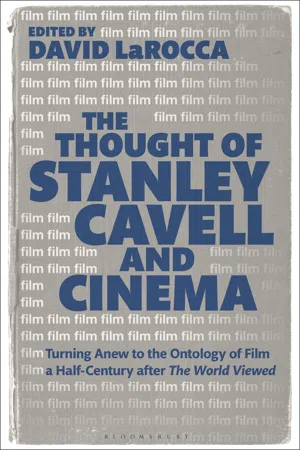
The Thought of Stanley Cavell and Cinema
Turning Anew to the Ontology of Film a Half-Century after The World Viewed
- 336 pages
- English
- ePUB (mobile friendly)
- Available on iOS & Android
eBook - ePub
The Thought of Stanley Cavell and Cinema
Turning Anew to the Ontology of Film a Half-Century after The World Viewed
About this book
Stanley Cavell was, by many accounts, America's greatest philosophical thinker of film. Like Bazin in France and Perkins in England, Cavell did not just transform the American capacity to take film as a subject for philosophical criticism; he had to first invent that legitimacy. Part of that effort involved the creation of several key now-canonical texts in film studies, among them the seminal The World Viewed along with Pursuits of Happiness and Contesting Tears. The present collection offers, for the first time anywhere, a concerted effort mounted by some of today's most compelling writers on film to take careful account of Cavell's legacy. The contributors think anew about what precisely Cavell contributed, what holds up, what is in need to revision or updating, and how his writing continues to be of vital significance and relevance for any contemporary approach to the philosophy of film.
Information
PART IV
Film, As If Made for Philosophy
10
Film Exists in a State of Philosophy: Two Contemporary Cavellian Views
Shawn Loht
THE QUESTION OF WHETHER PHILOSOPHY can occur through film (sometimes called in the shorthand “film-as-philosophy”) has been especially lively during the last twenty years of scholarship in the philosophy of film. Specifically, the question has concerned whether films can “philosophize” in a primarily cinematic fashion, and if so, how do they do this? Prominent figures in Anglo-American philosophy of film including Noël Carroll, Paisley Livingston, and Murray Smith have all leveraged strong arguments against this capacity in films.1 These counter-arguments frequently hold that a film’s purported philosophizing is really expressive of and parasitic upon one’s philosophical reading of it; that films can only philosophize on the shoulders of previously formulated philosophical theses in texts; or that films cannot present theses or claims with any kind of precision in their own right; and so forth. In contrast, some philosophers of a more continental persuasion have suggested that much of the affirmative side of the debate hinges not on fixed aesthetic possibilities of films as much as it depends on the philosophical power individual films reveal in and of themselves. From this latter perspective, whether a given film philosophizes is a function of the film’s very viewing, or ultimately, what the film gives the viewer to replay and contemplate critically and thoughtfully.
Stanley Cavell was one of the first philosophers to suggest that there are ontological grounds for how films can be said to exist in an inherent condition of philosophy. And much of the contemporary debate concerning the possibility of philosophy’s occurrence “in” film has its roots in Cavell’s legacy. Stephen Mulhall and Robert Sinnerbrink are two contemporary Cavellian philosophers of film who regard film in the mold of this legacy. Mulhall and Sinnerbrink have both produced bodies of work that suggest expansive ways of appreciating the philosophical capacity of films and of assessing film’s philosophical relevance for the twenty-first-century world. In this chapter I wish to compare the approaches of these two contemporary philosophers, and to highlight and dissect some of the Cavellian foundations that support their views. The larger underlying question I wish to address concerns the grounds upon which one can defend the very notions of film’s claim to philosophy, and of philosophy’s possibility to occur through film.
Stephen Mulhall on Philosophy in the Alien Films
Stephen Mulhall’s work, principally his influential book On Film (currently in its third edition) has been a watershed text, albeit controversially so, in the post-Cavellian conversation about film’s philosophical capacity. Decisive about Mulhall’s approach, vis-à-vis its Cavellian roots, is his unabashed defense of the view that films can function not merely as inspiration for philosophical thought or as handy illustrations of philosophical ideas, but rather, that they can provide bona fide contributions to philosophical debate. In other words, Mulhall eschews holding simply that films sometimes offer material to viewers that can be parsed into the traditional language of philosophers, as if a film’s purported philosophizing can only be parasitic on philosophical conversations and analyses external to it. Mulhall claims that films can be on par with actual philosophers in providing new insights about perennial philosophical questions.2 Films can comprise, in a memorable locution he employs in this light, “philosophy in action,” and for this reason certain films convey something like a reflective thought process, an exercise in the study of ideas. Mulhall does not advocate a global thesis regarding necessary or sufficient conditions underwriting a given film’s operation in the condition of philosophy. He also emphasizes the fruitlessness of attempting to nail down exactly what it would mean for films to philosophize purely cinematically, outside of a few very general parameters.3 Indeed, Mulhall holds that the best illustration of the medium’s philosophical capacity is an ostensive (and experiential) one, only possible through examination of particular films.4 Let us then consider what he says about some of the specific films that have seized his attention.
Given that Mulhall’s readings of the Alien films (to date, six films in number) have arguably been the most influential and widely read in his body of work, I will restrict the present discussion to his interpretations of these cinematic works, although it is worth noting that he reads these films with frequent reference to some of their cousins in the science fiction genre, among which Mulhall holds that there is a steady cross-flow of films mutually informing one another (for example, the Terminator series, Blade Runner, The Abyss).
A synopsis of the Alien series is as follows. The premise is a science fiction scenario initiated in the first film, Alien (1979, dir. Ridley Scott). In this film, a mining crew traveling through distant space aboard the ship Nostromo encounters a terrifying and violent alien species on an unoccupied planet. While exploring the planet—on which they had landed by pure happenstance, responding to an anomalous radio signal—the crew unwittingly unearths one of the creatures, waking it from a dormant, incubational state. The octopus-like creature is immediately aggressive, attacking by leaping up and attaching itself to the face of one of the astronauts, Kane (John Hurt). Shortly thereafter, it is discovered that Kane has become impregnated with an alien fetus. When a live creature bursts from Kane’s stomach and effectively takes over the ship, it becomes evident that these alien creatures require a human host to propagate. The aliens emerge as nonrational, yet highly proficient killing machines that strongly outmatch humans in speed, strength, and resiliency. And although the human characters quickly find themselves faced with an existential threat, their encounter with the aliens takes on a counterpoint dimension of amorality, as the alien species is, in fact, just another life-form striving to persist and now given an opportunity to do so. Unfortunately for Kane and company, it so happens that the humans fit the bill for a viable carrier. The ensuing films in the series each continue this narrative, revealing new and surprising ways in which the human and alien transform one another.
The various hermeneutic, historic, and biological relations borne out between th e two species becomes a recurring, almost symphonic theme. For instance, the narrative of the first and second films explores the aliens as an object of study for the advancement of scientific knowledge and human utility. In the third film, Alien 3 (1992, dir. David Fincher), the main character and star of the series, Ellen Ripley (Sigourney Weaver), has become impregnated with an alien fetus. At the film’s end she destroys herself by blowing up her space station in order to prevent any more carnage the aliens might cause. And the fourth film in the series, Alien: Resurrection (1997, dir. Jean-Pierre Jeunet), portrays Ripley as a reborn alien-human hybrid. She has been cloned from the DNA of the original Ellen Ripley and cross-bred with the alien creatures, who by this point have finally been subjugated by the human race in efforts to engineer them for military-industrial use. In contrast, the fifth film in the series, Prometheus (2012, dir. Ridley Scott), a prequel to the series’ first film, suggests that this deadly alien species was, in fact, created by a long-dead, proto-human species called the Engineers. The characters in Prometheus hypothesize that the alien creatures are the product of an experiment in military technology conducted by the Engineers that went horribly wrong.
In general, as the series has played out over the last three-plus decades, the overarching narrative exceeds the tropes of the horror-science fiction film genre, exploring more deeply mythological themes related to the nature of life, self-awareness, and historical destiny.
Additionally, a theme that ostensibly has become more pronounced in the last two installations of the series, Prometheus and its sequel Alien: Covenant (2017, dir. Ridley Scott), is the anthropomorphic, existential disposition of the android beings that figure into the storyline—an aspect that inspires Mulhall’s interest in Blade Runner and the Terminator movies. A central character of these latter two Alien films is David (Michael Fassbender), an android built to be immortal and perfectly rational, yet who lacks certain human features he finds himself wanting, particularly autonomy and the ability to procreate. The storyline of Alien: Covenant provides a number of clues to suggest that David aims both to conquer his human creators and to populate the universe with a breed of alien-human hybrids cultivated through his own creation.
On the surface, it is easy to justify Mulhall’s inclination to analyze the Alien films through a philosophical lens. For these films certainly thematize in various degrees a number of ready-made philosophical issues. Particularly decisive in Mulhall’s view is the sustained meditation the Alien films show in their portrayals of biological life, humanness, and the moral teleologies bound up in the interaction of the two. Mulhall also draws attention to these films’ ways of subverting traditional Western philosophical paradigms of gender, sexuality, embodiment, birth, and death. For instance, human men are “impregnated” (indeed, more provocatively, raped) by an invasive species; human life as we know it is pitched as the child of an ancestor species of a higher order of intelligence; living creatures are portrayed as products of engineering; machine-based beings take on God-like status; and so forth. Mulhall highlights the questioning, reflective character of these films’ explorations of many of our “inter-related anxieties about human identity” with questions such as:
What exactly is my place in nature? How far does the (natural) human ability to develop technology alienate us from the natural world? Am I (or am I in) my body? How sharply does my gender define me? How vulnerable does my body make me? Is sexual reproduction a threat to my integrity, and if so, does the reality and nature of that threat depend on whether I am a man or a woman?5
More controversially, however, Mulhall proposes that these films actually comprise original philosophical thinking on these topics in their own right; in particular, he sees the Alien films as worthy participants in the perennial Cartesian question of whether one’s being relates to one’s body. In one of his most striking series of claims, he writes:
The sophistication and self-awareness with which these films deploy and develop [the relation of human identity to embodiment] . . . suggest to me that they should be taken as making real contributions to these intellectual debates. . . . I see them rather as themselves reflecting on and evaluating such views and arguments, as thinking seriously and systematically about them in just the way philosophers do. . . . They are philosophical exercises, philosophy in action—film as philosophizing.6
Mulhall’s core claim appears to center on the fact that the Alien films equally concern issues that, in and of themselves, are of fundamental philosophical significance, and at the same time that the films foster a kind of philosophical contemplation precis...
Table of contents
- Cover
- Half-Title
- Series
- Title
- Epigraph
- Contents
- Foreword: Stanley Cavell and Cinema
- Introduction: Philosophy’s Claim to Film, Film’s Claim to Philosophy
- I Underwriting and Overhearing: Reconceiving Cinematic Ontology and Genre
- II Interlude: Temperaments for Film
- III Philosophy, As If Made for Film
- IV Film, As If Made for Philosophy
- Acknowledgments
- Contributors
- Index
- Copyright
Trusted by 375,005 students
Access to over 1.5 million titles for a fair monthly price.
Study more efficiently using our study tools.
Frequently asked questions
Yes, you can cancel anytime from the Subscription tab in your account settings on the Perlego website. Your subscription will stay active until the end of your current billing period. Learn how to cancel your subscription
No, books cannot be downloaded as external files, such as PDFs, for use outside of Perlego. However, you can download books within the Perlego app for offline reading on mobile or tablet. Learn how to download books offline
Perlego offers two plans: Essential and Complete
- Essential is ideal for learners and professionals who enjoy exploring a wide range of subjects. Access the Essential Library with 800,000+ trusted titles and best-sellers across business, personal growth, and the humanities. Includes unlimited reading time and Standard Read Aloud voice.
- Complete: Perfect for advanced learners and researchers needing full, unrestricted access. Unlock 1.5M+ books across hundreds of subjects, including academic and specialized titles. The Complete Plan also includes advanced features like Premium Read Aloud and Research Assistant.
We are an online textbook subscription service, where you can get access to an entire online library for less than the price of a single book per month. With over 1.5 million books across 990+ topics, we’ve got you covered! Learn about our mission
Look out for the read-aloud symbol on your next book to see if you can listen to it. The read-aloud tool reads text aloud for you, highlighting the text as it is being read. You can pause it, speed it up and slow it down. Learn more about Read Aloud
Yes! You can use the Perlego app on both iOS and Android devices to read anytime, anywhere — even offline. Perfect for commutes or when you’re on the go.
Please note we cannot support devices running on iOS 13 and Android 7 or earlier. Learn more about using the app
Please note we cannot support devices running on iOS 13 and Android 7 or earlier. Learn more about using the app
Yes, you can access The Thought of Stanley Cavell and Cinema by David LaRocca in PDF and/or ePUB format, as well as other popular books in Philosophy & Film & Video. We have over 1.5 million books available in our catalogue for you to explore.