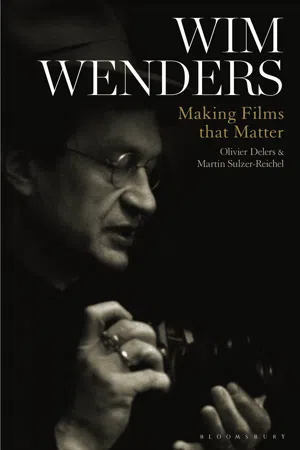
eBook - ePub
Wim Wenders
Making Films that Matter
- 208 pages
- English
- ePUB (mobile friendly)
- Available on iOS & Android
eBook - ePub
Wim Wenders
Making Films that Matter
About this book
Wim Wenders: Making Films That Matter is the first book in 15 years to take a comprehensive look at Wim Wenders's extensive filmography. In addition to offering new insights into his cult masterpieces, the 10 essays in this volume highlight the thematic and aesthetic continuities between his early films and his latest productions. Wenders's films have much to contribute to current conversations on intermediality, whether it be through his adaptations of important literary works or his filmic reinventions of famous paintings by Edward Hopper or Andrew Wyeth. Wenders has also positioned himself as a decidedly transnational and translingual filmmaker taking on the challenge of representing peripheral spaces without falling into the trap of a neo-colonial gaze. Making Films That Matter argues that Wenders remains a true innovator in both his experiments in 3D filmmaking and his attempts to define a visual poetics of peace.
Information
1
Introduction: New Perspectives on Wim Wenders as Filmmaker and Visual Artist
Olivier Delers and Martin Sulzer-Reichel
In a career that spans more than forty-five years, Wim Wenders is still busy adding to his extensive body of work: in the past two years alone, he has released two full-length feature films, exhibited his large-scale landscape photography at the Museum Kunstpalast in Düsseldorf, and announced a new documentary project featuring conversations with Pope Francis. And yet, despite being considered one of the leading figures of New German Cinema and a “cult” filmmaker thanks to films like Alice in the Cities (1974), Paris, Texas (1984), and Wings of Desire (1987), Wenders in recent years has played a relatively minor role in the field of film studies.1 The last monograph on his films, Alexander Graf’s The Cinema of Wim Wenders: The Celluloid Highway, was published in 2002,2 and, if we exclude the sudden proliferation of studies devoted to his collaborations with Peter Handke, research on Wenders has been stagnant and somewhat directionless, in particular for films released in the twenty-first century. No one, for instance, has written about Wenders’s ongoing visual and narrative exploration of Los Angeles and the American West in a second trilogy of sorts—Million Dollar Hotel (2000), Land of Plenty (2004), Don’t Come Knocking (2005)—and very little has been said about his acclaimed documentaries Pina (2011) and Salt of the Earth (co-directed with Juliano Salgado; 2014).
Wenders has certainly not been silent or resting on his laurels. On the contrary, over the past fifteen years, he has taken on new challenges, not only by exploring new motifs and using new technology in his substantial filmic and photographic output but also by acting as a champion of European cinema and reflecting upon the power of images in the digital age. Of particular interest to film studies scholars is a recent publication Inventing Peace: A Dialogue on Perception, published in 2013. Conceived as a series of dialogues between Wenders and his coauthor Mary Zournazi, the book addresses Wenders’s attempt to be more socially and politically engaged in his later films. It also theorizes what Wenders calls a “peaceful” gaze, a technical and spiritual way of looking at the world, inspired in large part by the films of Yasujiro Ozu, that has the potential to inspire images and films that participate in a new visual language of peace.3
Inventing Peace belongs to a larger body of self-reflective and critical writings that Wenders has produced over the years, most notably The Logic of Images (1992), On Film (2001), and A Sense of Place (2004). Along with the fascinating director’s commentaries he has recorded for new releases of his films on DVD, these essays and interviews reveal the importance for Wenders of thinking critically, as both a practitioner and a public intellectual, about what images do. They also offer a unique vantage point from which to examine his creative process and to understand what might motivate him to keep making new films. Perhaps the following statement best explains how Wenders sees the role of cinema in the twenty-first century:
Entertainment today constantly emphasizes the message that things are wonderful the way they are. But there is another kind of cinema, which says that change is possible and necessary and it’s up to you. Any film that supports the idea that things can be changed is a great film in my eyes. It doesn’t have to be overtly political. On the contrary a film can promote the idea of change without any political message whatsoever but in its form and language can tell people that they can change their lives and contribute to progressive changes in the world. Any movie that has that spirit and says things can be changed is worth making.4
For Wenders, the “idea of change” need not be exclusively political but should be apprehended in relation to the idea that cinema has a role to play in helping us, as human beings, move forward and see things from multiple perspectives. What he sees as the power of “another kind of cinema” also sounds like a personal manifesto and a key to reading his films. In other words, following a recipe for success that one has mastered is not enough—Wenders once responded to critics by saying that he no longer knew how to make a film like Wings of Desire, for instance.5 One has to make films that matter now and that imbue the auteur perspective with a keen sense of the ethical responsibilities of filmmaking.
Do Wenders’s films still matter? And, if so, how do they matter? We attempt in the collection of chapters here to answer these questions by taking stock of research published in the past fifteen years or so and arguing that Wenders studies deal with some of the most pressing questions posed in film studies and, more broadly, cultural studies. Three major themes emerge in the scholarship published on Wenders in the past fifteen years or so: first, the intermedial strategies used by Wenders to adapt texts written by Peter Handke and to make them come alive on the screen; second, the problematic representation of the non-European other and of subaltern spaces in several W enders films; and, third, the transnational and translingual dimension of his oeuvre. We also pay particular attention to Wenders’s newer films and show how they direct us toward new ways of questioning film as a medium. Wenders’s unique painterly gaze channels the style, mood, and perspective of realist painters like Edward Hopper or Andrew Wyeth. In this respect, several of his films are decidedly transmedial, moving seamlessly between an original written text, its visual translation into film, and references to painterly images that inform the meaning of particular scenes. Wenders is also a pioneer in 3-D auteur filmmaking and has used the technology to capture the movements and energy of Pina Bausch’s Tanztheater in Pina, to establish closer emotional identification between characters and viewers in Every Thing Will Be Fine (2015), and to explore the proximity of stage and filmic storytelling in The Beautiful Days of Aranjuez (2016). Finally, we focus on the theoretical underpinnings of Wenders’s visual aesthetic of peace and analyze its implementation in his films, arguing that the concept, even though it stems from Wenders’s own faith and personal vision, can be useful for thinking about making films that matter in the twenty-first century.
* * *
Adaptation and intermediality, the first overarching theme that stands out in the recent scholarship on Wenders, both harkens back to the beginning of his career (The Goalkeeper’s Fear of the Penalty in 1972, a film adaptation of a novel with the same title by Peter Handke) and is directly relevant to one of his latest films (The Last Days of Aranjuez, also drawn from Handke’s repertoire). No less than four books on the collaboration between the two men were published between 2004 and 2011: David Coury’s The Return of Storytelling in Contemporary German Literature and Film: Peter Handke and Wim Wenders (2004), Carlo Avventi’s Mit den Augen des richtigen Wortes: Wahrnehmung und Kommunikation im Werk Wim Wenders und Peter Handkes (also in 2004), Simone Malaguti’s Wim Wenders’ Filme und ihre intermediale Beziehung zur Literatur Peter Handkes (2011), and Martin Brady and Joanne Leal’s Wim Wenders and Peter Handke: Collaboration, Adaptation, Recomposition (2011). This outpouring is not particularly surprising since, as Brady and Leal have noted, the Wenders/Handke relationship is “perhaps the most important collaboration between a writer and filmmaker in the history of European cinema.”6 Of course, Wenders has adapted works or coauthored scripts with other major literary figures: Patricia Highsmith for The American Friend (1977), Sam Shepard for Paris, Texas and Don’t Come Knocking, and Peter Carey for Until the End of the World (1991), to name only the most important ones. But the Wenders-Handke partnership offers a particularly interesting case study because it reflects a range of adaptational strategies and challenges the assumption that an adaptation is a mere “copy” that should be as faithful as possible to the original. Their collaboration exemplifies some recent advances in the field of adaptation studies: adaptation is about “the mutation of forms across media” and should be understood as “metamorphosis,” “transvocalization,” “performance,” or “actualization.”7 Handke, in a joint television interview with Wenders, added another, more loaded, term to characterize their work together: “betrayal.” Whereas Handke felt that it was unnecessary, for instance, to represent the act of writing the dialogue between the two lovers in The Last Days of Aranjuez, Wenders argued that the person standing behind the typewriter had to be represented because it was also him, the film director—both the eyes that frame images and the brain in charge of transposing the story he is adapting.8 Hence, “betrayal” is not necessarily a negative term. On the contrary, it is a central aspect of the complex relationship between two different media with their own strengths and limitations and between two ways of thinking about authorship and its textual presence.
While adaptation theory can certainly offer new concepts or metaphors for deciphering the multiple dimensions of the Wenders-Handke relationship, the films born out of their collaboration have the potential to complicate our sense of what it means for them to work together and to enter into a creative dialogue through words and images. At one end of the spectrum, adapting means translating a novel into a different medium and bringing to life both Handke’s “goalkeeper” and his concerns with the ways in which language frames our perception of reality. At the other end of the spectrum, it means living with Handke’s texts and drawing inspiration from them, even if they are not referenced directly in the film itself (as was the case when Wenders was preparing for and shooting Alice in the Cities).9 Sometimes, adaptation involves a ménage à trois of sort. For Wrong Move (1975), Handke rewrites one of Goethe’s masterpieces for the screen, inspiring Wenders to cast Rüdiger Vogler as an angst-ridden Wilhelm Meister and Nastassja Kinski as a nymphet Mignon. Wings of Desire also functions as a polytextual film, in which Paul Klee’s painting Angelus Novus and Walter Benjamin’s reference to the “Angel of History” cross paths with Handke’s poem “Song of Childhood” and Wenders’s own vision of angels roaming around a divided Berlin that still bears the scars of the Second World War. These four creative encounters make it possible for Wenders to stretch the limits of what cinema, as a medium, can convey . He can “reflect essayistically,” “assimilate images and music,” “address the problem of writing through the iconography of German Romantic painting,” and “commission poetic dialogue to signify the capacity of film to tell stories that were once the province of the oral tradition.” In that sense, the Wenders/Handke films constitute “a tetralogy on the strengths and weaknesses of literary cinema and . . . a protracted experiment in different modes of collaborative ...
Table of contents
- Cover
- Half-Title
- Title
- Contents
- 1 Introduction: New Perspectives on Wim Wenders as Filmmaker and Visual Artist
- Part I Watching the Road Trilogy in the Twenty-First Century
- Part II Reimagining Cinema and Photography with Wenders
- Part III Transnational Wenders
- Bibliography
- Filmography
- Acknowledgments
- List of Contributors
- Index
- Copyright
Trusted by 375,005 students
Access to over 1.5 million titles for a fair monthly price.
Study more efficiently using our study tools.
Frequently asked questions
Yes, you can cancel anytime from the Subscription tab in your account settings on the Perlego website. Your subscription will stay active until the end of your current billing period. Learn how to cancel your subscription
No, books cannot be downloaded as external files, such as PDFs, for use outside of Perlego. However, you can download books within the Perlego app for offline reading on mobile or tablet. Learn how to download books offline
Perlego offers two plans: Essential and Complete
- Essential is ideal for learners and professionals who enjoy exploring a wide range of subjects. Access the Essential Library with 800,000+ trusted titles and best-sellers across business, personal growth, and the humanities. Includes unlimited reading time and Standard Read Aloud voice.
- Complete: Perfect for advanced learners and researchers needing full, unrestricted access. Unlock 1.5M+ books across hundreds of subjects, including academic and specialized titles. The Complete Plan also includes advanced features like Premium Read Aloud and Research Assistant.
We are an online textbook subscription service, where you can get access to an entire online library for less than the price of a single book per month. With over 1.5 million books across 990+ topics, we’ve got you covered! Learn about our mission
Look out for the read-aloud symbol on your next book to see if you can listen to it. The read-aloud tool reads text aloud for you, highlighting the text as it is being read. You can pause it, speed it up and slow it down. Learn more about Read Aloud
Yes! You can use the Perlego app on both iOS and Android devices to read anytime, anywhere — even offline. Perfect for commutes or when you’re on the go.
Please note we cannot support devices running on iOS 13 and Android 7 or earlier. Learn more about using the app
Please note we cannot support devices running on iOS 13 and Android 7 or earlier. Learn more about using the app
Yes, you can access Wim Wenders by Olivier Delers, Martin Sulzer-Reichel, Olivier Delers,Martin Sulzer-Reichel in PDF and/or ePUB format, as well as other popular books in Media & Performing Arts & Film & Video. We have over 1.5 million books available in our catalogue for you to explore.