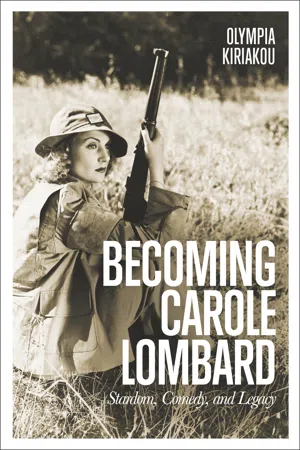
Becoming Carole Lombard: Stardom, Comedy and Legacy is a historical critique of the development and reception of Carole Lombard's stardom from the classical Hollywood period to present day. Based on original archival research, Olympia Kiriakou combines theoretically informed textual analyses of Lombard's performances and star image across different media (biographies, publicity materials, photography and film) with a critical engagement of the cultural, economic, social and industrial conditions that shaped her stardom.
Sitting at the intersection of feminist film theory, star studies and comedy theory, this work presents Lombard as a case study to challenge the screwball canon and existent academic discourse about female physical comedy and the alleged "delicate" female body. In doing so, it formulates a new historical approach to understanding gender, femininity, and identity in Hollywood comedies of the 1930s. Moreover, this is the first research of its kind to offer a comprehensive understanding of Lombard's stardom beyond her associations with the screwball comedy genre.
- 248 pages
- English
- ePUB (mobile friendly)
- Available on iOS & Android
eBook - ePub
About this book
Information
1
Slapstick, body politics, and Sennett Girl Comedies
By the time Carole Lombard made her first screwball comedy in 1934, she had already been working steadily in Hollywood for over a decade. Lombard’s formative years in Hollywood are critical to a broader understanding of her career, but unfortunately many sources simply treat them as a precursor to her later screwball stardom. As it stands today, however, little if any substantial analysis exists that solely focuses on Lombard’s performances in either her silent comedies or early sound films, and those that do tend to use her slapstick comedies to draw parallels to her screwball persona.1 With hindsight it is easy to fall into the trap of reading her silent films as benchmarks against her later success. Comparisons will inevitably be drawn, and admittedly they are beneficial when trying to establish a cohesive discourse about Lombard’s on-screen persona.
This period in Lombard’s career has, at least in an academic context, been under-studied. Recent academic scholarship by the likes of Emily Carman, Michael Hammond, and Christina Lane has made great progress in “correcting” the overall Lombard record, but there is still much left to uncover, particularly as it relates to her silent comedies with Mack Sennett. It is necessary to treat her early career and film performances on their own terms relatively free from the weight of hindsight knowledge, and to consider Lombard’s body of early work in relation to her stardom at the related temporal juncture. Only then will a fuller, historically conscious understanding of Lombard’s star persona and performance style be possible.
This chapter focuses on the period between 1908 and 1929, examining Lombard’s early career and her two-year tenure as a Sennett Bathing Beauty. If the chronological boundaries seem exceptionally large, the unfortunate reality is that many of her pre-1927 films no longer survive. The analyses in this chapter are therefore the result of limited access to many of Lombard’s early pictures. The first section focuses on her early years in Hollywood and the films she made up to 1927. The task of reviewing this body of work is especially tough because in what few films survive, Lombard either has a minor part, is barely identifiable, or appears in scenes that have been cut out of the final release print. This makes a substantial analysis nearly impossible. I will therefore draw mainly from biographical information and contemporary reviews—when available—to construct a chronology of her childhood and first years in Hollywood, which can provide some contextual and temporal grounding to map out her ascension to stardom.
The second section examines Lombard’s silent comedies that she made while under contract to Sennett from 1927 to 1929. My textual analysis is based upon original research conducted at the Motion Picture and Television Reading Room at the Library of Congress in June 2011, and at the UCLA Film and Television Archive in April 2015. Lombard made eighteen one- and two-reel comedies for Sennett over a two-year period, in which she played both supporting and lead roles. The films included in this chapter—and the titles in which Lombard has a role large enough for an analysis2—are: Smith’s Pony (Alfred J. Goulding, 1927), The Girl from Everywhere (Edward F. Cline, 1927), Run, Girl, Run (Alfred J. Goulding, 1928), The Campus Vamp (Harry Edwards, 1928), The Campus Carmen (Alfred J. Goulding, 1928), the first reel of The Swim Princess (Alfred J. Goulding, 1928),3 and Matchmaking Mamma (Harry Edwards, 1929). I will devote special attention to her body in her physical comedy performances and, in particular, the habitual juxtaposition between her feminine sex appeal and her conventionally masculine athleticism. This is not an exhaustive look at Lombard’s work with Sennett, but this chapter is the first scholarly text to offer an extended and detailed analysis of her silent film performance style.
Childhood and early Hollywood years
From an early age, Carole Lombard—born Jane Alice Peters—excelled in sports and enjoyed swimming, boxing, and playing baseball with the boys in her upper class Fort Wayne, Indiana neighborhood.4 She was described as a tomboy who gave up all “feminine interests,”5 who instead preferred to tag along with her older brothers Fred Jr. and Stuart, and their friends.6 In news articles from the 1930s, Lombard’s often-cited tomboy qualities were used by the fan magazines to decode her mastery of physical comedy7 and the curious balance between her “masculine deliberation” and feminine appearance, something Screenland columnist Betty Boone once described as “amazing in someone so blonde, so blue-eyed, and so fragile.”8 Her love of sports also prompted her entry into the movies.9 By the spring of 1921, twelve-year-old Lombard had moved to Los Angeles with her mother, Elizabeth (Bess), and two brothers, and was playing baseball in the street one day with some boy friends. Silent film director Allan Dwan happened to be in the neighborhood and observed the children, and was fascinated by Lombard’s natural athleticism. In an interview with Peter Bogdanovich from the 1960s, Dwan recalls Lombard as “a cute looking tomboy … out there knocking the hell out of the other kids, playing better baseball than they were.”10 He was looking to cast the “tomboy kid sister”11 of leading man, Monte Blue, for his film The Perfect Crime. Dwan asked her if she would like to be in his picture, and both she and Bess immediately accepted.12 Unfortunately the film is now lost, but several stills exist showing Lombard sitting with Blue in what appears to be a private study. Dwan remembers that she “ate [the part] up”13 during her two-day shoot, and Lombard allegedly decided “it was something she wanted to do again.”14 Despite her private aspirations, she did not make another film again until 1925, and her remaining childhood years were spent away from the Hollywood studios.15
In the spring of 1924, fifteen-year-old Lombard was a sophomore track star at Fairfax High School in Hollywood.16 Her natural athletic skill once again resulted in a brush with stardom: she caught the eye of Charlie Chaplin’s talent representative, who was scouting young actresses for Vitagraph Studios’ picture, The Gold Rush (1925).17 Her screen test did not result in a contract with Vitagraph,18 but the studio did encourage a name change. Biographer Wes Gehring explains the studio allegedly “liked the Peters family name, but the moniker of Jane struck them as too dull.”19 Lombard remembered the popular tennis player Carol Peterson and suggested that her new name be Carol Peters.20 There is much speculation about when exactly Lombard began spelling her first name with an “e.” In later years, she was said to have explained, “I just picked up Carole because I liked it. At first I dropped the ‘e’, but I tacked it on later for good measure. My first idea was to name myself Carrolle. There’s a flossy one … Then I thought of Carrulle. Isn’t it won-der-ful. Carrulle Lombard! But I got sane in time.”21 Lombard historian Vincent Paterno contends that she “began her official movie career as Carole Lombard in 1925,” and used both “Carole” and “Carol” intermittently before eventually dropping the “e” when she signed with Pathé on October 6, 1928.22 Historical documents corroborate Paterno’s timeline: in one of the earliest news articles about Lombard from the February 4, 1925 edition of Los Angeles Times, her name is spelled “Carole Lombard.”23
After the Chaplin screen test Lombard faced yet another false start, this time with the Mary Pickford melodrama, Little Annie Rooney (William Beaudine, 1925). A Pickford associate had originally promised her a small role, but according to both Swindell and Gehring, Pickford considered her “competitively too pretty” for the role.24 Bess was eager to help her daughter make headway in the movies and was put in touch with the influential gossip columnist, Louella Parsons, by Vitagraph producer, Al Lichtman.25 Parsons contacted Fox Films production chief, Winfield Sheehan, on Lombard’s behalf because he owed her a personal favor. Lombard received an appointment at Fox,26 and was immediately signed as a contract player for seventy-five dollars a week.27 With two actors already under contract with the last name Peters, Fox requested another name change.28 She and Bess settled on Lombard, chosen in honor of their family friends Harry and Etta Lombard.29
Fox assigned Lombard to a series of “lucrative low-budget westerns” including Gold and the Girl (Edmund Mortimer, 1925), Durand of the Badlands (Lynn Reynolds, 1925), and Hearts and Spurs (W.S. Van Dyke, 1925)30 all opposite Western star Buck Jones. In their review of the latter film, Variety described her as “attractive looking … but for expressiveness she might just as well have been labeled ‘for decorative purposes only.’”31 Lombard then starred with Tom Mix in Dick Turpin (John G. Blystone, 1925), but her scenes were cut out of the final release print.32 In 1936 Lombard allegedly reflected, “All I had to do was simper prettily at the hero and scream with terror while he battled with the villain.”33 Nevertheless, these roles gave her on-camera experience and a chance to establish herself among the roster of contract players. Her next Fox production was in the drama Marriage in Transit (Roy William Neill, 1925), in which she plays “a mature married woman” opposite Edmund Lowe.”34 It was originally titled The Best Man, and was ultimately a vehicle to showcase Lowe’s talents.35
Around this time Lombard was gaining publicity, and was included in a Los Angeles Times advertisement highlighting some of the screen’s most promising new starlets.36 She then appeared in Fox’s The Road to Glory, which was released in February, 1926 and directed by her future Twentieth Century director, Howard Hawks. Despite Lombard’s exposure in Fox’s films, she was dropped from her contract, but soon landed a...
Table of contents
- Cover
- Halftitle
- Title Page
- Contents
- List of Figures
- Acknowledgments
- Introduction
- 1 Slapstick, body politics, and Sennett Girl Comedies
- 2 Hollywood’s best-dressed star, 1929–1934
- 3 The queen of screwball comedy
- 4 “Goodbye Carole ‘screwball’ Lombard; Hello Mrs. ‘Ma’ Gable”: gender, identity, and the classical Hollywood star couple
- 5 Lombard gets dramatic: melodrama, domesticity, and performance
- 6 “If women ruled the world”: Lombard as protofeminist
- Conclusion: Carole Lombard’s legacy, 1942–present
- Bibliography
- Index
- Imprint
Trusted by 375,005 students
Access to over 1.5 million titles for a fair monthly price.
Study more efficiently using our study tools.
Frequently asked questions
Yes, you can cancel anytime from the Subscription tab in your account settings on the Perlego website. Your subscription will stay active until the end of your current billing period. Learn how to cancel your subscription
No, books cannot be downloaded as external files, such as PDFs, for use outside of Perlego. However, you can download books within the Perlego app for offline reading on mobile or tablet. Learn how to download books offline
Perlego offers two plans: Essential and Complete
- Essential is ideal for learners and professionals who enjoy exploring a wide range of subjects. Access the Essential Library with 800,000+ trusted titles and best-sellers across business, personal growth, and the humanities. Includes unlimited reading time and Standard Read Aloud voice.
- Complete: Perfect for advanced learners and researchers needing full, unrestricted access. Unlock 1.5M+ books across hundreds of subjects, including academic and specialized titles. The Complete Plan also includes advanced features like Premium Read Aloud and Research Assistant.
We are an online textbook subscription service, where you can get access to an entire online library for less than the price of a single book per month. With over 1.5 million books across 990+ topics, we’ve got you covered! Learn about our mission
Look out for the read-aloud symbol on your next book to see if you can listen to it. The read-aloud tool reads text aloud for you, highlighting the text as it is being read. You can pause it, speed it up and slow it down. Learn more about Read Aloud
Yes! You can use the Perlego app on both iOS and Android devices to read anytime, anywhere — even offline. Perfect for commutes or when you’re on the go.
Please note we cannot support devices running on iOS 13 and Android 7 or earlier. Learn more about using the app
Please note we cannot support devices running on iOS 13 and Android 7 or earlier. Learn more about using the app
Yes, you can access Becoming Carole Lombard by Olympia Kiriakou in PDF and/or ePUB format, as well as other popular books in Media & Performing Arts & Film & Video. We have over 1.5 million books available in our catalogue for you to explore.