LEGOfied: Building Blocks as Media provides a multi-faceted exploration of LEGO fandom, addressing a blindspot in current accounts of LEGO and an emerging area of interest to media scholars: namely, the role of hobbyist enthusiasts and content producers in LEGO's emergence as a ubiquitous transmedia franchise. This book examines a range of LEGO hobbyism and their attendant forms of mediated self-expression and identity (their "technicities"): artists, aspiring Master Builders, collectors, and entrepreneurs who refashion LEGO bricks into new commodities (sets, tchotchkes, and minifigures). The practices and perspectives that constitute this diverse scene lie at the intersection of multiple transformations in contemporary culture, including the shifting relationships between culture industries and the audiences that form their most ardent consumer base, but also the emerging forms of entrepreneurialism, professionalization, and globalization that characterize the burgeoning DIY movement.
What makes this a compelling project for media scholars is its mutli-dimensional articulation of how LEGO functions not just as a toy, cultural icon, or as transmedia franchise, but as a media platform. LEGOfied is centered around their shared experiences, qualitative observations, and semi-structured interviews at a number of LEGO hobbyist conventions. Working outwards from these conventions, each chapter engages additional modes of inquiry-media archaeology, aesthetics, posthumanist philosophy, feminist media studies, and science and technology studies-to explore the origins, permutations and implications of different aspects of the contemporary LEGO fandom scene.
eBook - ePub
LEGOfied
Building Blocks as Media
- 208 pages
- English
- ePUB (mobile friendly)
- Available on iOS & Android
eBook - ePub
About this book
Information
1
Palpable Pixels
Kate Maddalena
Toys are powerful world-producing and knowledge-making tools. They are tangible objects that serve as portals to the imaginary. Imaginary or “virtual”1 worlds are fashioned through our early experiments with various arrangements: pots and pans in a play kitchen, sand and water, concrete constructions, mud pies, LEGO builds.2 Long after our childhood, these experiences furnish us with metaphors through which we understand and relate to the world around us. And lately, LEGO metaphors have proven increasingly pervasive. In a 2017 Highline article bemoaning the millennial generation’s precarious financial status, writer Michael Hobbes describes the modularity of the twenty-first-century marketplace in terms of LEGO: “Companies were no longer single entities with responsibilities to their workers, retirees or communities. They were LEGO castles, clusters of distinct modules that could be separated, optimized, sold off, and put back together” (Hobbes 2017). And the first and most successful product in the field of synthetic biology, the BioBrick®, a chemical block with which the user can build living machines, directly references the LEGO brick in its name. LEGO supplies us with metaphors for describing corporate governance and for biochemical processes. What if we understood this not as “mere” metaphor, but as evidence of an increasingly LEGOfied world?
In the pages that follow, I argue that LEGO3 helped to produce (and now continues to reproduce) today’s digital world. LEGO bricks are not Lincoln Logs (a rustic toy that hearkens to an historical time) nor are they wooden building blocks (a timeless toy that transcends history).4 Rather, they are palpable pixels—a three-dimensional digital toy for a (screen-bound, largely two-dimensional) digital age. The toy’s success is tied to a history of computational logics and atomistic epistemologies that powerfully shape both the world itself and the possibilities for human existence in it. I’ll briefly consider LEGO as part of a long Western tradition of breaking things into pieces for the related purposes of understanding, as with molecules and genes, and (re)building, often with the same materials and often developing new ones (like bits and bytes), with which to model and (re)invent both real and imaginary worlds. Finally, I’ll provide a simple example in the marketing language of LEGO Education. A consideration of LEGO Education promotional materials via the theoretical framework developed at the outset of this chapter reveals a clearly articulated subject position for the LEGO enthusiast as maker-learner. Maker-learners, say the experts at LEGO Education, become engineer-scientists. LEGO bricks, then, are media firmly and deeply enmeshed in the ethical and epistemological commitments of technoscience.5 And, for better and worse, a world produced by technoscience is a world made of pieces, a modular world for humans to take apart and manipulate: a LEGOfied world.
Much of this book focuses on adults who use LEGO and adults’ use of LEGO, whether as collectors, artists, entrepreneurs, and/or fans.6 This chapter builds upon the Introduction’s focus on LEGO as media by exploring how LEGO is framed as educational children’s play for three main reasons. First, looking at LEGO as media establishes LEGO’s status as a materially digital form; this theoretical move allows us to look at LEGO in certain, especially digital, historical contexts. Second, adults who play with LEGO are participants in a larger culture that extends far beyond fan culture or pop culture. That culture—digital culture—has been and continues to be shaped by LEGO as a material instantiation of a digital way of being. Third and finally, adults who play with LEGO now grew up with LEGO. In order to treat LEGO as media for adult play, we must consider their evolution from tool to educational toy to adult and “serious” media. This chapter, then, starts further out and further back from these adult user communities, with LEGO as a cultural form (theoretically) and LEGO as an educational tool for children (historically).
LEGO and a Digital Episteme
Scholars in the history of computing, media theory, and cultural studies have recently grappled with the question of digital media and the definition of the “digital object.” Most accounts of the digital converge upon certain characteristics of culturally digital logics, specifically that they privilege non-semantic, manipulable, discrete objects and that they enable a “maker” ethic. However, few of these accounts acknowledge the physical media that came before and continue to act outside the screen-bound technologies of personal computers and mobile phones as co-constructive of digital ways of being. The basic LEGO brick is one of these media.
In order to talk about how the digital constitutes a way of knowing and being in the world, I should acknowledge that there is a long tradition of Western atomistic, linguistic, and analytical philosophy that predates and predicts the digital, most notably Gottfried Leibniz, whose “monads” resemble the non-semantic units I describe as the basis of the digital; Maurice Merleau-Ponty, who grappled with the impossibility of using language to speak truth in the context of embodied human experience; and Martin Heidegger, who argued, as does every good media theorist, that human existence cannot be considered as somehow separate from the world, and that our technological tools are exceptionally important connections to it. The ingenious artist Randall Munroe of the nerd-chic comic XKCD depicts this connection in a comic about LEGO called “Lego”: Figure 1.1.

FIGURE 1.1 “Lego,” XKCD, Randall Munroe. Copyright Randall Munroe.
A history of theories of knowing is (sometimes unknowingly) entangled with the abovementioned linguistic and ontological perspectives, as well. At the same time that Continental philosophy worried about the engagement of language with a world presumed to exist before or beyond language, the group of philosophers of science known as the Vienna Circle were interested in the truth-value of propositions and whether such propositions could be combined to produce new truths: linguistic LEGO. Their legacy of analytic philosophy and logic continues to be obsessed by the idea that a perfect language undisturbed by semantic ambiguities should be the language of truth in science. The logics developed by A. J. Ayer, Thomas Bayes, Bertrand Russell, and mathematician code breakers in the Second World War, most famously the Navajo Code Talkers and Alan Turing, are all legacies of the holy grail of a language above semantics. While Ayer’s language hinged on denotation of the truth-value of propositions and the enchainment of those propositions in proofs to discover true causes, Bayesian reasoning depended upon the calculation of the probability of a given proposition and led to the emergence of statistical reasoning to establish correlation and (probable) causation. Both efforts enable the digital because both hinge upon the non-semantic, entirely equal, and, at the outset, unmeaning nature of the terms of their statements. The logical operator’s meaning never changes; it only functions to link terms in potentially truthful ways. Likewise, one data point in a set to be analyzed via statistical probability cannot mean anything, by itself. One LEGO brick, or even more to the bit/byte point—one nub7 —doesn’t say or do much alone.
The power of logic and statistics is entirely dependent upon the separation of a given language from its slippery semantics. At best (and our “at best” is very good), we have learned that logic is an extremely powerful tool for designing efficient systems (e.g., machine-minds, robots, VR games, self-driving cars, etc.) to do things for us, but it is not very good at finding out the “truth” about the real world around us. And we have learned that statistical reasoning is quite excellent at helping us arrive at truths about the world around us, although it is very poor and even dangerous when applied to truths at the level of human experience. It is not advisable, for example, to decide you are not having a heart attack because you are statistically unlikely to have one (though women are three times more likely to die of a heart attack because of this assumption). And statistics show that thirteen-year-old girls who go missing are likely to have run away, but when that statistics translates to a “wait and see” policy for a police force, it costs individual lives. Both of these tragic generalizations of statistical ways-of-knowing into situated assumptions have required research and revision in practice. We have also discovered that logical operations (a computer program, for instance) applied to a statistically robust data set (a standardized, well-ordered database) is a powerful tool for knowing just about anything, with the right control mechanism, or software. Ultimately, though both logic and statistics give us powerful ways to parse propositions to produce predictive reasoning that very nearly approaches truths, and though both are undeniably our best bet for reasoning rationally to find out certain kinds of things about the world, neither fully solved the problem of explanation at the case-by-case level—the real-time event of a heart attack or a missing person as described above. The dream of a perfect spoken language remains unrealized,8 but we have computers as a (questionable) boon as a result of the ambition.
These philosophical lineages have informed more recent communication scholars, historians, and media theorists who employ some version of the digital concept as a key driver in the war machine (Kittler 1990), as the key driver of technoscience (Dyson 2012; Thacker 2004), as a worldview (Evens 2012; Hayles 2012), as a set of knowledge-making tools and methodologies (Drucker 2011), and as a functional ontology of the web and web-based communities (Manovich 1999). In “Web 2.0 and the Ontology of the Digital,” Aden Evens (2012) traces the binary basis of the digital into symbolic manifestations on web interfaces and the behaviors of web users with respect to them. Specifically, he argues that the 0 and 1 distinction becomes a “hegemony of choice” that requires all objects on the web (an icon, a link) to be self-identical and “equal” (25). The result, according to Evens, is a privileging of syntax over semantics:
The digital does not produce the binary but co-originates with it, and both rely most fundamentally on the (ontologically) prior operation of discretization. That is, the digital (and the binary code) depend on a way of conceptualizing the world and the objects in it as discrete, isolable entities, with independently determined, malleable properties. Digital technologies do not first create such a world nor do they produce the conditions of such a conceptualization, but they do reinforce this contrived perspective. (20)
Evens’s analysis concentrates on the web environment, an electronic space comprised by electronic and computational media. My own analysis extends outside of this space and time to media which predate the web and exist alongside it in the physical world: LEGO.
LEGO’s binary “hegemony of choice” is the nub—a zero/one analog in plastic form that affords LEGO its functionality. The “contrived perspective” that Evens refers to in the above quotation is, in essence, a Foucauldian episteme: a way of knowing and being that necessitates and is necessitated by the logics and media he describes.9 The machines that we use to read and manipulate (control and execute) our most common digital objects are electronic, but, as the perspectives summarized above establish, the “digital” quality has more to do with the conversion of information into a format that can be read by those machines. We are concerned here with a means of mediation that requires us to think of what we may have previously perceived as continuous information in discrete bits. The processes of such a mediation involve reduction: the picking-out of important words in a narrative to put on a telegram, for example, because the message must be carefully parsed into dots and dashes by the telegraph clerk, a section of a light-wave spectrum being read by a detector and put into one data “bin,” the checking of a box marked “male” or “female” in order to be coded in a database as a number associated with one of two recognized biological sexes. Digitally epistemic information is necessarily reduced from a more nebulous, continuous world of experience. In terms of media, digitally encoded information includes flag telegraphy, smoke signals, Morse code (Maddalena and Packer 2014), and the LEGO nub. And digitally constructed arrangements include the correctly decoded message and the LEGO build.
Conceiving of the digital as emerging from an apparatus rather than a kind of medium reinvigorates Michel Foucault’s conception of the episteme, a term he develops in different ways at different points in his work, but which is perhaps best defined in The Archaeology of Knowledge as
the total set of relations that unite, at a given period, the discursive practices that give rise to epistemological figures, sciences, and possibly formalized systems . . . the episteme is not a form of connaissance or type of rationality which, crossing the boundaries of the most varied sciences, manifests the sovereign unity of a subject, a spirit or a period; it is the totality of relations that can be discovered, for a given period, between the sciences when one analyses them at the level of discursive regularities. (Foucault 1...
Table of contents
- Cover
- Half-Title
- Title
- Contents
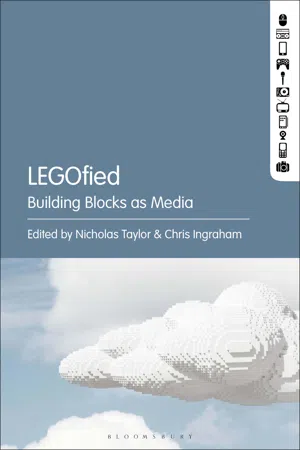
- Note about the Cover Image
- Acknowledgments
- Foreword: An Imaginary System
- Glossary
- Introduction: Clickable Media in a Plastic World
- Part One
- Part Two
- Part Three
- Notes
- List of Contributors
- Index
- Copyright
Trusted by 375,005 students
Access to over 1.5 million titles for a fair monthly price.
Study more efficiently using our study tools.
Frequently asked questions
Yes, you can cancel anytime from the Subscription tab in your account settings on the Perlego website. Your subscription will stay active until the end of your current billing period. Learn how to cancel your subscription
No, books cannot be downloaded as external files, such as PDFs, for use outside of Perlego. However, you can download books within the Perlego app for offline reading on mobile or tablet. Learn how to download books offline
We are an online textbook subscription service, where you can get access to an entire online library for less than the price of a single book per month. With over 1.5 million books across 990+ topics, we’ve got you covered! Learn about our mission
Look out for the read-aloud symbol on your next book to see if you can listen to it. The read-aloud tool reads text aloud for you, highlighting the text as it is being read. You can pause it, speed it up and slow it down. Learn more about Read Aloud
Yes! You can use the Perlego app on both iOS and Android devices to read anytime, anywhere — even offline. Perfect for commutes or when you’re on the go.
Please note we cannot support devices running on iOS 13 and Android 7 or earlier. Learn more about using the app
Please note we cannot support devices running on iOS 13 and Android 7 or earlier. Learn more about using the app
Yes, you can access LEGOfied by Nicholas Taylor, Chris Ingraham, Nicholas Taylor,Chris Ingraham in PDF and/or ePUB format, as well as other popular books in Sozialwissenschaften & Medienwissenschaften. We have over 1.5 million books available in our catalogue for you to explore.