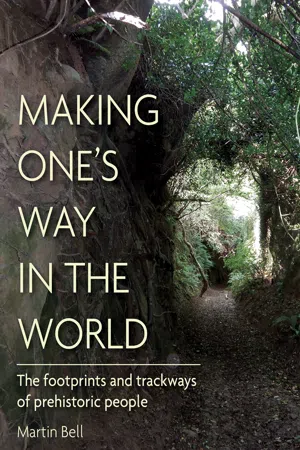
eBook - ePub
Making One's Way in the World
The Footprints and Trackways of Prehistoric People
- 304 pages
- English
- ePUB (mobile friendly)
- Available on iOS & Android
eBook - ePub
About this book
The book draws on the evidence of landscape archaeology, palaeoenvironmental studies, ethnohistory and animal tracking to address the neglected topic of how we identify and interpret past patterns of movement in the landscape. It challenges the pessimism of previous generations which regarded prehistoric routes such as hollow ways as generally undatable. The premise is that archaeologists tend to focus on 'sites' while neglecting the patterns of habitual movement that made them part of living landscapes. Evidence of past movement is considered in a multi-scalar way from the individual footprint to the long distance path including the traces created in vegetation by animal and human movement. It is argued that routes may be perpetuated over long timescales creating landscape structures which influence the activities of subsequent generations. In other instances radical changes of axes of communication and landscape structures provide evidence of upheaval and social change. Palaeoenvironmental and ethnohistorical evidence from the American North West coast sets the scene with evidence for the effects of burning, animal movement, faeces deposition and transplantation which can create readable routes along which are favoured resources. Evidence from European hunter-gatherer sites hints at similar practices of niche construction on a range of spatial scales. On a local scale, footprints help to establish axes of movement, the locations of lost settlements and activity areas. Wood trackways likewise provide evidence of favoured patterns of movement and past settlement location. Among early farming communities alignments of burial mounds, enclosure entrances and other monuments indicate axes of communication. From the middle Bronze Age in Europe there is more clearly defined evidence of trackways flanked by ditches and fields. Landscape scale survey and excavation enables the dating of trackways using spatial relationships with dated features and many examples indicate long-term continuity of routeways. Where fields flank routeways a range of methods, including scientific approaches, provide dates. Prehistorians have often assumed that Ridgeways provided the main axes of early movement but there is little evidence for their early origins and rather better evidence for early routes crossing topography and providing connections between different environmental zones. The book concludes with a case study of the Weald of South East England which demonstrates that some axes of cross topographic movement used as droveways, and generally considered as early medieval, can be shown to be of prehistoric origin. One reason that dryland routes have proved difficult to recognise is that insufficient attention has been paid to the parts played by riverine and maritime longer distance communication. It is argued that understanding the origins of the paths we use today contributes to appreciation of the distinctive qualities of landscapes. Appreciation will help to bring about effective strategies for conservation of mutual benefit to people and wildlife by maintaining and enhancing corridors of connectivity between different landscape zones including fragmented nature reserves and valued places. In these ways an understanding of past routeways can contribute to sustainable landscapes, communities and quality of life
Information
Topic
Scienze socialiSubtopic
ZoologiaTable of contents
- Cover
- Title
- Copyright
- Contents
- List of figures and tables
- Acknowledgements
- 1 Steps towards understanding: routeways in practice, theory and life
- 2 Walks in the temperate rainforest: developing concepts of niche construction and linear environmental manipulation
- 3 Niche construction and place making: hunter-gatherer routeways in north west Europe
- 4 Footprints of people and animals as evidence of mobility
- 5 Early farmers: mobility, site location and antecedent activities
- 6 Wetland trackways and communication
- 7 Barrow alignments as clues to Bronze Age routes
- 8 Trackways in later prehistoric agricultural landscapes
- 9 Maritime and riverine connectivity and the allure of the exotic
- 10 A case study of the Wealden District in south-east England
- 11 Conclusions: why paths matter
- Bibliography
Trusted by 375,005 students
Access to over 1.5 million titles for a fair monthly price.
Study more efficiently using our study tools.
Frequently asked questions
Yes, you can cancel anytime from the Subscription tab in your account settings on the Perlego website. Your subscription will stay active until the end of your current billing period. Learn how to cancel your subscription
No, books cannot be downloaded as external files, such as PDFs, for use outside of Perlego. However, you can download books within the Perlego app for offline reading on mobile or tablet. Learn how to download books offline
Perlego offers two plans: Essential and Complete
- Essential is ideal for learners and professionals who enjoy exploring a wide range of subjects. Access the Essential Library with 800,000+ trusted titles and best-sellers across business, personal growth, and the humanities. Includes unlimited reading time and Standard Read Aloud voice.
- Complete: Perfect for advanced learners and researchers needing full, unrestricted access. Unlock 1.5M+ books across hundreds of subjects, including academic and specialized titles. The Complete Plan also includes advanced features like Premium Read Aloud and Research Assistant.
We are an online textbook subscription service, where you can get access to an entire online library for less than the price of a single book per month. With over 1.5 million books across 990+ topics, we’ve got you covered! Learn about our mission
Look out for the read-aloud symbol on your next book to see if you can listen to it. The read-aloud tool reads text aloud for you, highlighting the text as it is being read. You can pause it, speed it up and slow it down. Learn more about Read Aloud
Yes! You can use the Perlego app on both iOS and Android devices to read anytime, anywhere — even offline. Perfect for commutes or when you’re on the go.
Please note we cannot support devices running on iOS 13 and Android 7 or earlier. Learn more about using the app
Please note we cannot support devices running on iOS 13 and Android 7 or earlier. Learn more about using the app
Yes, you can access Making One's Way in the World by Martin Bell in PDF and/or ePUB format, as well as other popular books in Scienze sociali & Zoologia. We have over 1.5 million books available in our catalogue for you to explore.