The crannog on Llangorse Lake near Brecon in mid Wales was discovered in 1867 and first excavated in 1869 by two local antiquaries, Edgar and Henry Dumbleton, who published their findings over the next four years. In 1988 dendrochronological dates from submerged palisade planks established its construction in the ninth century, and a combined off- and on-shore investigation of the site was started as a joint project between Cardiff University and Amgueddfa Cymru - National Museum Wales. The subsequent surveys and excavation (1989-1994, 2004) resulted in the recovery of a remarkable time capsule of life in the late ninth and tenth century, on the only crannog yet identified in Wales.
This publication re-examines the early investigations, describes in detail the anatomy of the crannog mound and its construction, and the material culture found. The crannog’s treasures include early medieval secular and religious metalwork, evidence for manufacture, the largest depository of early medieval carpentry in Wales and a remarkable richly embroidered silk and linen textile which is fully analysed and placed in context. The crannog’s place in Welsh history is explored, as a royal llys (‘court’) within the kingdom of Brycheiniog. Historical record indicates the site was destroyed in 916 by Aethelflaed, the Mercian queen, in the course of the Viking wars of the early tenth century. The subsequent significance of the crannog in local traditions and its post-medieval occupation during a riotous dispute in the reign Elizabeth I are also discussed. Two logboats from the vicinity of the crannog are analysed, and a replica described. The cultural affinities of the crannog and its material culture is assessed, as are their relationship to origin myths for the kingdom, and to probable links with early medieval Ireland. The folk tales associated with the lake are explored, in a book that brings together archaeology, history, myths and legends, underwater and terrestrial archaeology.
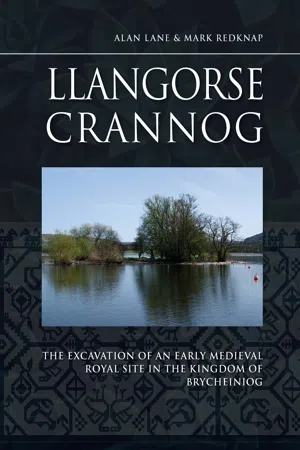
eBook - ePub
Llangorse Crannog
The Excavation of an Early Medieval Royal Site in the Kingdom of Brycheiniog
- 400 pages
- English
- ePUB (mobile friendly)
- Available on iOS & Android
eBook - ePub
Llangorse Crannog
The Excavation of an Early Medieval Royal Site in the Kingdom of Brycheiniog
About this book
Information
Topic
Sciences socialesSubtopic
Histoire de la Grande-BretagneSECTION 1
Introduction and Setting

Fig. 1.1 Llangorse Lake lies to the east of the medieval town of Brecon, within the Brecon Beacons National Park and is surrounded by three mountain ranges: the Brecon Beacons to the south, the Black Mountains to the east and Mynydd Eppynt to the north.
CHAPTER 1
The Crannog, its Name and its Setting
1.1 SITE LOCATION
Llangorse crannog lies on the north side of Llangorse Lake/Llyn Syfaddan, about 40 metres from its present, modified, northern shore (OS Grid Ref. SO132 265). Llangorse is the largest natural lake in south Wales, situated to the east of Brecon the old county town for Brecknockshire (now part of the larger county of Powys). It lies within the Brecon Beacons National Park, an area of outstanding natural beauty (Figs 1.1, 1.3).
1.2 THE NAME OF THE LAKE AND THE NAME OF THE CRANNOG
by David N. Parsons & Alan Lane
Earlier name-forms of what is currently, in English, called Llangorse Lake are listed and discussed by Peter Powell 1986–87, Morgan & Powell 1999, 138, and Owen & Morgan 2007, 260. The earliest documented form is Brecenanmere, which appears in the ‘Mercian Register’, a tenthcentury collection of annals incorporated into two manuscripts of the Anglo-Saxon Chronicle, Manuscript B of the late tenth century and Manuscript C of the mid-eleventh century (see below; Taylor 1983, 50; O’Brien O’Keeffe 2001, 75–76; Sims-Williams 1993, 59–60). It appears under the year ‘916’ (sub anno 919) in an account of a Mercian raid into Wales which ‘destroyed Brecenanmere and captured the king’s wife and 33 other persons’. The name is Old English and means ‘mere [= lake] of Brycheiniog [or possibly ‘of Brychan’, the kingdom’s eponymous founder]’, although the actual object of the attack was presumably the royal seat on the crannog rather than the lake itself.
The Welsh name, Llyn Syfaddan, is first found, as linn Syuadon, in the Liber Landavensis, an early twelfth-century compilation based in part on earlier materials (Evans & Rhŷs 1893, 146). The lake is mentioned in the boundary-clause to a charter (no. 146) which is theoretically of early eighth-century date, but is evidently a later fabrication; it is unclear how much earlier than the date of the manuscript’s compilation the boundaries may be (Sims-Williams 1993, 51–53; Davies 1979, 98), although Coe (2004, 38–40) makes a good, if properly cautious, case for the early eleventh century (see below, Chapter 21). The name combines Welsh llyn ‘lake’ with an element of unknown meaning; Syfaddan may possibly be a personal name (Rhŷs 1901, i, 74; Powell 1986–87, 41; Owen & Morgan 2007, 260). Some alternative early speculations are detailed by Powell (1986–67, 40); a more recent proposal by Thomas (1994, 160 n. 40), that the name may be an ancient *Samo-ton(a), explained as a ‘divine female personification of the summer months … as the best fishing period’ is rejected by Morgan & Powell (1999, 138) on linguistic grounds. In fact, since the weight of early spellings tends to suggest Syf- rather than Saf-, then most detailed suggestions to date which have usually involved -a- in the first syllable are problematic.
These two early names, Welsh and English, enjoyed lasting currency. In the first half of the sixteenth century Leland notes Brechenauc mere … in Walche Llin Seuathan (Smith 1906, 10). The Welsh version is recorded regularly from the fifteenth century (eg llyn syuadon in the work of the poet Lewis Glyn Cothi; Jones 1953, 181) into the modern period (eg Llyn Safaddu on the 1832 OS 1″ map; Fig. 1.2). The English mere is found from the thirteenth century onwards, although more often on its own than qualified by Brecon or Brycheiniog (eg a fishery in la mere 1299 CIPM iii, 426). Other records contain mara, probably as an approximate Latinisation of mere rather than with the Latin sense of ‘marsh, swamp’, although since this is also one sense of Welsh cors, in Llangorse (see below), a deliberate translation is conceivable. Note also that Mara was sometimes used, between the twelfth and eighteenth centuries, as an alias for Llangorse, sometimes as ‘Mara Moto’, ‘Mara Blaen Llevenye’ (Morgan & Powell 1999, 106).
The name Llangors, denoting the settlement lying 0.5 km to the north, is used as a qualifier for the lake from at least as early as 1689: Mara langors Glamorgan Archives MS CL I/1473 (ex. information Richard Morgan). Llangors Pool then appears on various eighteenth- and nineteenthcentury maps. Theophilus Jones marks Llangorse Mere on his 1805 map, which may be the first use of the nineteenth- and twentieth-century spelling Llangorse. Dumbleton and the Woolhope authors refer to Llangorse Lake or the Lake of Llangorse (Dumbleton, E. N. 1870b; Lloyd 1870). It may be noted that Brycheiniog and Llangors were not the only local place-names to be used as qualifiers for the lake: le Mere of Blaynleveny 1352 (CIPM viii, 521) makes reference to Blaenllynfi, a medieval castle some 3 km south of the lake.
The name Llangors itself contains a further term for the lake or its surroundings (Morgan & Powell 1999, 106; Owen & Morgan 2007, 260). In early Welsh cors meant both ‘reeds’ and the terrain in which they are generally found, ‘swamp, bog’. Either of these may have been the original sense in Llangors, the ‘church-enclosure’ by the cors, another name first recorded in the Liber Landavensis, this time in a more reliable document of apparent early tenth-century date (see below; charter no. 237b; Davies, W. 1979, 124; Sims-Williams 1993, 61–62). The characteristic reeds are probably alluded to also by Gerald of Wales at the end of the twelfth century. As transmitted, his text reads (Dimock 1868, 33): lacus ille de Brecheneiauc… quem et Clamosum dicunt, ‘that lake of Brycheiniog … which they also call Clamosus’. Latin Clamosus should mean ‘noisy’, giving rise to explanations about the sound of the ice groaning on the frozen lake; but it is likely that Gerald actually wrote Calamosus, ‘reedy, full of reeds’ (Jones 1940; Morgan & Powell 1999, 138). On this interpretation of Gerald’s evidence it is perhaps possible that the lake bore an alternative early Welsh name derived from cors, and that it is in fact the lake-name which enters into the place-name Llangors.

Fig. 1.2 Detail showing Llangorse and the crannog from the first series Ordnance Survey 1” map of 1832. (© Crown Copyright: Ordnance Survey)

Fig. 1.3 Aerial view from the north-west showing the lake with the crannog close to the northern shore in the centre foreground. (© Crown Copyright: RCAHMW)
There seems to be no record of a name for the crannog itself before the sixteenth-century court records cited by Richardson (2007, 115–21), which refer to it as twmp ‘mound’ (see below, Chapter 23). This may be compared with Bwlc, which appears on the Ordnance Survey 1” map of 1832’ (Fig. 1.2). This is a Welsh borrowing from English bulk, recorded in the sense ‘heap’ (Geiriadur Prifysgol Cymru cyfrol 1, 352), which is perhaps the intention here. Such a late English loan-word is hardly an ancient name, however. One earlier record, a fifteenth-century gloss to linn Syuadon in the Liber Landavensis, incorporates ynys ‘island’ (Evans & Rhŷs 1893, 340); however, aqua vocetur llinn ynys yvavon ‘water called the lake of Ynys Yvavon’ almost certainly represents a garbling of Llyn Syfaddan rather than an alternative early name for the lake based on a lost name of the island or crannog.
The earlier publications of our work on the crannog used the twentieth-century English spelling Llangorse which appeared on Ordnance Survey maps, in the village and on road signs. Some subsequent publications used Llangors. Current Ordnance Survey usage is Llangors for the village and Llangorse Lake for the lake. Several modern authorities prefer Llan-gors (Richards 1969; Powell 1986–87, 40; Davies, W. 1989; Owen & Morgan 2007, 260), the hyphen indicating that the stress falls on the second element of the name. There is of course a Welsh name for the lake – Llyn Syfaddan – so it might be appropriate to adopt a two language usage for the site and call it the Llangorse Lake/Llyn Syfaddan crannog. However, as Llyn Syfaddan does not seem to be a significant surviving local usage, we have adopted the English usage Llangorse for the lake and for the crannog and the Welsh spelling Llan-gors for the village.
1.3 THE CRANNOG TODAY
The modern appearance of the crannog is as a small wooded island (SO 12892690), measuring about 40 metres by 30 metres in size (Fig. 1.4). In summer the dense bush and tree vegetation (mainly alder) conceals the surface of the island, but when the vegetation dies down or is cleared, it is apparent that the island is a stony mound rising to about 0.8m above summer water level, made up of medium-sized and smaller stones and occasional boulders. Prior to the 2004 conservation measures, the edge of the island was clear of vegetation to the south, south-east and west, and eroding timber and stone deposits were apparent. To the northeast silt deposits obscured the edge of the island which gently sloped into the lake, while to the north a reed swamp makes definition of an edge fairly arbitrary. When the current work began on the island in 1988, oak timbers were visible round the southern and western edges of the island in two partial lines, some timbers rising out of the water in dry summers and submerged in wet winters (Fig. 1.5). Local recording since 2006 indicates that the water level fluctuates considerably with as much as a 1.50m difference between summer and winter water levels (Garnet Davies, pers. comm.; Fig. 1.6). Occasional larger roundwood timbers were also visible as well as eroding wattle deposits in some places. The mound is sharply eroded on the west and south sides, and shelves into about 1.2m of water (low summer lake level). To the north the reed swamp gives way to a shallow channel, 40 metres wide, between it and the modern jetties on the north shore of the lake (Fig. 1.7). This shoreline has been heavily landscaped for outdoor watersports activities with a children’s adventure camp being constructed in the mid-1960s (Cragg et al. 1980, 188). The original shoreline, which may have been much more heavily reeded and more graduated in depth in the past, was originally set further to the north.

Fig. 1.4 The crannog in summer 2004, overgrown with trees and bushes.

Fig. 1.5 Oak palisade planks 602–609 protruding above water level on the south side of the crannog (summer 1990), in front of platform rubble.

Fig. 1.6 The flooded crannog in the winter (November 1988).
1.4 LOCATION, ENVIRONMENT AND LAND-USE
The lake is situated in a low-lying basin between the catchments of the rivers Usk and Wye, two of the major rivers which drain the hills of mid-Wales (Fig. 1.1). The Usk flows from its source in Carmarthenshire eastwards between the Brecon Beacons and Black Mountains. Its valley provides a major east-west routeway into Wales with the hill massif of the Brecon Beacons rising over 800m beyond it to the south. Both Roman roads and modern highways emphasise the natural importance of this route into Wales and through it to the west coast of Britain. To the east the Black Mountains (over 700m in height) separate the Usk valley from the Wye basin while low hills to the north of the lake allow an easy passage along the river Llynfi down to the Wye valley at Talgarth and ...
Table of contents
- Cover
- Dedication
- Title
- Copyright
- Contents
- Foreword by Lord Elis-Thomas, AM, Deputy Minister for Culture, Sport and Tourism in the Welsh Government
- Acknowledgements
- Summary
- SECTION 1. INTRODUCTION AND SETTING
- SECTION 2. THE EXCAVATIONS
- SECTION 3. ARCHAEOZOOLOGY AND ENVIRONMENTS
- SECTION 4. PREHISTORIC, ROMAN AND EARLY MEDIEVAL ARTEFACTS
- SECTION 5. EVIDENCE FOR CRAFT ACTIVITIES
- SECTION 6. WATER TRANSPORT
- SECTION 7. POST-CRANNOG FINDS (PERIODS 5–6)
- SECTION 8. SITE CONSERVATION
- SECTION 9. LLANGORSE CRANNOG IN CONTEXT
- APPENDICES
- Bibliography
Trusted by 375,005 students
Access to over 1.5 million titles for a fair monthly price.
Study more efficiently using our study tools.
Frequently asked questions
Yes, you can cancel anytime from the Subscription tab in your account settings on the Perlego website. Your subscription will stay active until the end of your current billing period. Learn how to cancel your subscription
No, books cannot be downloaded as external files, such as PDFs, for use outside of Perlego. However, you can download books within the Perlego app for offline reading on mobile or tablet. Learn how to download books offline
Perlego offers two plans: Essential and Complete
- Essential is ideal for learners and professionals who enjoy exploring a wide range of subjects. Access the Essential Library with 800,000+ trusted titles and best-sellers across business, personal growth, and the humanities. Includes unlimited reading time and Standard Read Aloud voice.
- Complete: Perfect for advanced learners and researchers needing full, unrestricted access. Unlock 1.5M+ books across hundreds of subjects, including academic and specialized titles. The Complete Plan also includes advanced features like Premium Read Aloud and Research Assistant.
We are an online textbook subscription service, where you can get access to an entire online library for less than the price of a single book per month. With over 1.5 million books across 990+ topics, we’ve got you covered! Learn about our mission
Look out for the read-aloud symbol on your next book to see if you can listen to it. The read-aloud tool reads text aloud for you, highlighting the text as it is being read. You can pause it, speed it up and slow it down. Learn more about Read Aloud
Yes! You can use the Perlego app on both iOS and Android devices to read anytime, anywhere — even offline. Perfect for commutes or when you’re on the go.
Please note we cannot support devices running on iOS 13 and Android 7 or earlier. Learn more about using the app
Please note we cannot support devices running on iOS 13 and Android 7 or earlier. Learn more about using the app
Yes, you can access Llangorse Crannog by Alan Lane,Mark Redknap in PDF and/or ePUB format, as well as other popular books in Sciences sociales & Histoire de la Grande-Bretagne. We have over 1.5 million books available in our catalogue for you to explore.