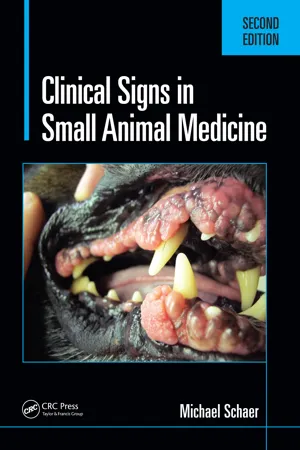
This new edition of the bestselling Clinical Signs in Small Animal Medicine presents 800 all new color photographs of the highest quality, with detailed captions that focus on key pointers to diagnosis and treatment. The book is organised into chapters by body system, each beginning with a list of 'Clinical Pearls'. These amusing and accurate key points will be invaluable when considering conditions or highlighting common concerns. Within each chapter, the superb photographs of real cases are annotated with brief, key information that provides a succinct and useful reminder of lessons learned.
- 228 pages
- English
- ePUB (mobile friendly)
- Available on iOS & Android
eBook - ePub
Clinical Signs in Small Animal Medicine
About this book
Information


1
Dermatologic disorders
DERMATOLOGY is derived from the Greek term derma, meaning skin, and logos, meaning study or speech, word, or reason. It is an essential discipline for the practitioner because of the high incidence of skin disease that one can encounter daily in practice. These disorders can occur as primary lesions or syndromes or they can be a reflection of some other internal disease process in the body. Adherence to the essentials of obtaining a full history and doing a complete physical examination will be most helpful in determining the cause of the dermatologic disorder. Perhaps the most common group of skin diseases involve hypersensitivity states, but other important conditions might be associated with autoimmune disorders, infectious diseases, neoplasia, nutritional disorders, and various metabolic and endocrine conditions. The diagnostic methodology of skin diseases, after taking a full history and conducting a physical examination, includes general tests such as a complete blood count, serum biochemistry profile, immune or infectious disease serology, skin hypersensitivity testing, and biopsy. The advantages of these tests are that they are readily available to the practitioner and noninvasive for the patient. In many instances the classic appearance of certain lesions will allow for a minimal diagnostic evaluation, thus saving the owner a substantial amount of expense.
1
Dermatologic disorders


1.1a, b. Cutaneous vasculitis. The dermatologic lesions on this dog began as distinct multifocal areas of erythema that progressed to eschar and eventual sloughing. These lesions were biopsied and diagnosed as cutaneous vasculitis. This disorder is usually associated with a type III immune reaction. The sensitizing trigger can vary and includes drugs, underlying diseases and infections, and serum sickness; sometimes the cause remains unknown or idiopathic. The lesions can appear as purpura, petechiae, or ulcers. Histologically, white blood cells are seen surrounding the blood vessel walls (leukocytoclastic vasculitis). Treatment entails removing the insulting agent, if possible, and administering immunosuppressive drugs such as prednisone. The vasculitis can involve both superficial and deep small, medium, or large arteries and arterioles.


1.2a–e. Drug-induced vasculitis. This dog developed diffuse superficial ulcerations involving its ears, oral mucosa, periocular skin, nose, and digits. Note the mucocutaneous localization, which would be typical of immune system involvement. The cause was the drug prazosin, which had to be discontinued and replaced by another drug with similar action.

1.3. Atypical mycobacterial infection. Shown is a chronic draining skin wound that had not responded to wound care and antibiotics. This scenario should prompt consideration of atypical mycobacterial infection, which requires special growth media for optimal culture conditions. Diagnosis requires obtaining deep tissue sampling. Once diagnosed these infections require months of continuous treatment and re-evaluation for the possibility of having to alter the antimicrobial treatment because of resistant bacterial strains. Recurrent infection is possible, especially if immunosuppression is present.


1.4a, b. Calcinosis cutis. This dermatologic condition is commonly associated with Cushing’s disease and, more rarely, with other medical disorders. Various forms occur, which can appear as moist inflamed skin lesions or as a dry form that is not inflamed. A yellow colored mineralized deposit in the superficial forms is typical. There is no specific treatment other than treatment of the underlying condition. Most cases will resolve once the hypercortisolism is resolved.

1.5. Heat pad-induced skin burns. Thermal skin injuries can be very extensive, as illustrated in this dog’s lesion. It is usually acquired when prostrate animals are covered with heat emitting devices such as heat pads and hot water bags. The earliest signs are erythema, soon followed by a hardening texture to the skin often accompanied by eschar formation, which e...
Table of contents
- Cover
- Title
- Copyright
- Contents
- Preface
- Abbreviations
- Dedication
- Introduction
- Clinical Pearls
- Chapter 1: Dermatologic disorders
- Chapter 2: Ophthalmologic disorders
- Chapter 3: Infectious diseases
- Chapter 4: Cardiovascular disorders
- Chapter 5: Serum electrolyte disorders
- Chapter 6: Fluid therapy complications
- Chapter 7: Respiratory disorders
- Chapter 8: Hematology and hemostasis disorders
- Chapter 9: Gastrointestinal disorders
- Chapter 10: Liver disorders
- Chapter 11: Immune disorders
- Chapter 12: Endocrine disorders
- Chapter 13: Urogenital disorders
- Chapter 14: Neurologic disorders
- Chapter 15: Neoplastic disorders
- Chapter 16: Toxicologic disorders (including snake bite envenomation)
- Chapter 17: Miscellaneous disorders
- Index
Trusted by 375,005 students
Access to over 1.5 million titles for a fair monthly price.
Study more efficiently using our study tools.
Frequently asked questions
Yes, you can cancel anytime from the Subscription tab in your account settings on the Perlego website. Your subscription will stay active until the end of your current billing period. Learn how to cancel your subscription
No, books cannot be downloaded as external files, such as PDFs, for use outside of Perlego. However, you can download books within the Perlego app for offline reading on mobile or tablet. Learn how to download books offline
Perlego offers two plans: Essential and Complete
- Essential is ideal for learners and professionals who enjoy exploring a wide range of subjects. Access the Essential Library with 800,000+ trusted titles and best-sellers across business, personal growth, and the humanities. Includes unlimited reading time and Standard Read Aloud voice.
- Complete: Perfect for advanced learners and researchers needing full, unrestricted access. Unlock 1.5M+ books across hundreds of subjects, including academic and specialized titles. The Complete Plan also includes advanced features like Premium Read Aloud and Research Assistant.
We are an online textbook subscription service, where you can get access to an entire online library for less than the price of a single book per month. With over 1.5 million books across 990+ topics, we’ve got you covered! Learn about our mission
Look out for the read-aloud symbol on your next book to see if you can listen to it. The read-aloud tool reads text aloud for you, highlighting the text as it is being read. You can pause it, speed it up and slow it down. Learn more about Read Aloud
Yes! You can use the Perlego app on both iOS and Android devices to read anytime, anywhere — even offline. Perfect for commutes or when you’re on the go.
Please note we cannot support devices running on iOS 13 and Android 7 or earlier. Learn more about using the app
Please note we cannot support devices running on iOS 13 and Android 7 or earlier. Learn more about using the app
Yes, you can access Clinical Signs in Small Animal Medicine by Michael Schaer D.V.M. in PDF and/or ePUB format, as well as other popular books in Medicine & Internal Medicine & Diagnosis. We have over 1.5 million books available in our catalogue for you to explore.