- 310 pages
- English
- ePUB (mobile friendly)
- Available on iOS & Android
eBook - ePub
About this book
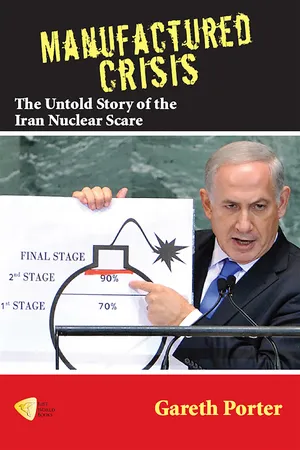
In Manufactured Crisis, investigative reporter Gareth Porter shows how Israel and the George W. Bush administration successfully waged their campaign claiming that Iran was trying covertly to acquire a nuclear weapon. Porter shows in detail that most of the so-called evidence for such a weapons program was of dubious origin, including the documents that allegedly originated from the laptop of an Iranian nuclear scientist. As Iran and the United States have engaged in serious negotiations over Iran's nuclear program, this book has provided crucial background material for those who want to make an independent assessment of the record, rather than relying on highly politicized allegations.
Frequently asked questions
Yes, you can cancel anytime from the Subscription tab in your account settings on the Perlego website. Your subscription will stay active until the end of your current billing period. Learn how to cancel your subscription.
No, books cannot be downloaded as external files, such as PDFs, for use outside of Perlego. However, you can download books within the Perlego app for offline reading on mobile or tablet. Learn more here.
Perlego offers two plans: Essential and Complete
- Essential is ideal for learners and professionals who enjoy exploring a wide range of subjects. Access the Essential Library with 800,000+ trusted titles and best-sellers across business, personal growth, and the humanities. Includes unlimited reading time and Standard Read Aloud voice.
- Complete: Perfect for advanced learners and researchers needing full, unrestricted access. Unlock 1.4M+ books across hundreds of subjects, including academic and specialized titles. The Complete Plan also includes advanced features like Premium Read Aloud and Research Assistant.
We are an online textbook subscription service, where you can get access to an entire online library for less than the price of a single book per month. With over 1 million books across 1000+ topics, we’ve got you covered! Learn more here.
Look out for the read-aloud symbol on your next book to see if you can listen to it. The read-aloud tool reads text aloud for you, highlighting the text as it is being read. You can pause it, speed it up and slow it down. Learn more here.
Yes! You can use the Perlego app on both iOS or Android devices to read anytime, anywhere — even offline. Perfect for commutes or when you’re on the go.
Please note we cannot support devices running on iOS 13 and Android 7 or earlier. Learn more about using the app.
Please note we cannot support devices running on iOS 13 and Android 7 or earlier. Learn more about using the app.
Yes, you can access Manufactured Crisis by Gareth Porter in PDF and/or ePUB format, as well as other popular books in History & Military & Maritime History. We have over one million books available in our catalogue for you to explore.
Information
1
The US Denial Policy and Its Consequences
What consumers of news coverage of foreign affairs have learned over more than a decade about Iran’s nuclear policy is that in the 1980s, Iran began a secret enrichment program, in violation of its safeguards agreement with the International Atomic Energy Agency (IAEA), and maintained that program for 18 years with the intention of producing nuclear weapons, or at least keeping that option open. Fortunately, according to this account, a secret Iranian enrichment facility was revealed by Iranian opponents of the regime in 2002, and the full investigation by the IAEA that followed uncovered the illicit nuclear activities that Iran had been pursuing in secret for many years.
That thumbnail sketch represents a nuclear scare that has surrounded the Iranian program since 2002 and has been the rationale for the long international crisis over the issue. But that version of the history of the Iranian nuclear program is a fundamental falsification achieved by eliminating the single most important historical fact about Iran’s nuclear program: Iran’s decision to enrich uranium was a direct response to a US policy that had challenged Iran’s right to have any peaceful nuclear power program at all.
The US policy that later became a determination not to allow Iran to have “a single centrifuge spinning”1—meaning that no uranium enrichment would be countenanced—began in the early to mid-1980s with an effort to deny Iran even the Bushehr nuclear reactor in which the country had already invested billions of dollars and which was 80 percent completed when the shah was overthrown. It was only because of that US policy that Iran decided to get into enriching its own uranium to fuel Bushehr. The story of that action-reaction dynamic between a US policy of denial of Iran’s right to obtain technology for the peaceful uses of nuclear power, as guaranteed by the Nuclear Non-Proliferation Treaty (NPT), and the Islamic Republic’s ultimate decision to acquire its own capabilities for uranium enrichment is the pivotal chapter in the untold history of the manufactured crisis over the Iranian nuclear program.
Iran’s Original Nuclear Program
A deeply ironic fact about the nuclear program that has provoked such an intense and prolonged crisis is that the Islamic revolution to overthrow the shah was initially accompanied by the mullahs’ strong reaction against nuclear power as a manifestation of the shah’s penchant for expensive toys—and the US sponsorship of the original nuclear program. Former ambassador Seyed Hossein Mousavian, who worked for Ali Akbar Hashemi Rafsanjani, the powerful head of the Iranian legislature, or Majlis, beginning in 1984, recalled that in 1979, the revolutionaries considered the shah’s ambitious plan for 23 nuclear power plants to be one of the “imperialistic projects” associated with the imperial regime and its American sponsors.2
In July 1979, the revolutionary government halted construction at Bushehr, the flagship facility of the shah’s extensive nuclear program, along with nearly all the other projects that had launched by the Atomic Energy Organization of Iran (AEOI). It also stripped the AEOI of most of its budget and staff. Some thought was even given to using the 80 percent completed Bushehr reactor for something else entirely, but after officials from Tehran made an inspection trip there, they decided it could serve no other use. Two years later, the government reversed the decision to strip the AEOI of its budget and staff, largely because the severe electricity shortages that marked the first two years of the revolutionary era persuaded policymakers that there might be a role for nuclear power reactors after all.3
Even after the decision to resume the nuclear program in 1981, however, the Islamic Republic’s nuclear ambitions remained extremely modest compared with those of the shah. “We didn’t want to have 20 nuclear power plants or to have enrichment,” Mousavian recalled. “The only things remaining [in the program] were to complete Bushehr and to continue the Tehran Research Reactor for medical purposes. We would have one nuclear power plant, with fuel from France.”4
Iran still hoped to obtain enriched uranium for fuel plates for Bushehr from the Iranian stake in the French-owned uranium enrichment consortium Eurodif. The shah had invested a total of $1.18 billion toward the construction of Eurodif’s enrichment facility, which entitled Iran to 10 percent of the production of enriched uranium it produced. Soon after the overthrow of the shah, Tehran canceled his contract with Eurodif. In February 1980, the French government refused to refund the sum Iran had invested in Eurodif, or to provide the uranium that Iran was due under the shah’s contract. Then, in the early 1980s, Iran sought to work out a deal under which it could reclaim its share of the production of the facility. But after the Socialist Party’s François Mitterrand came to power in May 1981, he reiterated France’s refusal to provide the enriched uranium from Eurodif that Iran was requesting. Nevertheless, according to Mousavian, Iran continued to negotiate with France over access to the nuclear fuel it would need once Bushehr could be restored, even as the question of the disposition of the money Iran had invested in Eurodif was being contested in French courts.5
Meanwhile, the Islamic Republic was also hoping to get help from the IAEA for its scaled-down nuclear program. In 1983, the AEOI approached IAEA Director Hans Blix to request the IAEA’s help in building the Iranian nuclear organization’s technical capacity. The AEOI asked Blix to send a team to do surveys of its Esfahan Nuclear Technology Center (ENTEC) and the Tehran Nuclear Research Center (TNRC) as the basis for further cooperation. Blix sent the Iranian request to Deputy Director Maurizio Zifferero, who in turn directed IAEA official Herman Vera Ruiz to conduct the survey in October 1983.6
By then, AEOI was only a shadow of the organization that existed at the end of the shah’s regime, when its staff had consisted of 862 scientists and it had commanded an annual budget of more than $3 billion.7 But ENTEC still had considerable expertise and equipment, and it had already decided to focus primarily on fuel fabrication and uranium conversion rather than on uranium enrichment. ENTEC’s largest department, with 23 scientists and what the IAEA judged to be “impressive” laboratory equipment, was the fuel-fabrication department, which was responsible for carrying out experiments on the fabrication of uranium oxide pellets. It also had a chemistry department with 20 scientists, which had responsibility for conducting experiments on the conversion of yellowcake (U308) into uranium dioxide (UO2) for fuel rods for nuclear reactors like Bushehr.
After his visit, Ruiz reported to Blix and Zifferero that ENTEC officials had informed him about plans to build a uranium conversion pilot plant to produce uranium hexafluoride (UF6), the form of uranium that is ready for enrichment. Ruiz’s memo made no mention of any AEOI request for assistance in uranium enrichment, reflecting the fact that Iran was still hoping to get enriched uranium from the French company Eurodif.
The memo from Ruiz recommended that the IAEA provide “expert services” in eight different fields to assist all of ENTEC’s departments, including designing a “pilot plant for fuel conversion,” which was a primary goal of the Iranian nuclear program. The IAEA Technical Cooperation Department was also prepared to assist ENTEC and TNRC on several of the items on the list of recommendations that Ruiz compiled in late 1983.8
Iran was thus poised to take advantage of its rights under the NPT to international cooperation for the pursuit of peaceful nuclear power. But that was before US officials saw the Ruiz report. Apparently, neither Iran nor the IAEA had anticipated that the Reagan administration would intervene to stop the proposed cooperation. That decision, unannounced at the time, began a process that would lead eventually to a crisis over what the world would be told was the threat of an Iranian nuclear weapon.
US Nuclear Embargo and the Iranian Response
The overthrow of the shah’s regime in 1979 was a traumatic shock to the US national security system. The Department of Defense and the CIA had built deep ties with the shah’s regime (as had Israel). Under the shah, Iran had served as the keystone of policy in the region for a quarter century. Preserving his regime had been seen as so important by some top officials that, as the State Department’s desk officer on Iran later recalled, when the popular uprising took place, national security adviser Zbigniew Brzezinski recommended that the United States urge the shah to have his troops “shoot down as many people as necessary and bring an end to the rebellion once and for all.”9
Once the shah had been toppled, the major thrust of US policy was, in effect, to watch for an opportunity to replace the Islamic regime so the United States could resume its former position of power in Tehran. When President Jimmy Carter’s administration got word in September 1980 that Iraqi president Saddam Hussein was planning to attack Iran to overthrow the regime, the United States did nothing to oppose the scheme, despite the enormous risk of regional instability inherent in such a war. Vice President Walter Mondale would later explain, “We believed that this war would put further pressure on the Iranian regime.”10
When Ronald Reagan entered the White House in 1981, internal discussions on Iran revolved around the expressions by senior officials of the desirability of removing the founder and leader of the Islamic revolution, Ayatollah Ruhollah Khomeini. CIA Director William Casey was tasked with exploring the possibility of a covert plan to oust Khomeini and replace him with the shah’s son, Reza Pahlavi.11 And when Iran was preparing to mount a massive counteroffensive against Iraq in spring 1982, the United States became an active supporter of the Iraqi war effort. Reagan agreed to a secret national security decision directive that the United States would do everything “necessary and legal” to prevent Iran from defeating Iraq. The staff of Reagan’s National Security Council worked closely with CIA Director Casey and his deputy, Robert M. Gates, to persuade third-country suppliers to ship to Iraq a variety of forms of weapons, including cluster bombs and anti-armor penetrators (most of them of Soviet origin). The United States also provided strategic advice to Saddam’s military on how best to use its troops.12 That initiative was followed in late 1983 by Operation Staunch, a diplomatic campaign to convince US allies and friends to stop selling arms to Iran in the interests of “achieving a negotiated end to the Iran-Iraq war.”13
The decision to do whatever could be done to support Iraq against Iran in the war was followed by a series of interventions by the Reagan administration to prevent international assistance of any kind to the Iranian nuclear program. The earliest documented US intervention to try to obstruct any progress by Iran toward completion of its nuclear reactor at Bushehr was the objection the United States registered to the IAEA’s late 1983 proposal to provide Iran with technical assistance for fuel production and uranium conversion. After the United States “directly intervened” to block any such IAEA assistance, those two major elements of the proposed assistance to the Iranian program were dropped by the IAEA. “We stopped that in its tracks,” a former US official recalled many years later.14
The US decision to prevent the IAEA from helping Iran in the same way it helped other states in good standing with the agency was simply an adjunct of the Reagan administration’s policy toward Iran and Iraq. “It was the war,” recalled Geoffrey Kemp, who was senior director for the Near East and South Asia on Reagan’s National Security Council staff. “We had made a decision to tilt toward Iraq across the board. It was part of the Iran-Iraq War syndrome.”15
The IAEA intervention was only the beginning of a much broader US policy of denial of international cooperation with the Iranian nuclear program. In April 1984, the State Department confirmed that the United States’ goal was to block all technology transfers to Iran’s nuclear program by external suppliers. In a written reply to a reporter’s question, the department spokesman said, “Previous actions by the Government of Iran do not provide us with great assurance that it will always abide by its international commitments.” Therefore, the State Department declared that the United States would not allow any US nuclear technology to be shared with Iran. “In addition,” the statement said, “we have asked other nuclear suppliers not to engage in nuclear cooperation with Iran, especially while the Iran-Iraq war continues.”16 That wording left open the possibility that the United States might continue its effort to deny all nuclear technology to Iran even after the Iran-Iraq War was over.
One might expect such a virtual declaration of war on a country’s nuclear program to be accompanied by some claim of evidence of covert nuclear weapons work or at least of Iran having committed serious violations of its NPT-derived safeguards agreement with the IAEA. But the State Department made clear that it had no evidence of bad faith on the part of Iran in regard to its commitments under the NPT. It admitted that it had “no evidence” that Iran had violated its pledge under the NPT to place its nuclear activities under international safeguards. Its spokesman even suggested that he did not see the Iranian nuclear reactor at Bushehr as a proliferation risk, saying there was “no evidence” of any construction of facilities there that could separate plutonium from spent reactor fuel. Instead, State Department officials justified the policy of denying all nuclear technology to Iran by telling reporters off the record that Iran was about to launch an all-out offensive against Iraq that could threaten Saddam’s regime, implying that Iran could emerge as the dominant power in the region.17 The Reagan administration was justifying its intervention to prevent Iran from having a nuclear power program purely on the basis of its assertion of geopolitical interests in the Middle East.
That policy was soon impinging on Iran’s relations with France and Germany, whose cooperation was crucial to the plan to complete the Bushehr reactor. Mousavian began following the nuclear issue in 1984, when he went to work as chief of staff for Rafsanjani, then the speaker of the Iranian parliament. He recalled later, “The French came to us saying we cannot give fuel for Bushehr. They were telling us, ‘This is an international decision.’” The ...
Table of contents
- Front Cover
- Back Cover
- Title Page
- Copyright Page
- Contents
- Dedication
- Map of Iran
- Abbreviations and Acronyms
- Introduction
- 1. The US Denial Policy and Its Consequences
- 2. The Politics of Iran’s Nuclear Secrecy
- 3. Iran’s Unknown Nuclear Politics
- 4. US Political Origins of the Nuclear Scare
- 5. Israeli Political Origins of the Nuclear Scare
- 6. Choosing Regime Change Over Diplomacy
- 7. The IAEA Comes Up Empty
- 8. The Mystery of the Laptop Documents
- 9. Intelligence Failure
- 10. The Phantom Bomb Test Chamber of Parchin
- 11. Phony War Crises
- Epilogue
- Dramatis Personae
- Acknowledgments
- Notes