- 154 pages
- English
- ePUB (mobile friendly)
- Available on iOS & Android
eBook - ePub
About this book
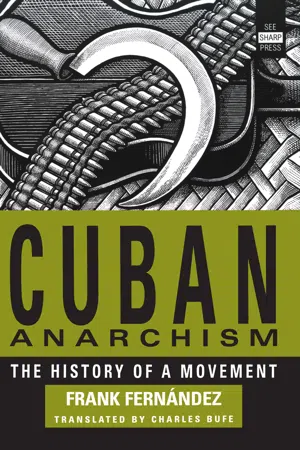
This inspiring history of the Cuban anarchist movement is also a history of the Cuban labor movement. It covers both from their origins in the mid-19th century to the present, and ends with an enlightening analysis of the failure of the Castro dictatorship.
Information
1
Colonialism & Separatism
(1865–1898)
Nineteenth-century Cuban society possessed a set of characteristics unique in the western hemisphere. From the beginning of the century, exploitation of Cuba’s economic wealth had been the work of the white ruling class, who bore titles of Spanish nobility. This Creole1 aristocracy had enough power and resources to influence Spanish policy during the colonial epoch. While the rest of Latin America was violently freeing itself of Spanish colonialism, Cuba’s Creole plutocracy considered itself more Spanish than Fernando VII, the king of Spain, and very deliberately opposed any type of reformism, no matter how modest.
The cultivation of sugar cane, tobacco, and coffee was the basis of Cuba’s agricultural abundance, and in order to compete in international markets Cuba’s elite needed cheap labor. So, in open collusion with the Spanish crown and the colonial authorities, Cuba’s plutocrats engaged in the massive importation of African slaves, in the process establishing an abusive, slavery-based society. By the middle of the 19th century, Cuba’s aristocracy had become powerful sugar barons and Cuba’s economy was abnormally dependent—by Latin American standards—on the slave trade and the institution of slavery.
The class structure of Cuban society was pyramidal in these years: on the top, the sugar barons and the Spanish colonial officials; in the middle, artisans, industrial, sugar and tobacco workers, including free blacks and campesinos; and on the bottom, black slaves. The division between the bottom two classes was not always clear cut despite the many racial and social divisions in Cuban society: campesinos and poor Spanish immigrants could suffer almost the same discrimination and exploitation as black slaves. It is well to keep in mind that these divisions in Cuban society were imposed by the dominant class and not by the people at the base of the social pyramid.
In this society, there was no social, racial, political, or economic integration. This was principally because Cuba was a Spanish colony and that the primary interest of the Spanish government was in holding its power through maintaining the polarized situation on the island; the more divided that Cuba was, the easier it was for the Spaniards to exploit its economic resources and to preserve their political power. For more than three centuries the Spanish authorities—in the same manner as the other European colonial powers in other lands—maintained this deplorable situation.
But despite the crushing influence of Spanish colonialism, new ideas found their way to Cuba. By the middle of the 19th century there were political tendencies in the following directions: national independence; reformism (with Cuba remaining a Spanish colony); integration into the United States; and integration into Spain. None of these currents was indigenous; they all came from abroad, because the Creole intelligentsia was weak and saw itself and its country’s situation as it was seen from abroad, be it in France, Spain, or the U.S.
At this time, the revolutionary independence tendency, even though it had taken root among the Creoles, was still in an intellectual phase; it had not yet entered its conspiratorial stage. Cuban reformism was aimed at obtaining small economic and political changes in return for maintaining the status quo. This tendency had gained some influence among the sugar barons and the large and small Creole bourgeois classes, in large part due to the obvious failure of integrationist efforts (in regard to the U.S.). For their part, those Cuban Creoles living in the United States were largely in favor of Cuba’s joining the U.S. (or at least its southern states) in the period before the U.S. Civil War. But the failure of two exile invasions of Cuba at the beginning of the 1850s (mounted with the help of southern secessionist elements) and the defeat of the South in the Civil War dampened, but did not extinguish, the hopes of Cuba’s annexation by the United States.
Ultimately, the most influential tendency in the mid 19th century was that of integration with Spain. This was natural given that the most powerful classes in Cuba depended upon Spanish colonial power—both political and economic—to maintain their privileged positions. Their slogan made their position extremely clear: “Cuba espanola.” At the same time, those Cubans outside of the favored social classes either didn’t have—or didn’t dare to express—social or political opinions.
Nonetheless, in the 1850s new social concepts began to spread among Cuban and Spanish workers at the bottom of the social pyramid. The massive Spanish emigration to Cuba around 1850, inspired by the fear of the creole ruling class and the Spanish crown of an “Africanized” Cuba, brought with it a series of totally new social concepts, to which the Spanish/Cuban proletariat was receptive. This isn’t surprising given the miserable conditions of Cuba’s workers at the time. Spanish immigrants were treated as virtual slaves by their own countrymen, and 16- or 18-hour work days, seven days a week, were typical. One important industry in which such conditions were common was tobacco, in which not only was the work unhealthy and the pay low, but the long work hours were filled with monotony in unsafe working conditions. So, the ideas that the newly arrived Spanish workers brought with them interacted with the misery of Cuban workers, slaves, and campesinos to produce a new Cuban social movement.
It was at this time that the social ideas of the French typographer, Pierre-Joseph Proudhon, one of the most original socialist thinkers of the 19th century, became influential in Cuba. Proudhon’s economic theories and social ideas—often lumped together under the title “mutualism”—had a great impact in Europe, and decisively influenced the origins of Cuban anarchism. The French thinker had disciples among the progressive workers and artisans on the island, and especially among those in the tobacco industry—the first in which some sort of class consciousness developed among Cuban workers.
In 1857, the first Proudhonian mutualist society was founded in Cuba, with the intention of creating a workers’ organization free of state and dominator-class influence. This was the first step toward the creation of a civil society within the Cuban proletariat, even though, unfortunately, as the Spanish historian Casanovas Codina notes, the artisans associations founded at this time were “racially segregated and restricted to artisans from the same neighborhood. But they laid the foundation from which Cuban organized labor would grow and evolve in the future.”
In 1865, the first strike threat occurred in Cuba. It took place on August 14 at the Hija de Cabanas y Carbajal and El Figaro tobacco works in Havana. The 400 workers taking part were demanding an increase in their daily wages, and the owners of both factories acceded to their demands.
At about this time the young Asturian, Saturnino Martinez, arrived in Cuba and went to work in the tobacco industry. He quickly became involved in the tobacco workers’ associations and by the end of 1865 had founded the first workers’ weekly paper in Havana, La Aurora, in which he outlined some of Proudhon’s ideas, which the mechanical engineer, Jose de Jesus Marquez, had introduced to him. It was in La Aurora, not coincidentally, that Marquez proposed for the first time in Cuba the idea of cooperative societies.
Martinez, although influenced by Proudhon’s ideas of federation and mutual aid, was not an anarchist, and his proposals regarding the organization of work in the tobacco industry, which he purported to represent, were not really revolutionary. His paper, La Aurora, even though in favor of workers’ associations, saw its primary mission as that of education, that of helping the Cuban/Spanish workers develop intellectually. La Aurora defended the right of workers to free association, but this was the same position as that of the Partido Reformista, which indeed owned the press on which La Aurora was printed. Nonetheless, La Aurora was Cuba’s first workers’ newspaper, and Martinez took the first step toward the protection of workers’ associations. He also initiated the practice of reading aloud in tobacco workshops, a practice which would have great utility in propagating anarchist ideas among tobacco workers in years to come.
Let there be no doubt about it: in the period before the Ten Years War for independence from Spain (1868–1878), the foundation of the first free societies and associations of tobacco workers, typographers, carpenters, day laborers and artisans lay in Proudhon’s ideas and their influence in Cuba. The country and its workers’ movement owe the creation of the first regional centers, secular schools, clinics, and workers’ mutual aid associations—at the very least—to the French anarchist. The Ten Years War would halt this impulse toward social emancipation of the most oppressed classes, while at the same time it would ruin the Creole sugar barons; and eventually this war would end in the enslavement of Cuba.
Those who participated in the Ten Years War—the first Cuban insurrection for independence—included tobacco workers and survivors of the Paris Commune who had escaped France, bringing with them more of Proudhon’s influence. Among the leaders of the Cuban insurgents at this time, one finds Salvador Cisneros Betancourt and Vicente García, who embraced the Proudhonian concepts of federalism and decentralization.
But the first openly anarchist presence in Cuba cannot be discerned until the 1880s, when J.C. Campos, a Cuban typographer who had taken refuge in New York during the Ten Years War, initiated contact between Cuban and Spanish anarchists upon his return to Havana. The profusion of libertarian propaganda in the form of pamphlets and newspapers that arrived regularly and clandestinely from Barcelona, along with the migration of Spanish workers to Cuba, reinforced the transmission of these new ideas. As a result, a new wave of revolutionary, socialist Cuban workers proceeded to involve themselves in the Alianza Revolucionaria Socialista (ARS).
It was in these years, the 1880s, that anarchist thought acquired an unprecedented influence among workers and peasants in France, Italy, Russia, and, above all, Spain. Its principal proponent was the notable figure Mikhail Bakunin, the Russian writer and revolutionary who elaborated on Proudhon’s ideas. The divisions between absolutist marxist socialism and revolutionary anarchist socialism had already been demonstrated in the congresses of The Hague and St. Imier,2 as well as with the founding of the ARS in 1873, and the establishment of the International Social Democratic Alliance in the same year. Ideologically, the well known Declaration of Principles of the Social Democratic Alliance, edited by Bakunin himself, had established the differences between the authoritarian socialism espoused by Marx, and the libertarian socialism espoused by the anarchists.
The revolutionary concepts of Bakunin were adopted by the Federacion Regional Espanola (FRE) in the Congress of Barcelona in 1881, and they had a definite impact on militant revolutionary workers in Cuba, supplanting the more gradualist ideas of Proudhon in the syndicalist (union) field. It was at this time that the Cuban working class began to achieve class consciousness in regard to ruling class abuses and began to clamor for social renovation and redistribution of wealth and power.
In 1882, Cuban anarchists began to struggle against the reformism preached within workers’ associations by Saturnino Martinez, now in another phase of his long life; and this time his was a reformism more favorable to ruling class interests than to those of the working class. He basically advocated collaboration with capitalist interests to obtain mild reforms in exchange for labor peace, an approach which was forcefully rejected by Cuba’s anarchists. Their combative approach resonated with Cuba’s working class, and it was at this time that Cuban anarchism began to distinguish itself and to gain adherents. One of its leading proponents, Enrique Roig San Martin, advocated that no guild or other working class organization should be tied to the “feet of capital.” Under these watchwords, the Junta Central de Artesanos was founded in 1885 with the idea of organizing and uniting Cuba’s workers in federations.3
Roig San Martin (1843–1889) was born in Havana and was without doubt not only the most persuasive and dedicated anarchist of his time, but probably the most influential and respected anarchist in Cuban history. This charismatic personality was a thinker and author whose writings first appeared in 1883 in El Obrero (“The Worker”), the first Cuban paper to espouse a specifically anarchist position to the Cuban working class. He next wrote for El Boletin del Gremio de Obreros (“Workers’ Guild Bulletin”) in 1884–1885, which was directed toward tobacco workers. And in 1887 he founded the influential Havana paper, ElProductor (“The Producer”), whose first issue appeared on July 12.
El Productor quickly became “must reading” among the working class in Havana, and by 1888 was publishing twice per week. In addition to San Martin, other prominent Cuban anarchists worked on the paper; these included Enrique Messonier, Manuel Fuentes, and Enrique Creci. El Productor had influence beyond the tobacco industry, and in fact represented the aspirations of the Cuban working class as a whole; it was the first Cuban paper to outline the idea of class struggle, and it offered Cuba’s workers anarchism as a clear alternative to Spanish colonialism and capitalism.
Alhough based in Havana, the paper had correspondents in Santiago de las Vegas, Guanabacoa, Tampa, and Key West. The material it published included locally written pieces, letters to the editor, and translations of articles from European anarchist papers, such as Le Revolté, edited by the anarchist writer/geographer Elisée Reclus in Paris, and La Acracia (somewhat loosely, “The Place Without Rule[rs]”) in Barcelona. El Productor was financed at least in part by the baker Rafael García, whom the Cuban historian Rivero Muñiz calls “a fervent partisan of the anarchist ideal.” The paper was circulated within tobacco factories, in other industrial work places by the workers in those industries, and by those who produced it.
The strikes that shook the Cuban tobacco industry at the end of the decade were all organized by anarchists, and were inspired by El Productor, “the weekly consecrated to the defense of working class socioeconomic interests.” The strike actions and the production of El Productor were backed by a committee in which many workers influenced by the ideas of the ARS participated. These included Pedro Merino, Francisco Domenech, Gervasio García Puron, Eduardo Gonzalez Boves, Enrique Messonier and Enrique Creci. All of these were tobacco workers from various labor associations based in Havana.
In order to facilitate and coordinate the efforts of the various workers’ groups and El Productor, a revolutionary organization with anarchist roots was created—the Alianza Obrera (Workers’ Alliance). This Alliance, composed largely of the above-mentioned workers, provided the first test of the advocacy of an explicitly anarchist program among the Cuban working class. On October 1, 1887, following the foundation of the Alliance, and with the support of Roig San Martin in El Productor, the first Congreso Obrero de Cuba was celebrated in Havana, sponsored by another recently created workers’ organization, La Federacion de Trabajadores de Cuba (FTC—Federation of Cuban Workers), which shared the revolutionary socialist orientation of the Alliance. This was the first assembly of workers in Cuba in a form designed to enduringly pursue their social aspirations. A majority of the members of the FTC were tobacco workers (that is workers in Cuba’s second largest industry), although members of many other trades participated—tailors, drivers, bakers, barrel makers, and stevedores among them.
The Congress issued a six-point “dictum”: 1) opposition to “all vestiges of authority” in workers’ organizations; 2) unity among workers’ organizations through a “federative pact” along the lines of the FRE; 3) complete freedom of action among all cooperating groups; 4) mutual cooperation; 5) solidarity among all groups; and 6) the prohibition within the federation of all political and religious doctrines (which in the coming years would be the most-discussed point). The “dictum” ended by expressing “the principles of emancipation … [and] confraternity … of all producers who people the Earth.”
Now more certain of an organization that would back them, the tobacco guild workers called more strikes in Havana. In October 1887, under the protective umbrella of the Federation, the Alliance, and El Productor, they called three strikes as a result of labor grievances. The first strike was called at the La Belinda factory; the second was called at the H. Hupmann factory, as a result of a worker being discharged without good reason and placed on an employers’ blacklist; and the third was called at the La Intimidad (The Intimacy) factory. This last strike lasted through most of November, and according to Roig in a November 24 article in El Productor titled “We Will Rectify [Things],” the issues were “apparently” resolved.
In July 1888, the tobacco workers called another strike at the Henry Clay tobacco factory in Havana. The strike had been provoked by the factory’s owner, Francisco Gonzalez, who was president of the powerful Unión de Fabricantes (Manufacturers’ Union), which was an association of tobacco industry owners. Roig San Martin was personally involved in this strike, and it quickly spread to other Havana tobacco f...
Table of contents
- Cover
- Title Page
- Copyright
- Dedication
- Contents
- Introduction (by Chaz Bufe)
- Preface
- Index of Organizations & Acronyms
- Map of Cuba
- 1. Colonialism & Separatism (1865–1898)
- 2. Intervention & Republic (1899–1933)
- 3. Constitution & Revolution (1934–1958)
- 4. Castroism & Confrontation (1959–1961)
- 5. Exile & Eclipse (1962–2001)
- 6. Reality & Reflection
- Photo Insert
- Bibliography
Trusted by 375,005 students
Access to over 1.5 million titles for a fair monthly price.
Study more efficiently using our study tools.
Frequently asked questions
Yes, you can cancel anytime from the Subscription tab in your account settings on the Perlego website. Your subscription will stay active until the end of your current billing period. Learn how to cancel your subscription
No, books cannot be downloaded as external files, such as PDFs, for use outside of Perlego. However, you can download books within the Perlego app for offline reading on mobile or tablet. Learn how to download books offline
Perlego offers two plans: Essential and Complete
- Essential is ideal for learners and professionals who enjoy exploring a wide range of subjects. Access the Essential Library with 800,000+ trusted titles and best-sellers across business, personal growth, and the humanities. Includes unlimited reading time and Standard Read Aloud voice.
- Complete: Perfect for advanced learners and researchers needing full, unrestricted access. Unlock 1.5M+ books across hundreds of subjects, including academic and specialized titles. The Complete Plan also includes advanced features like Premium Read Aloud and Research Assistant.
We are an online textbook subscription service, where you can get access to an entire online library for less than the price of a single book per month. With over 1.5 million books across 990+ topics, we’ve got you covered! Learn about our mission
Look out for the read-aloud symbol on your next book to see if you can listen to it. The read-aloud tool reads text aloud for you, highlighting the text as it is being read. You can pause it, speed it up and slow it down. Learn more about Read Aloud
Yes! You can use the Perlego app on both iOS and Android devices to read anytime, anywhere — even offline. Perfect for commutes or when you’re on the go.
Please note we cannot support devices running on iOS 13 and Android 7 or earlier. Learn more about using the app
Please note we cannot support devices running on iOS 13 and Android 7 or earlier. Learn more about using the app
Yes, you can access Cuban Anarchism by Frank Fernández, Charles Bufe in PDF and/or ePUB format, as well as other popular books in Política y relaciones internacionales & Historia de Latinoamérica y el Caribe. We have over 1.5 million books available in our catalogue for you to explore.