![]()
Chapter I
Knowledge Representations and the Structuring of Innovation Projects
This chapter presents the theoretical framework of our research. We begin by outlining a basic mechanism for the structuring of activities in innovation projects, which highlights knowledge representations as mediators between the knowledge production activities, with their cognitive and social effort deployment, and subsequent innovation activities, to which knowledge representations provide a cognitive and social value. We then introduce our main contingency argument, namely that the kind of representations that will be produced in an innovation project depends on the nature of the complexity faced by that project. This allows us to present a theory of the origins, properties and requirements of complexity in innovation projects and to suggest that different types of complexity will favor different types of knowledge. This led us to develop a typology of knowledge representations used in innovation projects, built around two basic dimensions, abstractness and complexity. We then discuss the specific cognitive effort required to build each type of representation, as well as the social resources that have to be provided to make this production possible. Subsequently, we suggest that the cognitive value of each type of representation stems from the interplay between, on the one hand, what it “fixes” for cognitive reference, and, on the other hand, the gaps (to use a term prominent in Iser's citation in the preliminary pages of this report) it leaves for actors’ cognition to fill. In turn, the social value of representations, we argue, comes from their mediator role in the games of influence, coordination and institutionalization that takes place between actors in innovation project organization.
I.1. Introduction
Recently, administrative sciences have become increasingly interested in knowledge-related issues and concepts. From the emergence of a “knowledge-based view” in strategy and organization theory (Eisenhardt & Santos, 2002) to a growing “knowledge management” stream in information systems research (Brown & Duguid, 2000), theoretical advances have enabled a better grasp of the role knowledge plays in shaping organizations. A long line of research in economics has also highlighted the complex interaction between knowledge production and innovation dynamics at the level of firms, sectors and the society (Dosi, 1982; Rosenberg, 1982). Researchers studying innovation projects also consider knowledge production a central process, and investigate its various aspects, such as integrating the knowledge of different individuals and organizational units (Dougherty, 1992; Carlile, 2002), prioritizing efforts in time and across uncertainty areas (Boehm, 1988; Sykes & Dunham, 1995; Thomke, 1998), as well as coordinating and overlapping different activities (Krishnan et al., 1997; Loch & Terwiesch, 1998).
A central conclusion of these research efforts is that knowledge plays a structuring role in the social systems in which it is involved. We build on this insight, and on research about the nature of knowledge, of the cognition processes that produce it, and of its representation (Fergusson, 1977; Henderson, 1999; Kandel, 2006), in order to advance our understanding of the knowledge used in innovation projects and of its influence on the activities occurring in such projects. In this pursuit, we adopt a particular perspective, by focusing on concrete, observable knowledge representations, such as reports, formulas, charts or drawings. Namely, we base our argument on the observation that the success of innovation activities, and of innovation projects in particular, hinges on participants’ ability to address a set of complex issues, which characterize the objects with which they deal, but also the socioeconomic systems in which they exert their activities. To deal with this complexity, deliberately or inadvertently, every innovation project produces a lot of knowledge, for example about technical objects, which is then represented in various forms.
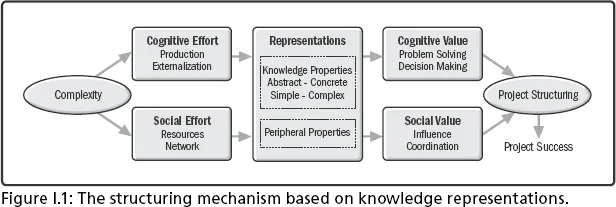
Our main theoretical argument is that the structuring effect of these representations comes from their interweaving in social mechanisms (Hedström & Swedberg, 1998) that begin with the recognition of complexity, influence the knowledge production efforts, and then, through the uses of these representations in innovation activities, condition the success of innovation projects. For example, when producing and representing knowledge, participants spend a non-negligible amount of effort and resources. They absorb and sort through an array of pre-existing knowledge, including background assumptions, tacit perceptions and routine procedures; produce new information; and integrate all this in some new form. They also externalize the results, be it as a hesitant sketch scribbled on a whiteboard or a piece of paper, or as a definitive “inscription” (Latour, 1987) carefully recorded in material or digital form. In turn, after being externalized, these representation “objects” have particular uses, and provide particular benefits for innovation activities, in terms of cognitive inspiration for problem-solving and decision-making, and as means of social influence and coordination (Callon, 1986). For instance, representations which are externalized and can be observed by other participants provide a communication link between project participants (Luhmann, 1995) and may even, as some would argue, replace human counterparts in present day “social” interactions (Knorr-Cetina, 1997). The rapport between representation production efforts and corresponding benefits is the essential manner in which representations interweave themselves in the social mechanisms of innovation projects. We further argue that this rapport depends on certain properties of these representations, in particular on their degree of abstraction and complexity. These ideas are expressed in Figure I.1, by including knowledge representations at the core of the social processes taking place in innovation projects.
Although similar mechanisms are implicit in many conceptualizations of innovation, they remain under-theorized. In this chapter we make three theoretical contributions in order to advance our understanding in this respect. First, we theorize the relation between the complexity faced by the project and the type of knowledge representations that participants tend to produce. Second, we propose two key properties of knowledge representations, namely abstraction and complexity, as most relevant for the structuring processes that occur in innovation projects. Moreover, by positioning in the space created by these two dimensions the universe of representations used in various kinds of innovation projects, we identify five types of representation emphases in innovation projects. Third, we develop a series of mechanisms that explain how representations insert themselves between antecedent and subsequent activities in innovation projects and suggest how these relations influence the structuring of innovation projects. These three contributions enable the development of testable hypotheses connecting project complexity conditions, the effort and emphases in the production of knowledge representations, and different outcomes, including project performance. The chapter begins with a detailed discussion of the structuring mechanism represented in Figure I.1, which clarifies the antecedent factors and the outcomes mediated by knowledge representations.
I.2. Structuring Mechanisms: Antecedents and Consequences of Knowledge Representation
A social mechanism is an intervening sequence of events and influences, which explains how one variable relates to another (Davis & Marquis, 2005; Hedström & Swedberg, 1998). Many such events refer to entities that are at a different level than the variables, such as individual cognitive processes with respect to variables characterizing a social system (Bunge, 2002). When theorizing about social phenomena, mechanisms typically provide “bits of theory” (Stinchcombe, 1991) or “nuts and bolts” (Elster, 1987), to be used in combination with other factors and mechanisms. Understanding mechanisms can explain the logics observed in the structuring of social systems (Kontopoulos, 1993). An example of such logic is the reduction of unit production costs function of cumulative production, which is explained by a series of learning-by-doing mechanisms (Argote, 1999). In turn, this logic explains not only firm-level attributes, such as profits and growth but also industrial structures, which are more concentrated in sectors with stronger learning effects (Arrow, 1962). This paper focuses on knowledge representations as intervening entities in the sequence of events and influences that occur in innovation projects. Although producing knowledge is not the explicit purpose, or even a secondary goal, of all innovation project activities, most of them produce knowledge and represent it at least implicitly. Obtaining satisfactory knowledge about market potential or technical feasibility is a condition for project approval and continuation; representing such knowledge convincingly is a key factor in attracting the needed resources to continue the project (Branscomb & Auerswald, 2001; Cooper, 2001).
The mechanism shown in Figure I.1 relates knowledge representations to the complexity faced by project participants, and to antecedent activities, via the effort needed to produce them, as well as to consequences, via the uses that participants make of these representations and the value they provide. This way, representations impact the social structuring processes that take place in projects, and ultimately influence the project's success. Project participants recognize that in order to achieve success with the innovation under development, they have to address a series of issues that stem from the complexity of the natural and artificial objects with which they deal. One of the key means for addressing these problems is to achieve some level of understanding or prediction about these objects and their behavior, in other words to develop some kind of knowledge about them (Garud, 1997). Hence, participants begin to produce this knowledge and to represent it in ways that can be used by themselves and others.
But the production of knowledge and representations is not an easy task. A good part of the effort it requires is individual and has a cognitive nature. Production is a first aspect of this individual effort, and refers to the energy spent to sense and memorize external stimuli, as well as to interpret these sensations, detect patterns in them, and envision them in a new synthetic form. Many of these processes occur automatically, outside the individual's consciousness. But insights from cognitive psychology and neurosciences suggest that some knowledge forms are produced with more effort, at a slower pace, and less naturally than others (Kandel, 2006). If, in addition to acquiring a personal representation in the brain, one wants to externalize knowledge in some form that is accessible to others, and which can also, ideally, be preserved or reproduced, then more effort is needed. There are different degrees and forms of externalization, ranging from spoken words and skill demonstrations, to texts, formulas, drawings, pictures, sound recordings, videos, and even artifacts. Here again, some kinds of knowledge are easier to externalize than others. For example, research on tacit knowledge suggests that it is difficult to fully externalize human perceptions and sensations about an object, or to codify individual sensorial, judgmental and motor skills in a discursive form (Polanyi, 1966).
Yet knowledge production is not an individual effort, but a distributed social process, involving individuals inside and outside the innovation project organization. One social aspect of this effort is the allocation or authorization of resources, such as work hours, equipment, and materials, in conditions of scarcity and competition for them. Producing some kinds of knowledge drains more resources than others do. Thus, resources spent to produce a representation of a new product increase from analytical (paper) models, to schematic drawings, to technical drawings, to virtual prototypes, to mockups, and, eventually, to fully functional prototypes (Ulrich & Eppinger, 2001). Likewise, the social cost of representing the therapeutic action of a drug increases from analytical (paper) models, to in vitro models, to animal models and to human models. A second social aspect of knowledge production is the dependence on other individuals, groups or organizations for the provision of existing knowledge or collaboration in the production of new one. This cooperation depends to a large extent on the nature of the social network that connects these entities. But creating and maintaining a network has a social cost. For example, an effective contact with external entities that produce advanced knowledge, to follow developments and understand results and implications, forces firms to maintain internal R&D in the respective area (Cohen & Levinthal, 1990). The cost of a maintaining network increases with the number of links and their strength (Granovetter, 1973). The required number of links depends on the number of separate knowledge sources that have to be activated (Burt, 1992). In turn, the required strength of the link, namely the intensity of interactions and the trust between partners, depends on the nature of knowledge to be obtained. For example, conveying or collaborating to produce tacit knowledge requires a lengthy personal presence or media, such as imaging, with more bandwidth, capable of conveying richer information (Daft & Lengel, 1986; Hansen, 1999).
Resulting representations also have a distinct impact on the activities that rely on them. Part of this impact is cognitive. Two of the most common conceptualizations of innovation project are as a problem-solving process (Brown & Eisenhardt, 1995), and as a decision-making process (Krishnan & Ulrich, 2001). The problem-solving conceptualization stresses the ability to generate solutions that achieve the needed functions and performance levels. From a cognitive point of view, it has been associated with creativity and processes akin to a blind search across unknown spaces (Campbell, 1960; Levinthal, 1997). Representations can support this process from the initial imagining of an object or mechanism that can fulfill the given goals (Henderson, 1999; Nonaka, 1994), to the subsequent identifying of ways to overcome their shortcomings, and to the in-depth understanding of their workings in order to increase the mastery over them (Bohn, 1994). In turn, decision-making conceptualizations stress the ability to select the best course of action among those available. Cognitive researchers stress the likelihood of evaluative biases and logical errors, as well as the difficulty of converging towards a unique choice (Tverski & Kahnemann, 1974; Thomke, 1998). They also suggest that representations can support one of two types of rationality: “substantive,” a straightforward analytic process based on high-fidelity information, and “procedural,” which offsets the lower fidelity with a more iterative decision-convergence process (Simon, 1978). Representations can help decisions in the initial “exploration” (March, 1991) of available choices, for example, by being applicable over a broader range of situations and parameters (Ahuja & Katila, 2004; Gavetti & Levinthal, 2000). They can also help in comparing a few remaining options or even in evaluating past decisions, when representations can be applied confidently and directly in a substantive analytic process. As will be explained below, fidelity and breadth often impose contradictory requirements on representations.
Representations also have social effects to the extent that they enable action in systems of actors with competing and converging interests. The first effect is important when projects are seen as systems of competing actors, in which individuals or groups maneuver to gain influence over other actors. Individuals or groups can manipulate representations symbolically in an effort to put up a “front” (façade) that enables them to promote a course of action and obtain the required resources (Callon, 1986; Goffman, 1958). For example, knowledge representations that can be more easily framed as legitimate have more value for this purpose. The social legitimacy attributable to representations increases when it varies from plausibility, which enables their use as arguments to persuade others, to a law- or rule-like status, especially one taken for granted, which opens the way for using them to coerce others into acting in certain ways (Latour & Woolgar, 1979; Suchman, 1995). An example of the latter is a formula and coefficients that are prescribed for certain types of calculations. The second effect of representations is important when projects are seen as collaborative systems, and relates to the fact that representations enable the coordination of distributed actions. Starting with the planned juxtaposition of separate work strands, the degree of coordination grows if ongoing interface coordination between strands is achieved, and increases even more if the strands are integrated in depth, based on reciprocal understanding and mutually-oriented contributions. As a minimum, coordinative value grows if referring to representations fosters mutual understanding, for example by standardizing the procedures used in similar situations (Ferguson, 1977; Mintzberg, 1979; Weick & Roberts, 1993). Further coordination value comes from representations that become the focal points of dissimilar actions, as interlocutors (Knorr Cetina, 1997) or “boundary objects” (Carlile, 2002).
Because knowledge representations mediate between antecedent and subsequent cognitions and actions, they can change the trajectory of the action streams occurring in innovation projects, and, in case the pattern of altering is recurring in several project interactions, they favor the emergence of practices, routines and other structural elements in innovation project teams and organizations. This structuring effect in turn can impact the project success, because it can, for example, channel and trap the interactions between project participants into unproductive paths (Henderson & Clark, 1990; Leifer et al., 2000).
In this chapter, we will address, in turn, each of the elements described in Figure I.1. We begin by discussing, in the next section, Section I.3, the varied nature of the complexity faced by innovation projects and suggest how each type of complexity encourages the production of different types of knowledge representations. In Section I.4, we will discuss the different types of knowledge representations used in innovation projects and the characteristics that, in light of our understanding of complexity, have the highest influence on innovation projects. Moreover, we introduce our typology of knowledge representations, which was used in the subsequent empirical studies. With this development, we are in a position, in Section I.5, to discuss the mechanisms that relate antecedent actions to representations via the cognitive and social effort needed for their production. In Section I.6, we present the mechanisms that relate knowledge representations to subsequent outcomes via their cognitive and social value. In the final section, we discuss the eventual structuring effects of the entire sequence presented in Figure I.1, and its impact on performance.
I.3. Complexity and Innovation1
One fundamental goal of human action has always been increasing the chances of survival in the face of forces acting in the outside world. This goal can be variously approached by imposing one's will upon the world, insulating oneself from it, taking advantage of its forces or living in harmony with them. However, the attempts to achieve these goals have been limited by the fact that objects found in the world resist attempts to master, influence, or even obey them. We designate this source of resistance with the generic term complexity, which we relate to the number of factors and interactions that need to be understood and handled in dealing with these objects. Scientific and technological advances ensure that an increasing number of these factors and interactions a...