- 207 pages
- English
- ePUB (mobile friendly)
- Available on iOS & Android
eBook - ePub
Secrets to Mastering the WBS
About this book
The Second Edition of the popular book on the most practical approach to project Work Breakdown Structures (WBS) and scope management! With hundreds of real-world project examples, this book will change the way you think about and understand the WBS. Learn the secrets to mastering the WBS and obtain smarter project results starting now. A must-read book for successful project managers.
Trusted by 375,005 students
Access to over 1.5 million titles for a fair monthly price.
Study more efficiently using our study tools.
Information
chapter 1
What is the WBS?
We need more than talent to achieve. We need preparation. This applies to everything, from soccer to project management.
Preparation comes with learning and then putting what we learned into practice. To master the work breakdown structure (WBS), you need to first learn about it, and then put its concepts into practice in your real-world projects. Otherwise, what you know will remain at a theoretical and unproven level. Before I explain in the next chapter why I believe you should use the WBS and what its benefits are, I'll now define and explain the WBS and its application in programs and portfolios.
WHAT IS THE WBS?
WBS stands for work breakdown structure. The WBS is a structure used to break down or divide the project work, to better manage the project scope, and to define and communicate the scope.

The WBS is not what we have to do (tasks). It's what we have to deliver (deliverables). It's the answer to what must be delivered to accomplish the project successfully. It presents the end vision, not the means to accomplish it. It's the answer to what's inside the project scope. It gives a full picture of the work to be performed among the stakeholders.
In practical terms, the WBS is what to deliver. It's not the how or when you'll deliver it. It isn't what to do. It isn't the list of activities or the schedule that tells you how to execute the work and what tasks you need to deliver the project's end results. It's a fundamental tool to properly manage the project scope. It requires you to focus on outcomes, outputs, or, said differently, project deliverables.
These aren't academic or formal definitions. They are the way I define the WBS when I am with my project stakeholders. However, they are supported by global standards as presented below.
According to The Practice Standard for Work Breakdown Structures, from PMI, “the WBS subdivides the project work into smaller, more manageable pieces of work, with each descending level of the WBS representing an increasingly detailed definition of the project work.” 1
The definition says that the WBS helps you subdivide the project work into smaller, more manageable pieces. This means that when you start a project and you are assigned to manage something that is new or complex for you, the WBS helps you understand the work and divide it into smaller pieces that you can manage better. It's the divide-and-conquer approach, which is very good the first time you have to manage a new kind of work.
While I was an information technology (IT) project manager, I remember the first time I was assigned to manage a Web project. I had managed IT projects but not in a Web or Internet platform. When I started defining the project scope, I had many questions about the work. At first, it seemed unmanageable. But using the WBS, I broke down the big picture, the large and complex problem, into pieces of work so I could manage it.
According to the PMBOK® Guide, “[the WBS is] a hierarchical decomposition of the work to be executed by the project team to accomplish the project objectives and create the required deliverables…The WBS organizes and defines the total scope of the project” 2 It also says that the WBS “is a structured vision of what has to be delivered.”3 This means that it is a deliverable-oriented structure.
The definition contains several concepts. First, it states that the WBS is a deliverable-oriented structure that defines the project scope. This is a key characteristic of a well-defined WBS as opposed to one that is task or activity oriented. Later, you'll see in Figure 10.1, the differences between tasks and deliverables, but What is a deliverable?
The definition contains several concepts. First, it states that the WBS is a deliverable-oriented structure that defines the project scope. This is a key characteristic of a well-defined WBS as opposed to one that is task or activity oriented. Later, you'll see in Figure 10.1, the differences between tasks and deliverables, but What is a deliverable?
A deliverable could be a book, a roof in a car construction, a wheel in a bicycle project, a training manual in a training project, a box of printed flyers in a congress project, or a finished wing in an airplane project.
The WBS is a way to structure different products, results, and/or services that are unique, verifiable, tangible, and measurable. They are called deliverables.
Understanding and applying the deliverables concept in the WBS is one of the drivers that will make the difference for your WBSs to create an impact. I'll discuss this more in chapters 5 and 6.
The second formal definition mentions that a WBS is a hierarchical decomposition of the project work. Figure 1.1 depicts a basic example of a WBS from a book project with the outcome of a book represented in this hierarchy.
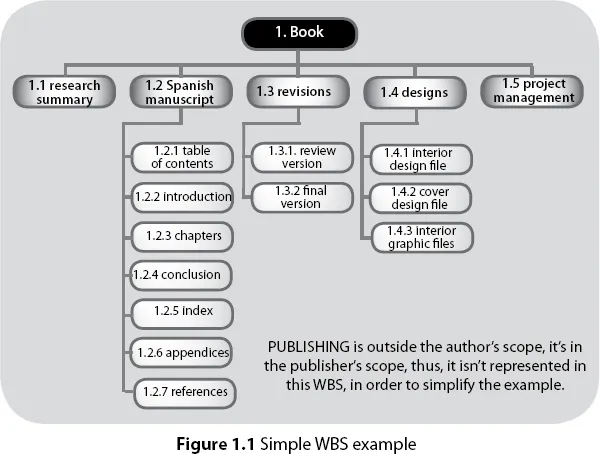
As you can see, the WBS also provides a way to graphically represent the project scope.
I'll explain this WBS, given this is the first WBS that I present and it could be challenging for you to realize if the components in this WBS depict tasks or deliverables. This is an introductory, simplified WBS. This is the WBS of the author's scope, not the publisher's scope. This doesn't mean that the author of the book will perform all this work alone; it means the author will manage it as this is a self-published book. This WBS example will be used in several sections throughout this book, so let's take a look at its major components before proceeding.
1. Book. This represents the project's end goal. This answers the question what will the project deliver? The project will deliver a book. The physical book is the outcome. To better manage the book project, the author decomposed (or divided) the book project into its major components, which are: research summary, Spanish manuscript, revisions, designs, and project management.
1.1 Research Summary. This is not the market research related activities. This is a deliverable, a document with an executive summary of the findings and results from the market research done before determining the need and demand for the book. To achieve the market research summary, you'll need to execute tasks. However, while developing a WBS, you don't think what activities or tasks are needed. Instead, you think about the end results that you need to deliver. Once the project scope is defined, you'll start addressing activities for each deliverable.
1.2 Spanish Manuscript. This is the key project deliverable. It's a series of documents with the different components of the book. This manuscript consists of the table of contents, the book introduction, the chapters, the conclusion, the index, the appendices, and the references. Each of the components of the Spanish manuscript is a document that needs to be delivered.
1.3 Revisions. This WBS branch represents the different revisions of the book. It consists of two deliverables. The first deliverable is a manuscript that is ready for input from reviewers. The second deliverable is the manuscript's final version which incorporates feedback from the reviewers and adjustments from the editors. You may wonder why in this WBS, you don't see all the tasks associated with the review and final edition. The answer is that you aren't concerned at this point, during scope definition, about the activities needed to create the book revisions. You just need to be sure to include in the project scope that you'll have a version of the book that's ready for reviewers, and another version, which is the final one, ready to be printed.
1.4 Designs. This component represents the deliverables associated with the designs for the book, meaning the configuration of page size, headings, paper type, the graphic designs that include the figures, images, comparison charts, tables, and diagrams needed for the book. The outcomes of this component will be a series of files created in design software. These files will be inserted into the book manuscript as visual aids. This component doesn't represent the activities that the graphic designer will have to carry out. You just know at this point that the book will have graphic designs in its scope. You also know that as part of the graphic designer's scope, the graphic designer will have to deliver the cover design file (1.4.2 Cover design file), the files for the book interior designs (1.4.1 Interior design files), and the entire book design (1.4.3 Manuscript design file). The manuscript design file is a final deliverable that will be sent to the printing company.
1.5 Project Management. This section represents the work associated with managing the project and will be addressed in chapter 5.
Once you define the scope with a WBS, you can create the project schedule to determine the activities needed to deliver the components defined in the WBS, but the WBS doesn't include tasks. I discuss this in chapter 10.

The WBS is to define the project scope and it will be the foundation to define the activities later on in the project schedule.
Let's review a few more things that appeared in the WBS definitions I mentioned earlier.
The first definition mentions that the WBS has levels and increasing details. The WBS is broken into different levels and I'll explain that in detail in chapter 5. However, this means that the WBS allows you to see the work from a very high level (the big picture), down to the lowest level of detail, providing a clear understanding of the scope.
The definitions also talk about defining the total project scope. This indicates that the WBS is not intended to make a nice drawing to capture attention or to show that you use it in your project management practices. The WBS is a tool that ensures you're planning for the total project work—no more, no less.
The WBS needs to include the work related to the interfaces, integrations, or dependencies between projects.
The WBS must not include anything that isn't part of the project scope.
An example of interfaces and integrations is two different software projects that exchange information. Project A will create a corporate website. Project B will create a website to track customer orders. Project A will integrate with project B by providing a link in the corporate website so customers can track their orders. There has to be a coordination and integration between the corporate website and the system to track orders.
An example of dependencies is, project A will need a deliverable from project B. Project A's WBS needs to define the work to coordinate and integrate with the deliverables that will receive from project B. Project A is an educational project where new techniques will be taught through the use of computers especially designed for children with disabilities. Project B is responsible to design, build, and deliver the special computers. Project A will integrate with project B and project B will provide the computers as inputs to project A.
The WBS significantly increases the chances of success, good planning, and execution if early in the project you have a WBS with a good definition of the total scope. As the definition says, the WBS helps to accomplish the objectives of the project.
There's a popular saying among project managers. “What isn't in the WBS, is outside of scope.” I use this phrase often. Keep this phrase in mind and use it! It'll remind both your stakeholders and you how important the WBS is. Chapters 3 and 5 will contin...
Table of contents
- Cover Page
- Title Page
- Copyright Page
- Dedication Page
- Acknowledgements
- Contents
- Figures and Tables
- Introduction
- 1 - What is the WBS?
- 2 - Why Should you use the WBS?
- 3 - What are the 4 Typical Confusions about the WBS?
- 4 - What are the Key Questions to Understanding the WBS?
- 5 - What are the Key Questions to Mastering the WBS?
- 6 - How do you Create a Valuable WBS?
- 7- What are the Software Tools for the WBS?
- 8 - How do you Integrate the WBS with Scope Management?
- 9 - How do you Integrate the WBS with the Schedule and Costs?
- 10 - How do you Integrate the WBS with Communications, Risks, Acquisitions, Human Resources, and Quality?
- 11 - How do you use the WBS in Global, Multicultural, and Virtual Projects?
- 12 - Can you use the WBS in Agile Projects?
- Conclusion
- Appendices
- Abbreviations and Acronyms
- References and Resources
- About the Author
Frequently asked questions
Yes, you can cancel anytime from the Subscription tab in your account settings on the Perlego website. Your subscription will stay active until the end of your current billing period. Learn how to cancel your subscription
No, books cannot be downloaded as external files, such as PDFs, for use outside of Perlego. However, you can download books within the Perlego app for offline reading on mobile or tablet. Learn how to download books offline
Perlego offers two plans: Essential and Complete
- Essential is ideal for learners and professionals who enjoy exploring a wide range of subjects. Access the Essential Library with 800,000+ trusted titles and best-sellers across business, personal growth, and the humanities. Includes unlimited reading time and Standard Read Aloud voice.
- Complete: Perfect for advanced learners and researchers needing full, unrestricted access. Unlock 1.5M+ books across hundreds of subjects, including academic and specialized titles. The Complete Plan also includes advanced features like Premium Read Aloud and Research Assistant.
We are an online textbook subscription service, where you can get access to an entire online library for less than the price of a single book per month. With over 1.5 million books across 990+ topics, we’ve got you covered! Learn about our mission
Look out for the read-aloud symbol on your next book to see if you can listen to it. The read-aloud tool reads text aloud for you, highlighting the text as it is being read. You can pause it, speed it up and slow it down. Learn more about Read Aloud
Yes! You can use the Perlego app on both iOS and Android devices to read anytime, anywhere — even offline. Perfect for commutes or when you’re on the go.
Please note we cannot support devices running on iOS 13 and Android 7 or earlier. Learn more about using the app
Please note we cannot support devices running on iOS 13 and Android 7 or earlier. Learn more about using the app
Yes, you can access Secrets to Mastering the WBS by Liliana Buchtik in PDF and/or ePUB format, as well as other popular books in Business & Project Management. We have over 1.5 million books available in our catalogue for you to explore.