eBook - ePub
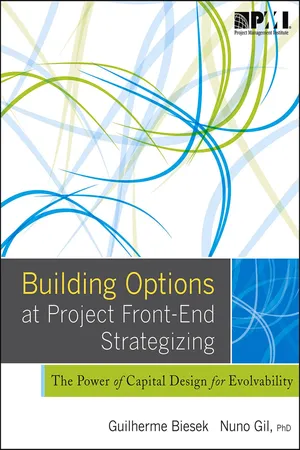
Building Options at Project Front-End Strategizing
The Power of Capital Design for Evolvability
- 200 pages
- English
- ePUB (mobile friendly)
- Available on iOS & Android
eBook - ePub
Building Options at Project Front-End Strategizing
The Power of Capital Design for Evolvability
About this book
How do project teams overcome differences to adopt a design plan that strikes a balance between short-term affordability and long-term adaptability? In the book, Building Options at Project Front-End Strategizing: The Power of Capital Design for Evolvability, Guilherme Biesek and Nuno Gil cite research indicating the need for a formal framework to develop front-end strategies that ensure cost-effective management of the project through future change. Biesek and Gil found limitations in the current practices and theory for management of capital projects, and turned to real options reasoning and design literature. Project teams often resort to real options reasoning, because investment in design flexibility is similar to buying options. If future changes are minimal or favorable the options can be exercised to adapt the design economically. In the event the future is not favorable to the project, a limited investment has been lost.
Information
CHAPTER 1
Introduction
1.1 Problem Articulation
The design and development of new large-scale infrastructure assets is a fundamental project-based undertaking through which private and public organizations can create value. Physical infrastructure such as airports, railway lines, bridges, factories, hospitals, or power stations are main components (or systems) of critical and large socio-technical systems (or systems of systems) in transport, manufacturing, healthcare, and energy (Hughes, 1987). New infrastructure development (capital) projects play an important role in ensuring that existing socio-technical systems can respond to increasing demand for new services, evolution in usage patterns, and changes in technology. Capital development is also fundamental to ensure the broader socio-technical systems can cope with population increase, deterioration and obsolescence of existing infrastructure, migration flows towards cities, and the globalization of supply chains (Gil, 2009a). They are also advocated by Keynesian economists as one “road to recovery” in times of an economic downturn. And according to this school of thought, capital investment in large-scale infrastructure projects contributes to the development of national economies by providing temporary and permanent employment, stimulating further investments, and promoting growth and development for local businesses. By the same token, the failure in delivering large-scale infrastructure projects effectively and efficiently can have enormous detrimental impact, both in the medium and in the long term, on the economy of whole nations, given the physical and economic scale of these projects (Flyvbjerg, Bruzelius, & Rothengatter, 2003).
A major challenge in capital development projects is the need to design and build new assets that can adapt economically to evolving requirements over long periods. Infrastructure assets may take many years to negotiate planning consent, design, and delivery. They are also invariably designed to operate for several decades—the construction of some railway stations in the UK, for instance, dates back to the middle of the 19th century. However, during a prolonged project delivery and service lifetime, the external environment will almost certainly evolve: new technology may emerge, user requirements and operating conditions may change, and new regulations may be introduced. These externalities can trigger developments in functional and operational requirements, which need to be accommodated through design changes. The cost of adaptation will then be a function of the flexibility built in the design of the asset.
Design definitions that are flexible to economically accommodate foreseeable changes in requirements in the future may need additional capital investment upfront to create modular architectures (Baldwin & Clark, 2000) or to safeguard integral architectures (Gil, 2007). From a life cycle perspective, this additional capital investment to make the asset definition more flexible may pay off if the foreseeable uncertainties resolve favorably in the future. However, in situations where capital resources are scarce, requests for additional investment at the design definition phase cannot be taken as a given. By definition, large-scale infrastructure projects require large capital sums. Their design definition also takes many years to be negotiated amongst a large number of stakeholders. Any business case for an additional investment in a flexible design solution (which will only pay off if uncertainties resolve favorably in the future) will have to compete with other business cases for more immediate needs. Making a compelling case to invest in design flexibility at the project front-end can, therefore, be a challenge for public agencies operating under tight budgets and struggling to fund projects all deemed urgent. Scarcity of capital resources can also be a problem faced by private developers of infrastructure as they invariably operate under commercial pressures to achieve profits in relatively short timescales.
Failure to make upfront investments in flexibility can nonetheless compromise the ability of the assets to cope economically with foreseeable change. Early-design decision-making in new capital projects therefore requires balancing decisions to make long-term investments in design flexibility (in order to mitigate the downside risk of costly changes in the future) with investments in rigid designs (at the downside risk that adaptation costs will be high if uncertainties resolve favorably). Put differently, capital investments in flexibility at the front end ensure the project can deliver an effective outcome in that it has the capability to respond with reasonable economic costs to potential changes in the environment over its lifetime.
The problem of balancing upfront investments in design flexibility with decisions not to invest at risk but that expediently reduce costs in the short-term is compounded by the need to collectively negotiate these decisions. The number of project stakeholders involved in negotiations to firm up the design can be vast and includes project sponsors (the ultimate client such as a government or a corporation), the project client (typically an agent appointed by the sponsor and often termed the “client” from a project suppliers’ perspective); future operators, and suppliers; and other relevant stakeholders such as local communities, local authorities, and other public agencies. The claims of these stakeholders over the design definition may exhibit different levels of legitimacy (Gil & Tether, 2011), as well as conflicting priorities, and perceptions of risk (Gil, Miozzo, & Massini, 2012). Despite the autonomy of each stakeholder organization, all organizations may share the ultimate project goal, a phenomenon observed not only in project-based undertakings but also in contemporaneous business ecosystems (Baldwin, 2012). Some stakeholders, however, may advocate design solutions that maximize their individual short-term gains, as opposed to be driven to maximise the shared value that the project can create to the whole. Empirical studies, for example, suggest that often project sponsors might endorse potential underperforming projects as long as they do not carry the risks themselves and are not accountable for performance failures (Flyvbjerg et al., 2003).
In summary, early-design decision-making in large-scale infrastructure projects is invariably the outcome of multilateral negotiations that require factoring in a number of stakeholder perspectives on the costs and risks of design flexibility. Each stakeholder's perspective will be shaped by: 1. different perceptions that foreseeable uncertainties will resolve favorably in the future; 2. the perceived costs of the design adaptation if uncertainties indeed resolve favorably; 3. the appetite to take calculated up- and downside risks; 4. affordability constraints and the stakeholders’ wherewithal to fund investments in flexibility; and 5. A stakeholders’ sense of entitlement to ask another organization to incur the design flexibility costs.
Some stakeholders, particularly cash-strapped ones, may be reluctant to commit capital towards investments in flexibility that may take decades to pay off or that in some circumstances might not even pay off at all (Gil & Tether, 2011; Gil, 2007). Unless another party agrees to fund the costs of built-in flexibility at risk, these stakeholders may be willing to incur the downside risk of costly changes in the future at the expenses of creating an issue of intergenerational equity. A lack of incentives to invest in design flexibility can also arise whenever the organizations commissioned by the project sponsor to deliver and eventually build a project outcome have limited responsibility in regards to its future operational costs and the extent the asset will cope with changes in the environment. For instance, some organizations may avoid including in their bids the costs of design flexibility to remain competitive (Laryea & Hughes, 2011; Garvin & Ford, 2012). The question of who pays, when, why, and how much is therefore central to capital project front-end strategizing. These projects invariably require different parties to coalesce their visions for uncertainty, urgency, and resource constraints into a concept that they can afford collectively and simultaneously ensures the operational longevity of the asset.
1.2 Conceptual Context and Research Gap
Extant research in the management of capital projects and design has inadequately addressed the tensions arising from the need to trade off capital investments in design flexibility with other investments more likely to pay off in the short term. The decision to invest in flexibility to mitigate the risk of costly changes invariably unfolds when capital resources are scarce at front-end strategizing—the period upfront in the project development lifecycle when key stakeholders need to assess alternative design concepts and negotiate a concept to progress into the next project stage (Miller & Lessard, 2007; Morris, 1994). Project teams have been exhorted to implement risk management practices to shield project delivery from the eventual occurrence of foreseeable change in requirements and standards, technological developments, and stakeholders’ opposition to the project (PMI, 2004). These recommendations emphasize the value of change controls and governance structures to ensure the business-case underpinning each change request is assessed before a change can be instructed to project teams. This way, changes that add value can be endorsed to ensure the effectiveness of the project outcome. Changes that fail to deliver value can be rejected. These recommendations, however, fail to acknowledge that the design definition itself will affect the potential impact of late changes to project delivery. Rather, the recommendations tend to fall under instructionist approaches that emphasize the pre-specification of stages to identify, estimate and respond to risk (Pich, Loch, & Meyer, 2002). Kahkonen (2006) argues that there is a fundamental need to improve risk management practices, especially regarding risk concepts and risk perceptions, as well as in terms of providing a more holistic approach that attends to the needs of the different stakeholders. As Lenfle and Loch (2010) put it for the case of product development projects, practices that overemphasize the application of risk management to protect efficiency are bound to overlook opportunities to create value through investments in flexibility and novelty that will make the project outcome more effective. The difficulties in reconciling calls for investing in flexible solutions—which risk that the investments will not pay off—with pressure to reduce capital costs under conditions of uncertainty have motivated calls for building options logic into project front-end strategizing (Gil, 2007; Miller & Lessard, 2007).
Options logic posits that strategy can be used to gain advantage under conditions of uncertainty (Black & Scholes, 1973; Merton, 1973). The aim of option-pricing theory is to provide analytical methods to guide the investor into making strategic investments under uncertainty that will enable investors benefiting from upside scenarios while limiting losses on the downside—that is, options logic introduces an asymmetry in the probability of distributions of payoffs (Merton, 1998). Real options theory draws from analytical studies on financial options, and explores their applicability, not to pure financial investment decisions but to decisions to invest in physical assets (Amram & Kulatilaka, 1999; Smit & Trigeorgis, 2004; Trigeorgis, 1996). Studies in real options have predominantly applied analytical methods to price capital project investments with built-in options (e.g., Lee, 2007; Smit & Trigeorgis, 2004; Zhao, Sundararajan, & Tseng, 2004).
Despite the advances of real options science since the mid–1980s, when options pricing models began to be used to value investments in real assets, and despite the current availability of various analytical methods to help assess capital investments, the uptake of the real options approach in capital investment practice has been slow. In 2002, for example, Ryan and Ryan (2002) indicated that 88.6% of Fortune 1,000 companies had rarely or never used real options. Five years later, the figures in regards to adoption had hardly changed, when Block (2007) reported that only 14.3% of Fortune 1,000 companies were using real options. The slow rate of adoption of real options theory in practice is in marked contrast with Copeland and Antikarov (2001)'s predictions, which suggested that the real options valuations would take off and dominate strategic investment decisions within a few years. Admittedly, there are examples of successful adoption of real options. However, they tend to be observed in industries where large investments with uncertain returns need to be made (Triantis & Borison, 2000). Anecdotal evidence also suggests that real options methods have been mainly applied to sophisticated analysis of capital investment decisions to acquire technology, energy systems, and utility companies (Block, 2007).
In contrast, evidence is limited on applications of real options pricing to inform more mundane design decisions in capital project front-end strategizing (Kalligeros, 2006). In these settings, the payoff of having an option can be limited relative to major strategic investments, which restricts the amount of time and effort that project teams can afford to dedicate to assess the option. Also, the cost of buying the option itself might require an upfront investment that is not negligible relatively to both the potential payoff it can provide (if uncertainties resolve favorably) or to the downside risks it mitigates. Therefore, the use of sophisticated analytical real options tools for mundane design decisions might offer a poor fit. An application of real options pricing methods can also be challenging if not overwhelming at front-end strategizing due to a conflation of reasons, notably difficulties in making reliable assumptions, in ensuring that the analytical models stay tractable, and in developing simple but accurate analytical representations of real-world problems (Bowman & Moskowitz, 2001; Kalligeros, 2006; Lander & Pinches, 1998).
Due to reluctance among practitioners in using real options pricing models, an alternative research stream has gained traction in the areas of assessing technology and research and development (R&D) investments: real options reasoning (MacMillan, Putten, McGrath, & Thompson, 2006; McGrath, 1997; McGrath & MacMillan, 2000). Real options reasoning proposes to use options logic in order to develop qualitative methods that can support decision-making under uncertainty. The aim is to preserve the logic of the real options theory to assess the value of flexible solutions while sidestepping the difficulties of quantitative modelling. McGrath and MacMillan (2000), for instance, develop a method that translates the parameters derived from options pricing into a series of qualitative statements, and asks managers to specify their level of agreement with each statement before prioritizing technological options and allocating resources. Other authors (MacMillan et al., 2006) have further real options reasoning applications into methods that aim to support longitudinal decision-making processes under uncertainty, providing mechanisms through which decision-makers can ensure the periodic validation of assumptions and update of rationales. Similarly, Angelou and Economides (2008) have developed a decision-making support framework that combines real options analysis and analytical hierarchy process to help teams prioritize investment in a portfolio of information and communication technology projects.
Some anecdotal evidence points to rudimentary applications of real options reasoning in capital infrastructure projects. In the U.K., for example, a health trust has spelled out in the tender documents that the consortiums bidding for developing and operating new hospitals through a private finance initiative (PFI) should “future-proof”1 the design, factoring in the costs for building pre-specified flexibilities up front and for exercising them in the future if need be (Lee, 2007). Likewise, informal and largely intuitive options logic has informed the write-up of the design brief that safeguarded the economical adaptation of the largely integral design of Heathrow airport's Terminal 5 to future changes in operational requirements (Gil, 2007). Extraordinarily, however, empirical studies suggest that capital projects teams rarely—if at all—receive training on options logic (Ford, Lander, & Voyer, 2002; Gil, 2007; Kalligeros, 2006). Admittedly, the cost of developing a sophisticated real options pricing model to assess relatively mundane design decisions at front-end strategizing may be disproportionate to the potential benefits that the model could generate. But an excessive reliance on informality and intuition to inform decision making in design flexibility makes decision outcomes a lot more vulnerable to short-term thinking, reduces accountability, and makes the whole collective decision-making process also more vulnerable to the self-interest of the more vocal or politically stronger parties.
The existing gap in the provision of suitable methods to support mundane design decision-making at the project front-end strategizing creates a research opportunity. On the one hand, sophisticated real options analytical models fit poorly with the nature of mundane early design decisions. On the other hand, intuitive assessments of future-proof decisions do not offer an alternative because they are vulnerable to misjudgment and lack of accountability. This gap provides the motivation for this doctoral research. The ultimate purpose is to develop a formal framework to support design decision-making at project front-end strategizing drawing from real options reasoning. The underlying hypothesis is that adding an options-like formalization to early-design decision-making can improve the quality of the front-end strategizing process and of outputs in capital projects. This framework is called capital design for evolvability. The aim of design for evolvability is to create affordable design assets that can adapt economically to change over their life time.
The idea of designing a system to evolve is not entirely new. Drawing from evolutionary studies in biological systems that seek to observe and explain how organisms naturally changed across generations, Gagliardi, Rajkumar, R., & Sha (1996) discuss the mechanisms that dictate how man-made systems can technologically evolve over time. They develop and test prototypes of evolvable systems in the area of real-time computing before broad-scale or commercial development of these computer artefacts. More recently, Beesemyer et al. (2011) contrast biological and technological studies to yield insights on prescriptive design principles for designing for evolvability. Both studies theoretically postulate principles or mechanisms that man-made commercial product designs such as the design of a car platform need to attend to in order to evolve over time as technology and user needs change. In commercial product development, the purpose of designing for evolvability is, therefore, to ensure that the design can be reused from one project-based new product development process into the next. The design principles include: system modularization to allow easy replacement of small parts without comprising the whole system, selection of crucial modules that should be immune to changes to reduce costs of adaptation of the system, and definition of common interfaces to allow compatibility among different modules (Beesemyer et al., 2011; Gagliardi et al., 1996).
The purpose of capital design for evolvability is, however, different. In this world, project sponsors typically have fewer opportunities to exploit an existing design over time, which limits design longevity. Of course there are exceptions. Engineering consultants often design base cases of bypass viaducts that can be reused from one highway project into the next. Another exception is the case of Intel's Copy Exactly policy, which instructs the capital project teams to reuse proven designs of new high-tech semiconductor fabrication facilities (fabs) from one project into the next. This approach aims to compress the time to develop and ramp new fabs (Terwiesch & Xu, 2004). It can work fine if the manufacturing tools the new fab will host have not suffer major changes relative to the tools in the old fab. But empirical studies have suggested that the reuse of fab designs can backfire if the tool technology has evolved in fundamental ways; or if there are major differences in local requirements from one project to the next (Gil & Beckman, 2007). Another obstacle to reusing capital designs is the intermittent nature with which sponsors of capital projects initiate new projects. For example, the time lag between the conclusion of Heathrow Airport's Terminal 4 and the start of Terminal 4 was around 20 years (Gil & Tether, 2011). A similar intermittency has been observed in new hospital development in the U.K. Although new hospitals are constantly being developed, new hospital projects are an intermittent activity for health care trusts setting local requirements (Barlow & Köberle-Gaiser, 2008).
Hence, capital design for evolvability aims to develop designs that enable the actual asset to cope economically with the occurrence of foreseeable changes in requirements during project delivery and later over the asset's operating lifetime. The conceptualization and validation of novel framework to design for evolvability at capital project front-end strategizing is the core purpose of this research. The approach is not new in the world of technology and R&D investment (MacMillan et al., 2006; McGrath & MacMillan, 2000). To the best of our knowledge, however, ...
Table of contents
- Cover Page
- Title Page
- Copyright Page
- Table of Contents
- Manuscript Summary
- Acknowledgements
- List of Tables
- List of Figures
- Chapter 1—Introduction
- Chapter 2—Literature Review
- Chapter 3—Research Method
- Chapter 4—Exploratory Study: Uncovering Design for Evolvability Practices in Single-Funder Capital Project Environments
- Chapter 5—Design for Evolvability in Multi-Funder Environments: Insights from an Embedded Case Study at Network Rail
- Chapter 6—A Proof-Of-Principle of a Method to Design for Evolvability
- Chapter 7—A Two-Group Controlled Experiment: Lab-Based Simulation of the Salford Crescent Redevelopment Project
- Chapter 8—Final Considerations: Research Implications and Outlook
- References
- Appendices
Trusted by 375,005 students
Access to over 1.5 million titles for a fair monthly price.
Study more efficiently using our study tools.
Frequently asked questions
Yes, you can cancel anytime from the Subscription tab in your account settings on the Perlego website. Your subscription will stay active until the end of your current billing period. Learn how to cancel your subscription
No, books cannot be downloaded as external files, such as PDFs, for use outside of Perlego. However, you can download books within the Perlego app for offline reading on mobile or tablet. Learn how to download books offline
Perlego offers two plans: Essential and Complete
- Essential is ideal for learners and professionals who enjoy exploring a wide range of subjects. Access the Essential Library with 800,000+ trusted titles and best-sellers across business, personal growth, and the humanities. Includes unlimited reading time and Standard Read Aloud voice.
- Complete: Perfect for advanced learners and researchers needing full, unrestricted access. Unlock 1.5M+ books across hundreds of subjects, including academic and specialized titles. The Complete Plan also includes advanced features like Premium Read Aloud and Research Assistant.
We are an online textbook subscription service, where you can get access to an entire online library for less than the price of a single book per month. With over 1.5 million books across 990+ topics, we’ve got you covered! Learn about our mission
Look out for the read-aloud symbol on your next book to see if you can listen to it. The read-aloud tool reads text aloud for you, highlighting the text as it is being read. You can pause it, speed it up and slow it down. Learn more about Read Aloud
Yes! You can use the Perlego app on both iOS and Android devices to read anytime, anywhere — even offline. Perfect for commutes or when you’re on the go.
Please note we cannot support devices running on iOS 13 and Android 7 or earlier. Learn more about using the app
Please note we cannot support devices running on iOS 13 and Android 7 or earlier. Learn more about using the app
Yes, you can access Building Options at Project Front-End Strategizing by Guilherme Biesek,Nuno Gil in PDF and/or ePUB format, as well as other popular books in Business & Project Management. We have over 1.5 million books available in our catalogue for you to explore.