eBook - ePub
Implementing Organizational Project Management
A Practice Guide
- 90 pages
- English
- ePUB (mobile friendly)
- Available on iOS & Android
eBook - ePub
About this book
Project Management Institute has introduced Implementing Organizational Project Management: A Practice Guide to assist organizations in developing and defining effective project management methodologies. In a 2012 PMI market research project, more than half of the respondents identified a lack of published guidance on development of customized methodologies. This practice guide outlines practical knowledge and steps to define and develop a methodology in alignment with the foundational standards and framework that were first provided in PMI's A Guide to the Project Management Body of Knowledge (PMBOK® Guide).
Information
1
INTRODUCTION TO THE PRACTICE GUIDE
This practice guide is a resource for those who want to devise an integrated approach to managing an organization's portfolios, programs, and projects. This approach is based upon the management concept of organizational project management (OPM), which is described later in this section.
OPM advances organizational capability by developing and linking portfolio, program, and project management principles and practices with organizational enablers (e.g., structural, cultural, technological, and human resource practices) to support strategic goals. An organization measures its capabilities, then plans and implements improvements toward the systematic achievement of best practices.
This practice guide provides information and suggestions for creating useful OPM practices and methods, focusing on implementing and tailoring essential processes for organizational use, particularly in organizations that do not have a unified approach to managing the projects.
1.1 Overview of OPM Basics
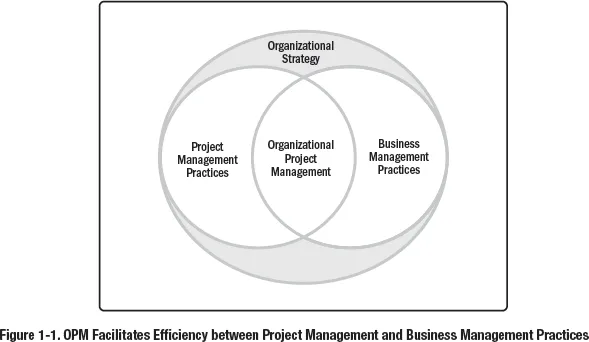
“OPM is a strategy execution framework utilizing portfolio, program, and project management as well as organizational-enabling practices to consistently and predictably deliver organizational strategy leading to better performance, better results, and a sustainable competitive advantage” [1].1 In short, OPM is the holistic management of portfolios, programs, and projects integrated with the organization's business management framework to deliver needed results. This strategy framework brings about balance and coordination, as Figure 1-1 reflects.
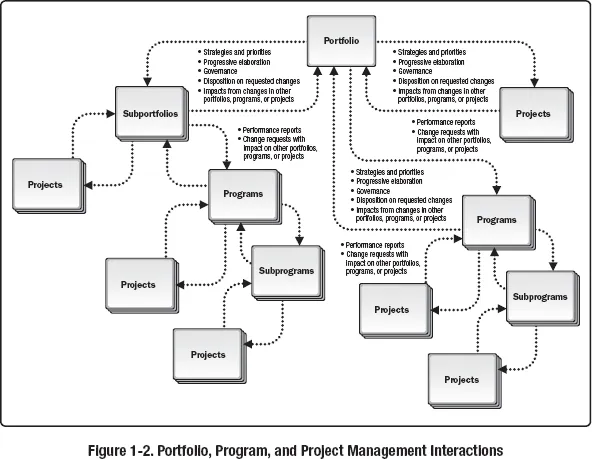
It is important to understand the relationship among portfolios, programs, and projects in order to understand OPM. A portfolio refers to a collection of projects, programs, subportfolios, and operations managed as a group to achieve strategic objectives. Programs are grouped within a portfolio and are comprised of subprograms, projects, or other work that are managed in a coordinated fashion in support of the portfolio. Individual projects that are either within or outside of a program are still considered part of a portfolio. Although the projects or programs within a portfolio may not necessarily be interdependent or directly related, they are linked to the organization's strategic plan by means of the organization's portfolio.
As Figure 1-2 illustrates, organizational strategies and priorities are linked and have relationships between portfolios and programs, and between programs and individual projects. Organizational planning impacts projects by means of project prioritization based on risk, funding, and other considerations relevant to the organization's strategic plan. Organizational planning can direct the management of resources, and provide support for the component projects based on risk categories, specific lines of business, or general types of projects, such as infrastructure and process improvement. It is in this context that OPM exists.
Utilization of OPM has grown in the past 20 years, emerging from establishing good practices for a project, to establishing good practices for a program, and then to establishing portfolio, program, or project management offices (PMOs) for handling various aspects of support, coordination, and improvement. Some organizations adopt centers of excellence in order to coordinate OPM policy and competency development across multiple business units with PMOs. Many organizations have formalized the management of programs and projects, and in a growing number of cases, portfolio management. While some organizations have formalized practices, other organizations tend to manage projects in an ad hoc manner. In any case, projects are the common starting point when thinking about how to apply OPM, but the concept expands across the organization with the principle of engaging all necessary parts in the fulfillment of strategic goals dependent upon the program and project.
More organizations are beginning to realize that project management means more than having good project managers. An integrated leadership, management, and support environment is just as critical for the management of portfolios, programs, and projects as are other more traditional operational and support functions. Effective project management reduces unnecessary costs of doing business and leads to realized strategic objectives.
Project management, in terms of simply focusing on scope, time, and budget, is not sufficient for managing the scale and rate of change that is the norm in most organizations. Organizations that drive portfolio, program, and project management strategically with top management visibility use active executive sponsors on projects; consistent and standardized project management practices; methods to detect and cope with change effectively; and competent qualified project managers. Those organizations tend to be successful in delivering projects on time and on budget [2]. An OPM approach ensures that the portfolio aligns with the set of programs and/or projects that yield the appropriate value decisions and benefits for the organization. Portfolio reviews occur regularly and are adjusted as market conditions or strategy change. An analysis of the business impacts on the portfolio guides the portfolio review. The portfolio is adjusted, as needed, to deliver results or when other work makes it necessary to revise. These results directly link to business value realization. Feedback from value performance analysis influences the strategy of the organization.
1.2 Intended Audience for this Practice Guide
This practice guide is useful for organizations that would like to benefit from realizing their strategy through successfully implemented programs and projects that achieve intended benefits. This practice guide is intended for anyone who is involved in the oversight, design, management, appraisal, or performance and improvement of process, portfolio, program, and project results. This may include:
- Executives with responsibility for business divisions or business units;
- Executives or managers involved in the leadership, management, or oversight of programs and/or projects;
- Executives or managers responsible for developing OPM-related policies;
- Executives or managers involved in the support of organizational project management, such as those responsible for PMOs or centers of excellence;
- Senior program and project managers in leadership and liaison positions for OPM-related organizational capabilities; or
- Process and organizational change professionals (including quality assurance and capability management maturity improvement) who are involved with the design and implementation of portfolio, program, and project performance improvement initiatives.
1.3 Benefits of OPM to the Organization
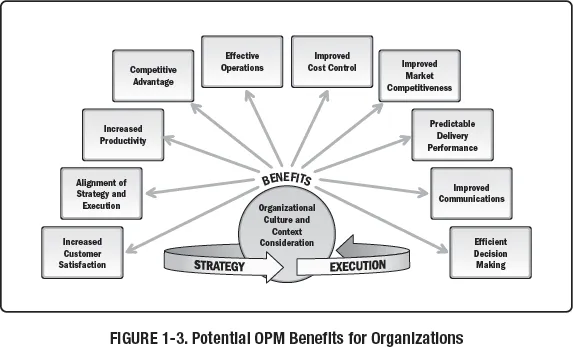
OPM promotes the alignment of the organization's strategic objectives with related projects and their management, which many organizations consider to be a big benefit. Other attractive benefits are possible, as reflected in Figure 1-3.
Benefits tend to build incrementally. Organizational leaders should consider and carefully plan the selection, sequence, and realization of those expected benefits by investing in OPM practices.
Whether in the foundational or improvement stage of an OPM implementation, a benefits realization plan describing the steps, timing, and measures is needed to achieve organizational benefits effectively.
1.4 OPM Essentials for Implementation
Figure 1-4 represents the key elements that an organization needs to consider when implementing OPM. These implementation elements reflect current good practice in organizations that have undertaken the implementation of an OPM approach and realized success.
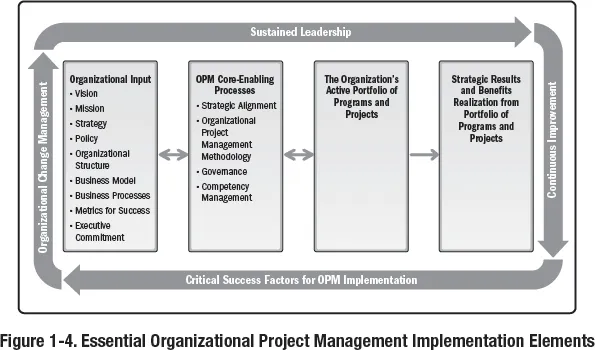
The OPM core-enabling processes facilitate an organization's ability to realize its strategic objectives through portfolio, program, and project management. The strategic alignment process ensures programs and projects support strategic intent. Organizational project management methodology defines how people and the processes work to select and deliver portfolios, programs, and projects. Governance provides a framework in which organizations can make decisions that satisfy business needs and expectations. Competency management ensures that the right skills and knowledge are available to support OPM.
As elaborated in Section 2, critical success factors are sustained leadership, continuous improvement, and change management. Sustained leadership is required to establish and retain the efficacy of OPM in the organization. Continuous improvement draws upon audits, benchmarking, lessons learned, and other factors to identify what needs to be improved; for example, people and processes, oversight, goals and objectives, and organizational perspectives. Change management capabilities and the implementation of supporting change management strategies, plans, and activities are necessary to embed significant change in the organization.
Having a good OPM strategy execution framework assumes the involvement of all parts of an organization that directly or indirectly affect, or have a stake in, the selection, delivery, and outcomes of projects. OPM is a broader concept than portfolios, programs, or projects; however, these three domains are the focus of OPM to ensure that the organization optimizes its work to deliver strategy in order to realize the organization's vision or future state.
1.5 OPM Fit with the Organization's Business Model
OPM processes, methods, and practices, adapted to the organization, will fit with the business model, the structural organization, and various functions that constitute the organization. The term “fit” in the context of this practice guide refers to the organization's challenge to implement what is actually needed to create the value sought from its portfolios, programs, and projects.
Organizations may have some elements of OPM existing already, such as executive portfolio steering committees, sponsorship practices through the delegation of authority, project procurement support processes, project manager training courses, or documented project management practices and procedures. By formally instituting OPM, all of the necessary elements integrate appropriately for an effective system of project selection, execution, and delivery across the organization.
From a structural standpoint, the leadership of an OPM initiative or program should be in a central leadership unit close to or within the executive team, so it can coordinate OPM processes and methods with existing organizational processes. These leadership activities often are found in units such as enterprise project management offices (or centers of excellence), program management offices, and the varieties of project management offices found in today's project-oriented organizations.
1.6 Tailoring the Approach to Implementing OPM Core Processes in an Organization
Organizations need to address all of the key implementation elements by documenting how the organization will approach, plan for, and bring about desired related processes, practices, and tools to achieve fit. The organization will advance its OPM capabilities to the degree that makes sense for its business purpose and in the appropriate sequence. OPM advocates continuous improvement, therefore, the organization should have the ability to accommodate strategic shifts, new business models, changing markets, or new technologies.
The OPM policy and methodology that an organization uses are critical to establishing a system of practices, techniques, procedures, and rules used in portfolio, program, and project work to meet requirements and deliver benefits. OPM methodology speaks to all levels and facets of performing portfolios, programs, and projects. The other core-enabling processes facilitate the implementation of an OPM methodology. A well-planned OPM methodology makes appropriate and useful connections and modifications within the business model of the organization. The result is a tailored OPM methodology that evolves to support the organization over time.
Tailoring is the appropriate selection and alignment of organizational practices and methods for the value and types of projects the organization performs, which results in “fit.” There are many dimensions of fit that each organization should consider carefully. Examples of important dimensions may include the following:
- A comprehensive, executive-led approach may be appropriate where there is a high degree of dependence on programs and projects for value delivery, rather than loosely managed functions or departments.
- A formal, defined and agreed-upon decision process may work better than an informal, nontransparent one when there is cross-functional involvement in major portfolio decisions.
- For organizations with multiple types of projects, it may be more efficient to align them to the appropriate levels of management rigor and governance by type, or group them in a program format, rather than using traditional grants of authority for functional or department managers.
Section 5 (Developing a Tailored Organizational Project Management Methodology) provides guidance that organizations can use to develop their own methodologies.
1.7 How to Use This Practice Guide
Figure 1-5 reflects the high-level input and outcomes of using this practice guide. In general, this practice guide is intended to assist organizational leaders with developing or improving an OPM framework that integrates the business model, the organizational culture, and this practice guide's elements and standa...
Table of contents
- Cover Page
- Title Page
- Copyright Page
- Notice
- Table of Contents
- List of Table and Figures
- Preface
- 1 - Introduction to the Practice Guide
- 2 - How to Prepare for an OPM Implementation
- 3 - How to Implement and Improve OPM
- 4 - How to Implement the Core-Enabling Processes
- 5 - How to Develop a Tailored Organizational Project Management Methodology
- Appendix X1 - Contributors and Reviewers of Implementing Organizational Project Management: A Practice Guide
- Appendix X2 - An Overview of OPM3® Organizational Enablers and Mapping to this Practice Guide
- Appendix X3 - Recommended Survey Questions Regarding Implementation of OPM Initiatives
- References
- Glossary
Trusted by 375,005 students
Access to over 1.5 million titles for a fair monthly price.
Study more efficiently using our study tools.
Frequently asked questions
Yes, you can cancel anytime from the Subscription tab in your account settings on the Perlego website. Your subscription will stay active until the end of your current billing period. Learn how to cancel your subscription
No, books cannot be downloaded as external files, such as PDFs, for use outside of Perlego. However, you can download books within the Perlego app for offline reading on mobile or tablet. Learn how to download books offline
Perlego offers two plans: Essential and Complete
- Essential is ideal for learners and professionals who enjoy exploring a wide range of subjects. Access the Essential Library with 800,000+ trusted titles and best-sellers across business, personal growth, and the humanities. Includes unlimited reading time and Standard Read Aloud voice.
- Complete: Perfect for advanced learners and researchers needing full, unrestricted access. Unlock 1.5M+ books across hundreds of subjects, including academic and specialized titles. The Complete Plan also includes advanced features like Premium Read Aloud and Research Assistant.
We are an online textbook subscription service, where you can get access to an entire online library for less than the price of a single book per month. With over 1.5 million books across 990+ topics, we’ve got you covered! Learn about our mission
Look out for the read-aloud symbol on your next book to see if you can listen to it. The read-aloud tool reads text aloud for you, highlighting the text as it is being read. You can pause it, speed it up and slow it down. Learn more about Read Aloud
Yes! You can use the Perlego app on both iOS and Android devices to read anytime, anywhere — even offline. Perfect for commutes or when you’re on the go.
Please note we cannot support devices running on iOS 13 and Android 7 or earlier. Learn more about using the app
Please note we cannot support devices running on iOS 13 and Android 7 or earlier. Learn more about using the app
Yes, you can access Implementing Organizational Project Management by Project Management Institute in PDF and/or ePUB format, as well as other popular books in Business & Project Management. We have over 1.5 million books available in our catalogue for you to explore.