- 120 pages
- English
- ePUB (mobile friendly)
- Available on iOS & Android
eBook - ePub
Managing Amidst Rapid Change
About this book
The ability to deliver value in dynamic environments has become an essential skill for today's project managers given the ever increasing rates of change driven by deregulation, the information age, and globalization. Managing Amidst Rapid Change responds to this new reality with specific management techniques that refine the theory of how best to handle projects significantly challenged by dynamism.
Information
CHAPTER | 1 |
INTRODUCTION
The pace of change is accelerating from incremental to revolutionary, driven by globalization, information technology, and deregulation (Graetz, Rimmer, Lawrence, & Smith, 2006). Billion dollar industries are simultaneously being created and destroyed in rapid succession (Diamandis, 2013). Without management approaches to keep pace, we will find it impossible to comprehend and adapt to an unfolding reality that is uncertain, ever changing, unpredictable (Boyd, 1986). As the world moves to an ever faster clock cycle, so must our management techniques change to keep pace (Hodgson & White, 2003). All industries are challenged by this problem and some industries are challenged by it almost continuously. While many small projects face this challenge, so do billion dollar projects critical for national security. This increasing phenomena is raising the stakes and risks for projects, organizations, and nations.
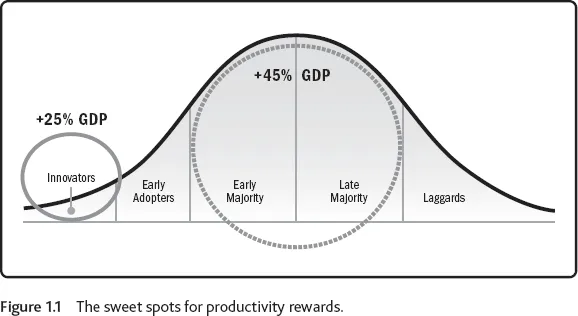
Studies indicate a relationship between technology adoption rates and national wealth (Comin, Easterly, & Gong, 2010; Comin & Hobijn, 2012). Delays in technology adoption may account for a 25% reduction in GDP. A study by Diego Comin and Martí Mestieri (2010) indicates even greater benefits from pervasive adoption of technology versus early adoption. Delays in pervasive adoption indicated a further 45% reduction in GDP. Taken together, the studies suggest that up to 70% of differences in cross-country per capita income can be explained by delays in technology adoption (Nobel, 2012). More flexible project management methods are therefore required “to regain the central place it should never have lost in the management of strategic initiatives, innovation, and change” (Lenfle & Loch, 2010). Project management techniques should support both innovation and more rapid and broad technology adoption as indicated in Figure 1.1 based on Roger's (2003) technology adoption life cycle.
This book combines management research with advice from experienced practitioners to document a range of practical approaches that can be used to manage projects in dynamic environments. Traditional project management undermines performance because it is designed for relatively static environments and focuses on the management-as-planning view of control (Koskela & Howell, 2002). Many managers now work in dynamic environments like that described Table 1.1.
In dynamic environments, unavoidable change occurs at a higher rate than it is practical to re-plan. A manager in a dynamic environment can be likened to a kayaker in white water rapids. Forcing a pre-conceived solution is like fighting the current. In dynamic environments, the manager should harness the current of change and intelligently steer toward the optimal result. This practitioner-focused book introduces the project management techniques that help steer work in this fashion. The techniques are particularly informed by three studies specifically dealing with the problem of dynamism. The studies involved interviews and focus groups with project managers to find out how they dealt with rapid change. Participants were project managers from ten different industries including: defense, community development, construction, technology, pharmaceutical, film production, scientific start-ups, venture capital, space, and research. The subjects covered included planning styles, culture, communication, and leadership in dynamic environments.
Table 1.1 Contrasting static and dynamic environments.
| Static Environments | Dynamic Environments | |
| Pace of change | Slow | Rapid |
| Predictability | Achievable | Difficult to achieve |
| Business cases | Stay valid for long periods | Rapidly outdate |
| Change impact | Mostly causes problems | Creates opportunities and problems |
Chapter Summaries
Chapter 1 – Introduction
This chapter introduces the book and provides a synopsis. The method used in the primary research is described along with the participants.
Chapter 2 – Dynamic Environments
The challenges of dynamism are introduced in this chapter, explaining how it is an increasing problem for project management across all industries, with high stakes for national wealth and security. Dynamism is defined with examples given. The key challenge of dynamism—difficulty planning and controlling—is discussed. Traditional responses to dynamism are reviewed.
Chapter 3 – Dynamic Planning
This chapter describes the dynamic planning process, led by a vision, and guided by desired outcomes. The iterative approach with stage gates, feedback, and evolving detail is discussed, along with emergent planning, simplification, recursive design cycles, prototypes, pilots, staged releases, and the cost of lost opportunity.
Chapter 4 – Dynamic Control
Traditional project management for static environments is focused mostly on a “management-as-planning” view of control, but in dynamic environments the plan outdates at a pace that makes it unhelpful for predictions and impractical to maintain. A range of alternate control approaches are discussed in this chapter, including input control, behavior control, output control, diagnostic control, interactive control, belief systems, and boundary controls.
Chapter 5 – Dynamic Culture and Communication
The culture of the project organization can affect how successfully it deals with rapid change. Cultures more suited to dynamic environments are described here. Case studies are presented, including Google, NASA, IBM, and The Spaceship Company. A range of communication approaches customized for dynamic environments are discussed encompassing regularity and formality.
Chapter 6 – Dynamic Leadership and Decision Making
Leadership and decision-making approaches suitable for mitigating dynamism are discussed in this chapter, including the need for flexibility, and situational awareness, collaboration, and pragmatism. Leadership qualities from the literature and from successful practitioners are outlined. A number of decision-making strategies are explained including: delegated decisions, decision making focused on speed and reasonableness, high levels of situational awareness, and pre-planned responses.
Chapter 7 – Dynamic Experimentation
Experimentation, discovery, and selection processes can play an important role for organizations working in environments with high levels of unknowns. This chapter discusses practical application of these techniques giving examples of their use in high-stakes environments.
Chapter 8 – Dynamic Practitioner Guide - Principles and Techniques
This chapter summarizes all the findings from the previous chapters into a quick reference guide of principles and te...
Table of contents
- Cover Page
- Title Page
- Copyright Page
- Table of Contents
- List of Figures
- List of Tables
- List of Case Studies
- List of Abbreviations
- Foreword
- Chapter 1: Introduction
- Chapter 2: Dynamic Environments
- Chapter 3: Planning for Dynamic Environments
- Chapter 4: Dynamic Control
- Chapter 5: Dynamic Culture and Communication
- Chapter 6: Dynamic Leadership and Decision Making
- Chapter 7: Dynamic Experimentation
- Chapter 8: Dynamic Practitioner Guide - Principles and Techniques
- Afterword
- References
Trusted by 375,005 students
Access to over 1.5 million titles for a fair monthly price.
Study more efficiently using our study tools.
Frequently asked questions
Yes, you can cancel anytime from the Subscription tab in your account settings on the Perlego website. Your subscription will stay active until the end of your current billing period. Learn how to cancel your subscription
No, books cannot be downloaded as external files, such as PDFs, for use outside of Perlego. However, you can download books within the Perlego app for offline reading on mobile or tablet. Learn how to download books offline
Perlego offers two plans: Essential and Complete
- Essential is ideal for learners and professionals who enjoy exploring a wide range of subjects. Access the Essential Library with 800,000+ trusted titles and best-sellers across business, personal growth, and the humanities. Includes unlimited reading time and Standard Read Aloud voice.
- Complete: Perfect for advanced learners and researchers needing full, unrestricted access. Unlock 1.5M+ books across hundreds of subjects, including academic and specialized titles. The Complete Plan also includes advanced features like Premium Read Aloud and Research Assistant.
We are an online textbook subscription service, where you can get access to an entire online library for less than the price of a single book per month. With over 1.5 million books across 990+ topics, we’ve got you covered! Learn about our mission
Look out for the read-aloud symbol on your next book to see if you can listen to it. The read-aloud tool reads text aloud for you, highlighting the text as it is being read. You can pause it, speed it up and slow it down. Learn more about Read Aloud
Yes! You can use the Perlego app on both iOS and Android devices to read anytime, anywhere — even offline. Perfect for commutes or when you’re on the go.
Please note we cannot support devices running on iOS 13 and Android 7 or earlier. Learn more about using the app
Please note we cannot support devices running on iOS 13 and Android 7 or earlier. Learn more about using the app
Yes, you can access Managing Amidst Rapid Change by Simon Collyer in PDF and/or ePUB format, as well as other popular books in Business & Project Management. We have over 1.5 million books available in our catalogue for you to explore.