- 104 pages
- English
- ePUB (mobile friendly)
- Available on iOS & Android
eBook - ePub
Middle Managers in Program and Project Portfolio Management
About this book
The increasing "projectization" of organizations has led to a greater reliance on program and project portfolio management, and middle managers are playing a central role in the management of multiple simultaneous projects. Experienced project managers understand the value of defining project roles and responsibilities, but what are middle managers' roles and responsibilities in program and project portfolio management? What are the best practices of successful companies today?
Information
CHAPTER 1
Introduction and Background
Throughout the latter half of the 20th century, there has been a shift in the management paradigm, from the functional, bureaucratic approach, almost universally adopted in the first half of the century, to project and process-based approaches. This shift has been in response to the changing nature of the work from mass production, with essentially stable customer requirements and slowly changing technology, to the current situation where every product supplied may be against a bespoke [custom-made] design, and technology changes continuously and rapidly (Turner & Keegan, 1999, p. 296).
More and more organizations organize their work by projects in order to achieve their business objectives most economically. This leads to a steady increase in the number of simultaneous projects in organizations. Through that, a need arises to manage these simultaneous projects from an organizational perspective. Recent years have shown that two distinct management approaches are primarily used for that purpose; these are program and project portfolio management. However, neither management approach is uniform, and they need to be adapted to each organization’s particular situation, based on its environment and business type. Along with differences in program and portfolio management approaches, the practices, roles, and responsibilities of middle managers in these organizations vary.
Middle managers have been the target in downsizing activities of organizations for many decades. While they diminish in number, they continue to hold a pivotal position at the crossroads of strategic thinking and operational implementation in organizations. Being perceived as problems solvers, they have to balance a multitude of requirements stemming from their supervisors (e.g., CEOs or management boards), their peers in neighboring organizations (e.g., department managers and vice presidents), and their subordinates (e.g., the first line managers of teams, groups, or projects). Middle managers are often seen as the “real” managers, due to their capability of converting strategy in day-to-day operations, and their role as advocates of whatever group they are working with. They do this by building coalitions between groups and networks of resources. Throughout recent years, middle managers have been asked to cope with the increasing use of projects as a way to do business in organizations. The present study shows the results from an empirical investigation in middle managers’ approaches to cope with this increasing “projectification” of organizations. It shows the practices, roles, and responsibilities of middle managers in program and portfolio management in project-based organizations.
Through its vision and interaction with members, as well as their different management groups, the PMI Project Management Research Program identified the need for a better understanding of the current practices, roles, and responsibilities of middle managers in program and portfolio management. The authors of this report were commissioned to execute a study, and this report provides the results. The report is intended to provide a complementary view to the existing literature on program and portfolio management, by focusing on middle managers in project-based organizations. This chapter describes the study context, underlying theoretical foundation, and research questions.
Program and Portfolio Management as a Subset of Corporate Governance
Program and portfolio management are approaches that structure and execute groups of projects in organizations. As such, they are part of an organization’s overall governance structure. Corporate governance is defined by the Organisation for Economic Co-operation and Development (OECD) as:
…one key element in improving economic efficiency and growth as well as enhancing investor confidence. Corporate governance involves a set of relationships between a company’s management, its board, its shareholders and other stakeholders. Corporate governance also provides the structure through which the objectives of the company are set, and the means of attaining those objectives and monitoring performance are determined. (2004, p. 11)
Being solely related to project activities, program and portfolio management become a subset of corporate governance known as the governance of project management, which, according to the Association for Project Management (APM):
…concerns those areas of corporate governance that are specifically related to project activities. Effective governance of project management ensures that an organization’s project portfolio is aligned to the organization’s objectives, is delivered efficiently and is sustainable. Governance of project management also supports the means by which the board, and other major project stakeholders, are provided with timely, relevant and reliable information. (2004, p. 4)
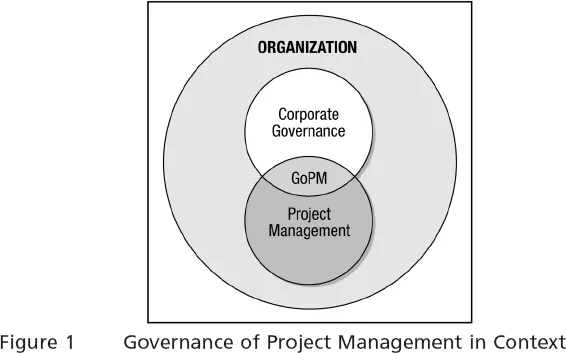
Figure 1, adopted from APM (2004), shows the relationship of organization, corporate governance, governance of project management, and project management. Here, governance of project management addresses the areas of overlap between corporate governance and project management. That includes program and portfolio management.
The main components of this governance structure for project management are (APM, 2004):
- Portfolio direction effectiveness and efficiency. This ensures that all projects are identified within one portfolio, or one of the portfolios. A portfolio should be evaluated and directed with the organization’s aims and constraints in mind.
- Project sponsorship effectiveness and efficiency. This ensures the effective link between senior executives and project management in the organization. Sponsors have decision-making, directing and representational accountabilities. Project managers report to sponsors, who own the project’s business case.
- Project management effectiveness and efficiency. This ensures that the teams responsible for projects are capable of achieving the project objectives. That includes skills and knowledge of the project team, project managers, and leaders, but also the resources available to them, their tools and processes, together with the ability to deploy them.
- Disclosure and reporting. This ensures the exchange of timely, relevant, and reliable information to support decision-making processes in an organization.
Program and portfolio management address the question of governance from two parallel perspectives. The first perspective takes into account the interconnectedness of the various project objectives in order to maximize accomplishment of combined project outcomes. This has led to the development of programs, which PMI defines as:
a group of related projects, managed in a coordinated way to obtain benefits and control not available from managing them individually (Project Management Institute [PMI] 2004, p. 368).
The second perspective is concerned with the interrelationships among the management requirements of these projects, in order to achieve the organization’s overall business results. This has led to the development of portfolio management techniques, which PMI (2004, p. 367) defines as:
The centralized management of one or more portfolios, which includes identifying, prioritizing, authorizing, managing, and controlling projects, programs, and other related work, to achieve specific strategic business objectives.
A portfolio is defined as:
A collection of projects or programs and other work that are grouped together to facilitate effective management of that work to meet strategic business objectives. The projects or programs of the portfolio may not necessarily be interdependent or directly related (PMI 2004, p. 367).
Past research on portfolio management has focused mostly on the management of R&D portfolios. However, as stated in the beginning, other industries increasingly use project-based organizational structures as well, in order to accomplish corporate objectives. This led to the application of portfolio management techniques in new areas such as customer-delivery projects, or for shorter and less capital-intensive projects. This trend contributes to a rapid increase in the number of projects in an organization. Portfolios of these projects are managed differently. Here, factors such as a customer’s program size and supplier priorities are taken into account. Approaches to portfolio management, therefore, are contingent on, for example, size and complexity of projects and programs.
Even though program and portfolio management are frequently described in the literature, there is no clear evidence of the way both governance structures are implemented in different organizations, and what the corresponding practices, roles, and responsibilities of the organizations’ managers are.
Governance and Transaction Cost Economics
Program and portfolio management are governance structures adopted to minimize the overall costs in converting “input” to “output” through projects. When viewing projects as transactions, these costs are known as transaction costs, which are the sum of all costs for governing projects. Williamson (1985, p. 18) explains that:
…transaction costs are economized by assigning transactions (which differ in their attributes) to governance structures (the adaptive capacities and associated costs which differ) in a discriminating way.
From a similar perspective, in his Transaction Cost Economics (TCE), Williamson (1985) explains the balance required in organizational governance mechanisms to:
- Provide a product’s “fit for purpose” by lowering maladaptation costs (i.e., such as done through program management), and
- Lower the costs for the organization by economizing existing scales and resources (i.e., such as in portfolio management).
This identifies program and portfolio management as the linkage between corporate governance and TCE. However, Williamson’s TCE claims that different governance structures are required in different types of transactions. The extent that organizations apply program and portfolio management as governance practices is, therefore, seen to differ by project type.
Moreover, the choice of governance structure is described by Williamson (1975) as contingent on the complexity of the environment of an organization. Based on Simon’s 1957 bounded rationality argument that humans exercise intended, but only limited, rational behavior in decision-making, Williamson (1975, p. 22-23) states that:
It is bounded rationality in relation to the condition of the environment that occasions the economic problem. […] When, [however,] transactions are conducted under conditions of uncertainty/complexity, in which event it is very costly, perhaps impossible, to describe the complete decision tree, the bounded rationality constraint is binding and an assessment of alternative organizational modes, in efficiency respects, becomes necessary.
Thus, governance structures are also seen to differ by the degree of uncertainty/complexity of an organization.
Research Questions
The above leads to the first research question:
Q1: How do project type and organizational complexity determine the use of project portfolio and program management in organizations?
Along with differences in projects and the associated application of program and portfolio management in organizations, the roles and responsibilities of the respective managers differ.
That leads to the second research question:
Q2: What are middle managers’ practices, roles, and responsibilities in program and portfolio management in successful organizations?
The scope and differences of these roles and responsibilities, in relation to organizations’ governance structures, are investigated through this study.
Objectives
The study’s objective is to allow middle managers in organizations to improve their practices, roles, and responsibilities in program and portfolio management for the benefit of their organizations, the economy, and, ultimately, society in general. For academics, the objective is to contribute to a refined theory on program and portfolio management structures and their contingency on environmental factors such as organizational complexity and project types.
Another objective is to encourage further research in this field, possibly building on the results of this study, in order to develop an overarching theory of program and portfolio management. That will contribute to the standardization of program and portfolio management practices, the improvement of project management methodologies, and creation of organizational project management maturity models
Scope and Underlying Assumptions of this Study
The scope of this study is limited to answering the research questions stated in the introductory chapter. The unit of analysis in this study is the middle manager with his/her roles and responsi...
Table of contents
- Cover Page
- Title Page
- Copyright Page
- Table of Contents
- List of Tables
- List of Figures
- Acknowledgements
- Executive Summary
- Chapter 1: Introduction and Background
- Chapter 2: Literature Review
- Chapter 3: Methodology and Analysis
- Chapter 4: Managerial Implications: What Middle Managers in Successful Organizations Do
- Chapter 5: Theoretical Implications and Conclusions
- References
- Appendix A: Interview Instrument
- Appendix B: Questionnaire Instrument
- Appendix C: Summary Tables
- Appendix D: Author Contact Information
Trusted by 375,005 students
Access to over 1.5 million titles for a fair monthly price.
Study more efficiently using our study tools.
Frequently asked questions
Yes, you can cancel anytime from the Subscription tab in your account settings on the Perlego website. Your subscription will stay active until the end of your current billing period. Learn how to cancel your subscription
No, books cannot be downloaded as external files, such as PDFs, for use outside of Perlego. However, you can download books within the Perlego app for offline reading on mobile or tablet. Learn how to download books offline
Perlego offers two plans: Essential and Complete
- Essential is ideal for learners and professionals who enjoy exploring a wide range of subjects. Access the Essential Library with 800,000+ trusted titles and best-sellers across business, personal growth, and the humanities. Includes unlimited reading time and Standard Read Aloud voice.
- Complete: Perfect for advanced learners and researchers needing full, unrestricted access. Unlock 1.5M+ books across hundreds of subjects, including academic and specialized titles. The Complete Plan also includes advanced features like Premium Read Aloud and Research Assistant.
We are an online textbook subscription service, where you can get access to an entire online library for less than the price of a single book per month. With over 1.5 million books across 990+ topics, we’ve got you covered! Learn about our mission
Look out for the read-aloud symbol on your next book to see if you can listen to it. The read-aloud tool reads text aloud for you, highlighting the text as it is being read. You can pause it, speed it up and slow it down. Learn more about Read Aloud
Yes! You can use the Perlego app on both iOS and Android devices to read anytime, anywhere — even offline. Perfect for commutes or when you’re on the go.
Please note we cannot support devices running on iOS 13 and Android 7 or earlier. Learn more about using the app
Please note we cannot support devices running on iOS 13 and Android 7 or earlier. Learn more about using the app
Yes, you can access Middle Managers in Program and Project Portfolio Management by Tomas Blomquist,Ralf Müller in PDF and/or ePUB format, as well as other popular books in Business & Management. We have over 1.5 million books available in our catalogue for you to explore.