
eBook - ePub
Understanding Decision-Making within Distributed Project Teams
- 109 pages
- English
- ePUB (mobile friendly)
- Available on iOS & Android
eBook - ePub
Understanding Decision-Making within Distributed Project Teams
About this book
Researchers from across the world and in a variety of disciplines have become interested in describing and understanding the phenomenon of distributed projects and teams. This study aims to measure the extent to which some dimensions of the decision-making process are valued and used by distributed teams, as well as the influence of certain contextual variables. The proliferation of geographically dispersed teams is, of course, related to the explosive development of information and communication technologies (ICT), and particularly technologies related to the Internet. Now that these technologies are performing better and becoming more accessible, companies no longer seem to be challenged by the barrier of distance.
Information
CHAPTER 1
Overview of the Recent Literature on Distributed Teams
In this collaborative project with a team of Australian engineers, I think we learned to better organize ourselves as a team. In the end, our approach was much more structured and effective than if we had functioned as a local team only.
Chief Engineer for an innovative technology project
Researchers from across the world and in a variety of disciplines have become interested in describing and understanding the phenomenon of distributed projects and teams. In this chapter, we review some of the most relevant studies that have appeared recently in the management literature. We limit the discussion to a small but representative portion of the current literature rather than presenting an exhaustive review. Particular attention is paid to empirical studies that provide a measure of the current situation.
1.1 Introduction
Distributed project teams are increasingly widespread. Whether they execute routine or extremely complex projects, teams are rarely located at a single site. In some respects, it could be said that this modus operandi has always existed, as customers, experts, and project managers have seldom been located at the same site. This is typical in the building industry, where construction sites are generally remote from the main project office. However, it could also be said that the economic and technological changes of recent decades have amplified this phenomenon. For example, most large enterprises have adopted offshoring or delocalization strategies, even for high value-added activities, which are deployed within a vast network of subsidiaries or independent partner companies. Major multinational companies with offices in North America, Europe, and Asia often distribute their work among specialized units, depending on the value they can add to a specific project. Moreover, the development of information and communication technologies (ICT), particularly Internet-based applications, has facilitated and enhanced the practice of distributed economic activities. It has become commonplace to exchange all kinds of information to support project execution, from technical data (e.g., CAD files) to management reports. Clearly, distributed team projects are an expression of modern realities such as globalization, interorganizational collaboration, and technological innovation, to name a few. The importance of distributed teams is also evident in the scientific literature. For over a decade now, many studies have examined teams characterized variously as “distributed,” “dispersed,” “decentralized,” “delocalized,” and “virtual.” With certain subtle differences, all of these concepts refer to work teams in which some members are located at some kind of distance (e.g., geographic, temporal) and must therefore interact intensively, but not exclusively, through information and communication technologies.
A few years ago, four research groups published literature reviews on virtual teams at about the same time (Hertel, Geister, & Konradt [2005]; Pinsonneault & Caya [2005]; Powell, Piccoli, & Ives [2004]). Their work provides a very comprehensive account of the important studies that aimed to identify the different dimensions that structure and impact project and project team functioning when distance between team members is involved. In the years that followed these literature reviews, many other studies were published, most of which focused more on theoretical and methodological aspects compared with studies published in the late 1990s and early 2000s. This chapter provides an overview of some typical studies that provide a deeper understanding of distributed team issues.
1.2 The Distributed Project Team: An Expression of Increasingly Close Collaboration Between Enterprises
Recently, a special issue of the journal R&D Management opened with this impressive statement: “Cisco is regarded as one of the world's most innovative companies. It does very little research and acquires most of its technology from external sources.” Guest editor Oliver Gassmann (2006) recalls how R&D visions have changed over the years. Particularly important is the fact that very few enterprises can go it alone today, not even the biggest ones. Trends such as globalization, the intensified technology content of products, new discipline fields developed through the overlapping of traditional domains (e.g., bioinformatics), and new ways of doing business have all contributed to various degrees of transforming how enterprises innovate. Although this transformation is manifest in several ways, according to Gassmann (2006), the distributed nature of R&D and innovation activities is certainly one of the most striking. For several years now, the plentiful literature on company networks and other forms of interorganizational relations has also underscored the importance of privileged links between firms. This goes beyond the conventional dichotomous economic philosophy of make or buy organizations (Milgrom & Roberts, 1992). Other authors such as Powell et al. (1996) believe that today's innovation projects require business alliances more than ever: “The locus of innovation is no longer the individual or the firm but, increasingly, the network in which a firm is embedded.” A literature review by Pittaway, Robertson, Munir, Denyer, and Neely (2004), covering 25 years of publications on company networks, is instructive in several respects. In their systematic reading of over 325 articles on the subject, the authors found several studies that confirmed the link between networking and the propensity of firms to innovate. This was especially true for biotechnology, the American informatics industry, and the aerospace industry. These formal and informal networks influence a number of underlying innovation issues, notably risk sharing, ready access to new markets and technologies, time-to-market, access to leading-edge knowledge and skills, and so on. Empirical studies also underscore the importance of informal interpersonal networks for disseminating innovations (Pittaway et al., 2004). Other empirical studies, for instance Hagedoorn's (2002; 1993), document the growth of partnerships in pioneering industries such as biotechnology, pharmaceuticals, and information technologies. Hagedoorn (1998) observed that shorter project and product life cycles, pooling complementary skills, and facilitated learning of “implied knowledge” are compelling motivations for firms to embrace technological collaboration.
All of these collaborative initiatives have a direct impact on the people who are assigned to carry out team projects. Although the availability of information and communication technology (ICT) may provide team members with a sense of proximity, managing projects with distributed members will most likely require new practices and new behaviors so that people, teams, and organizations can succeed in their collaborative endeavors. In this regard, empirical studies, such as those cited in this chapter, can provide some new directions.
1.3 Managing a Distributed Project Team: Some Key Dimensions
To date, the research findings on distributed teams are varied, to say the least, as pointed out by Martins, Gilson, and Maynard (2004), and allow only a confused grasp of the situation. Although a variety of definitions of the distributed team have been put forward, they all have some dimensions in common. As defined above, the distributed team is a group of workers who must interact at a distance due to physical and/or temporal constraints. In such circumstances, interactions are effected through ICT, which are currently available in a diversity of forms. This proliferation of descriptions has led some authors to define the notions of distribution and distance in extremely broad terms. Evaristo, Scudder, Desouza, and Sato (2004), for example, propose up to 12 dimensions of team distributedness. In their literature review, Knoben and Oerlemans (2006) identify at least seven types of proximity. Other authors such as Lojeski, Reilly, and Dominick (2007) discuss geographic, temporal, relational, cultural, and social distances, and so on. However, this effort to broaden the definition of distribution (or inversely, proximity) by describing multiple dimensions does not help simplify an already complex issue. For this reason, most authors stick to the physical and temporal boundaries, and sometimes include organizational ones (Lipnack & Stamps, 1997).
Martins et al.'s (2004) framework proposes an interesting way to consider and analyze the various dimensions of distributed teams. These authors regrouped the dimensions under a framework derived from Hackman and Morris (1975). The main themes investigated prior to 2004 are included and classified in terms of intrinsic team features (input), interactions and work processes (processes), and benefits (outcomes) generated by this functioning type. In Figure 1-1, some of Martins et al.'s (2004) dimensions are presented along with certain complementary factors.
In this model, teams have different characteristics that act as preconditions for the way processes unfold. These inputs include dimensions such as geographical and temporal distances between members, as well as their personalities, knowledge, skills, and abilities (KSA), national cultures, experience, disciplinary background, group size, technology infrastructure, and so on. Work/team processes define the ways in which teams carry out their tasks and how they ultimately achieve project objectives (Weingart, 1997). Martins et al. (2004) group these into three categories. The first comprises the planning processes, which include tasks such as analyzing the mandate, establishing objectives, and developing work strategies. The second process category includes the action processes (similar to Powell et al., (2004) description of task processes), which include tasks such as communication, collaboration, coordination, knowledge exchange and transfer, alignment of technology with task (task-technology-structure fit), and work monitoring. Finally, interpersonal processes (or socio-emotional processes in Powell et al.'s [2004] review) refer to the human aspects of team interactions, including conflict management, trust, and cohesion.
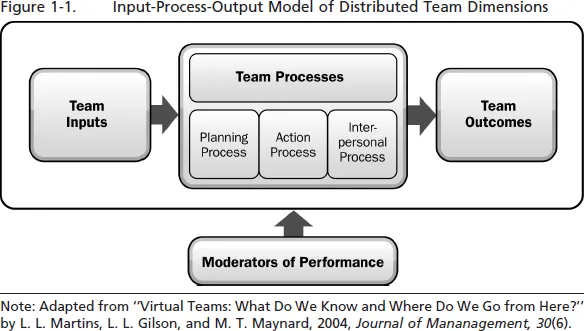
Team processes lead to certain levels of performance (team outcomes), as reflected in Martins et al.'s (2004) model. This performance dimension may be defined in several ways, including satisfaction of team members, quality of decisions, and/or achievement of traditional project indicators of time, budget, and quality. The Input-Process-Outcome (IPO) model also includes contextual factors that may influence the relationships between each of the dimensions. The moderators comprise dimensions such as task complexity and project duration. In the following sections, we discuss some of the latest research contributions based on the IPO model.
1.3.1 Team Inputs
To illustrate the role of team input dimensions in distributed teams, three recent studies examining dimensions such as geographical distance, leadership, and competencies are discussed.
Lee-Kelley and Sankey (2008) analyzed an information technology implementation involving professionals from the United Kingdom, Greece, Germany, and Singapore. They particularly examined the difficulties that the team experienced with time zones differences. They observed that a lack of sensitivity to this factor significantly affected communications and relations between team members. Ultimately, failing to take into account this important aspect of team functioning created all kinds of frustrations and tensions for the people involved in the project. Lee-Kelley and Sankey (2008) strongly emphasize the need to adopt a communication strategy at project outset and to maintain a high sensitivity to the dispersion factor during the project. This would involve a wide range of actions, from promoting higher awareness of local differences to providing teams with the appropriate communication tools.
Beyond the geographical distance separating team members, Lojeski et al. (2007) address the dimensions proposed by Evaristo and Scudder (2000) and consider the multi-dimensionality of distance (virtual or perceived distance) in their evaluation of the impact of multitasking on innovation. For these authors, physical distance reflects only part of the distance perceived by team members. This perceived distance comprises a multitude of factors, namely geographical distance, time zones, degree of task interdependence, possibility of interacting via face-to-face discussions, and other forms of diversity (e.g., technical, organizational, cultural, and social). Their results show that this perceived distance (or “virtual distance”) moderates the relationship between multitasking and innovation. In cases of high virtual distance, multitasking appears to have a negative impact on innovation, mainly because tacit knowledge transfer is reduced, along with absorptive capacity.
Zhang, Tremainé, Milewski, O'Sullivan, and Fjermestad (2006) adopt a multidimensional view of distance, similar to that of Lojeski et al. (2007) in their study on delegation within distributed teams. Zhang and colleagues investigated the moderating effects of team maturity and team distance on the relationship between leader delegation and team outcomes. More recently, the same authors (Zhang et al., 2008) explored the impact of delegation strategies on team outcomes mediated by team motivation, team flexibility, and team satisfaction with the team leader. They found that delegation tends to increase team satisfaction with its leader as well as team motivation and flexibility. However, they could not validate the mediating effect of these dimensions on team performance. These results are very relevant for understanding how to deal with issues such as competencies and delegation in a distributed team context.
Overall, studies such as those discussed here (Lee-Kelley & Sankey, 2008; Lojeski et al., 2007; Zhang et al., 2006, 2008) clearly show the importance of appropriately managing the distributedness factor, as it can pose a serious limitation to team performance. Similarly, these studies demonstrate how important it is for researchers to broaden the definition of distance to include further dimensions such as cultural diversity, competencies/skills diversity, and so on. This appears to be a “must” in order to better understand today's team dynamics.
In line with Zhang et al.'s (2008) work on delegation, Glückler and Schrott (2007) conducted a meaningful study on leadership in distributed (virtual) teams. These researchers raise the question of leadership in distributed teams when there is no predesignated leader. Thus, it is interesting to examine how (or if) leaders emerge and facilitate team functioning, including task assignment within the team. In their study, Glückler and Schrott (2007) observed the emergence of team leaders. They noted that the member who naturally assumed the “brokerage” role for information exchange tended to gradually gain recognition and legitimacy in the eyes of the other members. As the project unfolded, the same person tended to leverage this legitimacy and show increasing commitment to coordinating the work. In so doing, the emergent leader gradually confirmed his status, maintained control over information, and consolidated his power over the team. Glückler and Schrott (2007) made an important contribution to the distributed team literature by going against the traditional view whereby leadership is related more to personality traits. According to Glückler and Schrott (2007), leadership requires a will to develop and promote communication patterns within the team.
Carte, Chidambaram, and Becker (2006) also contributed to our understanding of leadership in distributed teams by exploring the emergence of leadership within self-managed teams. By examining various leadership dimensions (based on Denison, Hooijberg, and Quinn's [1995] framework), they found that high-performing teams were most likely to exhibit specific behaviors, and that the earlier these patterns emerged in the team life cycle, the greater the impact on the team's success.
From this very small sample of studies that considered the leadership issue in distributed teams (Zhang et al. [2008], Glückler & Schrott [2007], Carte et al. [2006]), it is clear that the research community needs to continue developing more focused approaches to understand the numerous and complex aspects of leadership in distributed teams. These studies and previous ones conclude that leadership plays a critical role in explaining distributed team success. However, the ways in which leadership emerges and is enacted can vary greatly, depending on the nature of the project and the composition of the team, and further research is needed in this direction.
Besides distance and leadership issues, researchers have examined other input dimensions of distributed teams such as the team competencies and skills required to succeed in distributed contexts. Blomqvist, Koivuniemi, Hara, and Äijö (2004) proposed a networked R&D management approach in which collaboration is viewed as a specific meta-capability for innovation. They referred to the findings of Miller and Morris (1999), who contended that, “No single department—including R&D itself—has the full knowledge needed to carry out the responsibility for innovation, which is now obviously an activity involving the entire organization and extending to include suppliers, customers, and other external partners as well.” Calvi, Blanco, and Koike (2005) reached a similar conclusion, suggesting close customer-supplier technological integration as a necessary condition for the new product design phase.
Input dimensions, including competencies, skills, and knowledge, remain crucial aspects for researchers in distributed team/project management to investigate. Dominant theories, such as the resource-based view of the firm, have argued that organizations currently face ongoing competitive challenges, and part of their resilience should be strongly anchored in a relevant set of competencies. Because distributed projects are at the heart of many organizations, they must pay a great deal of attention to team composition, as indicated in the above-mentioned studies.
1.3.2 Team Processes
Among the team processes included in Martins et al.'s (2004) model and illustrated in Figure 1-1, interpersonal and socio-emotional processes (e.g., trust building, quality of interaction, conflict management) and action processes (communication, collaboration, coordination) have received the most attention recently. For instance, Thomas and Bostrom (2008) investigated the impact of certain leadership styles (Theory X vs. Theory Y actions) on the trust-building process in a distributed team. Interestingly, and contrary to the current view by which trust building would more likely develop when Theory Y actions are used, Theory X actions play a role in these projects as well. Thomas and Bostrom (2008) also suggest that in the case of distributed teams, a specific attention to technology adaptation would provide an important lever for building trust and cooperation in teams.
Using a similar perspective on trust-building processes, Crowston, Howison, Masango, and Eseryel (2007) examined the importance of face-to-face interactions for those involved in distributed teamwork. The authors stress the importance of holding regular face-to-face meetings to build and maintain adequate social links, which in turn are essential for trust. However, according to Crowston et al. (2007), regardless of the processes in place, remote socialization remains difficult to achieve. Another interesting finding is that team members do not necessarily prefer to meet at the beginning of the project (i.e., at the kickoff meeting), but later, once the project is effectively underway, and when each team member's involvement is confirmed and concrete. Team members also tend to organize their work so as to reduce the interdependencies among them (e.g., the modular concept) when the nature of the project allows.
In the area of interpersonal processes, Hinds and Mortensen (2005) uncovered some direct and valuable associations concerning conflict management in distributed teams. Their survey of over 310 respondents reveals...
Table of contents
- Cover Page
- Title Page
- Copyright Page
- Acknowledgments
- Table of Contents
- List of Tables
- List of Figures
- Introduction
- Chapter 1: Overview of the Recent Literature on Distributed Teams
- Chapter 2: Overview of the Literature on Decision Making
- Chapter 3: Conceptual Framework
- Chapter 4: How Distributed Teams Adapt to Decision Making in Practice: Empirical Evidence
- Concluding Remarks
- List of References
- Appendix A: Identification of Contextual Factors Principal Component Analyses
- Appendix B: Paper Published in PMI's Virtual Library January 2008
- Appendix C: Article Published in Project Management Journal August 2008
Trusted by 375,005 students
Access to over 1.5 million titles for a fair monthly price.
Study more efficiently using our study tools.
Frequently asked questions
Yes, you can cancel anytime from the Subscription tab in your account settings on the Perlego website. Your subscription will stay active until the end of your current billing period. Learn how to cancel your subscription
No, books cannot be downloaded as external files, such as PDFs, for use outside of Perlego. However, you can download books within the Perlego app for offline reading on mobile or tablet. Learn how to download books offline
Perlego offers two plans: Essential and Complete
- Essential is ideal for learners and professionals who enjoy exploring a wide range of subjects. Access the Essential Library with 800,000+ trusted titles and best-sellers across business, personal growth, and the humanities. Includes unlimited reading time and Standard Read Aloud voice.
- Complete: Perfect for advanced learners and researchers needing full, unrestricted access. Unlock 1.5M+ books across hundreds of subjects, including academic and specialized titles. The Complete Plan also includes advanced features like Premium Read Aloud and Research Assistant.
We are an online textbook subscription service, where you can get access to an entire online library for less than the price of a single book per month. With over 1.5 million books across 990+ topics, we’ve got you covered! Learn about our mission
Look out for the read-aloud symbol on your next book to see if you can listen to it. The read-aloud tool reads text aloud for you, highlighting the text as it is being read. You can pause it, speed it up and slow it down. Learn more about Read Aloud
Yes! You can use the Perlego app on both iOS and Android devices to read anytime, anywhere — even offline. Perfect for commutes or when you’re on the go.
Please note we cannot support devices running on iOS 13 and Android 7 or earlier. Learn more about using the app
Please note we cannot support devices running on iOS 13 and Android 7 or earlier. Learn more about using the app
Yes, you can access Understanding Decision-Making within Distributed Project Teams by Mario Bourgault, PhD,Nathalie Drouin, MBA, PhD in PDF and/or ePUB format, as well as other popular books in Business & Gestione. We have over 1.5 million books available in our catalogue for you to explore.