eBook - ePub
Governance Frameworks for Public Project Development and Estimation
- 274 pages
- English
- ePUB (mobile friendly)
- Available on iOS & Android
eBook - ePub
Governance Frameworks for Public Project Development and Estimation
About this book
Governance Frameworks for Public Project Development and Estimation includes a thorough investigation into theoretical perspectives and theories, mainly from economy and social sciences. Thirty-two aspects of theory are assessed, and it is indicated whether each framework design seems to have put weak or strong emphasis on each of these aspects. The purpose of the report is to seek better understanding of how the governance framework and the projects interact and how the framework influences the project. Governance frameworks help to improve the initial and fundamental design of projects as well as avoid some of the common problems related to the implementation of projects. Implementation of governance frameworks represents a potential for considerable savings and added value by making cost estimation and time planning more effective.
Information
1Introduction
1.1 BACKGROUND
The increased use of projects as a way to organize and perform various tasks, not only in the business or industry environment but in all sectors of society, is challenged by a current focus on problems associated with the major projects. Despite the emphasis placed on improved methods to analyze and manage projects, the track record of projects reveals fundamental problems such as inadequate needs assessments, initial poor designs, tactical budgeting by authorities, inadequate cost estimation and risk assessment, etc. Classic examples documenting some of these problems are the Sydney Opera House in Australia (Hall, 1981), the Boston Artery/Tunnel in the United States (Altshuler & Luberoff, 2003), the Channel Tunnel in the United Kingdom and France (Morris & Hough, 1987; Anguera, 2006), and the Åsgard oil and gas field development in Norway (Norwegian Official Reports [NOU], 1999). These are spectacular cases well known in the project and program management world. The challenges for large investment projects are not unique for these megaprojects. Smaller projects fail but they do not get the same attention, since they are not as visible as the examples mentioned. This literature has identified two major problem areas:
- The issue of choosing and evaluating the right concept or alternative.
- The problems in executing large, complex projects.
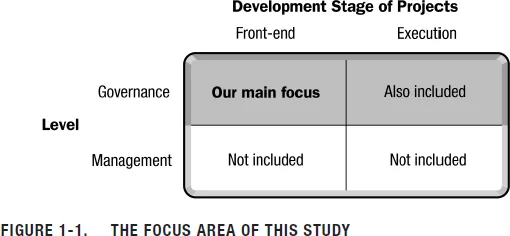
Both of these areas are important. In this study, we focus on the decision-making problem in the front-end of projects. Project management literature has traditionally focused on the operational perspective of management. This study examines the strategic perspective of the project owner. The focus area is illustrated in Figure 1-1. We will look at the framework under which the project concept is chosen and evaluated, continuing through the governance of the planning and execution. Governance frameworks that help to improve the initial and fundamental design of projects and to avoid some of the common problems related to the implementation of projects represent a potential for considerable savings and added value.
This study focuses on public investment projects. We look at less known projects that are complex and challenging, but of a more modest dimension and certainly less exposed than the previously mentioned projects. Our cases have not been chosen as examples showing signs of problems in projects, but because they have been identified to have potential for highlighting some of the effects of governance frameworks. Our study object is governance frameworks established by the government in the United Kingdom and Norway to improve the performance of major public projects.
1.2 DEVELOPMENT IN THE PROJECT LITERATURE AND PROJECT MANAGEMENT PROFESSION
From the beginning, the primary focus of project and program management (PPM) has been closely linked to the methods and tools perspective. This focus is still evident in 2007. In the earlier days of public projects, it is clear that insufficient attention was paid to the early phases of a project (in the United Kingdom, this pattern started to change with the influential Downey Report (Downey et al., 1969), which laid down the policy that early project definition should take up 15% of the cost and 25% of the time of the project. Results from an extensive international study by the IMEC Research Program published in Miller and Lessard (2000) clearly illustrated the importance of focusing on the early phases of major investment projects. A similar focus on front-end management has been carried out in Norway where the government has introduced a quality-at-entry regime and a research program to support it (Klakegg, Samset, & Magnussen, 2005).
We now understand that this early phase is vital, although there has been debate for much of that time (Slevin & Pinto, 1989) about the extent to which detailed planning should be carried out. However, it is not clear what the effects of the various governance frameworks set up by different governments have on the choice of concept and the development of project plans and estimates. Such frameworks are set up as self-evidently appropriate, but we know that apparently self-evident correctness does not apply to complex projects (Lundin, 1995; Packendorff, 1995; Williams, 2005.
One clear driver is the desire to develop plans within an environment that is changing all the time. Malgrati and Damiani describe this action as “the Cartesian clarity of inner structures clashes with the increasing porosity of projects to complex contexts that they seek to deny” (Ulri & Ulri, 2000, as cited in Malgrati & Damiani, 2002, p. 372). The risk, in short, is that the idealistic “island of order” may suddenly turn into a more realistic, very classic, “iron cage.” This is particularly the case in trying to define the project goals (Engwall, 2002), since “projects are complex, ambiguous, confusing phenomena wherein the idea of a single, clear goal is at odds with the reality” (Linehan & Kavanagh, 2004, p. 56). The response must look towards a governance framework that will comprehend such changes; the key is particularly the development of flexibility within the front-end of projects, a vital part of the thinking within the Norwegian University of Science and Technology (NTNU) (Olsson & Samset, 2006).
A second clear driver is the effect of bias on the estimates. There has also been well-known and well-documented work by Flyvbjerg, Bruzelius, and Rothengatter (2003) describing the effects of optimism bias and strategic under-estimation (both underestimating costs and overestimating revenue and other benefits), which are also known problems in the private sector (Condon, 2006). However, it is not clear what the effects of the various governance frameworks set up by different governments have in exacerbating or ameliorating these effects, which is crucial to understanding how to tackle this problem, rather than the sledgehammer of simply adding factors onto estimates as is currently the UK guidance (HM Treasury, 2003) based on Flyvbjerg's work (note in particular Flyvbjerg et al. 2003) (which of course will embed such features into the process).
In the world of project and program management, there still are a lot of discussions concerning the influence of the early phase/front-end planning in projects. In recent years, this influence has developed to include the important aspect of governance throughout the project life cycle. This development is described as a growing awareness of the importance of governance regimes (Klakegg, 2006). Miller and Hobbs (2005) described the new trend of project governance, and Turner (2006) defined the nature of project governance. Darshana Patel (2007) even goes so far as to call it “the project governance movement” (p. 1) connecting the phenomenon to the increasing use of project management offices (PMO) (Aubry, Hobbs, & Thuillier, 2007).
Turner (1999) showed how organizations can undertake projects and programs in order to help achieve their strategic objectives. Artto and Dietrich (2004) showed how program/project strategy can be developed from corporate and business strategies, and Artto, Kujala, Dietrich, and Martinsuo (2007) further investigated the implementation of strategy through projects. Morris and Jamieson (2004) carried out a major study into how organizations can realize their corporate strategy through projects and programs, including a number of case studies of organizations actually moving strategy into projects.
Other aspects of this have already been studied by some authors: Brunetto and Farr-Wharton (2002) showed that government reforms have improved the efficiency of processes undertaken during the life of a project, but have failed to address the issues arising from a lack of policy clarity relating to “what should be developed.” Winch (2006) looked at contracts as a governance instrument. Youker and Brown (2001) have described the hierarchy of objectives. Eskerod, Blickfeldt, and Toft (2004) questioned the underlying assumption of rationality in decision making within portfolio management.
The Association for Project Management (APM) (2002, 2007) has established guidelines for the governance of project management in single- and multi-owned projects, thereby marking one of the most important contributions to the issues in the field studied in this report. We will come back to some of these contributions later in this report. Current bodies of knowledge in project management, however, hardly even mention this issue (such as A Guide to the Project Management Body of Knowledge (PMBOK Guide®) – Third Edition (Project Management Institute [PMI], 2004), the body of knowledge developed by the Association for Project Management (APM), the APM Body of Knowledge (APM, 2006), and the Project Management Pathways (Stevens, 2002).
The overall impression from investigating the state of the art in the project management literature in fields related to, or with an interface to governance, is that most contributions look at the continuing failure of projects as a project management problem. We take a different approach by looking at this lack of success as a governance problem. The project management literature (with a few exceptions) does not seem to have a firm grip on the concept of governance. We, therefore, think there is a need to take a closer look at this field.
1.3 PUBLIC PROJECTS: A GOVERNMENT PERSPECTIVE
The project management literature has not fully taken in the aspect of governance, but what about the real executors of governance in public projects: Governments. How are they handling this issue? In the United Kingdom, the National Audit Office (NAO) and the Office of Government Commerce (OGC) have agreed on a list of common failures in projects, after assessing results in a large number of public projects (OGC, 2005). See Chapter 5.3.1 for the complete list. It includes governance aspects like a lack of a clear link between the project and the organization's key strategic priorities, including agreed measures of success, lack of clear senior management and ministerial ownership and leadership, evaluation of proposals driven by initial price rather than long-term value for money, and lack of understanding of and contact with the supply industry at senior levels in the organization. These findings are believed to be relevant to other countries and to the private sector, too. The potential for improvement should not be underestimated.
In order to meet the demand for better management and control of public projects, the Norwegian Ministry of Finance established a mandatory external Quality Assurance Scheme for all large public investment projects with an expected budget above 500 million (NOK)/$83 million (US) in the year 2000 (Magnussen & Olsson, 2006). Its equivalents in the United Kingdom are stage-gated frameworks imposed by bodies such as the OGC based on the OGC Gateway™ Process (OGC, 2004a) and the PRINCE2™ project management method (OGC, 2002a) and the new governance framework implemented by Ministry of Defence (MoD) in the United Kingdom. It seems governments—at least in these two countries—are trying to do something with the problems in question. This action motivates us to look closer at these initiatives.
The frameworks approach the problems of major public investment projects in very different ways. This comparative study will give the necessary background to understand the strength of the underlying hypothesis. It will also enlighten several problem areas and policy instruments (Bemelmans-Videc, Rist, & Vedung, 1998) available to improve the performance of projects. We return to this topic later.
Primarily, we examine how the governance regimes for major investment projects in different countries determine or affect project performance. In this report, we will also compare this with the intended effect of these frameworks.
The study is limited. While we will take a broad view and look at the overall effect of the frameworks, we cannot look into all possible aspects of project planning and management. We will focus somewhat upon the planning of time and cost, because they are very important factors in determining a project's future success. In any framework, the basic problem of under/overestimation will exist. In this study we will, if possible, question to what degree the two frameworks in this study have the potential to reduce the problem; the consequences of the different approaches to the cost estimation process in terms of review or control of estimates are important targets for investigation, because they reveal examples of practical steps to reduce cost overruns.
1.4 UNDERLYING HYPOTHESIS AND RESEARCH QUESTIONS
The governance framework, including government roles, policies, regulations, etc., is documented to have vital importance to the planning process and management of projects (Morris & Hough, 1987; Collingridge, 1992; Berg et al., 1999; Miller & Lessard, 2000; APM, 2002; Flyvbjerg et al., 2003). These authors and several others have also discussed the effect of the governance framework on projects, but often focused on a superior aspect (i.e., the decision-making process) and without revealing the specific way these frameworks interact with the actual planning and management of the projects. This study is designed to go into this field.
Our hypothesis is that the governance framework under which the investment project is planned and executed is important. In other words, the public governance framework under which an investment project is planned has a significant effect upon the project, particularly upon the effectiveness of cost estimation and time planning (in the front-end of major public projects). In turn, this is believed to influence the probability of success in a positive way.
Our study seeks a better understanding of how the governance framework and the projects interact and how the framework influences the project. We look for evidence that there is such an effect and its importance.
The initial research questions are as follows:
- What fundamentally characterizes an institutional framework and how do frameworks differ?
- How do the frameworks work out in practice? What effect does the framework have on a project? How well does that agree with the intended effects? And does this suggest any improvements to the frameworks?
- To what extent does the framework guard against underestimation in time and cost; and does it allow overrun to be exposed and/or reduced and for cost control to be effective?
In order to be able to come closer to answers to these and similar questions, it is necessary first to look more closely at the concept of governance and what it means in the world of projects. We will address that in the next chapter. The rest of this chapter looks at the specific context of the frameworks studied in this report.
1.5 ECONOMIC CONTEXT IN THE UNITED KINGDOM AND NORWAY
The study compares frameworks for front-end appraisal of major public projects (Samset, Berg, & Klakegg, 2006). Specifically, we analyze the background for and describe the current status of the frameworks implemented in the United Kingdom and Norway. These two countries were chosen for a few reasons: (a) they represent interesting and different approaches to the issue and (b) other countries tend to look to these two sources for impulses on how to improve their own governance frameworks. These two frameworks were well documented and easily available to the authors.
Comparing the frameworks for public investment projects in different countries should include taking into consideration some aspects of the national economics of the countries in question. By choosing the United Kingdom and Norway for comparison, it is important to remember that these are both western European democracies and highly developed countries. They have many things in common.
Initially, let us look at some of the characteristic economic data from Britain (UK) and Norway. This information tells us something about the context in which decisions of major public investment projects are made.
Figure 1-2 shows characteristic differences between Britain and Norway. Norway clearly has a higher gross domestic product (GDP) per ca...
Table of contents
- Cover Page
- Title Page
- Copyright Page
- Contents
- Executive Summary
- 1. Introduction
- 2. Governance
- 3. Methodology and Working Process
- 4. Characteristics of a Governance Framework
- 5. The United Kingdom and Norwegian Frameworks
- 6. Case Studies
- 7. Theoretical Analysis
- 8. Conclusion
- References
- Appendix A: Questionnaire Frameworks
- Appendix B: Questionnaire Case Study
Trusted by 375,005 students
Access to over 1.5 million titles for a fair monthly price.
Study more efficiently using our study tools.
Frequently asked questions
Yes, you can cancel anytime from the Subscription tab in your account settings on the Perlego website. Your subscription will stay active until the end of your current billing period. Learn how to cancel your subscription
No, books cannot be downloaded as external files, such as PDFs, for use outside of Perlego. However, you can download books within the Perlego app for offline reading on mobile or tablet. Learn how to download books offline
Perlego offers two plans: Essential and Complete
- Essential is ideal for learners and professionals who enjoy exploring a wide range of subjects. Access the Essential Library with 800,000+ trusted titles and best-sellers across business, personal growth, and the humanities. Includes unlimited reading time and Standard Read Aloud voice.
- Complete: Perfect for advanced learners and researchers needing full, unrestricted access. Unlock 1.5M+ books across hundreds of subjects, including academic and specialized titles. The Complete Plan also includes advanced features like Premium Read Aloud and Research Assistant.
We are an online textbook subscription service, where you can get access to an entire online library for less than the price of a single book per month. With over 1.5 million books across 990+ topics, we’ve got you covered! Learn about our mission
Look out for the read-aloud symbol on your next book to see if you can listen to it. The read-aloud tool reads text aloud for you, highlighting the text as it is being read. You can pause it, speed it up and slow it down. Learn more about Read Aloud
Yes! You can use the Perlego app on both iOS and Android devices to read anytime, anywhere — even offline. Perfect for commutes or when you’re on the go.
Please note we cannot support devices running on iOS 13 and Android 7 or earlier. Learn more about using the app
Please note we cannot support devices running on iOS 13 and Android 7 or earlier. Learn more about using the app
Yes, you can access Governance Frameworks for Public Project Development and Estimation by Ole Jonny Klakegg,Terry Williams,Ole Morten Magnussen in PDF and/or ePUB format, as well as other popular books in Business & Government & Business. We have over 1.5 million books available in our catalogue for you to explore.