- 264 pages
- English
- ePUB (mobile friendly)
- Available on iOS & Android
eBook - ePub
About this book
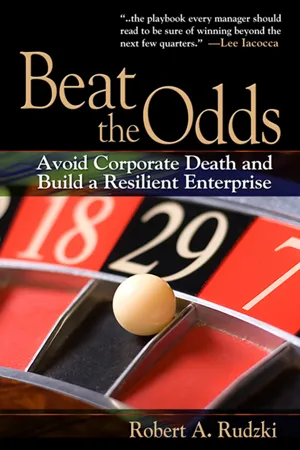
Beat the Odds fills a crucial void in the current business literature. It clearly illustrates why great organizations slip from leader to follower to road-kill, and how organizations can Beat the Odds and avoid this fate. This is a concise must-read for senior executives, and for any manager interested in seeing his or her organization avoid corporate death and build for the future.Over the past 10 years, there have been more than 600,000 business bankruptcies in the United States. Research findings confirm that the odds are very slim for any organization to survive more than a few decades. Many books that purport to offer secrets of business success only study companies that are currently successful. Other books provide pieces that don't fit together to solve the puzzle in real-world practice. Beat the Odds evolved from a study of a broad pool of companies across a wide spectrum of performance over an extended period of time. The book presents a tested and comprehensive nine-part framework for understanding, building and ensuring long-term organizational success through the ups and downs of business cycles, competitive cycles and management cycles. Supported by real case studies, each of the nine framework elements includes a clear description of the underlying principles pertaining to both successful and dysfunctional behaviors. The assessment and diagnostic tools provided in this book are designed to give managers deep insights into their firm's underlying challenges and for performing their own gap analysis of where they are now, versus where they should be. It also features the factual basis for corrective action and prescriptive steps for immediate deployment of this framework.
Information

UNDERSTANDING THE
REASONS UNDERLYING
SUCCESS AND FAILURE
REASONS UNDERLYING
SUCCESS AND FAILURE

INTRODUCTION
Why do senior executives dutifully submit to annual physical exams but don’t take the same kind of preemptive approach to the organizations they run? Why do they undergo an array of tests to gather facts and uncover subtle issues before they emerge into full-fledged personal health problems, yet they “wing it” when it comes to the organization’s diagnosis?
It’s a very significant concern, and one that has bothered me over the years. Corporations are living organisms too, and their basic design allows them to outlast their human founders. But many corporations have the seeds of terminal illness deep within them today. Left unidentified or unaddressed, those malignant cells can bring down a corporation long before its founders reach retirement.
The numbers bear this out. In the United States alone, there have been more than 600,000 outright business failures (bankruptcies) in the past 10 years. 1 An often-referenced source, an internal study of long-lived corporations by Royal Dutch/Shell, noted that only a handful of corporations have survived and prospered for more than a century.2 Bethlehem Steel, once an icon of American business, almost reached its ninety-ninth birthday, then had no more. (Interestingly, General Motors’ troubles appeared to be peaking as GM achieved its ninety-ninth birthday in early 2006.)
In another study, 1,008 companies were studied for the period 1962 to 1998. Only 160 of them survived this 36-year span.3 The inescapable conclusion is that there are factors at work that limit a corporation’s life expectancy to less than 50 years.
Beat the Odds sets out to offer a framework for diagnosis—one that if acted upon positively and decisively can help ensure that an organization enjoys robust good health over a long life. Three factors drove me to research and write the book. First, as a senior officer at a longtime North American manufacturing corporation that eventually collapsed, I often noted the absence of, and inattention to, many of the principles laid out in this book. Worse, I observed the presence of many destructive behaviors that acted like cancerous cells on the overall health of the organization.
Second, I knew that the stakes for businesses are becoming higher. Globalization creates threats and opportunities, for both revenues and cost structure. Ditto with the increased transparency of information. Shorter product life cycles have turned the competitive battle into one of innovation and speed. At the same time, managers must now manage not only across their organizations but across the “extended enterprise,” including their key suppliers. And earnings growth has become an excruciating challenge. As documented by consulting firm Bain & Company, “profitable growth is becoming increasingly elusive and more fleeting for most companies, and . . . this is likely to be even more true during the coming decade.”4
My third motivator is perhaps the most pressing. It’s not so much that many executives—including those who religiously read the business best sellers—still don’t “get it.” It’s that there are still too many examples of dysfunctional companies—symptomatic of executives who refuse to get it. Clearly there is still a message to be sent.
Preeminent business thinker Peter F. Drucker once noted that there are only three things certain in business: confusion, friction, and malperformance. One hypothesis underlying this book is that the problem described by Drucker is actually compounded by the aggressively dysfunctional behavior of leaders and managers. If you were to view their individual and collective actions with a clinical eye, those individuals seem intent on creating the confusion, friction, and malperformance that Drucker wrote about. Don’t believe it? Just one piece of evidence: The comic feature Dilbert draws its enormous popularity from explicitly poking fun at such dysfunctional behavior. Creator Scott Adams credits his readers with providing many of the anecdotes—based on their own real-life work experiences—that inspire Dilbert’s daily world.
While there is no shortage of top-notch business texts that address aspects of business success, there has not yet been a successful “unified theory” for organizational excellence. What is needed is an approach that identifies all of the relevant pieces and insights and then links them in a powerful, easy-toremember, and easy-to-use framework of foundation principles.
Beat the Odds offers a nine-part framework that places just as much emphasis on little-discussed qualitative elements such as “purpose” and a get-it- done bias for action as it does on quantitative metrics. Blending clear descriptions of straightforward principles with real-life case studies and self-assessment tools that readers can begin to apply immediately, the book helps cut through the complexity that regularly distracts senior managers and derails improvement initiatives. Beat the Odds does not profile only those few companies that have lived 100-plus years, because that would mean studying only part of the equation. By including explorations of companies that have failed and others that have swung from periodic success to near failure, additional insights become available.
The book comprises four parts. Part I answers the question: “Why Nine Principles? (Aren’t There Enough Business Books Already?)” It notes that quite a few of the companies highlighted in previous books on organizational performance have toppled off their pedestals. Similarly, some of those that have earned distinction as Fortune magazine’s “Most Admired Companies” have fallen on hard times just a few years after being celebrated. Over a longer period, the Fortune 500 listing has seen some remarkable shifts as formerly great companies have fallen swiftly down the rankings and in some cases disappeared altogether. Part I explains why that can happen and lays the groundwork for each of the nine principles for sustainable organizational fitness and success.
The book’s second part is its core—a detailed breakdown of each of the nine “Beat the Odds” principles. Each breakdown includes the following:
- A case illustration that introduces the principle and shows how attention to that principle will affect an organization’s health and success
- A detailed description and explanation of the principle itself
- One or more well-known companies that exemplify effective commitment to that principle, and the resulting contribution to the organization’s success
- One or more well-known companies that exhibit outrageous neglect of the principle, and the resulting damage to each organization
- An honor roll of companies that have been doing a commendable job of sticking to the principle, and dog house candidates that have done a remarkably poor job
- Key questions that the reader can use to begin assessing how well his or her organization adheres to the principle
- A “Yes, but…” section giving some of the classic arguments with which resistant senior managers may push back, along with a recommended response
Part III walks the reader through real-life narratives that explore the totality of the nine principles as applied by three very different organizations. These lively “inside stories” illustrate how energized and aligned leadership teams in companies large and small, public and private, can harness the nine principles framework to secure their organizations’ long-term success.
The last part of the book outlines Next Steps that will help generate the necessary insights and apply the nine principles to ensure success. In Appendix A, you will find detailed Assessment and Diagnostic Templates that are designed to assist you in pursuing Next Steps analysis and planning. These templates are based upon the key questions posed in Part II; used properly, they can provide deep insight into your organization’s underlying challenges along with the factual basis for corrective action. The takeaway is this: Don’t guess—assess! The next appendix, B, contains quotes from notable sources intended to inspire and entertain.
Part IV also illustrates other situations that relate to the nine success principles, and it asks the reader to analyze each situation. My goal is to make it easier for readers to identify where their organizations are versus where they should be—the all-important gap analysis. In addition, by highlighting the consequences of dysfunctional behavior, I hope to provide the motivation and the framework to help you commit to change on a personal basis, and as part of a more effective leadership team.
Each of us can be an agent of constructive change. In the long run, achieving positive change—in yourself, in your organization—can itself be one of your most rewarding and satisfying accomplishments. So if you find yourself in a “Dilbert-esque” situation, don’t despair. Use the framework presented in this book to trigger vigorous dialogue and a rigorous assessment of your organization (or your part of it). That’s the critical first step to building an effective corrective action plan that can impact the long-term health and success of your organization. It’s also a necessary step to ensure that work is personally and professionally satisfying. Since our workdays occupy far more than half of our waking hours, work deserves to be satisfying. It should even be fun.
If you’re not meeting these straightforward objectives in your working life, you owe it to yourself, your coworkers, and your company to pursue change in the organization. And if that option is not viable or not palatable? You’ve got one more choice: Find another situation where there is a better match.

WHY NINE PRINCIPLES? (AREN’T THERE ENOUGH BUSINESS BOOKS ALREADY?)
As I was heading into the final stretch of writing this book, I came across an article in my local newspaper headlined “Companies in ‘Built to Last’ Crumble Over Time” (see Figure 2.1). The article reviewed some of the “great” companies profiled in best sellers such as Built to Last and In Search of Excellence and looked at how they fared some years later. The story emphasized that quite a few of the previously identified “excellent” or “great” companies are no longer quite so great.1 Is this further proof that the infamous “front-page jinx” really exists, or is there something more fundamental at work?
This book is designed to answer that question. I describe a fundamental framework that, if consistently addressed and applied as part of an organization’s strategic guidance, will help to ensure long-term viability and success regardless of the economic, financial, regulatory, and technology factors that so forcefully buffet organizations today. The central theme in Beat the Odds is about building a resilient organization—one that can readily deal with and bounce back from the myriad surprises lurking in today’s tangled and volatile business environment.
The ideas in this book are not the conclusions of academicians or uninvolved observers of business. The power and relevance of each of the nine principles have been demonstrated by a number of experienced business practitioners who have lived through the successes and failures of organizations, large and s...
Table of contents
- Cover
- Endorsements For Beat The Odds
- Title
- Copyright
- Dedication
- Table Of Contents
- About the Author
- Acknowledgments
- Part I. Understanding the Reasons Underlying Success and Failure
- Part II. The Building Blocks of Success: Nine Principles for Organizational Fitness and Success
- Part III. Profiles of Success: Three That Are Beating the Odds
- Part IV. Next Steps
- Epilogue: Making a Difference Starts Here
- Appendix A. Assessment and Diagnosis Templates
- Appendix B. Quotable Quotes
- Source Notes
Trusted by 375,005 students
Access to over 1.5 million titles for a fair monthly price.
Study more efficiently using our study tools.
Frequently asked questions
Yes, you can cancel anytime from the Subscription tab in your account settings on the Perlego website. Your subscription will stay active until the end of your current billing period. Learn how to cancel your subscription
No, books cannot be downloaded as external files, such as PDFs, for use outside of Perlego. However, you can download books within the Perlego app for offline reading on mobile or tablet. Learn how to download books offline
Perlego offers two plans: Essential and Complete
- Essential is ideal for learners and professionals who enjoy exploring a wide range of subjects. Access the Essential Library with 800,000+ trusted titles and best-sellers across business, personal growth, and the humanities. Includes unlimited reading time and Standard Read Aloud voice.
- Complete: Perfect for advanced learners and researchers needing full, unrestricted access. Unlock 1.5M+ books across hundreds of subjects, including academic and specialized titles. The Complete Plan also includes advanced features like Premium Read Aloud and Research Assistant.
We are an online textbook subscription service, where you can get access to an entire online library for less than the price of a single book per month. With over 1.5 million books across 990+ topics, we’ve got you covered! Learn about our mission
Look out for the read-aloud symbol on your next book to see if you can listen to it. The read-aloud tool reads text aloud for you, highlighting the text as it is being read. You can pause it, speed it up and slow it down. Learn more about Read Aloud
Yes! You can use the Perlego app on both iOS and Android devices to read anytime, anywhere — even offline. Perfect for commutes or when you’re on the go.
Please note we cannot support devices running on iOS 13 and Android 7 or earlier. Learn more about using the app
Please note we cannot support devices running on iOS 13 and Android 7 or earlier. Learn more about using the app
Yes, you can access Beat the Odds by Robert A. Rudzki in PDF and/or ePUB format, as well as other popular books in Business & Business Strategy. We have over 1.5 million books available in our catalogue for you to explore.