- Align strategy with project execution
- Ensure consistent project delivery
- Foster cross-functional collaboration
- Add measurable value
- Promote continuous training and development
- 91 pages
- English
- ePUB (mobile friendly)
- Available on iOS & Android
eBook - ePub
The Standard for Organizational Project Management (OPM)
About this book
Optimize project outcomes with a unified, strategic approach.The Standard for Organizational Project Management (OPM) provides a framework for aligning project, program, and portfolio management practices with organizational strategy and objectives. This standard is particularly useful for organizations seeking a unified project management approach to improve strategic execution and benefits realization.This standard helps organizations:
Information
1
INTRODUCTION
This standard provides guidelines for creating an organizational project management (OPM) framework. OPM entails adapting and aligning practices and processes to provide optimum support for achieving the organization's strategic objectives by means of portfolio, program, and project management. This standard is particularly useful for organizations that do not have a unified project management approach and those in the process of improving or sustaining their current project management framework.
OPM advances organizational capability by developing and linking portfolio, program, and project management principles and practices with organizational enablers and organizational processes to support strategic objectives. Organizational enablers are structural, cultural, technological, or human-resource practices that the performing organization can use to achieve strategic objectives.
1.1 INTENDED AUDIENCE
This standard is intended for practitioners who are involved in portfolio, program, and project management. These practitioners may include but are not limited to:
- Executives with responsibility for strategy delivery in for-profit, nonprofit or government divisions, and organizational units;
- Executives or managers involved in the support of OPM, such as those responsible for portfolio/program/project management offices (PMOs) or centers of excellence (COEs);
- Any stakeholder involved in the leadership, management, or oversight of portfolios, programs, and/or projects;
- Any stakeholder responsible for oversight OPM governance or developing OPM-related policies;
- Portfolio, program, and project managers in leadership and liaison positions, such as functional and service delivery managers, who are responsible for OPM-related organizational capabilities;
- Process and organizational change professionals (including quality and capability management maturity improvement professionals) who are involved in the design and implementation of portfolio, program, and/or project performance improvement initiatives;
- Other management staff who may be responsible for oversight of portfolios, programs, and/or projects;
- Members of strategic portfolios, programs, PMOs, and/or COEs; or
- Functional managers, including those who manage portfolio, program, and project management professionals.
1.2 OVERVIEW
This standard provides guidelines to assist organizations in identifying, assessing, and applying recognized principles, concepts, methods, and best practices in order to establish and sustain OPM capability. It is intended to enable organizations to better structure the management of their portfolios, programs, and projects in order to achieve strategic objectives. This standard is organized as follows:
- Section 1—Purpose of the Standard for Organizational Project Management. This section includes an overview of the standard and describes OPM principles, key stakeholders, and essential considerations for implementation. Additionally, this section describes the relevance of OPM and its framework, the intended audience for the standard, and recommendations on how to apply this standard.
- Section 2—Foundational Concepts. This section describes foundational OPM-essential concepts and factors that contribute to a successful OPM implementation. It discusses what OPM is and how it supports the organization.
- Section 3—Introduction to the OPM Framework. The OPM framework describes the elements needed to provide ongoing support for OPM as well as the requirements to set up an OPM methodology in any organization. This section provides a description of the framework in terms of core elements including methodology, knowledge management, and talent management to support the implementation of an organizational strategy.
- Section 4—Elements of an OPM Framework within the Organization. This section describes the identification of an OPM framework, including the tailoring of key OPM elements such as methodology, knowledge management, talent management, and governance.
- Section 5—Implementation of OPM. This section describes considerations that typically are encountered in an OPM implementation program, such as future operating state design, program organization, business case, and areas of benefits identification. Examples of OPM maturity models are presented to allow understanding of their role in planning and controlling the OPM initiative from a capability identification and development perspective.
- Section 6—Ongoing OPM Management and Monitoring. This section describes how the organization can ensure that an OPM initiative successfully delivers the planned benefits and that the benefits will be sustained upon completion of the implementation program. It also discusses how long-term monitoring of the implemented OPM system is performed to ensure that it continuously improves the system and realization of benefits.
The appendixes included are as follows:
- Appendix X1. Contributors and Reviewers of the Standard for Organizational Project Management
- Appendix X2. Organizational Considerations for OPM Implementation
- Appendix X3. Recommended Survey Questions Regarding Implementation of OPM Initiatives
- Appendix X4. How to Develop a Tailored Organizational Project Management Methodology
- Appendix X5. Organizational Enablers for OPM
1.3 OPM APPROACH
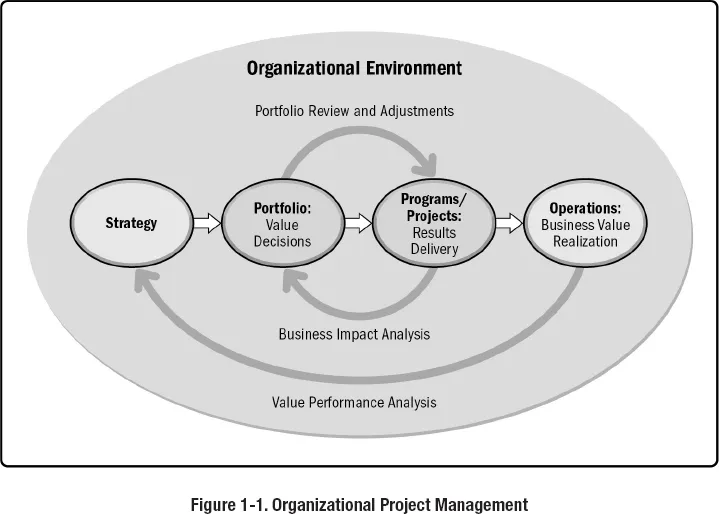
OPM is a framework in which portfolio, program, and project management are integrated with organizational enablers in order to achieve strategic objectives. OPM supports the appropriate balance of knowledge, processes, people, and supportive tools across all functional areas of the organization to provide guidance for its portfolio, program, and project management efforts. Figure 1-1 depicts a systematic OPM approach across all OPM domains that encompasses the following:
- Strategy. A high-level plan designed to achieve the major goals using internal and external resources from the organization in an effective and efficient manner. Strategic planning is the process of formulating and implementing decisions about an organization's future direction.
- Portfolio value decisions. Used to effectively select the initiatives in the portfolio that will support the strategy of the organization to achieve the established major long-term objectives.
- Programs and projects. Used for effective and efficient execution of initiatives aligned with strategies intended to deliver predictable business value.
- Operations. Operationalizes the initiatives and measures the business value through a benefits realization process.
- Portfolio review and adjustments. Aligns strategy and organizational resources through a disciplined business value decision process to reflect internal and external changing conditions.
- Business impact analysis. Analyzes the impact and value from the programs and projects that were implemented and incorporates business results data into the portfolio.
- Value performance analysis. Provides business value realization data from business value fulfillment back to the strategy of the organization.
- Organizational environment. Represents the organizational governance, policies, organizational culture and supporting practices of the organization that are created to support OPM and organizational strategy delivery.
Each OPM approach encompasses multiple processes that translate into specific capabilities that an organization should possess in order to improve its maturity and better succeed with its strategy execution. Additionally, the organization needs an environment with demonstrated OPM capabilities to support delivering its strategy and value.
Because OPM describes many capabilities, each organization needs to determine which capabilities are necessary to realize its strategy. For example, a bank in one country may not require the exact same capabilities as a bank in another country or the exact same capabilities as a software development organization.
OPM is based on performing portfolio, program, and project management, coupled with enabling business process and improvement practices conducted in the appropriate manner, to achieve consistent results that align with the strategic priorities. The implementation of business or process improvement practices that support a strategy execution framework does not ensure the achievement of better results. To achieve better results, strategy execution should be combined with the appropriate mix of skilled people using defined processes in order to achieve strategic objectives.
1.3.1 OPM PRINCIPLES
Organizations face challenges as they strive to improve. Organizations need to use resources effectively to efficiently achieve their objectives.
OPM is intended to assist organizations to deliver value and is based on the following principles:
- Alignment with organizational strategy. All portfolios, programs, and projects should transparently and measurably support organizational strategy.
- Integration with organizational enablers. Successful alignment, execution, and delivery of portfolios, programs, and projects are predicated on timely cooperation of all directly or indirectly involved practices.
- Consistency of execution and delivery. All authorized portfolios, programs, and projects should be executed and delivered consistently within governance and methodology parameters in an ethical and professional manner.
- Organizational integration. Successful alignment, execution, and delivery of portfolios, programs, and projects are predicated on timely cooperation and collaboration of all organization's stakeholders in addition to executive support.
- Value to the organization. Investing and working within the OPM framework delivers products, services, results, or benefits that outweigh costs to operate it.
- Continuous development. Tracking and documenting employees’ competences, skills, knowledge, and experience acquired formally and informally as they perform their daily activities.
1.3.2 ORGANIZATIONAL STRUCTURE
In many organizations, achieving strategic objectives are accomplished through established processes and governance structures. Executives make investment decisions considering a mix of programs and projects most likely to support the achievement of the organization's strategic objectives. These decisions are based on the organization's risk appetite, resource constraints, and knowledge base (i.e., people, knowledge, and funding).
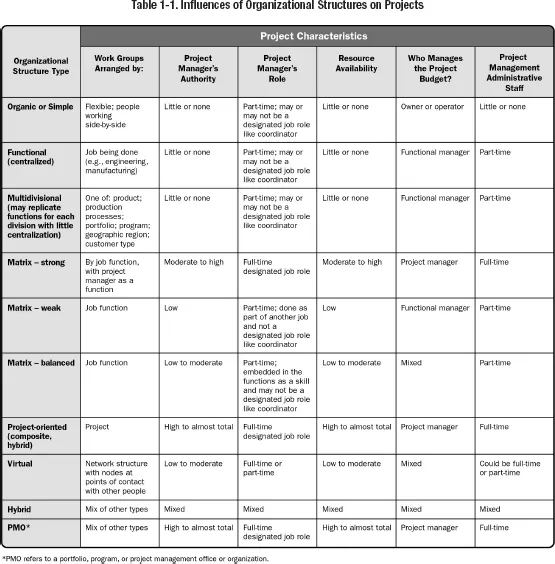
While executives, managers, and project management practitioners seek improved results through implemented strategies, organizations need to understand the various project-based organizational models that accommodate different situations. Organizational structures, which traditionally may be of many types (e.g., organic, functional, matrix, project-oriented, virtual or hybrid), can affect resource availability and influence how projects are executed. The organizational structure influences the environment in which the project will function within the organization as described in Table 1-1. Various structures should be considered to ensure proper resource allocation and proper approaches and policies to support the delivery of the proposed business plan value. The implementation of OPM requires cross-functional project teams. Team members should be available when the project starts, and in consideration of the organizational structure, the functional manager should support the team members’ participation on the project team.
Portfolio, program, and project management requires deliberate planning and action to create the optimal conditions for success. This entails implementing strategy, leadership, goals, processes, skills, systems, issue resolution, complexity navigation, risk mitigation, and structure to direct and exploit the dynamic nature of project execution. However, when strategy moves from the boardroom to operations, the ability to consistently and successfully deliver by using project management is sometimes overlooked.
Regardless of the organization type—organic, functional, multidivi...
Table of contents
- Cover Page
- Title Page
- Copyright Page
- Notice
- Table of Contents
- List of Tables and Figures
- Preface
- 1. Introduction
- 2. Foundational Concepts
- 3. Introduction to the OPM Framework
- 4. Elements of an OPM Framework within the Organization
- 5. Implementation of OPM
- 6. Ongoing OPM Management and Monitoring
- Appendix X1. Contributors and Reviewers of the Standard for Organizational Project Management
- Appendix X2. Organizational Considerations for OPM Implementation
- Appendix X3. Recommended Survey Questions Regarding Implementation of OPM Initiatives
- Appendix X4. How to Develop a Tailored Organizational Project Management (OPM) Methodology
- Appendix X5. Organizational Enablers for OPM
- References
- Glossary
Trusted by 375,005 students
Access to over 1.5 million titles for a fair monthly price.
Study more efficiently using our study tools.
Frequently asked questions
Yes, you can cancel anytime from the Subscription tab in your account settings on the Perlego website. Your subscription will stay active until the end of your current billing period. Learn how to cancel your subscription
No, books cannot be downloaded as external files, such as PDFs, for use outside of Perlego. However, you can download books within the Perlego app for offline reading on mobile or tablet. Learn how to download books offline
Perlego offers two plans: Essential and Complete
- Essential is ideal for learners and professionals who enjoy exploring a wide range of subjects. Access the Essential Library with 800,000+ trusted titles and best-sellers across business, personal growth, and the humanities. Includes unlimited reading time and Standard Read Aloud voice.
- Complete: Perfect for advanced learners and researchers needing full, unrestricted access. Unlock 1.5M+ books across hundreds of subjects, including academic and specialized titles. The Complete Plan also includes advanced features like Premium Read Aloud and Research Assistant.
We are an online textbook subscription service, where you can get access to an entire online library for less than the price of a single book per month. With over 1.5 million books across 990+ topics, we’ve got you covered! Learn about our mission
Look out for the read-aloud symbol on your next book to see if you can listen to it. The read-aloud tool reads text aloud for you, highlighting the text as it is being read. You can pause it, speed it up and slow it down. Learn more about Read Aloud
Yes! You can use the Perlego app on both iOS and Android devices to read anytime, anywhere — even offline. Perfect for commutes or when you’re on the go.
Please note we cannot support devices running on iOS 13 and Android 7 or earlier. Learn more about using the app
Please note we cannot support devices running on iOS 13 and Android 7 or earlier. Learn more about using the app
Yes, you can access The Standard for Organizational Project Management (OPM) by Project Management Institute in PDF and/or ePUB format, as well as other popular books in Business & Project Management. We have over 1.5 million books available in our catalogue for you to explore.