- 408 pages
- English
- ePUB (mobile friendly)
- Available on iOS & Android
eBook - ePub
About this book
The most obvious form of entrepreneurship is that of starting a new business; however, in recent years, the term has been extended to include other forms of entrepreneurial activity. Corporate entrepreneurship is the process by which teams within an established company conceive, foster, launch, and manage a new business that is distinct from the parent company but leverages the parent's assets, market position, capabilities, or other resources. A new, but similar form of entrepreneurial activity is the entrepreneurial supply chain. A supply chain connects customers with suppliers. An entrepreneurial supply chain is an innovative portion of that connection. The entrepreneurial supply chain usually consists of a new venture that is developed out of new and innovative ideas. The venture is responsible for resources, takes on risks, and is accountable for the payoffs. Most organizations view their supply chains merely as cost centers, not recognizing the fact that supply chains are well positioned to be the entrepreneurial drivers of the company. Entrepreneurial supply chains can look for innovation and revenue opportunities wherever they may be found: upstream on the supply side, downstream on the demand side, or with competitors in the middle. This book focuses on unexplored opportunities for growth and innovation through entrepreneurial supply chains. It shows how entrepreneurial supply chains can enhance the value of a business regardless of its form. Creating Entrepreneurial Supply Chains: A Guide for Innovation and Growth takes the reader through the entire process of opportunity identification, due diligence, writing the business plan, managing risks, integrating the entrepreneurial supply chain venture, and reaping the payoff.
Information
CHAPTER 1

INTRODUCTION TO
SUPPLY CHAINS AND
ENTREPRENEURSHIP
SUPPLY CHAINS AND
ENTREPRENEURSHIP
LEARNING OBJECTIVES
- Be able to articulate a broad understanding of supply chains and supply chain management.
- Understand why companies have multiple supply chains, a supply network, or a value web, and why different expressions are used with slightly different meanings.
- Comprehend the meaning of entrepreneurial supply chains and why they are useful for companies.
- Understand how you know when you are thinking entrepreneurially, and what to do with entrepreneurial thinking when you get it.
“Investment must be rational. If you can’t understand it, don’t do it.”
“Be who you are and say what you mean. Those who matter don’t mind, and those who mind don’t matter.”
Warren Buffett’s quote is one of the best ones on investing, and by extension, on entrepreneurship. Simply put, entrepreneurial supply chain activities must make sense. If we cannot understand why we’re considering an entrepreneurial venture, why we’re doing something, or how we can explain it, then we should not do it. It’s as simple as that.
KEY IDEA
If the U.S. Postal Service had originally been more entrepreneurial and innovative, competitors FedEx, UPS, and other delivery services may never have come into existence.
Dr. Seuss’s quote is also relevant. Some who read the book will disagree with some of what the author has to say. But, this book can be viewed as an opportunity to hear someone else’s viewpoint.
Supply chains and supply networks, demand chains and demand networks, value chains and value networks, and the list goes on. This list goes on and on, too: entrepreneurs, entrepreneurship, intrapreneuring, corporate entrepreneurship, entrepreneurial, etc. So it goes with terms and terminology about where we are and where we are going. Can terminology help to point the way?
Not to clog this book with buzzwords, but:
At the end of the day, it’s important to achieve a win-win solution. Be sure to think outside the box to demonstrate thought leadership. And harness key learning to change the game on that mission-critical project.1
Huh?
This book will be clear and straightforward, trying not to get hung up on terminology, nor using too many clichés or buzzwords.
This is not a book on “what supply chains are” or “how to manage supply chains.” It also is not a book on “entrepreneurship.” There are enough books on those subjects already. However, there appears to be no other book dedicated to the subject of entrepreneurial supply chains. That’s a pity, except that means there is a huge need for this one!
This book recognizes the state of many companies’ supply chains that are in dire need of transformation to make them more entrepreneurial and more innovative. The book recognizes the lack of entrepreneurship within too many companies. It focuses on supply chains that present unexplored opportunities for competitive advantage. It also discusses how supply chains can be used to enable and encourage entrepreneurial activity. The book’s subtitle, A Guide to Innovation and Growth, tells almost as much as the main title: companies’ entrepreneurial supply chains can drive innovation and growth, and vice-versa.
Why do companies find it so hard to grow? If you want some evidence, just go to Fortune magazine’s annual list of the world’s largest companies. Compare the latest list with the list of 20 years ago—they’re not the same! Many companies that were on the list then are not on the list now, or they are much further down the list. New companies have arisen. Why? Well, hopefully you can find some of the answers in this book as you struggle with supply chain issues of entrepreneurship, innovation, and growth.
A LITTLE HISTORY OF MANAGEMENT THOUGHT
So, where did supply chain management come from, and how did it get to its present state? Supply chain management has been around for millennia, but not by that name, of course. Let’s examine a little bit of history as a way of setting the stage for the present.
Many of today’s ideas about supply chains can be traced back to the ancient Egyptians and the pyramids. The pyramids were massive supply chain undertakings, especially in the era of 3000–2000 B.C. Quarrying large pieces of stone, shaping the stone, transporting it to the location of the pyramid, constructing the pyramid, and so forth, took enormous skill and massive resources. The best known Egyptian pyramids are those found at Giza, on the outskirts of Cairo. Several of the Giza pyramids are counted among the largest structures ever built. The great pyramid of Cheops, for example, covers 13 acres, contains about 2,300,000 stone blocks, and is estimated to have taken over 100,000 men more than 20 years to construct2—quite a supply chain project.
An Aside: Claude George was a professor in the Business School of the University of North Carolina at Chapel Hill. Professor George taught a required course in this subject for doctoral students, which I feel was one of the most valuable courses I ever took. Serious students of management have a lot to learn about supply chain management by studying its history.
According to Mark Lehner (2010),2 the earliest known Egyptian pyramid is the Pyramid of Djoser, which was built during the third dynasty, about 2600–2500 B.C. This pyramid and its surrounding complex were designed by the architect Imhotep, and generally are considered to be the world’s oldest monumental structures constructed of dressed masonry. According to Professor Claude George (1968),3 the ancient Egyptians also added to our knowledge of supply chains in other ways. Circa 4000 B.C., they recognized the need for planning, organizing, and controlling. Around 2600 B.C., they developed the concept of decentralization in organizations. The concept of centralized organizations was developed about 1000 years later.
A whole book on the history of supply chains could follow, but you get the point. Supply chains have been around for awhile! Instead, this chapter will provide an introduction and an overview of supply chains and entrepreneurship.
SUPPLY CHAINS AND SUPPLY CHAIN
MANAGEMENT EXPLAINED?
MANAGEMENT EXPLAINED?
What are supply chains, and what is supply chain management? The Council of Supply Chain Management Professionals (CSCMP)4 defines supply chain management as follows:
Supply chain management encompasses the planning and management of all activities involved in sourcing and procurement, conversion, logistics and all management activities. Importantly, it also includes coordination and collaboration with channel partners, which can be suppliers, intermediaries, third party service providers, and customers.
KEY IDEA
How can rice production in India affect wheat output in the U.S., the shipping industry in Norway, and rubber production in South America? Source: T. Rowe Price television ads in late 2010 and early 2011, discussing global supply chains as investment opportunities.
In essence, supply chain management (SCM) integrates supply and demand within and across organizations. SCM is an integrating function with primary responsibility for linking major business functions and business processes within and across companies into a cohesive and high-performing business model. It includes all of the product flow activities including suppliers and suppliers’ suppliers, manufacturing operations, and distribution to customers and customers’ customers—from the original source of raw materials to the ultimate user as well as return/recycle of the product. It drives coordination of processes and activities with and across marketing, sales, product design, finance, information technology, and other functional activities.
You already know a lot about supply chain management if you are reading this book, and some familiar material is included intentionally. The simple reason to use a very broad description of supply chain management is not to get hung up on narrow definitions about what’s in and what’s not in the supply chain.
The Value Chain
Today’s notions of supply chains are derived at least in part from Michael Porter’s5 concept of the value chain. An adaptation of his generic value chain is shown in Figure 1.1. Porter (1985) defines the value chain as follows:
A value chain is a collection of activities performed to design, produce, and market, deliver, and support its product [which] can be represented using a value chain. . . . A firm’s value chain . . . [is] a reflection of its history, its strategy . . . and the underlying economics of the activities themselves.
Porter distinguishes the firm value chain, business unit value chain, channel value chain, buyer value chain, and supplier value chain, as shown in Figure 1.2. Later, his structure will lead us into how an entrepreneurial supply chain works.
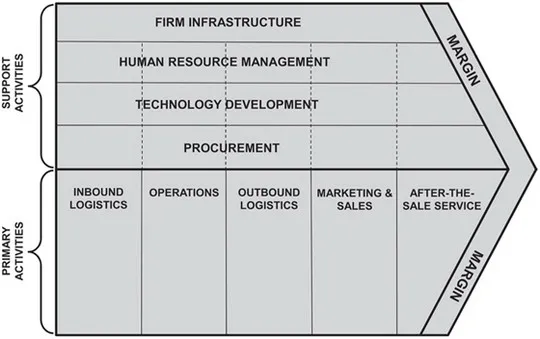
Figure 1.1 The Generic Value Chain. Adapted from: Porter, Michael E., Competitive Advantage: Creating and Sustaining Superior Performance, The Free Press, 1985.
Porter’s framework is designed primarily for established companies and not generally for start-up entrepreneurial companies. However, recognize that even the smallest start-ups will have to perform most or all of the activities described, even though they typically will not have an organizational structure for them.
Porter focuses on the business unit level of the firm and distinguishes between primary activities and support activities. The five primary activities include those which are generally attributed to companies with products: inbound logistics, operations, outbound logistics, marketing and sales, and after-the-sale service. This is the product life cycle, which is easy for most people to visualize. It is generally thought of applying to manufacturing companies, but it also could apply to wholesale, distribution, or retail firms.
Each primary activity can be disaggregated into a number of discrete entities that may be unique to the firm or its industry. Clearly, every company configures its activities differently. Each primary activity typically presents opportunities for entrepreneurial supply chain ventures, for example:
- Inbound logistics involves obtaining the product inputs from suppliers and the physical process of getting them from the supplier to where the operation is being conducted. Some companies obtain their inputs from a relatively few suppliers, while others use many suppliers. Some companies use trucking for their inbound transportation, while others use rail or ocean freight. Some companies use only domestic suppliers, while others use global sourcing. They are all different.
- Operations usually are defined as conversions. These could be physical conversions in the case of manufacturing companies or conversions of time and/or location in the case of distribution companies. Some companies have product designs that use few components, while others use many components. Some companies outsource most of their manufacturing, while others outsource little, if any. Some companies use a few large facilities, while others use more and smaller facilities. Some companies manufacture globally, while others keep their operations domestic. Again, they are all different.
- Outbound logistics are associated with physically moving the products from the operations locations to the customers’ locations. This could include physically assembling a customer’s order, scheduling a carrier, and offloading the products at the customer’s location. Some companies ship directly from manufacturing plants to customers, while others use distribution centers to store inventory and get it closer to the customers. Some companies ship via air freight, while others use trucking. Some companies use third-party logistics providers, while others operate their own trucking fleets. Some co...
Table of contents
- COVER
- TITLE
- COPYRIGHT
- DEDICATION
- TABLE OF CONTENTS
- FOREWORD
- PREFACE
- ACKNOWLEDGMENTS
- ABOUT THE AUTHOR
- WEB ADDED VALUE™
- CHAPTER 1. INTRODUCTION TO SUPPLY CHAINS AND ENTREPRENEURSHIP
- CHAPTER 2. WHY “ENTREPRENEURIAL” SUPPLY CHAINS
- CHAPTER 3. UTILIZING CUSTOMERS AND SUPPLIERS AS SOURCES OF IDEAS AND OPPORTUNITIES
- CHAPTER 4. HOW WE KNOW WE HAVE OPPORTUNITIES
- CHAPTER 5. MANAGING THE RISKS OF ENTREPRENEURIAL SUPPLY CHAINS
- CHAPTER 6. DUE DILIGENCE AND THE BUSINESS PLAN
- CHAPTER 7. IMPLEMENTING ENTREPRENEURIAL SUPPLY CHAINS
- CHAPTER 8. REAPING THE PAYOFF
- APPENDIX A: VISIONING ENTREPRENEURIAL SUPPLY CHAINS
- APPENDIX B: SAMPLE BUSINESS PLAN FOR AN ENTREPRENEURIAL SUPPLY CHAIN OPPORTUNITY
- APPENDIX C: SAMPLE EDUCATION AND TRAINING PROGRAMS FOR ENTREPRENEURIAL SUPPLY CHAINS
- APPENDIX D: GLOSSARY OF ENTREPRENEURIAL SUPPLY CHAIN TERMS
Trusted by 375,005 students
Access to over 1.5 million titles for a fair monthly price.
Study more efficiently using our study tools.
Frequently asked questions
Yes, you can cancel anytime from the Subscription tab in your account settings on the Perlego website. Your subscription will stay active until the end of your current billing period. Learn how to cancel your subscription
No, books cannot be downloaded as external files, such as PDFs, for use outside of Perlego. However, you can download books within the Perlego app for offline reading on mobile or tablet. Learn how to download books offline
Perlego offers two plans: Essential and Complete
- Essential is ideal for learners and professionals who enjoy exploring a wide range of subjects. Access the Essential Library with 800,000+ trusted titles and best-sellers across business, personal growth, and the humanities. Includes unlimited reading time and Standard Read Aloud voice.
- Complete: Perfect for advanced learners and researchers needing full, unrestricted access. Unlock 1.5M+ books across hundreds of subjects, including academic and specialized titles. The Complete Plan also includes advanced features like Premium Read Aloud and Research Assistant.
We are an online textbook subscription service, where you can get access to an entire online library for less than the price of a single book per month. With over 1.5 million books across 990+ topics, we’ve got you covered! Learn about our mission
Look out for the read-aloud symbol on your next book to see if you can listen to it. The read-aloud tool reads text aloud for you, highlighting the text as it is being read. You can pause it, speed it up and slow it down. Learn more about Read Aloud
Yes! You can use the Perlego app on both iOS and Android devices to read anytime, anywhere — even offline. Perfect for commutes or when you’re on the go.
Please note we cannot support devices running on iOS 13 and Android 7 or earlier. Learn more about using the app
Please note we cannot support devices running on iOS 13 and Android 7 or earlier. Learn more about using the app
Yes, you can access Creating Entrepreneurial Supply Chains by William Lee in PDF and/or ePUB format, as well as other popular books in Business & Operations. We have over 1.5 million books available in our catalogue for you to explore.