- 368 pages
- English
- ePUB (mobile friendly)
- Available on iOS & Android
eBook - ePub
About this book
Business Driven PMO Success Stories was written by and with over two dozen contributing authors from the worldwide project management and project management office (PMO) community. It offers executives, managers, and all those involved in the projects of the organization, an understanding of the value a PMO can provide, the knowledge they need to determine the purpose of their PMO, and how to craft a PMO best suited to fulfill that purpose.
Information
Part 1

Business Driven PMO
Insights and Techniques
Section 1
PMO Mandate
Mandate (noun)—the approval, power, or command to do something.
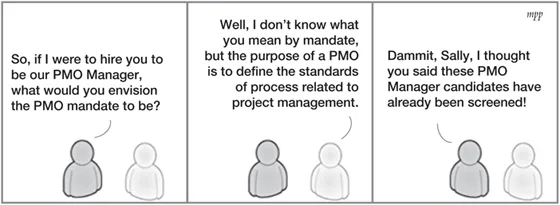
1
Why PMOs Fail
It’s a simple question. Why do PMOs fail? Over the years, there has been no shortage of analysis and commentary on this subject. We have all been treated to the research reports that show 25% of PMOs fail within their first year, 50% of PMOs fail by their second year, and 75% of PMOs fail and are closed by their fourth year. And these are permanent PMOs, not temporary program offices that by design will be closed after the program has concluded.
So, given this more than ample amount of analysis of the marked and measured rate of PMO failures, the documented reasons why PMOs fail, and the proposed recommendations for what a PMO should be and do to avoid failure, why has there been such little movement and improvement in the rate of PMO failures over the years? And with respect to PMOs in general, why is the project management community making such a mess of it all? We have tools, we have standards, we have certifications, and we have a lot of really smart people. So what is the problem?
I have my own thoughts and perspectives on why PMOs fail that are based upon more than a decade of asking this specific question to executives to whom the PMO reports, to management and constituents served by the PMO, to IT professionals, to agile software development enthusiasts or agilest as (a term many use to describe the passion and perspectives of this vibrant and growing community) and I have asked this question to the members of the PMO itself such as PMO managers, PMO officers, project managers, business analysts, and a wide variety of others who work in the PMO. But before sharing my thoughts and perspectives on why PMOs fail, let me first suggest that as a community of project management professionals most of us are stuck inside the box in terms of our thinking about PMOs.

Figure 1.1, stuck inside the box
As depicted in Figure 1.1, being stuck inside the box is not a lot of fun or where you want to be and it is hard to get out. It is akin to being stuck in a rut where the direction and outcome are all but predetermined. In the context of why PMOs fail, the only way we can become unstuck and get out of the box is to think outside the box. After all, it has been the same inside the box thinking about PMOs that has led to the high failure rate and in many cases negative sentiment about PMOs and the project management community as a whole.
For example, did you know that in the agile development community, the term PMO means Pissed Me Off? Other non flattering terms that I have heard over the years include Pretty Myopic Organization, Pouring Money Overboard, Project Management Overload, Poorly Managed Office, Project Management Orangutans, and on and on
Thinking outside the box, especially when trying to break a pattern or poor track record or losing streak, is tremendously beneficial. Actually, it is a requirement. Thinking outside the box can reveal new approaches and techniques that are often right before our very eyes and within our grasp. However, for most people, thinking outside the box is not natural, it is very hard to consciously do, and it is very difficult to see even the easiest and most obvious solutions to problems even though they are right in front of us all the time. Don’t believe me? Let me prove it to you.
Over the years, I have given PMO presentations and conducted PMO workshops in over 50 countries spanning six continents. When presenting new, outside the box ideas and concepts, I always like to start the presentation with a little exercise to demonstrate how hard it is for us to think outside the box, as well as to demonstrate how natural and prevalent our tendencies are to remain inside our own little box of thinking even when we are specifically asked to step out of it. As no challenge is complete without a reward, I always take a $100 bill out of my wallet and offer it as a reward to the first person who can successfully find the answers to the exercise. Are you ready?
The exercise goes like this. In less than five minutes, using the four numbers (1, 2, 3, and 4) and the two arithmetic operators for plus and equals (+ and =) as shown in Figure 1.2, rearrange all these numbers and operators into three different and correct equations. Each equation must use all four numbers and both operators and use them only once.
This seems simple enough. Did you already think of the answer 1 +4 = 2 + 3? That is the most common wrong answer that is quickly cited. The equation is correct of course, but the plus sign is used twice. Again, all numbers and operators must be used and used only once. As depicted in Figure 1.3, the three solutions to the exercise are (1) one to the power of two plus three equals four, (2) one to the power of four plus two equals three, and (3) three times four equals twelve. In this last solution, the plus sign is rearranged by rotating it 45 degrees, making it a multiplication sign. Arguably, this last solution is more outside the box than the first two solutions, which merely employed the use of exponential notation.
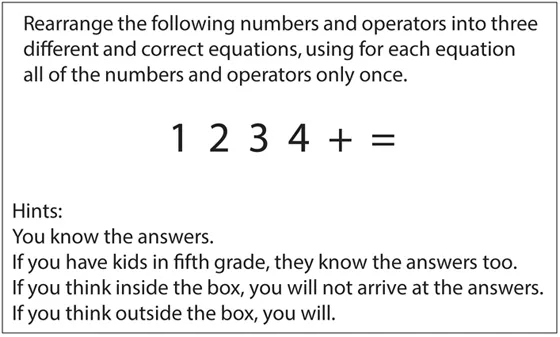
Figure 1.2 Thinking outside the box exercise
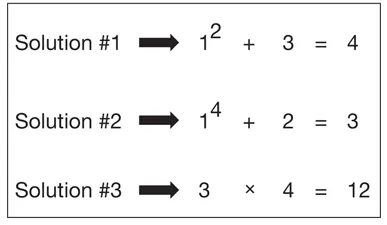
Figure 1.3 Solutions to the thinking outside the box exercise
The broader point, however, is that all these solutions to the exercise are quite simple, one might even say trivial. But did you arrive at any of these solutions, not to mention all three of them? If you did, then give your self a pat on the back as you are in very select company. In all the times over the years that I have conducted this little test at various PMO work shops and seminars as an example of how hard it is to think outside the box, only once have I lost my $100 bill to someone who was able to come up with all three answers.
Now, with that exercise behind us, think about all the reasons and rationale for why PMOs fail that have been posited within the project management community over the years as well as the suggestions and advice that are given to avoid PMO failure. The top five reasons for PMO failure that I often read about or hear in presentations are as follows:
- Lack of executive support
- Ineffective and overburden some project management methodologies
- PMO viewed as template police rather than helpful to the business
- PMO does not have enough decision-making authority to ensure success
- Value of the PMO not understood
But are the above reasons really the reasons why PMOs fail or are they merely symptoms of a deeper root cause for PMO failure?
For example, few PMOs magically appear out of thin air. There was obviously executive support for the PMO or it would not have come into existence. Likewise, such things as methodologies and templates are a means to an end, not the end to be achieved, so it is illogical that these things would be a root cause of PMO failure. In a similar vein, what can possibly be meant by not enough decision-making authority? Most people will inherently do what helps them succeed and avoid what doesn’t. If the PMO is helping others succeed, then wouldn’t people take the appropriate actions without the PMO needing more decision-making authority over them? And more decision-making authority for what aim—to make the business successful or to comply with a PMO strategy and project management methodology that may or may not be effective and appropriate for the organization? When people suggest that the value of the PMO is not understood, do they mean the value of preparing documents and reports or do they mean the value of best addressing specific project-related issues and opportunities that the organization has?
There is a very simple reason why PMOs fail, but it will not be found from inside the box of the traditional thinking about PMOs. Before we get to that very simple reason, let’s reflect upon some of the advice that has been given over the years and that has dominated the project management community. Have you heard the term people, process, and tools ?Have you read the often suggested road map for setting up a PMO that includes (1) pick a PMO model, (2) list your PMO roles and responsibilities,(3) establish quick wins, and (4) sell the value of the PMO? Have you heard the advice to crawl, walk, run?
All these perspectives and many more are the result of an inside the box way of thinking about the PMO, a perspective that is more focused on the means to the ends of the PMO and what a PMO ought to be in a perfect world, rather than a perspective that is focused on the ends to be achieved by the PMO as driven by needs of the business for which the PMO exists to serve. This causes execution difficulties for the PMO right from its start; PMOs are far too often set up and managed based upon someone’s idea of what a PMO ought to be, rather than specific business end results to be achieved.
Take the advice of a well-known and well-intentioned PMO authority who shall go nameless so as not to embarrass this individual. The advice that this individual, like so many others, has given on the role of the PMO includes the following:

That the above list, and other lists like it, is a collection of well-intention edideas for a PMO is of no debate. That the above list solves the specific business problems of a given organization would be a gross assumption and an error in business judgment. In layman’s terms, it is putting the horse before the cart.
It is put best by one of my dear friends and longtime project management and PMO expert Doc Dochtermann, formerly of the Microsoft Project Portfolio Management (PPM) Solutions team, who rhetorically asks:
If the PMO is the answer, then what was the question?
This pithy and pointed question illustrates a tremendous problem and issue within the formal project management community. There is far too little focus, v...
Table of contents
- Cover
- Title
- Copyright
- Dedication
- Contents
- Foreword
- Acknowledgments
- About the Author
- Contributors
- Preface
- Introduction
- Web added Value™
- Part 1: Business Driven PMO Insights and Techniques
- Part 2: Business Driven PMO Success Stories
- Epilogue
Trusted by 375,005 students
Access to over 1.5 million titles for a fair monthly price.
Study more efficiently using our study tools.
Frequently asked questions
Yes, you can cancel anytime from the Subscription tab in your account settings on the Perlego website. Your subscription will stay active until the end of your current billing period. Learn how to cancel your subscription
No, books cannot be downloaded as external files, such as PDFs, for use outside of Perlego. However, you can download books within the Perlego app for offline reading on mobile or tablet. Learn how to download books offline
Perlego offers two plans: Essential and Complete
- Essential is ideal for learners and professionals who enjoy exploring a wide range of subjects. Access the Essential Library with 800,000+ trusted titles and best-sellers across business, personal growth, and the humanities. Includes unlimited reading time and Standard Read Aloud voice.
- Complete: Perfect for advanced learners and researchers needing full, unrestricted access. Unlock 1.5M+ books across hundreds of subjects, including academic and specialized titles. The Complete Plan also includes advanced features like Premium Read Aloud and Research Assistant.
We are an online textbook subscription service, where you can get access to an entire online library for less than the price of a single book per month. With over 1.5 million books across 990+ topics, we’ve got you covered! Learn about our mission
Look out for the read-aloud symbol on your next book to see if you can listen to it. The read-aloud tool reads text aloud for you, highlighting the text as it is being read. You can pause it, speed it up and slow it down. Learn more about Read Aloud
Yes! You can use the Perlego app on both iOS and Android devices to read anytime, anywhere — even offline. Perfect for commutes or when you’re on the go.
Please note we cannot support devices running on iOS 13 and Android 7 or earlier. Learn more about using the app
Please note we cannot support devices running on iOS 13 and Android 7 or earlier. Learn more about using the app
Yes, you can access Business Driven PMO Success Stories by Mark Perry in PDF and/or ePUB format, as well as other popular books in Business & Project Management. We have over 1.5 million books available in our catalogue for you to explore.