- 309 pages
- English
- ePUB (mobile friendly)
- Available on iOS & Android
eBook - ePub
Implementing Project Portfolio Management
About this book
Implementing Project Portfolio Management addresses the "how-tos" of portfolio management. It is designed for three primary audience groups: Business Executives, Portfolio Leaders and Practitioners, and Portfolio Thinkers. The authors provide insights on how to apply the performance management domains covered in the standard that are in practice today by introducing tools and templates into their discussion. Far-reaching in its impact on portfolio management practitioners, thinkers, stakeholders, and the wider project management community, this guide envisions the continued transformation of portfolio management with the changing needs of organizations and advances in technology.
Information
Part I
An Executive Guide to Portfolio Management

Understanding Portfolio Management
by Te Wu
A goal without a plan is just a wish.
—Antoine de Saint-Exupery
1.1. A Case for Portfolio Management
In our current, intensely competitive environment, organizations confront a variety of difficult choices, particularly regarding major investments. To achieve success, organizations must not only have strong concepts, but also the ability to implement those ideas to achieve the intended business value. This means that having the idea is not enough; organizations must also possess the potential to prioritize and select which plans to implement, provide strong governance during a plan's life span, nurture the implementation of the plan, and execute it deftly. Just look at the world around us: There is an ample number of good and even great ideas, as evidenced by bold initiatives ranging from driverless vehicles to an entirely new economy based on apps. Regardless of industry, good ideas are commonplace. The strategic differentiation rarely, if ever, will be achieved on ideas alone. Moreover, this is truer today than ever before, as competition leaves very little room for errors. What sets successful organizations apart is their strategic business execution ability that harnesses their ideas and turns them into tangible benefits. Successful organizations use portfolio management.
Project management has been the discipline of choice for business execution. Since its founding as a formal school of study in the 1950s, project management has itself become the preeminent approach to implementing one-time and often complex initiatives. Yet the results are mixed at best. A 2015 PMI study showed that of every US$1 billion spent on projects, about US$122 million was wasted. However, a more recent PMI study in 2016 showed significant improvement. Will this trend continue? Not likely. The Standish Group, which has been studying information technology projects since 1994, has placed the success rate less than 33 percent for nearly every single year since inception. In 2015, the success rate was about 29 percent—dismal by any standard.
When examined under closer scrutiny, the problem of success can be largely divided into two areas: 1) doing the right projects; and 2) doing the projects right. Project management—and by extension, program management—has mostly been focused on the second problem of “doing the projects right.” When organizations apply a more disciplined approach to project management, the improvements are significant. For example, in the latter PMI study, published in 2016, when project management culture is a high priority, 71 percent of projects met their original goals and business intent versus 52 percent of projects when project management culture was a low priority. This improvement of almost 20 percent translates to a huge amount of savings.
Yet, “doing the project right” is only half of the equation. Are the right projects being done in the first place? For example, how many of you have ever questioned the importance of the projects you've worked on?
The importance of portfolio management became more evident when the Project Management Institute (PMI) introduced The Standard for Portfolio Management in 2006. Then in 2014, PMI launched a new certification, the Portfolio Management Professional (PfMP)®. This new professional certification sits atop the project management career ladder, helping to highlight the importance of the discipline while instilling project, program, and portfolio management as relevant topics in the boardroom. Portfolio management has finally arrived. The most recent work, which prompted the development of this book, is the latest update to The Standard for Portfolio Management, now in the fourth edition. The authors and contributors are all core committee members, including both the chair and vice chair, responsible for refreshing the current standard to keep up with the changing times.
1.2. Defining Portfolios and Portfolio Management
A portfolio is a logical group of components managed together to achieve certain strategic objectives. These components can be projects, programs, subsidiary components, and related operational activities. They may be related, such as targeting the same customers, or unrelated, such as projects from multiple functional areas. Even though components can be unrelated, as there are no dependencies or direct impact between these components, there is an underlying logic why these components are grouped in one portfolio versus another.
For example, a company may have an enterprise portfolio composed of large projects and programs. As these components require significant capital or operational expenditures, which is the underlying logic, the sponsoring organization wants a more dedicated focus on their management. However, aside from the budget size, these components can be from different areas of the organization, without any other relationships. Since portfolios are artificial constructs created to improve the efficient and effective management of these endeavors, an organization can have many portfolios; the number might depend on a multitude of factors, such as organization size, complexity, culture, capability, project and program intensity, and resources, to name a few. The strength of the underlying logic and the relationship of the components, as well as the desired outcome, often drive the major focus of portfolio management.
Portfolio management is the centralized management of portfolios by applying the principles, knowledge, and skills to achieve the intended business objectives. These can be strategic (e.g., long term, long lasting, with broad implications to the organization's mission and vision) or tactical (e.g., short term, immediate impact, with impact to near-term operations). Portfolio managers are chiefly responsible for guiding the portfolio management processes. This includes the identification, categorization, evaluation, selection and approval, prioritization, optimization, authorization, implementation, eventual transitioning or termination of portfolios, and management of the business value.
In practicality, portfolios of highly related components typically require more intensely focused management to achieve a high degree of synergy and coordination. Portfolios of unrelated components are typically grouped for convenience or to share certain resources. Aside from resource sharing and perhaps some minor integration management activities, the level of synergy and coordination is weak. For example, a portfolio of revenue-producing projects for a particular product line is likely to have a stronger centralized portfolio management setup than another portfolio composed of unrelated components assembled for convenience. All things being equal, unrelated portfolios have less structure and intensity within the portfolio management processes.
1.3. Relationship between Portfolio Management and Organization
Organizations have been practicing portfolio management since the dawn of business strategy as a focal area of concern. This occurs at all levels of organizations, from the enterprise to business units to departments and even teams. Executives and managers have implicitly recognized the importance of strategic choice, and when confronting the constraint of limited resources, these choices generally reflect some optimal balance of competing factors. Rigorous and process-driven organizations are likely to have specific business processes to generate new ideas, validate these ideas before committing serious resources, and implementing these ideas as projects or operational enhancements. In advanced organizations, approved business cases are evaluated for the benefits attained. Organizations practicing one or more of these activities are already using some aspects of portfolio management.
The contemporary challenges confronting organizations require them to adopt a more systematic approach to portfolio management. What may start out as a specific capability of ideation or prioritizing projects before approval or overseeing the implementation of a logical bundle of projects may address certain specific business needs. But to build sustainable capabilities addressing both strategic and tactical considerations, organizations need to reconsider portfolio management and how to incorporate it as a core competency in the organization. At the same time, to achieve greater value, the breadth of portfolio management needs to be broadened to include ideation to operations where business value is realized and the depth of portfolio management capabilities, such as capability and capacity planning, governance, and value management are also increased. Today's portfolio management is now much more than finding the best ideas, but also ensuring that they achieve the desired value.
Portfolio management today can take many forms. At the most strategic level, some companies build an “office of strategic investments” to bridge planning with execution. Most organizations establish a range of portfolio management capabilities and house them in enterprise or departmental-level project management offices (PMOs). At the more tactical end of the spectrum, organizations may create a portfolio management capability in an operational department for managing initiatives that lead to continuous improvement. Based on our experience, large and complex organizations can have up to 60 PMOs, with a handful of them having portfolio management capabilities. What is your organization like? What works best for your organization?
1.4. Relationship between Portfolio, Program, and Project Management
Portfolios are extensive collections of investment choices or endeavors to change the organization. These endeavors often take the form of programs, projects, quasi-projects (like continuous improvement initiatives), and operational activities. Collectively, these endeavors form the components of a portfolio. Portfolios are artificial constructs—they are formed to help organizations better manage a collection of related components. Thus, the nature of the portfolio (e.g., size, budget, focus, resources, etc.) depends on internal and external factors—internal factors, such as organizational culture, maturity, capability, and investment intensity; external factors, such as industry and its maturity, related industries that provide substitutions, macroeconomic environments, and regulatory and political settings.
As artificial constructs designed for effective management, portfolios can be flexible mechanisms for organizations to implement strategic and tactical components. In general, portfolios can contain multiple components across the life cycle. A robust portfolio is likely to have strong ideas in the pipeline, robust business cases waiting for approval, valuable programs and projects in implementation, completed components transitioning into operations, and successful components in operations realizing the intended benefits. Some programs may, in turn, contain smaller subsidiary programs and projects. Even some larger projects may include subsidiary projects. How well these components are managed throughout their life cycle can directly affect the health of the entire organization.
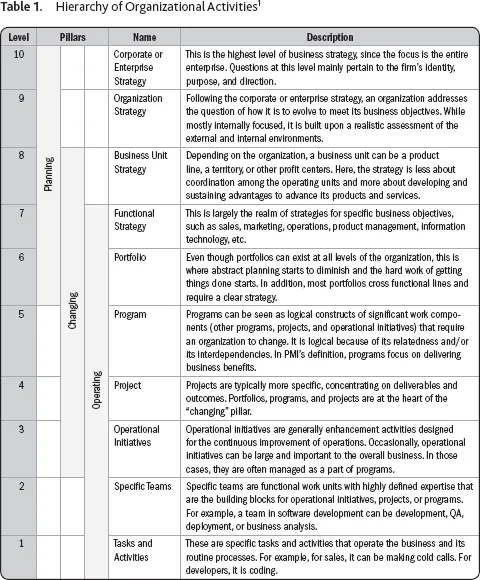
From a hierarchy of organization activities, portfolio management is at the crossroads of planning, operating, and changing. Table 1 illustrates relative positions of portfolio management among organizational activities:
1.5. How to Make Portfolio Management Work—Essential Principles of Portfolio Management
In The Standard for Portfolio Management – Fourth Edition, Section 1.7 lists eight fundamental principles of portfolio management without much description. The goal of this section is to elaborate on these ideas to both clarify and make them more executable. The eight principles are:
1.Strive to achieve excellence in strategic execution
2.Enhance transparency, responsibility, accountability, sustainability, and fairness
3.Balance portfolio value against the overall risk
4.Ensure that investments in portfolio components are aligned with the organizational strategy
5.Obtain and maintain the sponsorship and engagement of senior management and key stakeholders
6.Exercise active and decisive leadership for the optimization of resource utilization
7.Foster a culture that embraces change and risk
8.Navigate complexity to enable successful outcomes
1.5.1. Strive to achieve excellence in strategic execution
Today, most organizations have many wonderful ideas, but few of them are ultimately achieved. The challenges are many, such as limited resources, poor investment decisions, weak portfolio governance, and inadequate program and project management disciplines. For organizations, even the best ideas are worthless unless they can be successfully implemented to achieve the benefits. As a bridge between planning and execution, portfolio management is the first discipline in the project-program-portfolio management hierarchy to systemically manage these endeavors and tackle the complexities and intricacies of implementation. Portfolio management is the discipline that enables organizations to make optimal investment decisions of portfolio components and to oversee the performance of these components to achieve their intended value. By creating a sustainable environment for success to occur, portfolio management is the front line of achieving execution excellence.
1.5.2. Enhance transparency, responsibility, accountability, sustainability, and fairness
Effective portfolio management requires the appropriate governance of portfolio-level activities. Perhaps the most important outcome of governance is establishing the legitimacy of decisions where disenchanted executives, who otherwise would not support or endorse portfolio decisions, will abide by the governance team's decisions and implement them without significant issues. This is vital for the portfolio management team because portfolio decisions can be controversial when the interest of one party is pitted against an entrenched interest in another party. By establishing transparent processes where decision making is fair and where the decision makers have defined responsibilities and accountabilities, even controversial decisions can enjoy much higher degrees of support across the portfolio team.
1.5.3. Balance portfolio value against overall risks
At a portfolio level, uncertainties are prevalent. Commonly, risks can be inherent in the organization's operational environment, the internal uncertainties of capability and capacity, or the aggressiveness of the organization's strategy. Risks can bubble up from specific projects, programs, and operations. For portfolio managers, perhaps the biggest challenge is to create a sufficiently steady environment in which the portfolio management team and the component team can successfully implement and perform their work. This requires a delicate balancing act in which portfolios must manage the knowns and the unknowns to achieve the business value despite uncertainties. Taking on too many risks may jeopardize the target value; taking on too few risks may not maximize the value creation capabilities of the portfolio. Thus, portfolio managers are often walking a tightrope between analysis paralysis and acting upon what appears t...
Table of contents
- Cover Page
- Title Page
- Copyright Page
- Dedication Page
- Table of Contents
- List of Tables
- List of Figures
- Introduction
- Part I: An Executive Guide to Portfolio Management
- Part II: A Practitioner's Guide to Portfolio Management
- Part III: A Strategist's Guide to Advance Portfolio Management
- References and Endnotes
- Biographies
Trusted by 375,005 students
Access to over 1.5 million titles for a fair monthly price.
Study more efficiently using our study tools.
Frequently asked questions
Yes, you can cancel anytime from the Subscription tab in your account settings on the Perlego website. Your subscription will stay active until the end of your current billing period. Learn how to cancel your subscription
No, books cannot be downloaded as external files, such as PDFs, for use outside of Perlego. However, you can download books within the Perlego app for offline reading on mobile or tablet. Learn how to download books offline
Perlego offers two plans: Essential and Complete
- Essential is ideal for learners and professionals who enjoy exploring a wide range of subjects. Access the Essential Library with 800,000+ trusted titles and best-sellers across business, personal growth, and the humanities. Includes unlimited reading time and Standard Read Aloud voice.
- Complete: Perfect for advanced learners and researchers needing full, unrestricted access. Unlock 1.5M+ books across hundreds of subjects, including academic and specialized titles. The Complete Plan also includes advanced features like Premium Read Aloud and Research Assistant.
We are an online textbook subscription service, where you can get access to an entire online library for less than the price of a single book per month. With over 1.5 million books across 990+ topics, we’ve got you covered! Learn about our mission
Look out for the read-aloud symbol on your next book to see if you can listen to it. The read-aloud tool reads text aloud for you, highlighting the text as it is being read. You can pause it, speed it up and slow it down. Learn more about Read Aloud
Yes! You can use the Perlego app on both iOS and Android devices to read anytime, anywhere — even offline. Perfect for commutes or when you’re on the go.
Please note we cannot support devices running on iOS 13 and Android 7 or earlier. Learn more about using the app
Please note we cannot support devices running on iOS 13 and Android 7 or earlier. Learn more about using the app
Yes, you can access Implementing Project Portfolio Management by Dr. Panos Chatzipanos,Dr. Te Wu in PDF and/or ePUB format, as well as other popular books in Business & Management. We have over 1.5 million books available in our catalogue for you to explore.