eBook - ePub
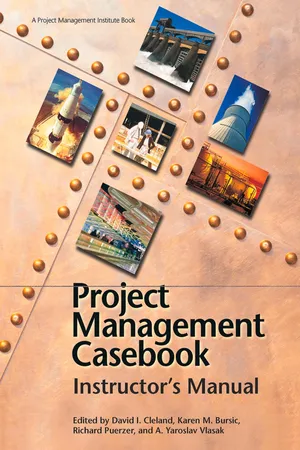
Project Management Casebook: Instructor's Manual
- 626 pages
- English
- ePUB (mobile friendly)
- Available on iOS & Android
eBook - ePub
Project Management Casebook: Instructor's Manual
About this book
Each of the cases provides new and unique challenges that have been mastered by the practice of project management. Readers will be able to apply the knowledge learned from this casebook in their work. The cases enable readers to see how and why projects are used in a wide variety of organizational settings in contemporary life. Readers are exposed to both successful and not-so-successful project management practices. The case-study approach encourages reader participation and active learning, and provides the opportunity to learn something of the real world of project management. It is essential in the curricula of project management training for both undergraduate and graduate students, as well as for continuing education, consulting, and in-house company training programs. The cases were chosen for their importance in discussing the fundamentals of project management. Most contain descriptions of actual projects, and each is followed by a series of questions to guide readers' analysis of the article to maximize the learning process.
Information
Subtopic
Human Resource ManagementIndex
BusinessPLANNING

1995 PMI International Project of the Year
The Benfield Column Repair Project
PM Network, February 1996, pp. 25–30
SYNOPSIS
This case describes the Benfield Column Repair Project, the 1995 PMI International Project of the Year. The project was to quickly replace a large section of a regeneration column at a coal, chemical, and crude oil company in South Africa. The project required that a large number of resources be pooled from around the world to engineer the repairs to the regeneration column. All aspects of project management were utilized to accomplish the project. Thanks to excellent project management, plus creative solutions to a number of challenges, the project was completed ahead of schedule and under budget.
LEARNING OBJECTIVES
In discussing this case, students should gain a better understanding of:
• the use of a work breakdown structure
• the importance of building commitment from team members
• how special management methods can be used to aid a project
• that communications management is a key to a project
• how a large and complex project such as this can be very successful.
DISCUSSION QUESTIONS AND POSSIBLE ANSWERS
- A work breakdown structure (WBS) was used in the management of the project described in this case. According to the PMBOK Guide, what is the concept of the WBS?
- In the PMBOK Guide, section 5.3.3, Outputs From Scope Definition, a WBS is termed a deliverable-oriented grouping of project elements that organizes and defines the total scope of the project.
- The WBS is also described as a key for the scope management of the project. Outline the process used in this project to develop the WBS.
- In the first meeting they used a brainstorming session with all interested parties present. Ideas were placed on post-it notes on a huge white board. At the second meeting, the WBS was refined and accepted. Times for each task were assigned by those who would carry out the tasks. This is essentially the same process documented in section 5.3.2, Tools and Techniques For Scope Definition, in the PMBOK Guide.
- The author of this case presents communications management as “the golden thread which ran through the project.” If the supplier relationships were less trustful, how would this have changed the management and success of the project?
- Because the supplier relationships enabled the suppliers to be trusted and relied upon, more effort was able to be put forth in expediting the project. Had the supplier relationships been less trustful, project managers would have had to have spent more time working with suppliers, assuring on time deliveries, and checking the quality of materials, and thus would not have been able to spend as much time expediting the project. Thus the project, although probably still a success, may not have been done as fast or as much under budget.
- This project challenged the way in which things are usually done, and based its success on what were considered special management methods. Mention a couple of the examples from the project which you think reflect these “special” practices.
- Mutual trust through the use of verbal contracts, followed by written contracts later.
- One person is used to handle all purchase orders instead of a department. All orders were recorded in a diary.
- The only written reports to management were concerning costs and the schedule.
- The project team was located on-site and had a clear presence throughout the life of the project.
- The easy use of clear and proper communications.
- Credit given for work done ahead of schedule.
- How did the project build commitment from every member of the team? List several reasons for this commitment.
- Scoreboard created to allow all to know project status and to recognize outstanding performance.
- Clear feedback for all involved (suppliers, management, etc.)
- The project team was located on-site and had a clear presence throughout the life of the project.
- Encouragement for enthusiasm and commitment was addressed from the inception of the project.
- A teamwork approach was taken as opposed to individual effort.
ADDITIONAL DISCUSSION POINTS:
The instructor may want to discuss the importance of the post-project analysis mentioned in the case as a source of continuous improvement in project management and as a part of continuous improvement in the company and its culture.
Food Waste Composting at Larry's Markets
PM Network, February 1995, pp. 32–33
SYNOPSIS
This case describes a recycling project which is a part of an environmental program instituted by a chain of grocery stores. The project was a success in that it achieved its mission, pleasing customers and environmental agencies, as well as generating a profit. The case illustrates the wide applicability of project management.
LEARNING OBJECTIVES
During the discussion of and answering questions on this case, students will gain a better understanding of the following:
• the concept of a project's mission, vision, objectives, goals and strategies
• the applicability of project management to any size of project
• the wide range of project management applications
• when to use project management.
DISCUSSION QUESTIONS AND POSSIBLE ANSWERS
- The case description contains the following statement: “The project's mission was to capture all of the produce and floral department byproducts for composting by late 1993.” The words mission, vision, objectives, and goals are very frequently used in management. What are their definitions and differences? Also, what were these for Larry's market project?
- From the book, Project Management: Strategic Design and Implementation, 2nd ed., by Cleland, Chapter 11, Project Planning, and from the book, Strategic Management of Teams, by Cleland, Chapter 1, The Concept and Process of Strategic Management, the following are defined: Vision: The vision is a dream or idea of what the future will hold. It is the general direction toward which an organization should head in order to be what its leaders want it to be.
Mission: The organization's mission answers the basic question of “what business are we in?” It also offers a symbol around which all organizational effort is focused and provides the final performance criterion for a company.
Objectives: Objectives are ongoing end purposes that will be achieved in the long run. Through the objectives, the mission is achieved. Objectives can be used as a performance measure if stated with reference to quantitative or qualitative issues.
Goals: Goals are measurable milestones that will be achieved by the enterprise in the process of aiming toward the objectives. They are the basic components for developing a control process.
Strategies: Strategies are the design of the means through the allocation of resources.
- From the book, Project Management: Strategic Design and Implementation, 2nd ed., by Cleland, Chapter 11, Project Planning, and from the book, Strategic Management of Teams, by Cleland, Chapter 1, The Concept and Process of Strategic Management, the following are defined: Vision: The vision is a dream or idea of what the future will hold. It is the general direction toward which an organization should head in order to be what its leaders want it to be.
- Would this project be termed a success even if it meant no economic gain but the same environmental gain? If you were developing the proposal for this project given only the non-economic gain how would you “sell” it to stakeholders?
- Yes it would be a success given that environmental gain were at least one of the objectives of the project. However, the project would provide at least an indirect economic gain through public relations and as a morale booster through the company. Another of the objectives achieved was that the project also fulfilled a legal requirement on recycling rate.
- This effort began as a project. In its current state, it is an ongoing effort by the company with no end in sight. Review the definition of a project and answer the following question: How can it be determined that an effort need no longer be managed as a project?
- From the PMBOK Guide, section 1.2, What Is a Project, a project is defined as “a temporary endeavor undertaken to create a unique product or service. Temporary means that every project has a definite beginning and a definite end. Unique means that the product or service is different in some distinguishing way from all similar products or services.” Therefore, it could still be considered a project if it was designed to increase or change the company's recycling methods using a work breakdown structure and a schedule. However, once the recycling has been ingrained into the day-to-day business of the company in that it only needs to be monitored, it no longer requires management as a project.
- The outcome of this project was outstanding. What do you think are the primary reasons for this success?
- The project had a clear mission and objectives from its origin.
- It serves as a source of pride and motivation to employees and customers.
- The project received recognition from the government and environmental groups that fostered commitment to the project.
ADDITIONAL DISCUSSION POINTS:
The instructor may want to have the students discuss how the methods and results for this project could be extended to a larger project. How do the challenges and the management of a project change with size?
Winning the Sydney to Hobart: A Case Study in Project Management
PMI Proceedings, 1993, pp. 53–59
SYNOPSIS
This case discusses the application of project management to the project of preparing for an ocean classic yacht race. The author makes specific reference to tasks which make up the project and relates them to specific work involved in project management. Campaigning for a yacht race includes determining the concept of the project (determine scope, risk assessment, review alternatives), developing the project (select the boat, establish the project team, prepare the boat), execute the project (procure the boat, train the team, enter the races) and finish the project (continually tune the boat, race the boat, and win). The case offers a novel look at project management in that the application is interesting and atypical.
LEARNING OBJECTIVES
Through the study of this case, students should gain a better understanding of:
• characteristics of a successful project
• the importance of all of the phases of a project
• the importance of a good project team
• the planning of a successful project
• the risk assessment of a project.
DISCUSSION QUESTIONS AND POSSIBLE ANSWERS
- The project initiator believes that winning a yacht race depends 80 percent on the preparation stage and only 20 percent on the effort in the actual race. Einstein was quoted as saying that a creation is 10 percent inspiration and 90 percent perspiration. Which of these statements do you agree with? Why, given a project management context?
- The amount of planning for a project is very project dependent. The planning of a project is discussed in the PMBOK Guide in section 3.3.2, Planning Processes. It states that the planning of a project is very dependent on the previous experience in the area of the project, and should be commensurate with the scope of the project and the usefulness of the information developed. Einstein's 90 percent perspiration should include planning.
- This project essentially describes a job-shop point of view. How might the creation of a fleet of championship boats change the described project life-cycle?
- The project life-cycle, described in PMBOK Guide in Section 2.1, made up of feasibility, planning and design, production, and turnover and start-up, would need to be refined to include more emphasis on the prototype and validation stages of development. Again, the question of 80 percent of the effort spent in planning would come into question as more work in production monitoring and performance may be required.
- Cost management was described as subsidiary to time and quality objectives for this project. If this situation had been different, i.e., a restrictive boat budget, how might the project results have changed?
- It is difficult to say that the results would have changed at all. The experienced crew may have made the difference, and an inferi...
Table of contents
- Cover Page
- Title Page
- Copyright Page
- Table of Contents
- Chapter One: Planning
- Chapter Two: Organizing
- Chapter Three: Motivating
- Chapter Four: Directing
- Chapter Five: Controlling
- Chapter Six: General
- Appendix A: PMI's Code of Ethics for the Project Management Profession
- Appendix B: Recommended Reading
Trusted by 375,005 students
Access to over 1.5 million titles for a fair monthly price.
Study more efficiently using our study tools.
Frequently asked questions
Yes, you can cancel anytime from the Subscription tab in your account settings on the Perlego website. Your subscription will stay active until the end of your current billing period. Learn how to cancel your subscription
No, books cannot be downloaded as external files, such as PDFs, for use outside of Perlego. However, you can download books within the Perlego app for offline reading on mobile or tablet. Learn how to download books offline
Perlego offers two plans: Essential and Complete
- Essential is ideal for learners and professionals who enjoy exploring a wide range of subjects. Access the Essential Library with 800,000+ trusted titles and best-sellers across business, personal growth, and the humanities. Includes unlimited reading time and Standard Read Aloud voice.
- Complete: Perfect for advanced learners and researchers needing full, unrestricted access. Unlock 1.5M+ books across hundreds of subjects, including academic and specialized titles. The Complete Plan also includes advanced features like Premium Read Aloud and Research Assistant.
We are an online textbook subscription service, where you can get access to an entire online library for less than the price of a single book per month. With over 1.5 million books across 990+ topics, we’ve got you covered! Learn about our mission
Look out for the read-aloud symbol on your next book to see if you can listen to it. The read-aloud tool reads text aloud for you, highlighting the text as it is being read. You can pause it, speed it up and slow it down. Learn more about Read Aloud
Yes! You can use the Perlego app on both iOS and Android devices to read anytime, anywhere — even offline. Perfect for commutes or when you’re on the go.
Please note we cannot support devices running on iOS 13 and Android 7 or earlier. Learn more about using the app
Please note we cannot support devices running on iOS 13 and Android 7 or earlier. Learn more about using the app
Yes, you can access Project Management Casebook: Instructor's Manual by Project Management Institute, Project Management Institute Project Management Institute in PDF and/or ePUB format, as well as other popular books in Business & Human Resource Management. We have over 1.5 million books available in our catalogue for you to explore.