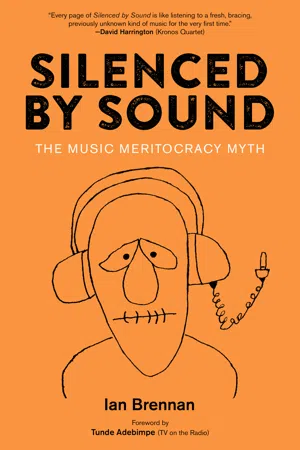
Popular culture has woven itself into the social fabric of our lives, penetrating people's homes and haunting their psyches through images and earworms. Justice, at most levels, is something the average citizen may have little influence upon, leaving us feeling helpless and complacent. But pop music is a neglected arena where concrete change can occur—by exercising active and thoughtful choices to reject the low-hanging, omnipresent corporate fruit, we begin to rebalance the world, one engaged listener at a time. Silenced by Sound is a powerful exploration of the challenges facing art, music, and media. Ian Brennan delves into his personal story to address the inequity of distribution in the arts and demonstrates that there are millions of talented people around the world more gifted than the superstars for whom billions of dollars are spent to promote the delusion that they have been blessed with unique genius. Silenced by Sound is defined by muscular, terse, and poetic verse, and a nonlinear format rife with how-to tips and anecdotes. The narrative is driven and made corporeal via the author's ongoing field-recording chronicles, his memoir-like reveries, and the striking photographs that accompany these projects. After reading it, you'll never hear quite the same again.
- 304 pages
- English
- ePUB (mobile friendly)
- Available on iOS & Android
eBook - ePub
About this book
Information
VIII.
FAMILY RESEMBLANCE:
We’re All Just Passing Through
50
Dangerously Similar Others:
False Friends
He threw a missing punch, just hanging there.
I knew I should run, but didn’t.
And then he burst out laughing.
I’d called his bluff.
Like a catapult,
we were destined to become best friends.
There is nothing that one can hate quite as much as oneself, for there is no escape. We are quartered.
The common assumption is of neighbors being alike. But often they are even more inclined to resent one another due to sharing space, and the wars and disputes that can bring.
Like siblings mad-dogging each other over Thanksgiving dinner, the resemblance is too close for comfort. Border towns share each other’s backwash.
The same dynamic drives my Rwandan mother-in-law to detest our daughter possessing a nappy-haired doll. She angrily insists that if we were fit parents, we would replace it posthaste with a white and “normal” one instead “like everybody else.”

Ustad Saami surveys his own city block, a world abuzz to itself.
FIELD-RECORDING CHRONICLE
Pakistan:
God Is Not a Terrorist
Hawks crowd the skies above Karachi as a blessing. They are fed scraps from animal sacrifices due to the prayers of the nonverbal being thought to reach God more powerfully.
Seventy-five-year-old Ustad Saami risks his life daily in Pakistan to keep alive his microtonal, pre-Islamic, multilingual (Farsi, Sanskrit, Hindi, the ancient and dead language of Vedic, gibberish, Arabic, and Urdu) music. He is the only vocal practitioner of Surti left in the world, which was handed down by his ancestors for over a thousand years, and when he passes, this music will most likely die with him as well. Extremists resent his work, as they do anything predating Muhammad.
In the land where Osama Bin Laden last hid, Master Ustad Naseeruddin Saami has spent his entire life mastering the nuances of every given note.
It has been said that India once had a region where all of the preeminent singers came from. And that place is Pakistan.
One of just nine countries to possess nuclear arms—and the only Islamic nation to do so—the Pakistani state is so feared that the governmental advisory was for its staff to not stay in hotels anywhere in the entire country—any hotel. About as daunting a travel warning as could be issued.
Driving in from the airport I noticed a man cleaning what I thought a musical instrument but then realized was a machine gun. Weaponry is another visual motif throughout the city. En route, we passed celebrity-soldier-sponsored billboards for house paint. Here, army officers carry a similar hollow cachet to reality stars in America.
“To sing is to listen.” These are the words of the master. The translation of his own last name, Saami, even means “to hear.”
For him, everything centers on one note. From that, all else grows and music is seen as a sixth sense for people to better communicate with each other.
Almost every musical system known starts with five notes and then enlarges as players add decoration through passing notes. With great precision, Saami utilizes forty-nine notes versus the West’s mere seven. That means that for a single Western note, his customized Surti system contains the same number of intervals between each as is in our entire scale. The genesis of this Surti spectrum came from a mixed-race royal whose lifelong endeavor was to make peace with duality, and Ustad has cobbled his own vision together from multiple ancient sources. It is related to the predecessor to Qawwali music named Khayál, an Arabic word for “imagination” and in it the melody carries the meaning. The lyrics instead are almost incidental during these call-and-responses.
Ustad Saami believes that the rigid divisions of what are and are not notes has done “violence” to music and he is trying to restore “lost” pitches.
The much internationally hyped Qawwali music (due to Nusrat Fateh Ali Khan having been championed by a bona fide rock star in the 1980s) has mystic origins but is now used mostly for celebrations. Therefore, it is kept alive by what are essentially wedding singers and, as with all party music, has unavoidably been corrupted by its commercialization.
In contrast, Jazz’s trajectory was the reverse. It started as commercial fare (barrelhouse-piano entertainment for brothels) that was melded into an art form by its inheritors. Jazz was the rare case where the shift from dancing to seated and close-listening music did not tame but resulted in greater abstraction.
Today, neophyte, urbane media moguls tell master Saami that he doesn’t know how to sing, since his notes fail to align on their disinfected and dumbed-down grid. Engineers unable to see his notes on their Pro Tools program, assume that it’s the artist and not the machine that is mistaken. But it is the uneven pitches that the master values. They are the most searching. Those with even numbers, too stable.
A compounding cultural force is that extremists strive to drive the music out of Islam, viewing it as having no place in a righteous society. So now instead of beckoning, the five calls to prayer are barked over intercoms around the clock, coarsely and off-pitch. The master’s taking on female students is yet another sore point.
Harmonium, the instrument that is now so strongly associated with the region, was actually introduced by missionaries and banned from the radio until 1962. That was D-Day culturally for Pakistan. The instrument restricted music to off/on keys, excluding other possibilities.
Faced with fretted instruments in America, African abductees and their descendants simply picked up beer bottles and butter knives—along with any other household tool nearby—to slide across the neck, ignoring the dictated framework to instead float and hover over notes of their own design—literally transcending the sonic shackles that’d been imposed.
As we sat being interviewed by a local Karachi journalist in a hotel lobby, there was comedy to the endless loop of Christmas songs that impregnated every corner, and badly rendered MIDI versions, at that.
Pakistan was created by the largest mass migration in history as Muslims and non-Muslims swapped sides of the border. Most westward migrants ended up in the port city of Karachi with the promise that they would eventually be relocated and integrated throughout Pakistan. But that promise remains unfulfilled and these relative newcomers remain cordoned off throughout the city, with neighborhoods forming microregions that reflect wherever they migrated from in India before first alighting.
As he sings, Ustad shapes the notes with his hands like playing a Theremin. Most masters now hide their knowledge, possessively passing their skills down through family only. Subsequently, traditions have withered and died. Master Saami’s mission is to share his knowledge freely with the world, so that the music can potentially continue on.
The emphasis on creating deadened rooms for recording has always struck me as a signifier of why so many records end up sounding lifeless. Though overdubbed recordings can layer sounds, they lack the sympathetic overtones that can only be created when elements physically coexist and resonate with one another in real time, beyond the control of anyone and anything but the elements at hand.
What antiseptic methods expunge are the sounds that are suggested, but not entirely there. Yet it is exactly whatever listeners imagine is happening that can be every bit as important as that which actually is. Saami’s album was performed entirely live on his rooftop while accompanied by his sons who cradled and gently finger-plucked three-foot-high, hand-carved, family heirloom drones on either side of him.
With the musicians’ tongues reddened and teeth devastated from chewing paan, we recorded all night long, taking only a brief break for a meal. In the morning, after the sun had come up, the younger players were understandably collapsed from exhaustion. The master, though, displayed markedly more energy than when we’d begun the night before. He urged the others to keep going, though unsuccessfully. His power proved too much for them to keep pace.
WEED-LIKE ROOTS
Not Nearly the Best,
but Still Enough
I regularly mowed the lawn of an elderly neighbor who had a laugh that sounded more like hate. He’d sit shaded on his patio and watch me bake beneath the sun, then begrudgingly hand over whatever coins he could find in his pocket.
Eventually, I managed to save enough to buy my mother tickets to see Tom Jones, the only artist she’d ever expressed any interest in.
It was the height of his sex-god fame, and I found myself the only other male in a sold-out theater. For the duration of the concert, a procession of fans approached the stage. After waiting their turn, without missing a line Sir Jones would dutifully towel his neck and face with the handkerchief that each person came armed with. The women would then walk away squealing and often inhaling the scent.
My mother was too timid to advance forward. So I made my way slowly in the dark.
Ever the showman, he instantly spotted the gag—a nine-year-old fat kid had to be good for a laugh.
After having busted trashy, over-the-top poses for an hour, he gasped for breath and leaned down, showering me with sweat. The stage was strewn with bras, panties, and bouquets that had been hurled at his feet as offerings. He asked what it was that I wanted. He towered over me even more atop his platform heels.
“This is for my mom. But she’s too shy.”
It brought down the house. When I walked back to my seat, my mom hugged me harder than she ever had before, around the neck, as if it were for the last time.
It was at that moment that I knew that to elicit such happiness—no matter how fleeting—a singer’s job must be among the most sacred to be found.
51
Fueled by Fear
An OB/GYN doctor told me that every woman she’s attended during a delivery protests that they cannot go on with labor at the exact moment that it begins in earnest.
This is in much the same way that a majority of relationships splinter right as true intimacy—and the fright it brings—emerges. Through an overabundance of self-sabotage, legions leave...
Table of contents
- Cover
- Title Page
- Copyright
- Oblivion Embrace
- Contents
- Preface
- Foreword
- Introduction
- Prologue Don’t Call Me Baby: I wrote you a love song on an air-sickness bag
- I. De-Rigging the System: Spitting Out the Spoonfed Shit
- II. False Friends: The Perils of Underestimation
- III. Music Matters: The Trivial Should Not Be Trivialized
- IV. Liberating Spirit Through Sound: Choosing Life over Things
- V. Raising Our Voices: Singing Back the Tidal Wave
- VI. Losing the Human Race: Compartmentalization Coffins
- VII. We First: Rising above Compulsive Competitiveness
- VIII. Family Resemblance: We’re All Just Passing Through
- Afterword
- About The Author
Trusted by 375,005 students
Access to over 1.5 million titles for a fair monthly price.
Study more efficiently using our study tools.
Frequently asked questions
Yes, you can cancel anytime from the Subscription tab in your account settings on the Perlego website. Your subscription will stay active until the end of your current billing period. Learn how to cancel your subscription
No, books cannot be downloaded as external files, such as PDFs, for use outside of Perlego. However, you can download books within the Perlego app for offline reading on mobile or tablet. Learn how to download books offline
Perlego offers two plans: Essential and Complete
- Essential is ideal for learners and professionals who enjoy exploring a wide range of subjects. Access the Essential Library with 800,000+ trusted titles and best-sellers across business, personal growth, and the humanities. Includes unlimited reading time and Standard Read Aloud voice.
- Complete: Perfect for advanced learners and researchers needing full, unrestricted access. Unlock 1.5M+ books across hundreds of subjects, including academic and specialized titles. The Complete Plan also includes advanced features like Premium Read Aloud and Research Assistant.
We are an online textbook subscription service, where you can get access to an entire online library for less than the price of a single book per month. With over 1.5 million books across 990+ topics, we’ve got you covered! Learn about our mission
Look out for the read-aloud symbol on your next book to see if you can listen to it. The read-aloud tool reads text aloud for you, highlighting the text as it is being read. You can pause it, speed it up and slow it down. Learn more about Read Aloud
Yes! You can use the Perlego app on both iOS and Android devices to read anytime, anywhere — even offline. Perfect for commutes or when you’re on the go.
Please note we cannot support devices running on iOS 13 and Android 7 or earlier. Learn more about using the app
Please note we cannot support devices running on iOS 13 and Android 7 or earlier. Learn more about using the app
Yes, you can access Silenced by Sound by Ian Brennan in PDF and/or ePUB format, as well as other popular books in Mezzi di comunicazione e arti performative & Teoria e gusto musicale. We have over 1.5 million books available in our catalogue for you to explore.