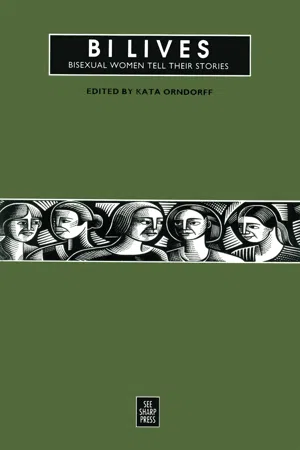
A collection of 18 in-depth interviews with a wide range of bisexual women of different races, ages, and economic classes involved in a very wide variety of lifestyles.
Dannielle Raymond McClintock is a 27-year-old drugstore clerk who lives in San Francisco. She is a “peer safer sex educator” and has been involved with the queer youth movement. Her mother is Lani Ka’ahumanu whose interview also appears in this book.
K: Tell me a little bit about your family background, your class background, and your ethnic background. Were you raised with any religion?
D: My Dad came from a poor working-class family. My mother came from an upper-middle-class family. It was shocking for her when they first started dating, because the families were so different. So I got mixed class influence. I mostly identify with being working class, but in a lot of ways I’m very middle class.
Ethnically, I’m your basic mutt—mainly European, but my maternal grandmother was born in Japan and raised in Hawaii. She’s European, Japanese, and Hawaiian, but mostly identifies as a Polynesian woman. So I was brought up with an awareness of various cultures and of how race impacts experience. Although it was very much a Euro-American culture. The schools I went to were very white. The neighborhood I lived in was mixed ethnically in that there were immigrants from different parts of Europe, but it was still white.
I was raised without a religion, and that was intentional on my parents’ part. My mother was brought up Catholic. The story I always heard is that she was folding my diapers one day and decided she didn’t want to go to church anymore, because she didn’t want my brother and I to be raised with the kind of guilt feelings that she was raised with. So it was a conscious decision that she made when I was a baby. My Dad wasn’t raised with much religion so it was easy for him to go along with our not being brought up in one.
This was in the ‘60s. There was a lot of change going on at that time—a lot of rejection of tradition and a lot of experimentation. My parents were very open to new ideas, and new ways of thinking and being and doing. So I grew up in that environment. I felt encouraged to explore who I was and to feel good about whoever I happened to be.
My parents divorced when I was seven years old, and my mother moved out. She lived in the same neighborhood for the first nine months, then she moved 20 miles away to San Francisco. She and I saw each other regularly and stayed in close contact, but I grew up with my dad. A couple of years after my mother moved out she came out as a lesbian.
K: How was that for you?
D: It was really hard. I was in the fifth grade when she came out, and I was still reeling from the divorce, which was probably the hardest thing that ever happened to me in my life. When my mother came out she wasn’t subde about it. She didn’tjust quietly tell her closest friends and family or have a discreet affair. She was marching in the streets and doing public speaking about it and feeling that it was really important to tell every single soul on the planet.
Approaching adolescence is a very difficult time anyway, but I felt like I had an extra stigma as the child of a homosexual. I felt like I had a big secret. So my first experience of homophobia and of being closeted was as the child of a lesbian. That was a big struggle. By the time I got into high school I was comfortable with my Mom’s sexuality and I told everybody that she was a lesbian. How someone reacted to this information became a barometer of whether or not I wanted to be friends with them, because if they had any problem with it they were obviously somebody that I couldn’t care about.
When I was in the eighth grade my mother figured out that she wasn’t a lesbian, that she was really a bisexual. That was really hard for her, because at that time there was no such thing as a bisexual. By coming out as a bisexual woman she probably lost half her lesbian friends.
K: What enabled you to go from being closeted about your mother’s sexuality to feeling comfortable with it?
D: Initially it wasn’t my choice. I had this friend who I had been friends with since the first grade. My mother, being the kind of person that she is, thought of this friend as her friend too. Since she felt it was important to tell her friends that she was a lesbian, my mother came out to my friend. That was awful for me, because being 12 years old, in junior high school, is probably the worst time that anybody has. I felt that this friend used it against me in certain ways. Fortunately she moved, so after that I didn’t have to worry about her telling everybody at school.
When I was in the eighth grade I met a woman who continues to be my best friend. She told me that my stepbrother had told her about my mom, and she was supportive. That meant a lot to me. She said, “It’s fine. I know lesbians. A lesbian used to be my babysitter.” I had met other kids who had lesbian mothers or gay fathers, but they were all in San Francisco; they weren’t in the suburbs. They were two different worlds to me. So having one friend in the suburbs who was not just tolerant but supportive helped a lot.
I was also getting older with a stronger sense of myself and feeling less worried about peer approval. When you’re approaching adolescence there’s tremendous pressure to feel that you’re just like everybody else whether or not you have a queer parent. I think just getting older and not worrying about being exactly like everybody else contributed to my being able to feel comfortable with my mother’s sexuality.
I have always felt very comfortable with my mother. I always thought that her sexuality was fine. I didn’t think there was anything wrong with it. What bothered me was that everybody else was so freaked out about it. I wasn’t mad at her that she loved women. I was mad at the world for treating her as a pariah for loving women.
K: When were you first aware of sexual attractions and to which gender?
D: Having my mother come out when I was 10 made me hyper-aware of sexuality and sexual identity before I was ready to think about it. Not to say that sexual feelings didn’t occur before then, but they were just part of sensual life. They were not conscious.
Because I had the stigma of having a queer parent, I censored my feelings towards girls. I remember in junior high school being attracted to my girlfriend and absolutely not showing it, not acting on it, not expressing anything remotely close to it, because I was so afraid of people calling me a lesbian. There’re so many things to feel alienated about as an adolescent that if you’re queer on top of it, or you think you might be, it’s really hard. That’s why the suicide rates are so high for young people who are attracted to people of the same sex. Also because I was a child of divorce and a child of a queer parent, I felt that the whole world was watching me to see how these things were going to affect me. I felt a lot of pressure to be the perfect child.
K: Did you date in high school and junior high?
D: I always had flirtations with boys. It was expected, but that’s not the only reason why I was doing it. I’m a very sexual person so I started exploring sexually. I was kissing boys by late junior high school. Then in high school I seriously dated a number of boys and was sexual with them.
I began to identify as bisexual when I was in high school. It just felt natural to me to call myself bisexual, because I was attracted to men and I was attracted to women. My actual physical experiences were mostly with boys at the time, but I acknowledged to myself that I felt attracted to girls as well. It was very easy to find guys to date. It was very hard for me to find any women.
I would get crushes on women, and they would get totally freaked out if I tried to do anything about it, which I don’t think is unusual. I tried a number of different times to expand my relationships with female friends in high school, and they were completely unresponsive. Some would get mad. I had a couple of women reciprocate interest but be too freaked out about the idea to actually do anything sexual with me.
When I got out of high school I kept trying to date women, and I kept having awful experiences while having successful relationships with men. When I was 20 years old it got to the point that I thought, “Maybe I’m not bisexual. Maybe I’m just fooling myself. Maybe I’m just doing this because my mother’s bisexual, and I want to check it out.”
Then I was in a relationship with a man for almost four years. When we broke up I was 24 years old, and I thought, “This is it. I’m single. I’m going to make my last ditch effort to be with a woman, and if it doesn’t work out I’m going to drop this bisexual identity.” I was not in a relationship with anyone for about a year, and in that time I was going out to the women’s clubs and being where there were other women who liked to sleep with women.
Then I met Ann, the partner that I have right now. We’ve been together for over two years. We had this really fun flirtation for a little while, and then we went on a date. It was just like fireworks, and then a totally mad rush to spend time together and get to know each other. It was very intense.
K: Tell me about your current situation.
D: I’m living with my partner, Ann. We’ve been together for a lite over two years. We’re engaged to be married next summer, and we’re planning our wedding. Everybody knows about it: my family, my dad, my stepmother, my mother, my extended step family and my extended queer family. Everybody is very supportive and very excited. I even got the approval of my best friend from the eighth grade, Dawn, which is great because she’s never liked anybody I’ve dated. Nobody’s ever been good enough, and Ann is.
K: Why did you decide to get married since this is not going to be legally recognized by the state?
D: For me marriage is only partially a legal relationship. For me a marriage is a public declaration of my love for the person I am marrying and my commitment to our relationship. I am gathering before my community, my friends, my family, and my God to make a public declaration of my commitment to this person for the rest of my life with the expectation of my community’s support for this commitment. That’s what it’s all about. We can’t get the legal protections and recognition that a heterosexual couple get, but we’re going to do as much of that as we can through legal contracts. We’re going to have power of attorney for each other and wills, but we can never fully duplicate what a differing-gender couple can get with one signature, $35 and a blood sample.
K: Are you and Ann monogamous?
D: Yes, we are monogamous.
K: Is the situation you’re currently in with Ann your ideal in terms of what you want in a relationship?
D: For me it is. I don’t think that it is for everybody, but I’m a very coupling kind of person. I don’t feel like I’m dependent on being in a couple for my security and identity, but I find it very comfortable to be coupled. There’s an intimacy that can be created over time. You could do this with somebody you’re not monogamous with too, but I find just being with one person over a period of time you move into deeper layers of relating through getting to know each other, while you’re getting to know yourself at the same time. That’s just most comfortable for me in a couple.
K: Is Ann lesbian or bisexual?
D: Ann is lesbian.
K: How does she feel about your being bisexual?
D: She loves me, so I guess it’s okay that I’m bisexual, but it definitely was an issue when we first got together. She had a lot of biphobia, a lot of misunderstanding, a lot of knee-jerk reaction about it. There’s always the issue of, “If you’re bisexual and we’re living in a homophobic society, why would you choose to be with a woman?” Which to me is mind boggling because it’s such a pleasure to be with her. Why would I not choose to do that?
K: How have you resolved this? Why is she with you, a bisexual woman?
D: Because I’m a wonderful person. Because we are really good for each other. We have a lot of fun together. We have a lot of sim...
Table of contents
Cover
Titlepage
Copyright
Contents
Introduction
Preface
Acknowledgements
1. Dannielle
2. Anuhea
3. Margarita
4. Peg
5. Sonya
6. Rosa
7. Mary
8. Lani
9. Susan
10. Vidya
11. Rachel
12. Judy
13. Carol
14. Michelle
15. Casey
16. Pamela
17. Revi
18. Diana
Appendices a. Safer Sex (by Rowan Frost)
B. Resources for Bisexual Women (by Robyn Ochs)
C. Additional Resources
Trusted by 375,005 students
Access to over 1.5 million titles for a fair monthly price.
Study more efficiently using our study tools.
Frequently asked questions
Yes, you can cancel anytime from the Subscription tab in your account settings on the Perlego website. Your subscription will stay active until the end of your current billing period. Learn how to cancel your subscription
No, books cannot be downloaded as external files, such as PDFs, for use outside of Perlego. However, you can download books within the Perlego app for offline reading on mobile or tablet. Learn how to download books offline
Perlego offers two plans: Essential and Complete
Essential is ideal for learners and professionals who enjoy exploring a wide range of subjects. Access the Essential Library with 800,000+ trusted titles and best-sellers across business, personal growth, and the humanities. Includes unlimited reading time and Standard Read Aloud voice.
Complete: Perfect for advanced learners and researchers needing full, unrestricted access. Unlock 1.5M+ books across hundreds of subjects, including academic and specialized titles. The Complete Plan also includes advanced features like Premium Read Aloud and Research Assistant.
Both plans are available with monthly, semester, or annual billing cycles.
We are an online textbook subscription service, where you can get access to an entire online library for less than the price of a single book per month. With over 1.5 million books across 990+ topics, we’ve got you covered! Learn about our mission
Look out for the read-aloud symbol on your next book to see if you can listen to it. The read-aloud tool reads text aloud for you, highlighting the text as it is being read. You can pause it, speed it up and slow it down. Learn more about Read Aloud
Yes! You can use the Perlego app on both iOS and Android devices to read anytime, anywhere — even offline. Perfect for commutes or when you’re on the go. Please note we cannot support devices running on iOS 13 and Android 7 or earlier. Learn more about using the app
Yes, you can access Bi Lives by Kata Orndorff in PDF and/or ePUB format, as well as other popular books in Social Sciences & LGBT Studies. We have over 1.5 million books available in our catalogue for you to explore.