1
Fear or Terror on Every Countenance: Yellow Fever
The production of yellow fever by the injection of blood-serum that had previously been through a filter capable of removing all test bacteria is, we think, a matter of extreme interest and importance.
Reed and Carroll, 1902 (33)
Introduction
In 1793, within two decades of the writing of the Constitution of the United States and the Declaration of Independence, Philadelphia experienced an outbreak of yellow fever which shredded the fabric of civil society. While the Declaration of Independence and the Constitution have stood as blueprints for the philosophical and practical bases of representative government, the understanding of yellow fever at that time was still mired in the miasma of pre-germ theory speculation.
The first case of yellow fever in the Philadelphia 1793 outbreak was recognized in August by Benjamin Rush as the “bilious remitting yellow fever” (34). As the outbreak grew, there was no consensus on its origin. Rush attributed it to “putrid coffee” which “had emitted its noxious effluvia” after being dumped on a dock. The College of Physicians was “of the opinion that this disease was imported to Philadelphia by some of the vessels which were in the port after the middle of July.” The role of the mosquito as a vector for disease was not to be recognized until decades later. In the 1793 Philadelphia outbreak, “Fear or Terror was set on every countenance.” The effect on families was devastating. In reporting the horror of the desertion of sick wives by husbands, the desertion of sick husbands by wives, and the departure of parents from sick children, Mathew Carey, another contemporary observer, noted that those actions “. . . seemed to indicate a total dissolution of the bonds of society in the nearest and dearest connexions. . . .” He commented on “the extraordinary panic and the great law of self-preservation . . .” (6). Rush reported on the exodus, “The streets and roads leading from the city were crowded with families flying in every direction for safety in the country” (34). J. H. Powell, the modern-day chronicler of the 1793 Philadelphia epidemic, noted that business languished and public administration virtually halted. With widespread sickness, over 40,000 deaths, and diminished population, the economy of the city collapsed. It was not until November 1793 that the city began to rebound, “. . . a time of recovery—of moral, psychological, intellectual reconstruction” (28).
Rush, who remained in the city, worked relentlessly, at times seeing upwards of 150 people in a day. At the end of his 1794 account of the epidemic, Rush tells of the effect on himself in a “Narrative of the state of the Author’s body and mind . . .” (34). Following the death of his sister, he wrote, “. . . my short and imperfect sleep was disturbed by distressing or frightful dreams. The scenes of these were derived altogether from sickrooms and graveyards.” This courageous, indefatigable physician embodied the paradox of latter 18th-century Philadelphia, which was the site of advanced social-governmental thinking but backward in scientific-medical thinking.
Beyond his medical pursuits, Rush was an advanced social thinker, a delegate to the Continental Congress, and a signer of the Declaration of Independence. He promoted improved conditions for mental patients and prisoners, promoted education, and promoted the abolition of slavery (35a). Yet Rush also reflected the confusion and ignorance of infectious diseases before the advent of laboratory methods. Ascribing yellow fever to the effluvia of putrefying coffee, he treated infected individuals with powerful purging and bloodletting and considered all diseases derived from one cause, comparing the “multiplication of diseases” to polytheism (34). Unrecognized at this time was the association of microbes with infectious diseases, which would come in the next century, along with the recognition that specific insect species could be vectors for disease transmission.
Elsewhere, too, outbreaks of yellow fever were seen as striking suddenly and “in an unaccountable fashion.” A chronicler of epidemics of colonial America, John Duffy quoted from an outbreak in Charleston “. . . ‘the Distemper raged, and the destroying Angel slaughtered so furiously with his Avenging Sword of Pestilence’. . . .” (13). Thus, the metaphors of divine punishment, of an angry God, were the means of understanding the ravages of infection. The people were reduced to struggling with the effects of the epidemics: “‘nothing was done but carrying medicines, digging graves, (and) carting the dead . . .’” (13).
The understanding of infectious diseases was to change dramatically in the next century, with the work of Louis Pasteur and Robert Koch establishing the germ theory. Just about a century after the 1793 yellow fever outbreak, the first understanding of viruses as filterable agents requiring living cells for propagation was established separately in the 1890s by Dmitri Ivanowski (20) and Martinus Beijerinck (3). Shortly thereafter, yellow fever was the first human virus shown to be a filterable agent (30). With the Philadelphia epidemic of 1793 as a dramatic backdrop, the details follow of how germ theory was proven and how the concepts of viral diseases, including yellow fever, were experimentally determined.
Germ Theory
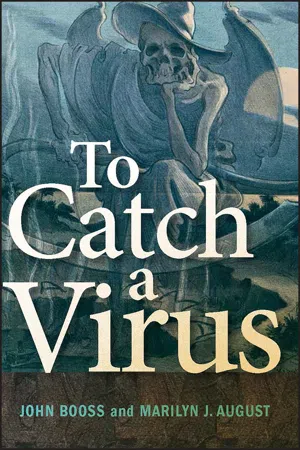
Seeing with one’s own eyes is important for understanding the causation of infectious diseases. The microscopic or submicroscopic size of microbes was the root cause of centuries of misunderstanding of infectious diseases. For millennia, diseases were conceived as the work of demonic spirits, the wrath of God, or the miasmic emanations of decaying matter (40). These “invisible” microbes spawned massive epidemics and fear (Fig. 1). The reigning theoretical concept of disease causation was that of humoralism, of an imbalance of the four humors: blood, phlegm, black bile, and yellow bile. Interventions such as bleeding and purging were designed to restore the balance of the humors. The concept originated with Hippocrates and Galen and held sway for centuries (15). It did not account for microbes as the cause of infectious illness.
Figure 1 Specter of death waiting over Panama (U. J. Keppler, 1904). Yellow fever, which had been termed “the American Plague,” struck Philadelphia in 1793. It later threatened the construction of the Panama Canal, as shown in this cover illustration for Puck, a political satire and humor magazine. (Courtesy of Beinecke Rare Book and Manuscript Library, Yale University.)
doi:10.1128/9781555818586.ch1.f1
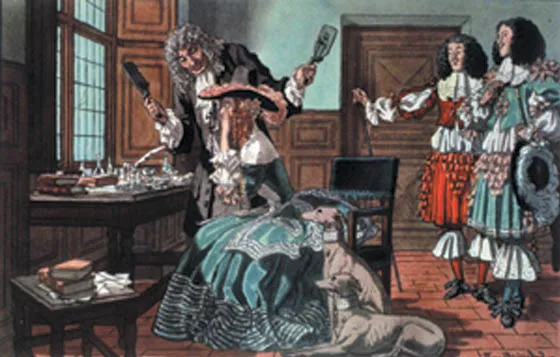
That is not to say that there weren’t glimmers of recognition of transmissible infectious agents. Girolamo Fracastoro (Fracastorius), whose poem about the shepherd Syphilis named that disease, wrote of its contagiousness in the 16th century (11). In his 1546 work On Contagion, he described germs as transmitters of disease (41), according to Garrison the first scientific statement on the nature of contagion (15). However, it was with the development of the first crucial piece of laboratory equipment, the microscope (4), that the particulate microbial nature of infectious diseases was visualized. With improved magnifying lenses introduced by Antony van Leeuwenhoek and Robert Hooke in the 17th century, it was finally possible to describe the microscopic world (16). van Leeuwenhoek called bacteria “animalcules” (Fig. 2).
Figure 2 van Leeuwenhoek exhibiting his microscopes for Catherine of England (painting by Pierre Brissaud). Leeuwenhoek first described bacteria viewed through his early microscopes as “animalcules.” (Courtesy of the National Library of Medicine.)
doi:10.1128/9781555818586.ch1.f2
In the 19th century, Louis Pasteur laid to rest the magical thinking implicit in an unseen world when he disproved the theory of spontaneous generation. This advance relied on a second crucial innovation: artificial growth medium in which microbes could visibly multiply. Pasteur’s swan-necked flask contained a growth-supportive fluid, which showed turbidity when exposed to the atmosphere and remained clear and uninfected when unexposed. Further, Pasteur’s studies with silkworms established the crucial concept that specific pathological conditions were associated with specific causes—a concept we now take for granted (12). After years of experimentation with the silkworm diseases pébrine and flacherie, Pasteur demonstrated their causation and means of prevention by eliminating the offending microbes.
Robert Koch, the genius who laid bare the specific causes of infectious diseases, refined the tools for laboratory diagnosis of infection (Fig. 3). He markedly facilitated the viewing of microbes through a microscope with the development of a substage condenser, a lens that concentrates light from the source through the object studied. The visualization of microbes was further enhanced through the application of histological stains to differentiate the organelles from other structures in specimens (5). With his development of photomicroscopic methods, Koch was a...