Provides a clear and accessible summary of all stages and aspects of the discovery, design, development, validation and clinical use of anticancer drugs
This new edition provides an update on the current state of the art of cancer chemotherapy and clinical practice and presents new pipeline anticancer agents and promising therapeutic strategies that are emerging alongside new breakthroughs in cancer biology. Its unique approach enables students to gain an understanding of the pathological, physiological, and molecular processes governing malignancy, while also introducing the role of health professionals and scientists in the research and treatment of cancer.
Invaluable for its clarity and accessibility, Cancer Chemotherapy: Basic Science to the Clinic, 2nd Edition offers complete coverage of the scientific and clinical aspects of the creation, development, and administration of drugs or drug regimens used in the treatment of the disease. Chapters look at: cancer epidemiology and histopathology; carcinogenesis; current research; tumor hypoxia; antiangiogenic and antivascular agents; protein kinase and Ras blockers; new targets associated with development such as Hedgehog and Wnt signaling; stem cells; immunotherapy and oncolytic viruses; and more.
Presents a clear, accessible, and comprehensive approach to cancer chemotherapy from basic science to clinical practice
Offers a major update that reflects the latest developments in personalized chemotherapy
Provides in-depth coverage of advances in biomarker diagnostics
Includes new chapters/sections on bioinformatics and the 'omic sciences'; pharmaceutical strategies used to achieve tumor-selective drug delivery; and cancer cell autophagy
Combines descriptions of both clinical protocol and explanations of the drug design process in one self-contained book
Features numerous diagrams and illustrations to enhance reader understanding
Aimed at upper undergraduate, graduate, and medical students, Cancer Chemotherapy: Basic Science to the Clinic, 2nd Edition is also an excellent reference for health professional, especially clinicians specializing in Clinical Oncology, and their patients who want to gain an understanding of cancer and available treatment options.
The art of war is of vital importance to the State. It is a matter of life and death, a road either to safety or to ruin. Hence it is a subject of inquiry which can on no account be neglected.
– Sun Tzu
Cancer is not a new disease. Humans are not the only species to get cancer. In fact, cancer is found throughout the animal kingdom. Therefore, hominids were likely to have suffered from cancer before the advent of Homo sapiens.
The history of cancer is evidenced by traditional medicines used by many cultures around the world. These “folk remedies” actually serve as the basis of many medical treatments used today. Many of these natural products are discussed in subsequent chapters of this book.
Perhaps the earliest reference to cancer can be found in the writings of the ancient Egyptian physician Imhotep from around 2600 BCE (see Figure 1.1). In papyrus documents dating from this period, Imhotep describes treating breast tumors with cauterization. The procedure was evidently less than successful since he instructs the reader, “Tumor against the god Xenus … do thou nothing there against.” Unfortunately, even today we are left with questions about whether side‐effects of some treatments are worse for patients than the disease.
Regardless of its history, cancer is a huge problem today, and is likely to become an even larger problem tomorrow. About 14 million people were diagnosed with cancer in 2012, and 18 million in 2018. This trend is daunting, with the number of new cases expected to reach 24 million by 2035.
1.1 Cancer Incidence and Mortality
Over 14 million people around the world are diagnosed with cancer each year, and this number is expected to rise. By current estimates, more than one in three people will develop a form of cancer at some point in their lifetime. Around 10 million people died from cancer in 2018. Thus, cancer kills an average of over 15 people every minute. A comprehensive understanding of cancer incidence and outcomes is an important step toward decreasing these numbers.
Figure 1.1 Statue of the Egyptian physician Imhotep (ca. 2600 BCE).
Cancer incidence, defined as the number of new cases arising in a period of time, is gender and age specific. In males, prostate cancer is the most prolific, where over 1 million new cases were diagnosed in 2018, accounting for around 8% of all new cancer cases and 15% of all new cancer cases in men. In females, breast cancer continues to be the most common tumor type. Over 2 million new cases were diagnosed in 2018, making it the second most common cancer. Breast cancer represents about 12% of all new cancer cases, and 25% of all cancers in women.
Cancer incidence may be further defined by the lifetime risk of developing the disease. For instance, in females, the risk of developing breast cancer is 1 in 8. In males, the risk of developing prostate cancer is 1 in 6; however, 80% of men who are 80 years old are likely to have some stage of prostate cancer. Some other tumor types also show considerable gender‐related differences in cancer risk. For example, males are over twice as likely to develop lung cancer as women worldwide. However, lifestyle can be a factor for some of these differences. For instance, the chance of women getting lung cancer increases in countries such as the USA where women are more likely to smoke tobacco than in some other regions of the world.
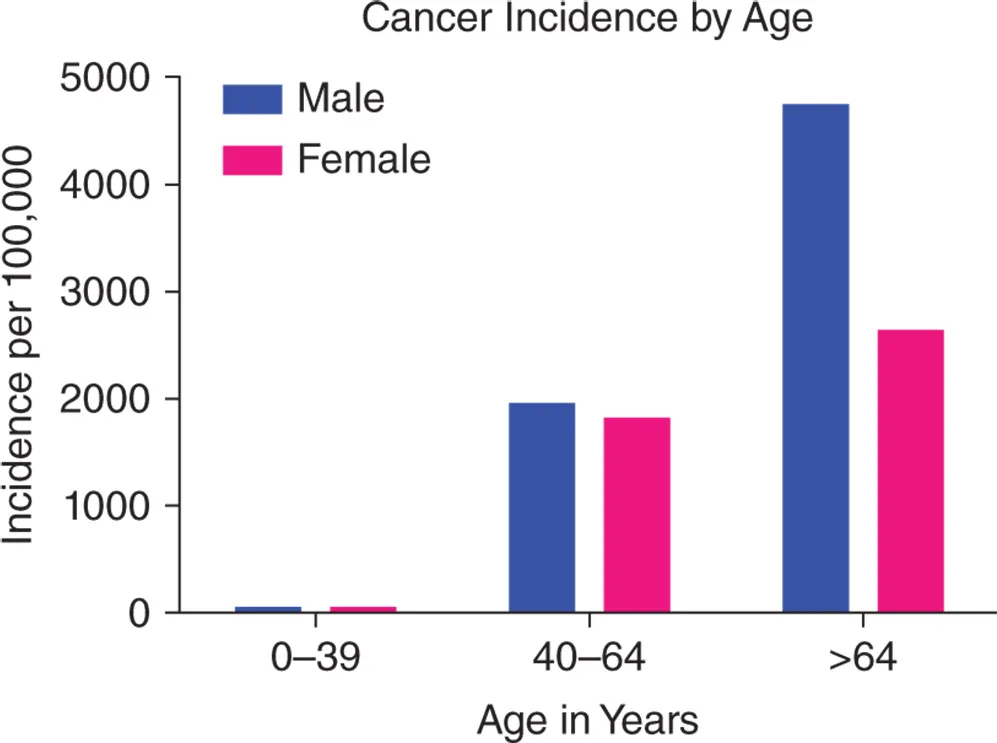
Figure 1.2 Worldwide cancer incidence by age. Statistics are shown for 2012.
Source: Data from http://gco.iarc.fr/today.
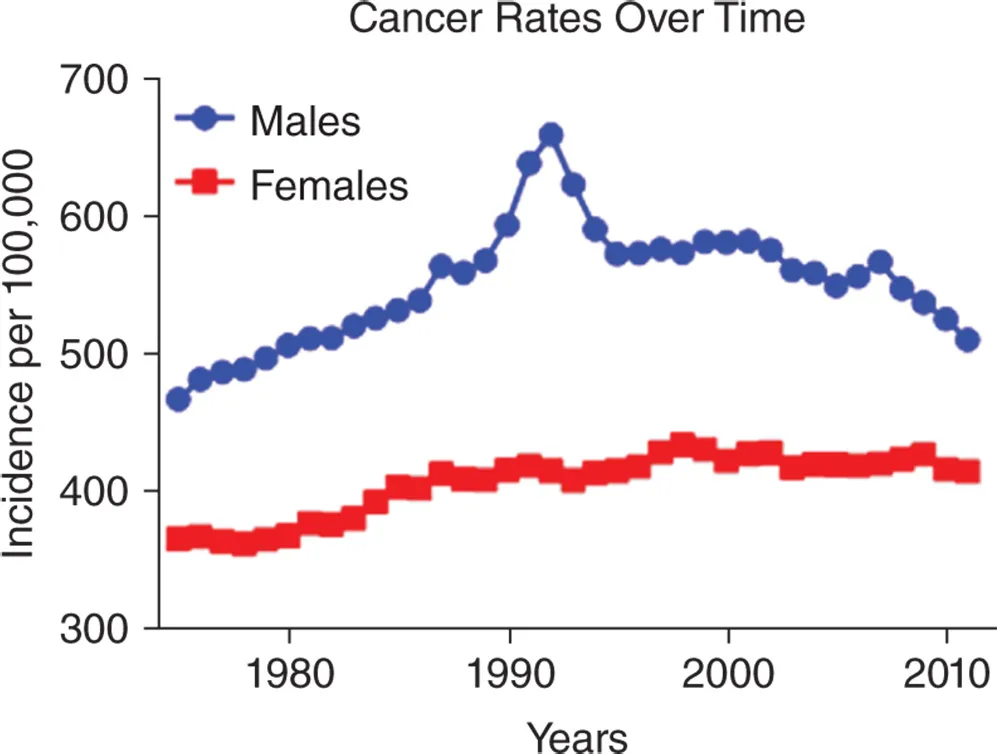
Figure 1.3 Cancer rates over time. Invasive cancers from SEER 9 areas (San Francisco, Connecticut, Detroit, Hawaii, Iowa, New Mexico, Seattle, Utah, and Atlanta) age adjusted to 2000 USA population.
Source: Data from http://gco.iarc.fr/today.
In general, cancer risk increases with age, as shown in Figure 1.2. For example, less than 50 people per 100 000 under 39 years old were diagnosed with cancer in 2012. This number increased to over 1800 people between 40 and 64 years old, and over 3500 people older than 64 years. The rate of diagnosis in males 65 years or older rises most sharply with an incidence of over 4700 per 100 000.
Cancer is a major public health problem and is expected to become even worse. Cancer incidence rates have been steadily increasing over time. This is true for both males and females. However, regional spikes and dips can be seen in trends over time. For example, a spike in male cancers is seen in the 1990s in some areas of the United States, as shown in Figure 1.3. This spike has ebbed but incidence is still higher now than it was 40 years ago. In contrast, female cancer incidence has steadily climbed in these same areas over time.
Incidence rates of some types of cancer appear to be increasing more than others. Sites with annual cancer incidence increases of 1% of more include melanoma, renal, thyroid, pancreas, and liver. Meanwhile, although incidence rates are less than 1% per year, cancers such as non‐Hodgkin lymphoma, certain childhood cancers, leukemia, myeloma, testicular, and oral cancers are still on the increase. Cancer is the second leading cause of death in the USA and UK (behind heart disease). In fact, cancer causes about 25% of all the deaths in these countries.
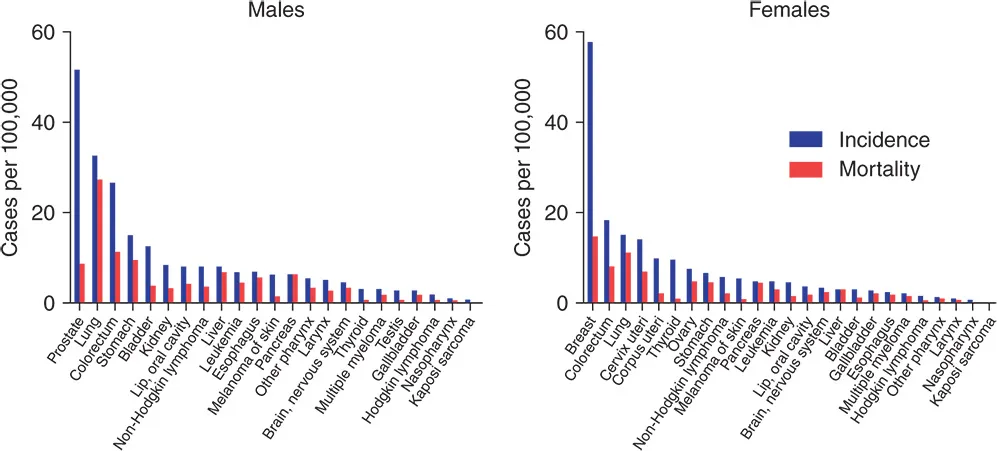
Figure 1.4 Cancer incidence and mortality by tumor site. Numbers from IARC member countries (Germany, France, Italy, United Kingdom, USA, Australia, Austria, Belgium, Brazil, Canada, Denmark, Finland, India, Ireland, Japan, Norway, Netherlands, Qatar, Republic of Korea, Russia, Spain, Sweden, Switzerland, and Turkey) are shown for 2012.
Source: Data from...
Table of contents
Cover
Table of Contents
Preface
About the Companion Website
1 Cancer Epidemiology
2 Cancer Histopathology
3 Carcinogenesis
4 Molecular Biology of Cancer
5 Cancer Metastasis
6 Health Professionals and Cancer Treatment
7 Principles of Cancer Chemotherapy
8 Cytotoxic Compounds
9 Antimetabolites and Hormonal Blockers
10 Cancer Research
11 Clinical Trials
12 Tumor Hypoxia
13 Antiangiogenic and Antivascular Agents
14 Protein Kinase and Ras Blockers
15 Modulating Global Gene and Protein Expression
16 Stem Cells – Telomerase, Wnt, Hedgehog, Notch, and Galectins
17 Immunotherapy and Oncolytic Viruses
18 Pharmaceutical Problems in Cancer Chemotherapy
Index
End User License Agreement
Trusted by 375,005 students
Access to over 1.5 million titles for a fair monthly price.
Study more efficiently using our study tools.
Frequently asked questions
Yes, you can cancel anytime from the Subscription tab in your account settings on the Perlego website. Your subscription will stay active until the end of your current billing period. Learn how to cancel your subscription
No, books cannot be downloaded as external files, such as PDFs, for use outside of Perlego. However, you can download books within the Perlego app for offline reading on mobile or tablet. Learn how to download books offline
Perlego offers two plans: Essential and Complete
Essential is ideal for learners and professionals who enjoy exploring a wide range of subjects. Access the Essential Library with 800,000+ trusted titles and best-sellers across business, personal growth, and the humanities. Includes unlimited reading time and Standard Read Aloud voice.
Complete: Perfect for advanced learners and researchers needing full, unrestricted access. Unlock 1.5M+ books across hundreds of subjects, including academic and specialized titles. The Complete Plan also includes advanced features like Premium Read Aloud and Research Assistant.
Both plans are available with monthly, semester, or annual billing cycles.
We are an online textbook subscription service, where you can get access to an entire online library for less than the price of a single book per month. With over 1.5 million books across 990+ topics, we’ve got you covered! Learn about our mission
Look out for the read-aloud symbol on your next book to see if you can listen to it. The read-aloud tool reads text aloud for you, highlighting the text as it is being read. You can pause it, speed it up and slow it down. Learn more about Read Aloud
Yes! You can use the Perlego app on both iOS and Android devices to read anytime, anywhere — even offline. Perfect for commutes or when you’re on the go. Please note we cannot support devices running on iOS 13 and Android 7 or earlier. Learn more about using the app
Yes, you can access Cancer Chemotherapy by Gary S. Goldberg, Rachel Airley, Gary S. Goldberg,Rachel Airley in PDF and/or ePUB format, as well as other popular books in Medicine & Oncology. We have over 1.5 million books available in our catalogue for you to explore.