As you have probably noticed, there are quite a few investing books out there. Many of them were written by some of the world's greatest investors. So, why should you read our book?
Stock investing is more prevalent than ever, whether directly or indirectly through brokerage accounts, exchange-traded funds, mutual funds, or retirement plans. Despite this, the vast majority of individual investors have no training on how to pick stocks. And, until now, there hasn't been a truly accessible, easy-to-understand resource available to help them. The Little Book of Investing Like the Pros was written to fill this void.
We believe the simplicity and accessibility of our stock picking framework is truly unique. Using real-world examples and actual Wall Street models used by the pros, we teach you how to pick stocks in a highly accessible, step-by-step manner. Our goal is straightforward—to impart the skills necessary for finding high-quality stocks while protecting your portfolio with risk management best practices.
Our practical approach is designed to help demystify the investing process, which can be intimidating. This training will help set you apart from others who are largely flying blind.
Pilots require extensive training before receiving a license. Doctors must graduate medical school, followed by a multi-year residency. Even those providing professional investment advice require certification. But, anyone can buy a stock without any training whatsoever. While buying stocks on a hunch and a prayer may not endanger your life, it can certainly put your finances at risk.
Chapter One Step I: Idea Generation How do you find investment ideas?
There are tens of thousands of publicly-traded companies on various stock exchanges around the world. So, where do you begin? The search for investment ideas takes many forms. At a basic level, it starts with reading … a lot. Stay on top of industry standards, such as Barron's, Bloomberg, Grant's, The Financial Times, and The Wall Street Journal, and broaden from there. Successful investors pay attention to what is going on in the world.
Your search also extends to everyday life and the products and services around you. There are countless stories of people who found great stock ideas inspired by observations from their daily lives. What are people buying? Where are they shopping? What are they talking about? What websites are they visiting?
Many investors take a bottom-up approach, which focuses on the fundamentals of individual companies. Within bottom-up, several common sources of investment ideas are prevalent. These include undervalued companies, “earnings compounders,” operational improvement and turnaround stories, M&A, spin-offs, restructurings, and capital return. Evaluating these opportunities requires a basic understanding of business drivers, financial analysis, and valuation. You didn't go to business school? Don't worry—bottom-up investing is the primary focus of our book and we've got you covered in the chapters ahead.
Others employ a top-down approach, whereby they search for opportunities based on macro or secular themes. These themes are expected to drive accelerated earnings growth and ideally the revaluation of a particular sector. Key macro top-down strategies center on global market trends and business cycles, as well as movements in interest rates, currencies, and commodities. Secular themes include changing consumption patterns, product penetration rates, and demographics, as well as emerging technologies, structural competitive shifts, and regulatory developments.
Experienced investors tend to incorporate elements of both bottom-up and top-down in their approach. Even the most ardent fundamentals-based investors are highly attuned to the macro environment. It is imperative to understand the impact that certain scenarios can have on individual stocks. As the saying goes: “If you don't do macro, macro will do you.”
The process of generating ideas requires great patience and discipline. You may need to review hundreds of companies before a high-quality opportunity stands out. Therefore, it is critical to know where to look and what to look for.
While certain techniques are prevalent, each investor develops a distinct style with its own nuances and variations. The experience-based nature of investing means that professional investors tend to fine-tune their idea generation techniques over time. Even the most seasoned pros must evolve and adapt to dynamic market conditions, adding various bells and whistles along the way.
Screens
Screening tools are helpful for efficiently sourcing investment ideas. Screens allow you to use customized criteria to sift through large databases of companies to identify stock opportunities. Pros run screens on a regular basis in their continuous search for ideas.
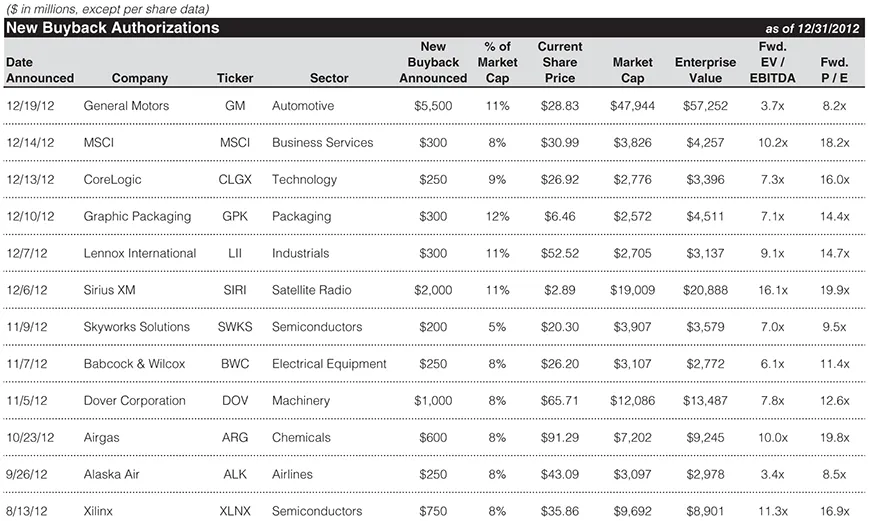
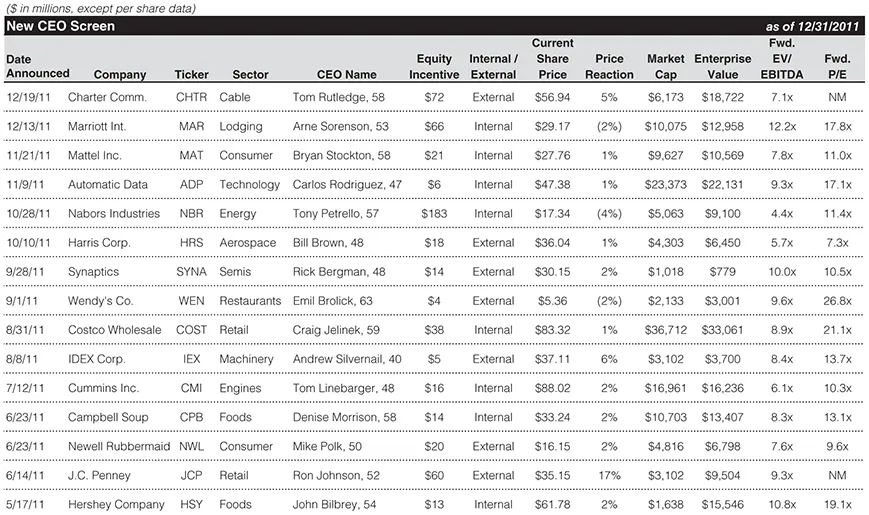
A bottom-up screen might target stocks trading below a specified valuation level or growing above a certain rate. Another might focus on recent M&A transactions, upcoming IPOs, new share repurchase authorizations, or companies with new CEOs (see Exhibits 1.1A and 1.1B).
A top-down investor with a thesis on increasing oil prices would screen for energy sector opportunities in combination with financial criteria. Alternatively, a thesis might center on the secular trends of increasing broadband usage or mobile device proliferation. Here, the screen would focus on sub-sectors within Tech, Media & Telecom (TMT) with additional filters for selected financial metrics.
A multitude of stock screening tools are widely available online for free or at relatively low cost (e.g., Yahoo! Finance). At a minimum, you should set up alerts from financial news sources (e.g., Google Alerts, WSJ) that automatically pick up newly announced corporate events. More advanced tools that are highly customizable can be accessed from subscription services, such as Bloomberg.
EXHIBIT 1.1A Screening Output—Buyback Authorizations >5% of Market Cap & Market Cap >$1 billion
Bottom-up investing is a company-first approach to identifying attractive stocks. You start with the individual company and perform in-depth analysis on its business drivers, financial performance, valuation, and future prospects. This type of work forms the basis of traditional stock picking.
Common bottom-up investment strategies include long-only, long/short, and event-driven/special situations. Others focus on specific sectors or geographies. The long-only strategy is centered on buying and holding a portfolio of quality stocks, often with a long-term perspective. Long/short layers in a shorting strategy to protect against specific stock or sector risks, overall market risk, or to produce returns in its own right (see Chapter 5). An event-driven/special situations strategy focuses on corporate actions such as M&A, spin-offs, and buybacks.
As shown in Exhibit 1.2, certain areas have proven to be fruitful for sourcing quality investment ideas. For example, “value investors” tend to focus on undervalued stocks that are misunderstood by the market. Stock pickers also look for companies undertaking shareholder-friendly activities, such as buybacks, M&A, and management upgrades.
EXHIBIT 1.2 Bottom-Up Approach
Bottom-Up Approach
Valuation
Financial Performance
Mergers & Acquisitions
Spin-offs & Divestitures
Restructurings & Turnarounds
Buybacks & Dividends
Initial Public Offerings
Insider Buying & Ownership
CEO Changes
Tracking Successful Investors & Activists
Valuation – traditional valuation screens seek to identify stocks that are “cheap,” usually on the basis of a valuation multiple. It is, however, important to distinguish between companies that are cheap because they are misunderstood vs. those that deserve to be.
Financial Performance – financial metrics and trends are critical for identifying potential winners and losers. Improving fundamentals may signal a compelling investment opportunity, e.g., accelerating growth rates, expanding profit margins, deleveraging, and improving returns. Companies with inferior margins vs. peers merit analysis on whether they can close the gap.
Mergers & Acquisitions – M&A can create substantial long-term value for shareholders. This is especially true when acquirers undertake transformational acquisitions or “bolt-ons” that are accretive and portfolio enhancing. Identifying sectors “in play” can lead to opportunities among both acquirers and targets.
Spin-offs & Divestitures – transactions where a company “spins” (distributes to existing shareholders), IPOs, or sells one or more of its businesses/divisions. Spin-offs and divestitures aim to unlock or highlight the full value of distinct businesses currently under one corporate umbrella.
Restructurings & Turnarounds – restructurings are situations where a company emerges from bankruptcy/reorganization with a public equity listing, typically accompanied by a stronger balance sheet. Turnaround situations exist outside of formal bankruptcies and restructurings. Any troubled company represents an opportunity to explore the potential for dramatic improvement.
Buybacks & Dividends – two main methods for returning cash to shareholders. For buybacks, companies engaging in first-time, systematic, or substantial share repurchases (e.g., >5% of the public float annually) are particularly interesting. For dividends, new initiations, sizable yields, or increasing payout ratios1 merit exploration.
Initial Public Offerings – first-time public offerings by companies, including those owned by private equity (PE) 2 and venture capital (VC) firms. Often, these companies are offered at a discount to peers and may not be well-understood by the market due to lack of a public track record or comps.
Insider Buying & Ownership – senior executive(s) purchasing substantial stock in their company may signal that the shares are undervalued or there is significant value creation ahead. Correspondingly, proven CEOs t...
Table of contents
Cover
Series
Title Page
Copyright
Dedication
About the Authors
Foreword by Howard Marks
Acknowledgments
Disclaimer
Introduction
Chapter One Step I: Idea Generation
Chapter Two Step II: Identifying the Best Ideas
Chapter Three Step III: Business & Financial Due Diligence
Chapter Four Step IV: Valuation & Catalysts
Chapter Five Step V: Investment Decision & Portfolio Management
Post-Mortem: Delphi Automotive
Bibliography & Recommended Reading
End User License Agreementk
Trusted by 375,005 students
Access to over 1.5 million titles for a fair monthly price.
Study more efficiently using our study tools.
Frequently asked questions
Yes, you can cancel anytime from the Subscription tab in your account settings on the Perlego website. Your subscription will stay active until the end of your current billing period. Learn how to cancel your subscription
No, books cannot be downloaded as external files, such as PDFs, for use outside of Perlego. However, you can download books within the Perlego app for offline reading on mobile or tablet. Learn how to download books offline
Perlego offers two plans: Essential and Complete
Essential is ideal for learners and professionals who enjoy exploring a wide range of subjects. Access the Essential Library with 800,000+ trusted titles and best-sellers across business, personal growth, and the humanities. Includes unlimited reading time and Standard Read Aloud voice.
Complete: Perfect for advanced learners and researchers needing full, unrestricted access. Unlock 1.5M+ books across hundreds of subjects, including academic and specialized titles. The Complete Plan also includes advanced features like Premium Read Aloud and Research Assistant.
Both plans are available with monthly, semester, or annual billing cycles.
We are an online textbook subscription service, where you can get access to an entire online library for less than the price of a single book per month. With over 1.5 million books across 990+ topics, we’ve got you covered! Learn about our mission
Look out for the read-aloud symbol on your next book to see if you can listen to it. The read-aloud tool reads text aloud for you, highlighting the text as it is being read. You can pause it, speed it up and slow it down. Learn more about Read Aloud
Yes! You can use the Perlego app on both iOS and Android devices to read anytime, anywhere — even offline. Perfect for commutes or when you’re on the go. Please note we cannot support devices running on iOS 13 and Android 7 or earlier. Learn more about using the app
Yes, you can access The Little Book of Investing Like the Pros by Joshua Pearl,Joshua Rosenbaum in PDF and/or ePUB format, as well as other popular books in Business & Investments & Securities. We have over 1.5 million books available in our catalogue for you to explore.