eBook - ePub
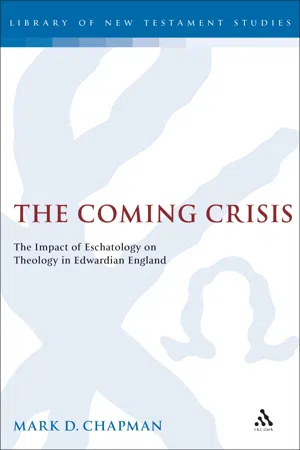
The Coming Crisis
The Impact of Eschatology on Theology in Edwardian England
- 194 pages
- English
- ePUB (mobile friendly)
- Available on iOS & Android
eBook - ePub
About this book
This is a compelling case study of a distinctive theological theme - the eschatological interpetation of the historical Jesus in Edwardian England - as an attempt to add greater precision to the history of theology in a neglected period. Looking at the impact of Adolf Harnack, Alfred Loisy, Albert Schweitzer and Johannes Weiss on biblical studies and theology before the First World War, Chapman argues that the future course of theology, in which eschatology played such a crucial role, was already mapped at this time. Assessing the work of William Sanday F.C. Burkitt and George Tyrrell, Chapman looks at the theological diplomacy between Britain, France and Germany and uncovers a cultural crisis that made eschatology such an appealing idea.
Information
Chapter 1
INTRODUCTION: THE PROBLEM OF ESCHATOLOGY AND THE EDWARDIAN CRISIS
After the First World War the doctrine of ‘eschatology’ had become such a commonplace in theology that Karl Barth could boldly proclaim in a well-known passage in his Epistle to the Romans: ‘If Christianity be not altogether restless eschatology, there remains in it no relationship whatever with Christ’.1 Similarly, in his history of twentieth-century German-language theology, Heinz Zahrnt saw the dominance of eschatology after the First World War as one of the great turning points in modern theology.2 The importance of eschatology after the First World is undeniable, yet, perhaps because of histories of theology (of which Zahrnt’s is a good example) which have regarded the First World War as a kind of caesura, few commentators have looked in detail at the emergence and the significance of eschatology in the years before 1914.3 What is offered in this book is a case study of one distinctive theological theme—the eschatological interpretation of the historical Jesus in Edwardian England—as a modest attempt to add greater precision to the history of theology in a neglected period. It will become clear that the future course of theology, in which eschatology played such a crucial role, was, to some extent at least, already mapped some years before the deluge of the First World War. Indeed the War may have served merely to accelerate theological currents that were already well under way.
The relative ease with which an eschatological interpretation of the historical Jesus, particularly as developed by Albert Schweitzer in his book Von Reimarus zu Wrede,4 made inroads into England is far from self-explanatory, and it certainly baffled many contemporary commentators. For instance, Ernst von Dobschütz, who was one of more widely-read German theologians in England before the First World War (and who will be discussed in detail below), asked in his lectures on eschatology given at the Oxford Summer School in Theology in 1909:
I wonder how it happened that [Schweitzer’s] theory [i.e. thoroughgoing eschatology], put forth in the form of a history, or rather an historical review, of the research on the life of Christ in the last hundred years ‘from Reimarus to Wrede’ [1906], met with much more appreciation in England than in Germany.5
Similarly, looking back in 1951, J.K. Mozley remarked: ‘As to Schweitzer’s work, it is not too much to say that for a quarter of a century New Testament study in England has been continually concerned with the interpretation that he gave of the Kingdom of God in the preaching of Jesus’.6 Indeed, as the Dean of Wells Cathedral remarked to F.C. Burkitt, one of the leading figures in the reception of Schweitzer in England, so important had eschatology become that it had grown into a ‘blessed word’.7 Although Schweitzer’s book was not without some immediate (albeit slight) impact in his native Germany,8 it is one of the quirks of the history of theology that the ‘thorough-going eschatology’ developed there should have exerted significantly more influence in England, at least in the years immediately after its publication.9
If my interpretation of the story of the reception of eschatology into English theology in the Edwardian period is plausible, this study should also assist in clarifying some of the difficulties of Edwardian social history. Although the twists and turns of the story are complex and sometimes surprising, what should become clear is that theological ideas, while not necessarily direct products of their social and historical context, gain academic and ecclesial currency in response to broader social, political and intellectual movements. As Gregory Baum remarked in relation to the use of a sociology of culture in theology: ‘Theologians often tend to regard the variations of doctrine and theology simply as a development of ideas, without paying sufficient attention to the socio-political reality, of which this development is a reflection’.10 It is surely implausible to suggest that it was simply accidental that an eschatological picture of Jesus, which viewed him primarily as an apocalyptic preacher, should have gained currency in a society in which the relatively harmonious social order of Victorian England had reached breaking point.
In summary, what will be argued is that under the impact first (and to a very limited extent) of Alfred Loisy, and then (far more decisively) of Johannes Weiss and Albert Schweitzer, the picture of the historical Jesus changed for many English theologians. No longer was he seen as the comfortable and relatively safe ethical teacher with a decidedly Johannine flavour who had dominated the preceding Victorian culture; instead he became the herald of an apocalyptic crisis, who simply could not be contained within the old liberalism. The fact that the ‘real’ apocalyptic Christ could no longer be tamed11 by the theologians meant that the strange amalgam of eschatology and ethics included in the term ‘Kingdom of God’ was decisively re-ordered.12 This served to disrupt the theological scene with a crisis at least as profound as the social and political crisis described by many contemporary critics. In short, my suggestion is that the revitalization of eschatological theology was an expression of a broader crisis which struck at the very foundations of religion, politics and society.
The Edwardian Crisis13
Like its theology, Edwardian society is hard to characterize. It contains so many contradictions and countercurrents that it is almost impossible to reach any definitive understanding. In the words of a recent historian, it was ‘a ramshackle and amorphous society...capable of evolving contingently in many different ways. It was not (despite the fashionable jargon of the Edwardian era) a coherent “organism”, still less a “corporation”, a “system”, or a “machine”’.14 Despite the best of the efforts of the New Liberals and others to work towards some form of integrated social whole, it seems nevertheless true to say that many of the competing intellectual, social and political currents served, often invisibly, to undermine the sense of social harmony and stability which had marked an earlier generation. Far from being the final triumphant expression of Victorian self-satisfaction, the Edwardian period can be viewed as a period of transition, an ‘interregnum’,15 which contained the germs of the future. Indeed a case study of Edwardian theology provides as clear an example as any of the breakdown of what might be described as the old liberal synthesis; at the same time it reveals emergent expressions of themes which were to dominate in the future.16 As Ensor put it in his classic history of the period:
Most of the familiar post-war tendencies were already developing in [the pre-war years]. The war altered direction less than is often supposed. It accelerated changes—at least for the time being; but they were already germinating before it. It may have been that some would have been carried through more wisely but for the war’s revolutionary atmosphere... What is not [a matter of speculation] is the seething and teeming of this pre-war period, its immense ferment and its restless fertility.17
Although the term ‘crisis’ might in hindsight be something of an overstatement when describing English society in the ten years or so before the outbreak of war in 1914,18 there was undeniably a sense of unease, at least among those in positions of authority.19 This was provoked by many factors, including the increasing number of strikes, the movement for women’s suffrage, the militancy in Ireland, as well as the constitutional crises provoked by the conflict between the Liberals and ‘Mr Balfour’s poodle’, the House of Lords.20 In addition, there was (to some extent at least) an identifiable religious crisis.21 Discussing this growing sense of crisis Asa Briggs remarked:
Edwardian Society was picturesquely but perilously divided, and the greatest of the many contrasts of the age was not with that which had gone before but that between the divergent outlooks and fortunes of different groups within the same community. The implications of the clash of outlooks, fortunes, and tactics could seldom be completely evaded... More particularly during the four years after the king’s death in 1910, there was open and violent internal conflict. Will transcended both law and conviction. The greater international violence of 1914 was a culmination as well as an historical divide.22
All these different symptoms seem to be manifestations of the tensions which accompanied the pluralization and fragmentation of culture in the often disturbing transition from Gemeinschaft to Gesellschafi which characterizes the movement towards an advanced industrial society: social bonds are weakened and the hitherto dominant model of a society held together by a semi-feudal network of duty and obligation collapses as a result of increasing mobility and the concomitant destruction of close-knit communities.23 Yet alongside increasing fragmentation and rootlessness, the movement towards a modern industrial economy was also marked, perhaps somewhat paradoxically, by increasing levels of social uniformity: the machine mentality of the age encouraged suppression of individuality.24 Given these tensions it is hardly surprising that the transition to modernity in England was painful; and that it looked to many like a crisis.
To others, however, there was little cause for anxiety; Paul Thompson writes in his oral history of the period, of a London hatter who remarked: ‘When my Lord comes in to have his hat ironed on those spring mornings in the spring-time of this century I firmly believed that kind of life was to continue forever. Catastrophes might and did happen elsewhere’.25 Such an attitude is evoca...
Table of contents
- Cover
- Title Page
- Copyright
- Contents
- Preface
- Abbreviations
- Chapter 1: Introduction: The Problem of Eschatology and the Edwardian Crisis
- Chapter 2: Harnack, Loisy and the Beginnings of Eschatology
- Chapter 3: William Sanday, Johannes Weiss and Albert Schweitzer
- Chapter 4: F.C. Burkitt and the Failure of Liberal Theology
- Chapter 5: Ethics and Eschatology
- Chapter 6: J.N. Figgis: Eschatological Critique in Edwardian England
- Chapter 7: George Tyrrell: Modernism, Eschatology and the Religious Crisis
- Chapter 8: Conclusion: The Dominance of Eschatology
- Bibliography
- Index of Authors
Trusted by 375,005 students
Access to over 1.5 million titles for a fair monthly price.
Study more efficiently using our study tools.
Frequently asked questions
Yes, you can cancel anytime from the Subscription tab in your account settings on the Perlego website. Your subscription will stay active until the end of your current billing period. Learn how to cancel your subscription
No, books cannot be downloaded as external files, such as PDFs, for use outside of Perlego. However, you can download books within the Perlego app for offline reading on mobile or tablet. Learn how to download books offline
Perlego offers two plans: Essential and Complete
- Essential is ideal for learners and professionals who enjoy exploring a wide range of subjects. Access the Essential Library with 800,000+ trusted titles and best-sellers across business, personal growth, and the humanities. Includes unlimited reading time and Standard Read Aloud voice.
- Complete: Perfect for advanced learners and researchers needing full, unrestricted access. Unlock 1.5M+ books across hundreds of subjects, including academic and specialized titles. The Complete Plan also includes advanced features like Premium Read Aloud and Research Assistant.
We are an online textbook subscription service, where you can get access to an entire online library for less than the price of a single book per month. With over 1.5 million books across 990+ topics, we’ve got you covered! Learn about our mission
Look out for the read-aloud symbol on your next book to see if you can listen to it. The read-aloud tool reads text aloud for you, highlighting the text as it is being read. You can pause it, speed it up and slow it down. Learn more about Read Aloud
Yes! You can use the Perlego app on both iOS and Android devices to read anytime, anywhere — even offline. Perfect for commutes or when you’re on the go.
Please note we cannot support devices running on iOS 13 and Android 7 or earlier. Learn more about using the app
Please note we cannot support devices running on iOS 13 and Android 7 or earlier. Learn more about using the app
Yes, you can access The Coming Crisis by Mark Chapman in PDF and/or ePUB format, as well as other popular books in Theology & Religion & Theology. We have over 1.5 million books available in our catalogue for you to explore.