- 250 pages
- English
- ePUB (mobile friendly)
- Available on iOS & Android
eBook - ePub
About this book
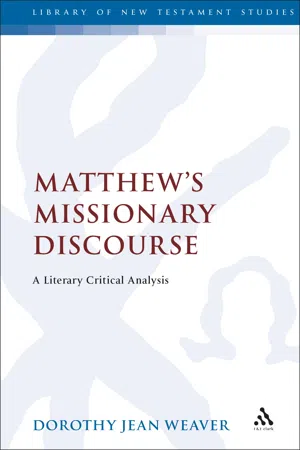
This book offers a distinctive solution to the interpretative difficulties surrounding Matthew's Missionary Discourse. While the discourse proper lies within a narrative framework designating the setting of its delivery, the outlined mission does not at all points agree with the designated setting. Weaver shifts attention from historical-critical to literary-critical concerns. Rather than focusing on the historical setting(s) of the disciples' mission(s), she analyses the role of Mt. 9.35-11.1 within its literary setting in the Gospel and assesses the impact of this text on the reader of the Gospel.
Information
Chapter 1
INTERPRETIVE APPROACHES TO MATTHEW 9.35–11.1: FROM HISTORICAL CRITICISM TO LITERARY CRITICISM
I. Introduction: Description of the Problem
From the standpoint of historical critical studies Mt. 9.35–11.1, the so-called ‘Missionary Discourse’1 of Matthew’s2 Gospel, has long proved problematic to scholars. This passage consists of a discourse of Jesus (10.5b-42) enclosed within a narrative framework (9.35–10.5a and 11.1) which designates the occasion of its delivery. But a closer look at the actual contents of the discourse reveals that certain elements within it do not appear congruent with the setting designated by the narrative framework. A brief comparison of the contents of the discourse with the designated setting will make clear the exact nature of the problem.3
Matthew establishes the setting for the discourse of 10.5b-42 in two ways. He designates the general setting by the position which he gives to the discourse and its narrative framework within his overall account of the life of Jesus. The position of 9.35–11.1 points to a setting within Galilee, where Jesus began his public ministry (4.18, 23) and to which he has just returned following a trip to the other side of the lake to the country of the Gadarenes (8.18, 23, 28; 9.1).
Matthew specifies the more immediate setting for the discourse in the narrative introduction (9.35–10.5a) and the narrative conclusion (11.1). In the narrative introduction he describes the specific events which lead up to the delivery of the discourse: Jesus’ own mission tour through the cities and villages (9.35), his compassion for the crowds whom he encounters (9.36), his plea that the disciples pray for workers to be sent out into the ‘great harvest’ (9.37-38), and his empowering of these same disciples with his own authority to cast out unclean spirits and to heal the sick (10.1; cf. 9.35). Finally, Matthew lists the names of Jesus’ twelve ‘apostles’ (apostolōn), whose designation as ‘sent out ones’ functions to foreshadow the climactic announcement of 10.5a: ‘These twelve Jesus sent out (apesteilen) …’ Matthew has thus identified the setting as a specific occasion during the Galilean ministry of Jesus on which he sends out his twelve disciples on a mission of their own.
Following the discourse of 10.5b-42 Matthew then restates in his narrative conclusion (11.1) the basic elements of the previously established setting. In language strongly reminiscent of 9.35 he gives notice that ‘when Jesus had finished instructing his twelve disciples, he went on from there to teach and to proclaim in their cities’.4 Thus the two halves of the narrative framework (9.35–10.5a and 11.1) together present a unified picture of the occasion on which Jesus delivers the discourse of 10.5b-42.
The discourse itself is a three part speech5 in which Jesus instructs his twelve disciples concerning the mission on which he is sending them. The first section (10.5b-15) lays out the specifics of the disciples’ mission in terms which appear fully congruent with the setting designated in the narrative introduction (9.35–10.5a). The section opens in 10.5b-6 with the command: ‘Do not go out among the Gentiles and do not enter any city of the Samaritans, but go rather to the lost sheep of the house of Israel’. The mission on which Jesus is sending his twelve disciples is thus defined as a mission to Israel (i.e., the Jewish nation)6 at the specific exclusion of both the Gentiles and the Samaritans. The following verses (10.7-14) clarify in detail how this mission to the Jews is to be carried out: the disciples are instructed concerning their proclamation (10.7), their healing ministry (10.8), their means of support for the mission (10.9-10), their strategy for finding lodging along the way (10.11-13), and the steps to be taken in case of rejection in any given town (10.14). Finally, 10.15 concludes this section of the discourse with a solemn warning of what those who reject the disciples and their message can expect on the ‘day of judgment’. Nowhere in these verses are there elements out of keeping with the idea of a mission by the twelve disciples during the time of Jesus’ own Galilean ministry.
The second section (10.16-23), however, presents a more complicated picture. Here different portions of the text offer conflicting evidence concerning the relationship of this section to the setting established in the narrative framework and reinforced in 10.5b-15.
In certain respects 10.16-23 appears to agree with its setting. Verse 16a introduces the section with a repetition of the ‘sending’ motif of 10.2 and 10.5a, this time as a first-person declaration by Jesus: ‘Behold, I send you out (apostellō) as sheep in the midst of wolves’. This opening line thus performs the same function as the opening line of the previous section (10.5b-6), namely, that of linking the verses which follow to the act of ‘sending’ described in 10.5a.
Further, the theme of 10.16-23 can be viewed as a logical—if somewhat startling7—followup to the theme of 10.5b-15. If 10.5b-15 defines the disciples’ mission in terms of the task to be accomplished, 10.16-23 defines that mission in terms of the persecution which the disciples will be certain to face as a result.8 And even the language used to describe this persecution points back to the mission defined in 10.5b-15: in 10.17b Jesus warns that the disciples will be handed over ‘to the [Jewish] councils’9 and flogged ‘in their [i.e., the Jewish] synagogues’, a warning fully in keeping with the Jewishness of the designated setting.
In other respects, however, 10.16-23 appears not to agree with its setting. Following the warning of 10.17b there comes an additional and unexpected prediction (10.18): ‘And you will be led before governors and kings on my account, as a witness to them and to the Gentiles’. In the present setting this reference to ‘governors’, ‘kings’, and ‘the Gentiles’ seems out of place. The prediction that the disciples will be led before an indeterminate number of ‘governors and kings’ points to a mission apparently broader in scope than the present one, which prohibits the disciples from ‘going out among the Gentiles’ and from ‘entering any city of the Samaritans’ (10.5b). The further indication that the disciples will bear witness to ‘the Gentiles’ stands in direct conflict with the absolute prohibition (10.6) against going to any but ‘the lost sheep of the house of Israel’. Thus the prediction of 10.18 effectively bursts the geographical boundaries of the mission initiated in 10.5a and described in 10.5b-15.
And if the prediction of 10.18 is problematic geographically, there are other predictions in this section which are problematic from the standpoint of time. Following a further warning of persecution and hatred for the disciples (10.21-22a), 10.22b offers the promise that salvation awaits the one who perseveres ‘to the end’ (eis telos), an apparent reference to ‘the end of the age’.10 And following a command to the disciples to flee from one city to the next when they are persecuted (10.23a), Jesus provides the reason for this action (10.23b): ‘For truly, I say to you, you will not have completed the cities of Israel before the Son of man comes’.11 Thus 10.22b and 10.23b support each other in bursting the time boundaries of the mission previously described: a mission which extends ‘until the end of the age’ and will not reach its completion ‘before the Son of man comes’ does not coincide chronologically with a mission which occurs within the framework of Jesus’ Galilean ministry.12
In spite of the introduction and the theme of this section, therefore, 10.16-23 does not fit readily into its designated setting. Rather, it seems to depict a mission with considerably broader horizons.
The final section, 10.24–42, paints a similar picture. This section combines the ‘mission’ theme of 10.5b-15 and the ‘persecution’ theme of 10.16-23 by calling for ‘fearless confession’ of Jesus in the face of life-threatening persecution. In doing so, however, it omits any concrete references to the ‘sending’ act described in 10.5a. Instead of opening with the command to ‘go’ (10.6) or with the declaration ‘I send you’ (10.16), this section opens with a generalized definition of the relationship between the ‘disciple’ and the ‘teacher’, the ‘slave’ and the ‘master’ (10.24-25a). Further, while the form of address continues to be that of the second person plural in certain passages (10.26-31, 34, 40), the referents of 10.32-42 are for the most part designated in the third person and in general terms: ‘everyone who …’ (pas hostis + finite verb),13 ‘whoever …’ (hos/hostis … [an] + finite verb),14 and ‘the one who …’ (ho + present/aorist participle).15 Finally, there is no further mention of the original geographical setting (10.6; cf. 10.23), the original time frame (10.5a), or the original recipients of the mission (10.5b-6). As a result, there are no elements in 10.24-42 which specifically link this section to the clearly delineated mission of 10.5a, 5b-15. Rather, the overall generality of this section seems to point toward the broader mission hinted at in 10.16-23.
In light of the above evidence it is clear that 9.35–11.1 presents some difficult questions for its interpreters. Does 10.5b-42 represent a unified discourse which can be interpreted solely in terms of the setting provided by its narrative framework, 9.35–10.5a and 11.1? Or does 10.5b-42 in fact require the assumption of two settings, only one of which is the setting provided by the narrative framework? And if this is so, what then is the second setting?
II. Three Major Historical Critical Approaches to 9.35–11.1: Presentation and Critique
Three major approaches have been taken to the resolution of these questions. But while they differ significantly from each other, these three approaches nevertheless share a basic historical orientation. In each case an attempt is made to interpret 10.5b-42 in terms of an actual historical setting or sequence of settings, i.e., in terms of the life of Jesus and/or of the Matthean church.
The ‘Galilean’ approach
The first approach assumes for the entire discourse a setting within the Galilean ministry of Jesus. H.A.W. Meyer, for example, resolves the apparent contradiction between 10.5b-6 and 10.18 by referring the ‘witness’ of 10.18 not only to the ‘governors’ (hēgemonas) and ‘kings’ (basileis) of the same verse but also to the Jews who are the implicit subjects of the previous verse.16 Accordingly, the disciples’ witness ‘to them and to the Gentiles’ no longer refers to the ‘governors and kings’ of 10.18 on the one hand and to unspecified ‘Gentiles’ on the other. Instead, the witness ‘to them’ is now a witness to the Jews of 10.17, while the witness ‘to the Gentiles’ is a witness to ‘the hēgemonas and basileis and their Gentile environment’.17 Meyer’s tacit assumption appears to be that if he can establish the identity of the ‘Gentiles’ of 10.18 with the ‘governors and kings’ of the same verse, then there will no longer be a contradiction in terms between 10.5b-6 and 10.18. Rather, the reference to ‘Gentiles’ will then be primarily a reference to the secular officials in Palestine before whom Jesus’ disciples will be led as a result of their mission work within Israel.18
J. Lange takes this argumentation one step further by making concrete what Meyer leaves unspecified, namely, the specific identity of these ‘governors and kings’.19 Judging on the basis of Matthean usage, Lange argues that hēgemōn is for Matthew none other than a reference to Pilate (cf. 27.2, 11, 14, 15, 21, 27; 28.14) and that basileus refers to such figures as Herod the Great (cf. 2.1, 3,9), Archelaus (cf. 2.22), and Herod Antipas (cf. 14.9). He therefore concludes that just as Jesus was vulnerable to ‘kings’ (2.13, 22; 14.13), ‘Gentiles’ (20.19), and ‘governors’ (27.11) on Palestinian soil, so also Jesus’ disciples can be brought before ‘governors’ and ‘kings’ even while they are still in Israel.20
Meyer and Lange, accordingly, interpret 10.5b–42 in terms of a single setting within the Galilean ministry of Jesus. And they arrive at their conclusion by arguing that 10.18 is a prediction which found its fulfilment in a one-time mission to Israel by the twelve disciples of Jesus.
But the most well-known attempt to explain 10.5b-42 in terms of a setting within the ministry of Jesus argues in opposite fashion to Meyer and Lange. A. Schweitzer, in his polemic for the eschatological interpretation of 10.23b (‘For truly, I say to you, you will not have completed the cities of Israel before the Son of man comes’),21 starts with the same assumptions as the above scholars: (1) Jesus delivered this entire discourse on a single historical occasion; and (2) this discourse pertained to an immediate mission which was then carried out by Jesus’ twelve disciples. But while the above scholars assume the reliability of Jesus’ prediction that the disciples will meet with persecution on this mission, Schweitzer argues on the basis of 10.23b that Jesus’ predictions in this chapter are mistaken predictions and thus not reliable. Since the Son of man has not ‘come’—as Jesus has predicted in 10.23b that he would - by the time the disciples have returned from their mission,22 it follows that Jesus was mistaken in this prediction as well as in the prediction of the sufferings to befall the disciples.23 Schweitzer thus argues that 10.1...
Table of contents
- Cover
- Title Page
- Copyright
- Contents
- Acknowledgments
- Abbreviations
- Chapter 1: Interpretive Approaches To Matthew 9.35-11.1: From Historical Criticism To Literary Criticism
- Chapter 2: Analysis Of Matthew 1.1-9.34: The Implied Reader’s ‘Pre-Information’
- Chapter 3: Literary Critical Analysis Of Matthew 9.35-11.1
- Chapter 4: Analysis Of Matthew 11.2-28.20: To See The End’
- Notes
- Bibliography
- Index of Biblical References
- Index of Authors
Trusted by 375,005 students
Access to over 1.5 million titles for a fair monthly price.
Study more efficiently using our study tools.
Frequently asked questions
Yes, you can cancel anytime from the Subscription tab in your account settings on the Perlego website. Your subscription will stay active until the end of your current billing period. Learn how to cancel your subscription
No, books cannot be downloaded as external files, such as PDFs, for use outside of Perlego. However, you can download books within the Perlego app for offline reading on mobile or tablet. Learn how to download books offline
Perlego offers two plans: Essential and Complete
- Essential is ideal for learners and professionals who enjoy exploring a wide range of subjects. Access the Essential Library with 800,000+ trusted titles and best-sellers across business, personal growth, and the humanities. Includes unlimited reading time and Standard Read Aloud voice.
- Complete: Perfect for advanced learners and researchers needing full, unrestricted access. Unlock 1.5M+ books across hundreds of subjects, including academic and specialized titles. The Complete Plan also includes advanced features like Premium Read Aloud and Research Assistant.
We are an online textbook subscription service, where you can get access to an entire online library for less than the price of a single book per month. With over 1.5 million books across 990+ topics, we’ve got you covered! Learn about our mission
Look out for the read-aloud symbol on your next book to see if you can listen to it. The read-aloud tool reads text aloud for you, highlighting the text as it is being read. You can pause it, speed it up and slow it down. Learn more about Read Aloud
Yes! You can use the Perlego app on both iOS and Android devices to read anytime, anywhere — even offline. Perfect for commutes or when you’re on the go.
Please note we cannot support devices running on iOS 13 and Android 7 or earlier. Learn more about using the app
Please note we cannot support devices running on iOS 13 and Android 7 or earlier. Learn more about using the app
Yes, you can access Matthew's Missionary Discourse by Dorothy Jean Weaver in PDF and/or ePUB format, as well as other popular books in Theology & Religion & Biblical Studies. We have over 1.5 million books available in our catalogue for you to explore.