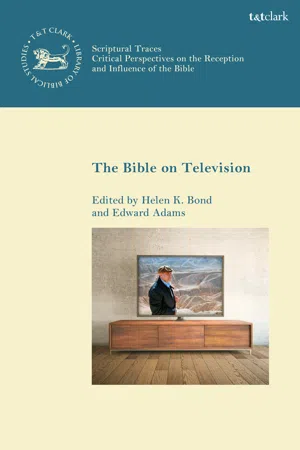
This volume examines and discusses selected Bible documentaries and academically informed dramatizations of the Bible. With a major focus on recent productions in UK mainline television within the past 15 years, the contributors also engage with productions from the USA.
After a critical introduction by Helen K. Bond, charting and reflecting on the use of the Bible on television in recent years, the book falls into three sections. First, a number of influential filmmakers and producers, including Ray Bruce and Jean- Claude Bragard, discuss their work in relation to the context and constraints of
television - especially religious television - programming. The volume then moves to reflections of various academics who have acted as 'talking heads', historical consultants and presenters, allowing discussion of different aspects of the process, including the extent to which they had influence and how their contributions were used. Finally, a number of scholars assess the finished products, discussing what they tell us about the modern reception of the Bible, with additional consideration of how these productions influence biblical scholars and contribute to the scholarly agenda.
- 280 pages
- English
- ePUB (mobile friendly)
- Available on iOS & Android
eBook - ePub
The Bible on Television
About this book
Information
Chapter 1
GENESIS OF THE BIBLE DOCUMENTARY: THE DEVELOPMENT OF RELIGIOUS BROADCASTING IN THE UK
Richard Wallis
Television genres and sub-genres are rarely stable over time. The Bible documentary is a form of factual programme-making that emerged recognizably during the 1970s, reflecting broader stylistic trends in television. Today more than ever, in a climate in which the stakes are high for the winning and retention of audiences, television commissioning editors are caught between a cultural aversion to risk-taking, and an ambition to claim the next big ‘genre-busting’ hit. The consequence of these contradictory pressures is that programme genres are not so much invented as developed through a process of cultivated adaptation and hybridity: a tendency towards small iterative changes. To a significant extent, the template for the modern ‘authored’ documentary remains the seminal Civilisation (BBC, 1969): art historian Kenneth Clark’s personal view of the philosophy, art and architecture of the Western world. The remarkable impact of this thirteen-part series is attributable, in part, to the erudition and urbane authority of its on-screen presenter (Clark was knighted for his achievements), and in part to its visual richness (being one of the first such series to be filmed in colour) establishing the lavish travelogue style. It was this approach that was repeated by Civilisation’s producer, Peter Montagnon, in his subsequent thirteen-part series The Long Search (BBC, 1977), written by the scholar Ninian Smart, which examined the world’s major religions.
There are other reasons, however, why the documentary was embraced as a vehicle for religious programmes during the 1970s, and its particular history should be understood in the context of the evolution of religious broadcasting in the UK more generally. This chapter aims to provide this broader frame. The way in which religious broadcasting was established, and the way it subsequently evolved over its first five decades, is central to understanding how and why the Bible documentary emerged as it did, when it did. As will be seen, the transition from a radio-dominated, to a television-dominated, broadcasting era was marked by a number of important cultural shifts that had significant impact on religious broadcasting practice. It is against this background that the developments that follow (and that are discussed by others in this volume) may be understood. In particular focus here are: the way in which Bible-related themes came to be treated within the documentary genre; the controversies and tensions that have arisen, especially between broadcasters and the churches; and the changing role that advisors and ‘experts’ have played throughout.
Religion on ‘the Wireless’
Religion has been part of broadcasting output in the UK since Christmas Eve 1922, when the Rector of Whitechapel delivered the first ‘wireless’ sermon. In his address, he wondered at the extraordinary technological development that had enabled him, in one moment, to speak to more people than the apostle Paul had done in his entire lifetime. Such technological developments had certainly been profound, but it would be a mistake to assume that it had been technology that had determined the way in which public service broadcasting developed, or that there was anything inevitable about the way in which religious programmes evolved with reference to it. The BBC Charter of 1927 – like the Television Act that was to follow twenty-seven years later – carried no mandatory requirement that religious content should to be produced. Yet religious programmes have played an important part in the story of UK broadcasting since its inception. The way in which this occurred, the forms that programmes took and the role that advisors and experts came to play is largely due to the distinctive and formative role played by the BBC’s first Director-General, John Reith.
Reith was the son of a Presbyterian minister and viewed his position in terms of a ‘calling’.1 He was determined that the BBC should actively promote religion, and that this should be of the right kind. He held strong personal Christian convictions while being generally opposed to narrow dogmatism. Reith wanted the BBC to represent a practical, non-denominational faith, broadly representative of what he thought of as the mainstream of historic Christianity.
As the Sunday evening address became a regular feature of BBC output, Reith established a ‘Sunday Committee’ to provide him with expertise and advice. This small hand-picked group of clerics was intended to be broadly representative of the Christian churches, but crucially, chosen by Reith and not their institutional constituencies. By July 1926 the group had become known as the Religious Advisory Committee, and later, as regional advisory committees were set up, it became the Central Religious Advisory Committee (CRAC). CRAC was to be the model for advisory committees on a number of subject areas during the early years of the BBC, and extended its influence still further with the establishment of ITV. Its central role in the evolution of religious broadcasting, the relationship between it and the religious institutions that it ostensibly ‘represented’ and its defence (and sometimes criticism) of broadcasting practices are an essential part of this story.
CRAC’s early role was primarily to offer advice to the BBC on Sunday speakers. It also provided a line of resistance to sustained criticism of the BBC’s approach to religion, including from many within the churches, some of whom believed that the medium and the message were simply incompatible. In 1923, for example, the Chapter of Westminster rejected the request to broadcast the marriage service of the Duke of York (soon to be King George VI) on the grounds that men in public houses might be listening with their hats on.2 Three years later, the magazine Life of Faith, published a series of letters debating the question of whether or not the very medium was the work of the devil. One contributor demanded: ‘Are we not told to avoid even the appearance of evil? “Come out from among them and be ye separate”. “Touch not the unclean thing”. Are not the world’s pleasures, the wireless, cinema, etc. unclean today?’3 At a purely pragmatic level, there were widespread concerns that the broadcasting of church services might result in a fall in church attendance. At the same time, organizations like the British Humanist Association, the Rationalists and Fabian Society objected to the primacy of place being given to the Christian religion, whilst groups like the Christian Scientists and the Seventh Day Adventists were angered at having been excluded by what the BBC had decided constituted ‘mainstream’.
Against this criticism, Reith enlisted allies from those who shared his own vision for ‘BBC religion’: a version of Christianity best illustrated by his recruitment of Dick Sheppard, vicar of St. Martin-in-the-Fields. Sheppard was initially drafted in to join the Sunday Committee, but subsequently became a major contributor to the BBC’s output, with broadcasts from St Martin’s becoming a staple part of the BBC’s output (continuing to the present). Sheppard’s ‘diffused rather than sectional Christianity’4 was what Reith identified as the middle ground of Christian consensus, and justified in terms of the BBC’s public service duties:
In a national service to which nothing that pertains to the life of men is foreign, it was natural that from the beginning religion should find its place in British Broadcasting. It could not be otherwise. Even if the programmes aimed only at providing education and recreation, religion could not be denied a place; but when those who were responsible for Broadcasting set before themselves the object of raising the national standard of values and of a constructive idealism, it was obvious that the religious service should be one of the regular programme features.5
What was obvious to Reith was not obvious to everyone, yet Reith pursued his vision with energy. Reith wanted more than just church services and epilogues. The first religious ‘talks’ series was God and the World Through Christian Eyes (BBC, 1933). Across two 12-part series’, eminent academics and theologians addressed themselves to a range of subjects broadly grouped around the themes of ‘God’, ‘Christ’, ‘Man and His World’ and ‘Christianity’. In the first series, J. Y. Simpson, Professor in Natural Science at New College Edinburgh, spoke on Science and the Idea of God; Maude Royden, the theologian and suffragist, spoke on God and the World of Art; and the New Testament scholar, C. H. Dodd, spoke on ‘Christ Crucified’. Much effort was concentrated in trying to find the most engaging and convincing speakers to communicate Christian ideas. Being an ardent Sabbatarian, such programmes – and only such programmes – dominated Sunday broadcasting, although nothing was broadcast during the normal hours of church services. Early religious broadcasting on ‘the wireless’, therefore, consisted of a limited Sunday listening diet of mainly church services, sacred music, talks and (sometimes more ambitious) religious educational content aimed at children.
The War Years and After
Reith departed the BBC in 1938. The war years that followed constituted the period that most solidly established the Corporation’s reputation as an institution of national and cultural importance. As well as being a reassuring source of information and entertainment, it also became an instrument of national unity as it developed more of a mass audience appeal. The changes that resulted from the BBC’s role of keeping the nation cheerful were evidenced in all departments, including new opportunities for religious broadcasting. The accessible combination of fireside chat, theology and Christian apologetics made the wartime talks of contributors like C. S. Lewis enormously popular.6
One of the most ambitious projects during this period was The Man Born to Be King.7 James Welch, Director of Religious Broadcasting, commissioned the popular crime writer, Dorothy L. Sayers, to write a dramatization of the life of Christ for the Sunday Children’s Hour. Sayers, who had also written works of theological scholarship,8 agreed, on the condition that the character of Jesus should be portrayed with the same degree of realism as other characters, and not ‘lost in a kind … of Apollinarian mist’.9 The result provoked a good deal of controversy. Many objected to the very idea of a Bible dramatization. The Lord’s Day Observance Society asked the BBC to ‘refrain from staging on the wireless this revolting imitation of the voice of our Divine Saviour and Redeemer’.10 The campaign prompted over two thousand letters of complaint prior to the broadcast, although the subsequent reception of the programmes was mostly favourable. The (eventually acknowledged) success of the series signified that religious broadcasting did not have to be limited to devotional talks and church services.
The BBC television service pioneered from 1936, but closed at the beginning of the war, was re-opened when hostilities ended. Initially television was treated as radio with pictures. The first televised religious programme was a service of consecration of a war memorial chapel at Biggin Hill, transmitted on 15 September 1946, but only an enthusiastic minority had the equipment to view it. It was not until the Coronation of 1953 that general public interest in television was really awakened, although the thought of television cameras violating the ‘rightful intimacy’11 of the ceremony was too much for some. Fears were expressed particularly about intrusion into the sacred environment east of the church screen. After some considerable negotiation and compromise, permission to televise was granted, and the effect of the broadcast on the general public was significant, as for the first time a television audience exceeded a radio audience. The new age of television had dawned.
The Aims of Religious Broadcasting
Throughout the war years, CRAC’s definition of the aims of religious broadcasting remained tru...
Table of contents
- Cover
- Title Page
- Copyright
- Contents
- Notes on Contributors
- Preface
- Introduction
- Chapter 1 Genesis of the Bible Documentary: The Development of Religious Broadcasting in the UK
- Chapter 2 The Bible According to TV
- Chapter 3 Interview with Ray Bruce
- Chapter 4 The Story of Lumo
- Chapter 5 Scholars Working in Television: Some Personal Reflections and Advice
- Chapter 6 Critical Black Christian Body: Opposition and Resistance in the Religious Documentary
- Chapter 7 The Nativity on TV
- Chapter 8 Putting Paul on TV: The Case of David Suchet: In the Footsteps of St Paul
- Chapter 9 How Do ‘Bible-Users’ Respond to the Bible on TV?
- Chapter 10 Plundering Egypt: Exodus Documentaries and the Exploitation of History
- Chapter 11 The History Channel’s The Bible, an Epic …?
- Chapter 12 When the Resurrected Biblical Epic Transferred to the Small Screen … and Promptly Died Again: A Critical Autopsy of the 2016 ABC Series Of Kings and Prophets
- Index of References
- Index of Authors
Trusted by 375,005 students
Access to over 1.5 million titles for a fair monthly price.
Study more efficiently using our study tools.
Frequently asked questions
Yes, you can cancel anytime from the Subscription tab in your account settings on the Perlego website. Your subscription will stay active until the end of your current billing period. Learn how to cancel your subscription
No, books cannot be downloaded as external files, such as PDFs, for use outside of Perlego. However, you can download books within the Perlego app for offline reading on mobile or tablet. Learn how to download books offline
Perlego offers two plans: Essential and Complete
- Essential is ideal for learners and professionals who enjoy exploring a wide range of subjects. Access the Essential Library with 800,000+ trusted titles and best-sellers across business, personal growth, and the humanities. Includes unlimited reading time and Standard Read Aloud voice.
- Complete: Perfect for advanced learners and researchers needing full, unrestricted access. Unlock 1.5M+ books across hundreds of subjects, including academic and specialized titles. The Complete Plan also includes advanced features like Premium Read Aloud and Research Assistant.
We are an online textbook subscription service, where you can get access to an entire online library for less than the price of a single book per month. With over 1.5 million books across 990+ topics, we’ve got you covered! Learn about our mission
Look out for the read-aloud symbol on your next book to see if you can listen to it. The read-aloud tool reads text aloud for you, highlighting the text as it is being read. You can pause it, speed it up and slow it down. Learn more about Read Aloud
Yes! You can use the Perlego app on both iOS and Android devices to read anytime, anywhere — even offline. Perfect for commutes or when you’re on the go.
Please note we cannot support devices running on iOS 13 and Android 7 or earlier. Learn more about using the app
Please note we cannot support devices running on iOS 13 and Android 7 or earlier. Learn more about using the app
Yes, you can access The Bible on Television by Helen K. Bond, Edward Adams, Helen K. Bond,Edward Adams in PDF and/or ePUB format, as well as other popular books in Theology & Religion & Biblical Studies. We have over 1.5 million books available in our catalogue for you to explore.