Celebrated as a poet, novelist and non-fiction writer, and the winner of numerous major literary prizes including the Whitbread Poetry Prize, the T.S. Eliot Prize and the James Tait Black Memorial Prize, John Burnside is one of Britain's leading contemporary writers.
John Burnside: Contemporary Critical Perspectives brings together leading scholars of contemporary literature to guide readers through the full range of the author's writings, from his fiction and poetry to his autobiographical and nature writing, exploring texts such as The Dumb House, The Light Trap, A Lie about My Father, Glister and Black Cat Bone. The book examines the major themes of Burnside's work, including the environment and the natural world, hauntings and dwelling, and his intertextual engagement with philosophy, music and the visual arts. Featuring a timeline of Burnside's life, an interview with the writer himself and a detailed list of further reading, this is the first authoritative guide to this major contemporary writer.
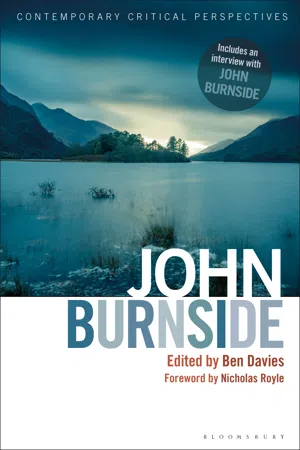
- 176 pages
- English
- ePUB (mobile friendly)
- Available on iOS & Android
eBook - ePub
About this book
Information
1
John Burnside’s Metaphysical World: From The Dumb House to A Summer of Drowning
In his essay ‘Iona: A Quest for the Pagan’ (2000), Burnside says he believes in an ‘underlying pattern that informs the universe’ and a ‘fundamental self’ discerned occasionally by ‘those who have transcended the contingent person’, and that he ‘experienced this authentic ground of being by some process of self-forgetting’ (2000b: 22). In Burnside’s blending of animism and Gnosticism, knowledge comes through physicality, with sensory perception more than the conscious mind providing understanding.
In his second volume of memoirs, Waking up in Toytown (2010), Burnside also notes, not for the first time, that:
When I was a full-scale lunatic, I suffered from a condition called apophenia. This condition, this unease, was described by Klaus Conrad, the schizophrenia specialist who coined the term, as the unmotivated seeing of connections, coupled with the specific experience of an abnormal meaningfulness. In other words, seeing things that weren’t there … For normal folk, this connective faculty allows them to make sense of the world, to find a modest local and hopefully shared order by which to live. For the apophenic, it means a wild and unrelenting search for the one vast order that transcends all others, a hypernarrative, an afterlife … I still suffer from this condition, though only very occasionally. (2010: 5–6)
Burnside’s writing seems to be fuelled by these twin perspectives: a belief in an ‘underlying pattern that informs the universe’, and a ‘fundamental self’, but also a knowledge that such beliefs are coloured by his apophenic sensibility, an ‘unmotivated seeing of connections’ that to different degrees underpins how his principal characters ‘make sense of the world’. It may be this condition that spurs an unrelenting search in his writing for the connective tissue of a hypernarrative, but, if so, Burnside’s distinctive receptivity also contributes significantly to the uniqueness of his poetry and fiction.
For example, in the essay ‘Strong Words’ (2000), Burnside makes clear the basis for his heightened perception of connectedness and for the openness to the non-human world found in his writing. He says we are ‘part of a rich and complex narrative’, that we are human but more truthfully express ourselves as spirits, and as such ‘we also live in eternity’ (2000c: 260). In this chapter, I shall consequently sketch aspects to this responsiveness in Burnside’s novels and then turn to a discussion of the influence of gnostic and alchemical ideas across his writing.
Fictions of Spiritual Connection
Burnside’s first novel sets out distinctive twin perspectives, in characteristically brutal terms. Near the start of The Dumb House (1997), its protagonist, Luke, declares: ‘Happiness, or fulfilment, or whatever else you choose to call it, seems to me to consist of a glimpse of the world as a patterned and limited whole’ (Burnside 1998: 23). To find the essence of this pattern, Luke takes the approach to locating the soul of a hubristic scientist: ‘I believed there would be a moment when the spirit ebbed … I wanted to see what it was like when the life dissolved, leaving nothing but inert matter’ (65). He adds that, ‘Sometimes I managed to open a living body carefully enough to be able to see the heart beating … I knew that, one day, I would discover its essence’ (67).
Despite his psychopathology, Luke is informed by an intimation with which Burnside has sympathy. Luke feels connected to the earth and to some ancient, pagan existence, ‘a manifold spirit, like the genii cucullatii I had read about in a book on pagan Britain: those dark creatures of the verges and borderlines the Romans had adopted as companions to Mercury … if spirits existed, in any form, they would have to be like these: impersonal, neutral, rooted in the physical, utterly remote from human concerns’ (85–6). We later learn that Luke’s teacher, Miss Matheson, tried to explain to him in school that ‘dissection is murder’, and that the imperceptible ‘soul’ is also cut away in such an operation: ‘as soon as you chose to dissect a living thing, you lost its essence, something bled away, something invisible’ (184). Luke nonetheless believes that taking a scalpel to flesh can reveal ‘some filament of preternatural warmth, some subtly of design’ (184). In Luke’s failure, Burnside underlines a conviction of material enquiry’s inability to find this ‘filament’, akin to a statement of hardware’s lack of potential to reveal anything meaningful of the software it enables.1 Similarly, the material world is unable to apprehend the immaterial, so Burnside’s many angels, ghosts, devils and preternatural others, such as the huldra in A Summer of Drowning (2011), are intimations of the essential precondition sought by Luke and that haunts existence.
Like Burnside, Luke is also attracted to the Tibetan Buddhist concept of bardo, an intermediary state ‘to guide the soul through death’ (Burnside 1998: 139), and one that reappears in Burnside’s sixth novel Glister (2008). More complex in its conjectures on the ethereal and spectral than The Dumb House’s search for evidence of a soul, Glister plays repeatedly with the question of whether any putative spiritual essence is ‘intrinsically good’ or ‘a creature that takes up residence in the human body like a parasite and feeds on it, a creature hungry for experience and power’ (Burnside 2008: 236). Burnside’s benign images of spirit draw repeatedly on the traditional symbol of the bird, but in Glister a darker cryptid figure is characteristically caught in the portrayal of the pupal Moth Man, which in part alludes to the supernatural bird creature supposedly sighted in West Virginia in the mid-1960s.2 The Moth Man comes to be equated with the Angel of Death (Burnside 2008: 254), acting like a bardo figure to guide the spirit to another world, but Burnside also calls this figure ‘the necessary angel’, referencing Wallace Stevens’s name for the imagination and subjective reality in ‘Angel Surrounded by Paysans’ (ll. 11–13), which closes Stevens’s collection The Auroras of Autumn (1950). In the poem, a supernatural creature visits the inhabitants of a village to bring them to a renewed understanding of reality:
I am the necessary angel of earth,
Since, in my sight, you see the earth again,
Cleared of its stiff and stubborn, man-locked set.
Thus, in keeping with Burnside’s other quasi folk-tale novels, Glister mythologizes the transformation of an industrial landscape in a way that complements an apophenic understanding of connections between ineluctable and intuited realities, between the visible and the hidden. From one angle, this can be understood in terms of the mythopoeic imagination that informs Burnside’s approach to prose as well as verse. For instance, in his Introduction to a selection of poetry by Stevens, Burnside espouses the view that ‘Poetry is how we imagine the world’ and, as such, is an ‘ontological activity’ inseparable from fundamental understandings of existence and being (Stevens 2008: vii–xiv).
In Burnside’s third novel, The Locust Room (2001), Paul’s housemate Steve has hallucinations of angels and ascensions while recovering in the Fulbourn hospital in Cambridgeshire. Echoing Burnside’s portrayal of himself recovering in the rehabilitation clinic when ‘Waking up in Toytown’ (2010: 1–11), Steve imagines looking in a mirror and seeing ‘a small hole in nature, an emptiness, a loose stitch which, if pulled, might unravel the universe and show its underlying blackness, a blackness like decay, or like the small local darkness that falls each and every time an animal dies’ (2002: 158). The final simile encapsulates a central message of the novel’s specific interest in respect for the sanctity of lives steeped in silence, stealth and solitude. Throughout Burnside’s writing, there is a Manichean dark side to this sensibility, here most clear in the Cambridge rapist, mindful of both himself and the assembly around him in a kind of double-consciousness.3 He is said to be ‘like that invisible presence the Arctic explorers described when they came home from being lost, walking for hours or days in the snow and the dark, with a single unseen companion’ (148).
In Burnside’s previous novel, The Mercy Boys (1999), Sconnie similarly believes ‘there is a real world that we cannot see or directly experience unless we get outside ourselves, unless we forget who we are’ (2000a: 55). A familiar character type in Burnside’s writing of the troubled, questing male experiencing an apophenic perception of preternatural connections, Sconnie is finally victim to a Lawrentian sun-god sacrifice when he becomes prey to Nietzschean murderers, who are reminiscent of Luke in The Dumb House (see Lawrence, The Plumed Serpent, 1926, and ‘The Woman who Rode Away’, 1925; see also, Nietzsche, Beyond Good and Evil, 1886). Sconnie’s own dreamlike epiphany of falling through space as he loses consciousness in a drink-and-drug haze is turned into nightmare as Burnside’s brutal clown-dressed students ritualize their murder of Sconnie in terms of ‘the priests who would open his veins and draw out his soul’ (2000a: 212).
In contrast to Sconnie’s dark interior sun-sacrifice, the narrative’s more central character, Alan, concludes the novel by finding release far from society in the exterior light and space of water. He stands at the shore of the loch with ‘a sense of the life that was waiting to touch him, not just at the surface of his skin, but … as far as whatever it was the soul might be, buried in its house of flesh’ (2000a: 259). While Sconnie dies with a certainty of the waste and banality of his killing, Alan embraces the weightlessness of slipping into water as the words ‘Spirit and light’ run through his mind (265). The close of The Mercy Boys suggests a transition into the intermediate bardo state accompanied by the dream-figure that opened the novel, when in this premonition of his own passing, Alan rescues a bird-like angel that he fears will die in the ‘watery light of Magdalen Green’ (7–8).
In The Devil’s Footprints (2007), as in Glister, the negative of this winged image appears as Michael ponders the embodiment of ‘fear’: ‘a man in the process of becoming a bird, or a bird that had started to become a man, hideously ugly, perhaps, but capable of inspiring pity’ (2007: 34). Michael first imagines that the devil is a living creature ‘somewhere between angel and beast, between Ariel and Caliban’ (4). Only later does he recognize a spectral relation to the fear he himself experiences, when he says:
I felt something rise to the surface of my skin, something old, a forgotten sensation of fear … an apprehension that somehow predated my human existence … All at once, I was aware of a chill, animal pleasure, a continuity between my own flesh and the shadows in the bushes. (134)
He decides at the end of the novel that ‘before it became the devil, that spirit had been something else – an angel, Pan, the genus cucilatus, some wandering breath of wind or light that touched a man from time to time’ (202). Such stories, linking human emotion to mythological presences, also have numerous traces in Burnside’s preceding novel, Living Nowhere (2003), in which spectral manifestations are identified as markers of something that has been long lost to contemporary culture (110). At Jan’s funeral, for example, Tommy wonders what it would be like ‘if all the spirits returned – not just the people, but everything: the animals, the birds, the children dead in childbirth, the trees felled to make way for factories and roads. Think of the slow fade of those ghostly stains on the air, in the grass, in the earth’ (183–4).
Gnosticism and Alchemy
Imagining the co-presence of everything that has existed is one vision of the underlying connective pattern Burnside’s novels speculate upon, but as I suggested at the start, an important strand in Burnside’s ‘wild and unrelenting’ perception of patterns is his interest in Gnosticism and its associations with alchemy. Burnside has said that for him poetry is ‘a form of alchemy’ (2000c: 259) and that he was drawn to Gnostic texts as a student:
some of the Gnostic ideas are actually taken up in alchemy. By ‘alchemy’ I mean a magical process and I saw it then as a kind of metaphor: it seemed to me that changing metal into gold was quite straightforwardly a metaphor for taking incomplete and messed up human mind and spirit and trying to achieve a pleroma or fullness out of that. (Dósa 2003: 13)
The fundamental tenet of Gnosticism, which has had many traditions since its heyday in the second century, is that the route to the divine is through the revelation of knowledge and not through faith, and also that this gnosis is of a particular kind: a direct experiential awareness of the senses rather than a rational understanding in the mind (Martin 2006: 28). Elements of the Gnostic tradition that Burnside incorporates into his writing are numerous, and a list might feature the following examples: the conviction that a gnosis exists in every person not the few and can be awoken by insight (Rudolph 1983: 57); that this insight comes like poetry in an ordinary activity, often ‘a sudden moment of clarity and silence into which something else makes its presence known’ (Martin 2006: 30); an interest in dualisms or binaries, informed by the Gnostic view of two co-existing cosmological and anthropological levels; (Rudolph 1983: 57–67); an understanding of death and resurrection as not embodied but an awakening into a fundamental reality or true nature shielded by immersion in the distracting activities of near-constant social interaction (Pagels 1990: 42); a belief in the divine Mother as well as Father, a dyad embracing male and female elements (Pagels 1990: 71–2); and to an extent a fascination with the idea of the twin, which in Gnostic writing is found in the Gospel of Thomas, attributed to Jesus’s twin brother (Pagels 1990: 47), and from which Burnside is wont to quote.
Burnside says he has no religion but has long been intrigued by spiritual writings and the concept of ‘the soul’ (Burnside 2000b: 22). Echoing the novel extracts I have cited, Burnside elucidates this by explaining that for him the soul is neither immortal nor personal but something experienced in moments of self-forgetting when the individual is detached from social consciousness, absorbed in activity and consequently removed into a more fundamental identity. It would be possible to align this with numerous philosophical theories, but Burnside argues that an ‘underlying pattern that informs the universe … cannot be described, only intuited’ (22–3). This gnosis seems not to be adequately communicable in verbal language, which is why Burnside says that what is ‘needed is an image’ (23). Thus, his fiction foregrounds such symbols as The Devil’s Footprints in the snow, the Glister ship in the chemical factory and the hawthorn tree in Living Nowhere. Chiming with the quotation above from Living Nowhere, Burnside also says these mythemes help him, as a poet and person, to appreciate ‘a pagan sensibility which believed that everything – humans, animals, trees, stones – is connected in an almost sensual way to everything else’ (2000b: 23–4). He suggests that this is what he finds, for example, ‘walking along a beach on an island at the edge of the Atlantic’ where ‘you suddenly see yourself from outside, no isolated figure, but one woven into the continuum of human history’ (25).
To put a name to this, on occasion Burnside...
Table of contents
- Cover
- Halftitle Page
- Title Page
- Contents
- Series Editors’ Preface
- Foreword: Starting Hares (Nicholas Royle)
- Acknowledgements
- Contributors
- Chronology of John Burnside’s Life
- By Way of an Introduction: John Burnside, Writer Ben Davies
- 1 John Burnside’s Metaphysical World: From The Dumb House to A Summer of Drowning
- 2 John Burnside’s Numinous Poetry
- 3 ‘A Temporary, Sometimes Fleeting Thing’: Home in John Burnside’s Poetry
- 4 Violent Dwellings and Vulnerable Creatures in Burning Elvis and Something Like Happy
- 5 ‘This Learned Set of Limits and Blames’: Masculinity, Law and Authority in the Work of John Burnside
- 6 Consequences of Pastoral: The Dialectic of History and Ecology in The Light Trap
- 7 Walking the Tightrope: Félix Guattari’s Three Ecologies and John Burnside’s Glister
- 8 ‘A Kindred Shape’: Hauntings, Spectres and the Poetics of Return in John Burnside’s Verse
- 9 ‘It Was Suddenly Hard Winter’: John Burnside’s Crossings
- The Space at the Back of the Mind: An Interview with John Burnside
- Notes
- Further Reading
- Index
- Imprint
Trusted by 375,005 students
Access to over 1.5 million titles for a fair monthly price.
Study more efficiently using our study tools.
Frequently asked questions
Yes, you can cancel anytime from the Subscription tab in your account settings on the Perlego website. Your subscription will stay active until the end of your current billing period. Learn how to cancel your subscription
No, books cannot be downloaded as external files, such as PDFs, for use outside of Perlego. However, you can download books within the Perlego app for offline reading on mobile or tablet. Learn how to download books offline
Perlego offers two plans: Essential and Complete
- Essential is ideal for learners and professionals who enjoy exploring a wide range of subjects. Access the Essential Library with 800,000+ trusted titles and best-sellers across business, personal growth, and the humanities. Includes unlimited reading time and Standard Read Aloud voice.
- Complete: Perfect for advanced learners and researchers needing full, unrestricted access. Unlock 1.5M+ books across hundreds of subjects, including academic and specialized titles. The Complete Plan also includes advanced features like Premium Read Aloud and Research Assistant.
We are an online textbook subscription service, where you can get access to an entire online library for less than the price of a single book per month. With over 1.5 million books across 990+ topics, we’ve got you covered! Learn about our mission
Look out for the read-aloud symbol on your next book to see if you can listen to it. The read-aloud tool reads text aloud for you, highlighting the text as it is being read. You can pause it, speed it up and slow it down. Learn more about Read Aloud
Yes! You can use the Perlego app on both iOS and Android devices to read anytime, anywhere — even offline. Perfect for commutes or when you’re on the go.
Please note we cannot support devices running on iOS 13 and Android 7 or earlier. Learn more about using the app
Please note we cannot support devices running on iOS 13 and Android 7 or earlier. Learn more about using the app
Yes, you can access John Burnside by Ben Davies in PDF and/or ePUB format, as well as other popular books in Literature & English Literary Criticism. We have over 1.5 million books available in our catalogue for you to explore.