Media discourse is changing at an unprecedented rate. This book presents the most recent stylistic frameworks exploring different and changed forms of media. The volume collates recent and emerging research in the expanding field of media stylistics, featuring a variety of methods, multimodal source material, and a broad range of topics. From Twitter and Zooniverse to Twilight and Mommy Blogs, the volume maps out new intellectual territory and showcases a huge scope, neatly drawn together by leading scholars Helen Ringrow and Stephen Pihlaja.
Contributors write on topics that challenge the traditional notions and conceptualisations of "media" and the consequences of technological affordances for the development of media production and consumption. There is a particular focus on the ways in which contemporary media contexts complicate and challenge traditional media models, and offer new and unique ways of approaching discourse in these contexts.
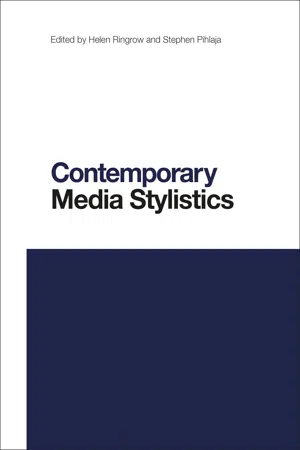
eBook - ePub
Contemporary Media Stylistics
- 344 pages
- English
- ePUB (mobile friendly)
- Available on iOS & Android
eBook - ePub
Contemporary Media Stylistics
About this book
Information
Chapter One
Introduction
Helen Ringrow and Stephen Pihlaja
1 Background
The study of media discourse has long been an established sub-field within applied linguistics. With the development of the internet has come an increasing interest in the influence of different mediated contexts on the interaction among readers and text, including reading practices (Ensslin, 2012; Allington and Pihlaja, 2016), storytelling (Page, 2014, 2018), interaction of readers with texts in online spaces (Rowberry, 2016) and new forms of digital fiction (Shie, 2016; Bell, 2010; Bell, Ensslin and Rustad, 2013). This interest is due in part to the growing ubiquity of media in everyday life and also because the development of technology has created space for new ways in which text and audience interact, for example, with newspaper articles available online (Bruce, 2017). Contemporary media texts now exist in more formats and more platforms, offering stylisticians numerous opportunities to explore the changing shape and style of media discourse.
Contemporary Media Stylistics focuses on the analysis of stylistic features of contemporary media texts, situating these features within their discursive and social contexts. For our purposes, we take a broad and inclusive view of the terms ‘contemporary’, ‘media’ and ‘stylistics’. From the outset, we recognize that ‘(the) media’ is, of course, not one monolithic structure owned and operated by a limited number of powerful actors but refers in its most basic sense to communication that is in some way mediated by technology. Increasingly, day-to-day communication among individuals takes place in technologically mediated contexts, from text messaging to social media and video chats, that embed technology in many of our social relationships. This creates complex issues in how to treat technologically mediated interaction, particularly with increasing ambiguity between private communication and public broadcasting of messages. ‘Media’ is therefore used throughout the chapters in this book to refer to different collections of media types, including YouTube videos, blogs, Facebook pages, Twitter, online chat forums/message boards and newspapers.
As the term ‘media’ can be a problematic category, differentiating between different kinds of media can also be problematic, particularly in the contemporary world. A distinction in the existing literature has been made between ‘old’ and ‘new’ media, with the ‘new’ referring broadly to more recent forms of communication on digital platforms (see Manovich, 2001, for an early discussion of how this term is used) compared with the older technologies that broadcast using analogue technologies (such as radio, television and newspapers). The differentiation between ‘new’ and ‘old’ media has been viewed as having an explanatory property: new media and old media represent not only different technologies but different ways of communicating. However, the ‘newness’ of this so-called new media, as Neary and Ringrow (2018) point out, is difficult to delineate from old media because the shift to digital technologies has meant that much of the old, legacy media (including radio and television) are now often accessed through digital technologies on ‘new media’ platforms on the internet, like the reading of newspapers online (Dovey et al., 2009). Differentiating between the two based on this criterion requires focusing primarily on the technology that is delivering the content to the audience; looking, for example, at a tabloid newspaper article online may be a materially different experience from holding a physical newspaper, but the content of the article could be identical.
Our use of the term ‘contemporary’ attempts to capture this emerging media environment as it exists at the time this book is published. We recognize that the constant development of technology and its incumbent changes to language use means that differentiation between ‘old’ and ‘new’ media is increasingly problematic. We choose to view digital technology as providing new affordances – or ‘action possibilities’ (McGrenere and Ho, 2000) – for interacting with digital content and for interacting with others via mediated platforms. These new affordances can result in an almost identical experience to analogue technologies, or it may have some similarities and some differences, or it may be completely different, with new digital objects and new uses being created with these technologies. However, as Knobel and Lankshear (2014) point out in their discussion of new literacies, technological developments can embody new ‘ethos’ for how texts should be read and how readers interact with them. To that end, we are not primarily interested in how the data is classified but rather in considering how people communicate with one another in technologically mediated contexts. By examining a range of texts, this book explores issues surrounding blurred boundaries of media categorization, in a contemporary media landscape where texts, and their reading and writing practices, are in flux.
Contemporary media, and particularly social media, contexts are often characterized by heightened interactivity and a disappearing distinction between producer and consumer (Seargeant and Tagg, 2014). Audiences both engage with texts in digital forms, such as commenting on online news sites or responding to media texts via Twitter, and generate their own media content on YouTube, Instagram, Periscope and so on. The increase in media interactivity can be seen to have led to ‘the transformation of a previously unidirectional broadcast mechanism to one which is bidirectional and increasingly dialogic’ (Neary and Ringrow, 2018: 305). The binary terms of ‘producer/consumer’ and ‘addresser/addressee’ can therefore not sufficiently capture how people interact with media and within technologically mediated contexts.
Additionally, within these newer settings, pre-existing media audience models are not always sufficient for analysis, particularly given how contemporary media does not offer the audience a neutral picture of the world but rather provides representations with both implicit and explicit ideological positions (Baker, Gabrielatos and McEnery, 2013). This awareness of implicit and explicit ideology has been a long-standing tenet of critical discourse studies (Fairclough, 1995, 2001; Davies, 2012), and in new and social media contexts ideology has been made increasingly relevant in the filter bub bles (or echo chambers), wherein systems for providing content to users favour information that the system calculates as being most relevant for the user as well as increasing the use of the platform or site (Pariser, 2011). Filter bubbles further complicate how audiences and text producers (and those who often assume the role of both) interact and how that interaction should be analysed. The notion of a neutral reporter continues to be eroded in news reporting contexts that are increasingly and explicitly representing a particular view of the world.
This book represents the state of the applied linguistic study of media stylistics at a point in the development of technologically mediated communication where mobile devices have become in many ways essential to contemporary life, but where the internet and being online is still recognizable as discrete from being offline. This book represents the breadth of approaches and conceptualizations of media in this context and highlights the diverse ways stylisticians make sense of the interaction in mediated spaces using close analysis of the interaction among texts, contexts, and text producers and consumers. Before introducing the work of this volume, a reflection on the current state of media stylistics, as well as where it has been and where it is going, will provide a framework for understanding the different studies included here and how the approaches relate to one another.
2 Methods and approaches
Because of the close relationship between media and technology, the analysis of text production and consumption in mediated contexts requires drawing on a variety of different tools to parse the influence of different contextual factors in the analysis of mediated language use. Media stylistics can be seen as a sub-field of stylistics, but it also has clear relationships with literary and media studies, with contributors to this volume drawing on different traditions in their theoretical, methodological and analytic frameworks. The nature of these interdisciplinary relationships results in the diversity of perspectives and authorities, often without an obvious lineage of shared authoritative scholars.
At the same time, contemporary media stylistics methods, as this book shows, frequently have close relationships with methods for language analysis in other fields of linguistics and applied linguistics, and more generally, with stylisticians adapting methodologies and often then becoming leaders in the development of the tools they employ. Tools for stylistic analysis often include mixing of methods and approaches to describe and analyse different parts of media texts, particularly when considering the contexts in which they are produced and consumed. Stylisticians have also seen themselves as attempting to make tools for the empirical study of language relevant in literary studies and helping develop systematic, reliable methods that bridge the gap between two closely related, but often theoretically and methodically opposed, groups.
Critical discourse analysis (CDA) (Fairclough, 1989, 1995) is perhaps the most influential analytic framework for language in media contexts from a linguistic perspective in the recent past. CDA is explicitly focused on how stylistic features, evidenced in lexicogrammatical structures, affect how power is represented and enacted in discourse. CDA studies regularly employ media texts in their analyses because of their ubiquity and importance in producing and sustaining political power in society. Studies of representation of power in media have historically focused on newspapers, both broadsheets and tabloids, in investigations of how different groups are favoured or marginalized by text producers. Critical stylistics (Jeffries, 2010) applies and adapts methods derived from critical analysis to look specifically at how CDA might be applied to ‘literary texts’.
In a similar way, corpus stylistics (Semino and Short, 2004) has adapted methodologies from corpus linguistics (Biber, Conrad and Reppen, 1998). The focus of corpus linguistics began with using large collections of texts to study the regularities in lexicogrammatical structures in language. Early work in corpus linguistics had a profound effect on the ways in which patterns in language were perceived and studied. As methods have developed, the use of corpora and the adaptation of corpus linguistics tools in stylistics has evolved to become an important sub-field. Regularities in style choices can be observed over large collections of texts, giving evidence that can serve a variety of different topics in media discourse, including representations of processes and actors, recurring metaphorical imagery, and idiolects and dialects, as well as in the study of historical texts.
Cognitive stylistics (Semino and Culpeper, 2002) applies the theories and approaches of cognitive linguistics to the study of text production and consumption. Cognitive stylisti...
Table of contents
- Cover
- Half-Title
- Series
- Title
- Contents
- List of Illustrations
- Notes on Contributors
- 1 Introduction
- 2 ‘Beautiful masterpieces’: Metaphors of the female body in modest fashion blogs
- 3 Wolfing down the Twilight series: Metaphors for reading in online reviews
- 4 The language of citizen science: Short strings and ‘we’ as a group marker
- 5 The pragma-stylistics of ‘image macro’ internet memes
- 6 The stylistics of emoji: An interactional approach
- 7 Rape victims and the law: Victim blaming and victimization in reports of rape in the British press
- 8 Changing media representation of Gina-Lisa Lohfink as the icon of the ‘Nein heißt nein’ (no means no) movement in Germany
- 9 Child victims of human trafficking and modern slavery in British newspapers
- 10 Reader comments and right-wing discourse in traditional news media websites
- 11 Straight-talking honest politics: Rhetorical style and ethos in the mediated politics of metamodernity
- 12 The aura of facticity: The ideological power of hidden voices in news reports
- 13 The style of online preachers
- 14 Conclusion: Contemporary media stylistics – The old, the remediated and the new
- Index
- Copyright
Trusted by 375,005 students
Access to over 1.5 million titles for a fair monthly price.
Study more efficiently using our study tools.
Frequently asked questions
Yes, you can cancel anytime from the Subscription tab in your account settings on the Perlego website. Your subscription will stay active until the end of your current billing period. Learn how to cancel your subscription
No, books cannot be downloaded as external files, such as PDFs, for use outside of Perlego. However, you can download books within the Perlego app for offline reading on mobile or tablet. Learn how to download books offline
Perlego offers two plans: Essential and Complete
- Essential is ideal for learners and professionals who enjoy exploring a wide range of subjects. Access the Essential Library with 800,000+ trusted titles and best-sellers across business, personal growth, and the humanities. Includes unlimited reading time and Standard Read Aloud voice.
- Complete: Perfect for advanced learners and researchers needing full, unrestricted access. Unlock 1.5M+ books across hundreds of subjects, including academic and specialized titles. The Complete Plan also includes advanced features like Premium Read Aloud and Research Assistant.
We are an online textbook subscription service, where you can get access to an entire online library for less than the price of a single book per month. With over 1.5 million books across 990+ topics, we’ve got you covered! Learn about our mission
Look out for the read-aloud symbol on your next book to see if you can listen to it. The read-aloud tool reads text aloud for you, highlighting the text as it is being read. You can pause it, speed it up and slow it down. Learn more about Read Aloud
Yes! You can use the Perlego app on both iOS and Android devices to read anytime, anywhere — even offline. Perfect for commutes or when you’re on the go.
Please note we cannot support devices running on iOS 13 and Android 7 or earlier. Learn more about using the app
Please note we cannot support devices running on iOS 13 and Android 7 or earlier. Learn more about using the app
Yes, you can access Contemporary Media Stylistics by Helen Ringrow, Stephen Pihlaja, Helen Ringrow,Stephen Pihlaja in PDF and/or ePUB format, as well as other popular books in Languages & Linguistics & Linguistics. We have over 1.5 million books available in our catalogue for you to explore.