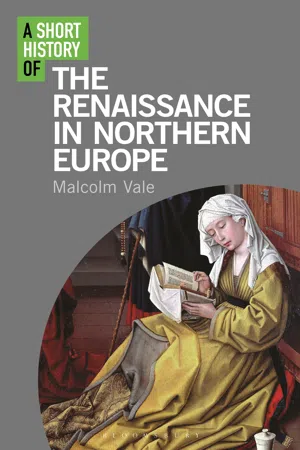
The concept of a Northern European 'Renaissance' in the arts, in thought, and in more general culture north of the Alps often evokes the idea of a cultural transplant which was not indigenous to, or rooted in, the society from which it emerged. Classic definitions of the European 'Renaissance' during the 14th, 15th and 16th centuries have often seen it as an Italian import of, for example, humanism and classical learning into the Gothic North.
There were certainly differences between North and South which have to be addressed, not least in the development of the visual arts. In this book, Malcolm Vale argues for a Northern Renaissance which, while cognisant of Italian developments, had a life of its own, expressed through such innovations as a rediscovery of pictorial space and representational realism, and which displayed strong continuities with the indigenous cultures of northern Europe. But it also contributed new movements and tendencies in thought, the visual arts, literature, religious beliefs and the dissemination of knowledge which often stemmed from, and built upon, those continuities. A Short History of the Renaissance in Northern Europe – while in no way ignoring or diminishing the importance of the Greek and Roman legacy – seeks other sources, and different uses of classical antiquity, for a rather different kind of 'Renaissance' in the North.
- 264 pages
- English
- ePUB (mobile friendly)
- Available on iOS & Android
eBook - ePub
A Short History of the Renaissance in Northern Europe
About this book
Information
1
What was the ‘Northern Renaissance’?
We are reluctant to acknowledge how medieval the man of the Renaissance really was, the man whom we salute as a superman, the liberator of the individual from the dark prisons of the church. (Aby Warburg, Flanders and Florence [1901])1
The concept of a renaissance
To embark on any account of the so-called Renaissance in Northern Europe, we must first attempt to define what we mean by the term ‘Renaissance’. The idea of a ‘Renaissance’ or ‘rebirth’ (from Fr. renaitre, Lat. renascere, It. rinascita) has been linked to notions of renewal, renovation and sometimes reformation, in many epochs of human history. We hear of a ‘Carolingian Renaissance’, a ‘Twelfth-Century Renaissance’, a ‘Christian Renaissance’, an ‘Elizabethan Renaissance’ or, most recently (2017), a Franco-German ‘renaissance’ of the European Union. The Renaissance which is the subject of this book is that which is normally thought to have taken place in Western Europe between the fourteenth and sixteenth centuries. But what was actually ‘reborn’ during these periods? What, if anything, has prompted the desire to represent an age as one which gave birth to a renewed and reinvigorated world? Is the Renaissance, it has been asked, nothing but a metaphor, which obfuscates rather than illuminates, forming a ‘mere figurative intrusion’ into historical thought and historiography? But a tendency to lament, often in nostalgic terms, the decline or decay into which a civilization, culture or some aspects of their specific forms were judged to have fallen, can be found in many past – and indeed present – societies. A renewal or revival is awaited. The Renaissance is no exception to this rule. To be ‘reborn’, something has presumably had to die, or at least to have degenerated and broken down into a condition in which it is either unrecognizable or unacceptable, or both. Rebirth can take place in a religious context – Christian, Buddhist or Hindu – and assume very different forms in each case. A ‘born again’ Christian, for example, in a Protestant Evangelical context, is one who has experienced a spiritual rebirth or regeneration. Their former, tepid faith has been renewed and reinvigorated by an injection of life-giving fervour, through the tonic of Bible reading, preaching and witnessing, thereby committing them to a new, personal and often emotional relationship with Christ. And Christ’s stricture to Nicodemus that ‘no one can see the kingdom of God unless they were born again’ (Jn 3.3-5) could, for instance, be secularized to apply to a theory of evolution or progress whereby a state of artistic, political or any other degree of perfection – a secular ‘kingdom of God’ – can ultimately be attained.
But in order for a rebirth to take place, we must know at least something of what had gone before. The ‘new’ faith can only be understood in contrast to the ‘old’. In historical thought about the rise, fall and changing nature of civilizations, cultures or art forms, analogies and metaphors of a pseudo-biological or anthropomorphic kind, attributing to them human or other characteristics, and giving rise to theories of organic development, are common. Civilizations and the arts, it is argued, ‘like human bodies, are born, grow up, become old, and die’.2 The visual arts, literature, music, and other of man’s acquired habits and attributes, are all part and parcel of that process. Hence, it is claimed, they undergo transformation through a succession or cycle of births, deaths and rebirths. This metaphorical underpinning of cultural history has, perhaps surprisingly, had a long lifespan. In 1919 the Dutch cultural historian Johan Huizinga (1872–1945), in his masterpiece, The Waning of the Middle Ages (perhaps more accurately translated from the Dutch Herfsttij der Middeleeuwen as The Autumn of the Middle Ages) wrote:
In history, as in nature, birth and death are equally balanced. The decay of overripe forms of civilisation is as suggestive a spectacle as the growth of new ones. And it occasionally happens that a period in which one had, hitherto, been mainly looking for the coming to birth of new things suddenly reveals itself as an epoch of fading and decay.3
Together with seasonal, botanical and even meteorological metaphors, a quasi-biological image has loomed large in cultural history from the sixteenth to the twentieth centuries. Allusions to an ‘autumn’, a ‘dawn’, a ‘sunset’ or a ‘flowering’ have also not been absent from the titles and texts of books on the declining later Middle Ages and the emergent Renaissance. The ‘Renaissance’ phenomenon is therefore one product of a tendency to holistically depict whole civilizations within a given period as possessing a biological, seasonal or ‘dawn-to-dusk’ character. Metaphors which depend on analogies between human civilizations and biological, botanical or seasonal processes may exert a highly stimulating power over our imagination. But they do not always analyse or elucidate the cultural phenomena which we seek to explain.
The perennial question which is usually asked about the European Renaissance is this: What was it that was actually reborn? And at what time, and by what process, was that achieved? A pattern was set in 1568 by the Florentine artist and writer Georgio Vasari (1511–74) in his Lives of the Artists. His book has been profoundly influential ever since. Vasari set out to trace the organic development of Italian art – with a few glances outside Italy – in three stages. The first, comprising the beginning of a rebirth of the arts after the demise of Roman civilization in the fifth century AD, followed by a long period of decay, he associated with stylistic innovations by the Italian artists Cimabue (1240–1302) and Giotto (1266–1337) in the later thirteenth and early fourteenth centuries. This was followed by the experiments and achievements of Masaccio (1401–28), Brunelleschi (1387–1446) and Donatello (1386–1466) in the fifteenth century (the Italian Quattrocento). Finally, the summit of absolute perfection in the arts was attained by the collective consummate genius of Leonardo da Vinci (1452–1519), Raphael (1483–1520) and Michelangelo Buonarroti (1475–1564). Central to Vasari’s thought was the notion that a revival of the study and appreciation of classical (i.e. primarily Roman but also the less well-understood Greek) antiquity had led to the direct imitation of nature in the arts. This was the supreme aim of great art – to represent the visible world naturalistically, and to render both human and divine subjects in as realistic a manner as possible. A teleological process had been set in train in the course of the later thirtee nth century which was, he thought, to reach full fruition only in Vasari’s own time. The ancient world of Greece and Rome could never be physically recreated or reincarnated. But its thought, art and literature, and the principles behind them, could be revived and ‘reborn’ as a rinascita (Vasari uses the word). It could be argued that this was the narrower vision and conception of the ‘Renaissance’, as a revival of interest in, and appreciation of, classical antiquity. A broader and much more comprehensive one, seeing the ‘Renaissance’ period as introducing fundamental changes in the ways in which men and women viewed and explained the world, was to follow. But that was only after another 250 years or so had passed. And the geographically limited scope of the concept (confined very largely to Italy alone) inevitably raised questions about conditions and developments in other parts of Europe, especially in the North. Why had the Renaissance phenomenon only affected Southern Europe, and the Italian peninsula in particular? What was happening elsewhere on the continent? Historians have certainly identified a ‘Northern Renaissance’, but have disagreed over its nature and chronological span.4 Some would place it, as an art-historical period, between about 1380 and 1580; some as beginning even earlier in the fourteenth century; others would limit it to the reception in the North of Italian humanist thought and Italian, or Italianate, artistic styles between about 1480 and 1540. And the Protestant Reformation, beginning in the 1520s and 1530s, provides, for some, a terminal dividing line. So significant questions still remain to be discussed and this book attempts to provide some answers to at least some of them.
It has been argued that the ‘Age of the Renaissance’ was an ‘age of transition’ from the Middle Ages to modern times. The history of the emergence and development of this notion dates from its first appearance, as we shall see, in the early nineteenth century. We need to trace the course, and vicissitudes, of the concept of the Renaissance, especially in its Northern manifestations, through the works of some of the many scholars and others who have embarked on its study from the early 1800s until the present day. I make no apology for discussing the historiography of the concept of a Renaissance at some length, above all in its Northern forms. It is fundamental to our understanding of how that concept has evolved, changed and adapted to different schools and traditions of historical thought. But its artificial nature has not gone without critical responses. A recent historian of the art of printing and its impact has questioned whether the Renaissance represented simply ‘a hypothetical transition rather than an actual occurrence’.5 The notion of a passage from ‘medieval’ to ‘modern’ is, after all, a construct of historians and their need to periodize European history. The claims made for the Italian Renaissance, in and of itself, as forming the transitional period between medieval and modern times, have been challenged. It has been argued that ‘when one considers what was happening elsewhere on the Continent between 1350 and 1450, one may wonder if an encounter with peculiar local conditions [in Italy] has not been mistaken for the advent of a new age’.6 One aim of this book is to discover what was in fact happening outside Italy between 1350 and 1450 (and beyond). Can some form of indigenous, if not self-contained, ‘Renaissance’ be seen in Northern Europe? How far, if at all, did this indicate the ‘advent of a new age’? Or, before any ‘Renaissance’ characteristics can be discerned in Northern Europe, did it have to receive the influence of Italian humanistic thought and a revival of classical antiquity, stemming largely from Italy? But to speak of a transition to ‘modern times’ does not take account of the essentially time-bound nature of that concept. For example, what may have appeared ‘modern’ in 1860 might not have been thought so in 1960, let alone 2019. As with other conceptual constructs, change over time is of the essence here. The very concept of a ‘Renaissance’, whether in Southern or Northern Europe, or both, underwent profound changes between, say, 1530 and 1830, as well as in the course of the nineteenth and twentieth centuries.7 Alongside the artificial abstractions embodied in terms such as the ‘Renaissance ideal’ or ‘Renaissance man’, a search for concrete evidence for the new, innovatory and what has been called ‘the gradual’(or less gradual) ‘erosion of existing presuppositions’8 has to be undertaken.
The Middle Ages and the Renaissance
Perhaps more than any other period in pre-industrial European history, the Renaissance has been portrayed as possessing a ‘spirit’ of its own. The notion of a Zeitgeist, or ‘spirit of the age’, has descended to us from the lofty heights of Friedrich Hegel’s (1770–1831) philosophy. It presupposes that every age or epoch has a ‘supra-individual collective spirit’.9 This permeates, informs and unifies every area of life, especially the arts, social habits, morals and conventions, laws, and all of a society’s other cultural attributes and acquisitions. This holistic interpretation of cultural history (Ger. Geistesgeschichte) has also not been without its critics. At a very early stage, Hegel’s near-contemporary Goethe (1749–1832) made his Faust declare that ‘what you call the spirit of the ages is really no more than the spirit of all those people in which the ages are reflected’.10 The Zeitgeist is thus simply a historian’s metaphysical construct or artificial abstraction, lacking concrete existence in reality. The implicit notion, moreover, that there was a unity between the various, sometimes disparate, manifestations of an entire civilization, could be a mere illusion. More recently, art historians and cultural historians have tended to reject such a holistic approach, preferring to concentrate on the particular and the individual. Since Erwin Panofsky, Edgar Wind and Ernst Gombrich, among many others, began to concentrate on iconography and the elucidation of the ‘hidden meanings’, symbolism and allegory inherent in Renaissance works of art, the shift away from a Hegelian-influenced approach has been almost total.
It has been argued that the apparent unity ascribed to the ‘spirit of the age’ is fictitious and takes no account of what is disparate and different within a given civilization, society or art form. Disparate, sometimes dissenting, forms coexist within a given culture. There is, it is claimed, ‘no unbreakable unity between every branch of knowledge’,11 just as there is none within the arts or literature. During the Renaissance, Raphael’s or Leonardo’s art may represent the ‘Renaissance ideal’, but that ideal was completely rejected, in its Florentine heartland, by the rabble-rousing preaching of the Dominican friar Savonarola (1452–98) against the worldly vanities which, for him, it represented. To gain any credibility, the Renaissance had, therefore, to define itself against what may be seen as its antithesis, and that antithesis was, for its early historians, provided by the Middle Ages.12 As a generic term for a set of assumptions and presuppositions, expressed in a wide range of forms, the Renaissance could only exist in relation to what had preceded, and indeed what followed, it. And to discover its predecessor, which provided the conditions for a ‘rebirth’, an agreed concept of the ‘medieval’ had to be born.
Just as the ‘Enlightenment’ presupposes the existence of a former, unenlightened period in the history of thought, so the Renaissance posits a previous, relatively benighted age in which ‘renascent’ qualities or characteristics were absent. But beneath the artificial abstractions and labels which we use to characterize commonly shared outlooks there lay considerable degrees of diversity and disparity. Shared ‘Renaissance’ ideals, or ideas held in common, were not always understood in the same way by different individuals or groups – controversies over Christian beliefs and doctrines, or over the nature and interpretation of classical thought and literature, are a case in point. What then gave the Renaissance, whether in Southern or Northern Europe, its essential characteristics and how was the contrast with the Middle Ages first made?
The Middle Ages as we know them today are largely a creation of the nineteenth century.13 Much the same could be said for the Renaissance. The advent of a battle of styles – classical/Renaissance versus Gothic/medieval – in the early nineteenth century reflected two opposed and contrary images. On the one hand, there was the image of the Renaissance, depicted imaginatively as an age of ‘purple and gold’, the musical equivalent of which would be a positive and jubilant key of C major.14 The Middle Ages, on the other hand, as the age of romanticism dawned, were set in a minor key, with a backdrop of moonlight, scudding clouds, Germanic forests, Gothic ruins, silhouetted cathedrals seen through the mist and the evocative sound of hunting horns, epitomized by Caspar David Friedrich’s (1774–1840) paintings and Carl Maria von Weber’s romantic opera Der Freischutz (1821). And, critical for our purposes, the ‘medieval’ came to be identified essentially with Northern Europe. But this did not preclude the injection of brighter, primary colours into the picture, as the Middle Ages were also viewed as the Age of Chivalry and all its pageantry. Against this, the Renaissance came to be defined not only as a movement in the arts, thought and literature but also as a distinct cultural period, free-standing and autonomous. Yet its essential character derived as much from what it was not, as from what it was. Its alleged escape, not only from two-dimensional icon-like images and an art regarded as wholly subservient to the Church but also fr...
Table of contents
- Cover
- Half-Title
- Series
- Dedication
- Title
- Contents
- List of figures
- Acknowledgements
- Timeline
- Introduction
- Chapter 1 What was the ‘Northern Renaissance’?
- Chapter 2 Realism and the visual arts
- Chapter 3 Humanism in the North
- Chapter 4 The old and the new devotion
- Chapter 5 The impact of print
- Chapter 6 Wisdom, folly and the darker vision
- Conclusion
- Notes
- Further reading
- Index
- Copyright
Trusted by 375,005 students
Access to over 1.5 million titles for a fair monthly price.
Study more efficiently using our study tools.
Frequently asked questions
Yes, you can cancel anytime from the Subscription tab in your account settings on the Perlego website. Your subscription will stay active until the end of your current billing period. Learn how to cancel your subscription
No, books cannot be downloaded as external files, such as PDFs, for use outside of Perlego. However, you can download books within the Perlego app for offline reading on mobile or tablet. Learn how to download books offline
Perlego offers two plans: Essential and Complete
- Essential is ideal for learners and professionals who enjoy exploring a wide range of subjects. Access the Essential Library with 800,000+ trusted titles and best-sellers across business, personal growth, and the humanities. Includes unlimited reading time and Standard Read Aloud voice.
- Complete: Perfect for advanced learners and researchers needing full, unrestricted access. Unlock 1.5M+ books across hundreds of subjects, including academic and specialized titles. The Complete Plan also includes advanced features like Premium Read Aloud and Research Assistant.
We are an online textbook subscription service, where you can get access to an entire online library for less than the price of a single book per month. With over 1.5 million books across 990+ topics, we’ve got you covered! Learn about our mission
Look out for the read-aloud symbol on your next book to see if you can listen to it. The read-aloud tool reads text aloud for you, highlighting the text as it is being read. You can pause it, speed it up and slow it down. Learn more about Read Aloud
Yes! You can use the Perlego app on both iOS and Android devices to read anytime, anywhere — even offline. Perfect for commutes or when you’re on the go.
Please note we cannot support devices running on iOS 13 and Android 7 or earlier. Learn more about using the app
Please note we cannot support devices running on iOS 13 and Android 7 or earlier. Learn more about using the app
Yes, you can access A Short History of the Renaissance in Northern Europe by Malcolm Vale in PDF and/or ePUB format, as well as other popular books in History & European History. We have over 1.5 million books available in our catalogue for you to explore.