![]()
CHAPTER ONE
UNDERSTANDING
OURSELVES, OUR
POTENTIAL AND
THE SITUATION
![]()
If we want to progress and succeed at work we need to understand that it is our behaviour that provides the key. We will only be given opportunities by our bosses, if we can convince them of our potential. To do that, they must believe that we can come up with appropriate behaviour and excel at what we are required to do. But what does this mean? Surely we all know how to behave?
Our behaviour is defined by what we do or say and how we react in any particular situation. It is in essence how we come across to others and it is the basis of how people interact. When we come to reflect on how to behave at work, we need to look beyond the horizons of our usual instinctive behaviour. Work imposes its own demands and we are not there just to give expression to our own personality. After all, we are being paid for what we do.
Human beings are creatures of habit which in other words means that we are rather predictable in the way we behave. We seem to give few behavioural surprises to others – least of all to the ones who have known us a long time. Perhaps we also find it hard to change how we behave towards those who already have a preconception about our behaviour.
As we proceed through our working lives, we frequently change the way we behave. And yet we still feel we are the same person. So how do we reconcile these differences? Can we be two different things at the same time? The answer is that we can. We adapt our behaviour to fit different situations, often without any sense of conflict. It is just as well that we do. Failing to adjust our behaviour is equivalent to being unresponsive to others. No one adopting that attitude would easily progress in a career or be liked by their fellow beings. So that poses a dilemma. We have to consider how to develop character and grow in maturity without losing a sense of personal identity.
So how do we reconcile the two? Are we all very different characters who have our own idiosyncrasies and set patterns of behaviour or are we chameleons who simply adjust to the situations we find ourselves in? Perhaps the answer is that we are both. The first step in combining the two is to understand ourselves.
We need to understand ourselves in order to gain direction. Over a period of time we begin to build up a sense of the things we like doing and the things we perceive we are good at. We have a comfort zone and if we go too far outside its boundaries we feel a certain amount of stress. Individual differences become apparent at an early age and although no character is set in stone, our own unique behavioural fingerprint begins to show. Some of these clusters of characteristics will become useful in the work place.
All through our lives we are continually letting others see how we behave and react in different situations. Every time we have a go at something new, we show others our potential. Normally confidence is gained by success and is diminished by failure, but sometimes our own understanding of ourselves is misplaced. We can become overconfident or under-confident in our own abilities. Over-confidence however can be a handicap. No-one will believe a "know all" or a self proclaimed all-round expert. Those who win the support of others usually come from the range of ordinary mortals. They will be observed to possess some positive strengths along with some admitted weaknesses.
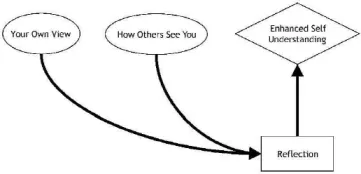
What we need is a reality check from other people – a democratic one and one that does not damage the ego. In this way we can be guided to areas where our own contributions can be best appreciated and used to greatest effect. Further on in the book we will look at how this can be achieved, but first let us look at the nature of work and situations in which we find ourselves.
ADAPTING TO THE SITUATION
The world of work is continually changing. And if we are to survive and indeed succeed, we need to change too. That entails learning to contribute in more than one way.
Many organisations, private and public, endorse the idea of "competencies." This means that you as a worker should be able to tick as large a number of boxes as possible, hit all desirable targets and be well received by all the people you encounter in your employment. But people don't work in this way. Eventually, natural preferences and dislikes will surface. You will naturally work better with some people than with others and no one is equally competent at all tasks. The good news is that such inequality is no impediment to progress and efficiency. In fact, if we were equally competent at all tasks, it would be difficult to decide who should do what or who should work with whom.
The different abilities and inclinations of members of a team provide an insight into the best way of getting things done. In complementary working relationships, individuals can achieve more than they would if they worked alone. In any team formed or any pairing between two individuals, each person will have to consider what they can bring to the party and where they can fit in best.
Employees and managers will naturally gravitate towards the people they like to work with and the type of work that fits in with their personal needs. That is why it is helpful if individuals project their preferences while avoiding the dangers of doing so too emphatically, for jobs contain an obligatory element. Any organisation which fashioned jobs solely in the interests of employees would be heading for bankruptcy. So a balance has to be struck between your needs and those of the organisation.
This division first becomes apparent at interview. In applying for a job there is a need to convey enthusiasm and experience. However, the job in question may not be entirely appropriate for you. This may not be obvious at first, since job titles have a tendency towards the grandiose.
Another common problem is one of uncertainty. What if you don't know exactly what you want to do? No one who wants to secure a job offer can afford to admit such doubts. A more common strategy is to appear versatile and willing regardless, but will this have a detrimental effect on your longer-term goals?
To become a highly-valued employee, you need to think on both fronts. The first need is to become aware of the broad range of demands placed on any organisation; the second need is to assess what part you can best play. But how do you go about making the job your own? And how do you find your feet and make progress if you're not sure where your talents lie?
To those in management, nothing matters more than having the right people in the right positions. This is in fact teamwork at its most effective. You can help with the process by understanding the job, and by understanding yourself.
Understanding and managing our own behaviour is the key to being appreciated at work.
We need to adapt our behaviour according t o the situation.
We need to be aware of how we are interacting with others.
People need to be in positions that suit their talents.
![]()
CHAPTER TWO
JOBS AND WORK
![]()
Wouldn't it be nice to find the perfect job? Is there really such a job out there that is ideally designed for you? Perhaps it is best looking at the question the other way around. Is there an organisation out there that can use your potential? The answer is yes – but you won't know until you dip your toe in the water. The first thing to do when consider...