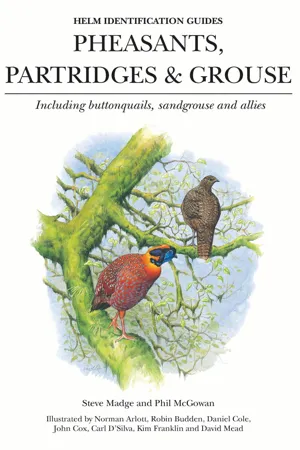
This guide brings together, for the first time in single volume, a comprehensive review of all the world's pheasants, partridges, quails, grouse, turkeys, guineafowl, buttonquails, sandgrouse, and the enigmatic Plains-wanderer - over 250 species in all. The group includes some of the world's most familiar and beautiful birds, such as Indian Peafowl and the stunning tragopans, as well as some of the rarest and most threatened. Some survive in fragments of over-exploited habitats, whilst others are now so familiar in domestication that it is difficult to imagine that they had any wild ancestors at all. As with other volumes in the award-winning Helm Identification Guide series, this book concentrates on identification and distribution, but also highlights conversation issues where relevant. Each species is treated in detail, reflecting the extensive knowledge of both authors. The 72 colour plates, by leading bird illustrators, show male, female, juvenile and subspecies plumages, and form the finest set of illustrations of these birds to date. There is also a colour distribution map for each species. Pheasants, Partridges & Grouse is a welcome addition to the Helm Identification Guide series, more importantly, a landmark volume in the literature of this attractive and vulnerable group of birds.
eBook - ePub
Pheasants, Partridges & Grouse
Including buttonquails, sandgrouse and allies
- 408 pages
- English
- ePUB (mobile friendly)
- Available on iOS & Android
eBook - ePub
Pheasants, Partridges & Grouse
Including buttonquails, sandgrouse and allies
About this book
Information
FAMILY PHASIANIDAE
Partridges, Quails and Pheasants
Partridges, Quails and Pheasants
SUBFAMILY PERDICINAE
Partridges, Old World Quails and Spurfowl
Partridges, Old World Quails and Spurfowl
A varied assemblage of short-tailed gamebirds, comprising 110 species in 22 genera. Francolinus (41 species) and Arborophila (21) account for over half of these, whereas no fewer than 11 genera are monotypic.
Genus LERWA: Snow Partridge
A monotypic genus containing a heavily-barred Himalayan partridge. Its rather broad wings are strangely pointed for a partridge, and the exceptionally long tertials conceal the wing-tip. The tarsus is short and feathered to halfway at the front. The downy chick is remarkably similar to that of the unrelated Blood Pheasant.
1 SNOW PARTRIDGE
Lerwa lerwa (Hodgson, 1833)
Lerwa lerwa (Hodgson, 1833)
Plate 1
This distinctive close-barred, rear-attenuated partridge of the high Himalayas is unique. Its whistling calls and eggs suggest a distant relationship to snow-cocks, but these attributes are perhaps merely indicative of a similar lifestyle. It is even possible that the species is an aberrant francolin.
IDENTIFICATION A dark partridge of the high Himalayas. The intense barring of the head and upper-parts is only apparent at close range; in the field it generally appears dark with a red bill, relieved by a whitish frontal collar and white flank striping. If flushed, the whitish trailing edge to the secondaries can be striking, especially in fresh plumage. Confusion with other species unlikely, but shares habitat with Tibetan Partridge, the much larger snowcocks and, at lower elevations, marginally overlaps with Chukar.
DESCRIPTION Bill coral-red (male), pinkish or greyish-pink (female). Irides red or reddish-brown. Legs red or orange-red, relatively short and feathered to midway on tarsus. Wings very broad, sharply pointed at tip. Rear body and tail relatively long. Sexes similar, but female slightly smaller, with bill paler pink than male.Male has a strong, blunt spur, sometimes with a smaller second; female unspurred. Adult (both sexes): Face and throat almost blackish, head and entire upperparts closely-barred black and white, finest on head and neck. Tail barred. Wing-coverts and secondaries similar, the latter broadly tipped white; primaries unbarred blackish with narrow white tips; some scapulars have largely white outer webs; mantle and upper scapulars washed greyish-brown, becoming rusty on tertials, but less evident with wear. White bars on outer part of each feather abrade to produce blacker overall appearance. Breast and underparts rich dark chestnut, becoming whitish on upper chest and vent; flanks boldly striped white. Juvenile: Duller, paler buffy-brown below, with pale shaft streaks on both upper- and underparts, breaking the barred pattern above.
GEOGRAPHICAL VARIATION Chinese birds usually larger (male wing 193–213), less rufous-toned above and slightly paler below. They have been considered as separate subspecies, major (Sichuan) and callipygia (Gansu), but differences either inconsistent or perhaps clinal, and their validity is doubtful, although Cheng et al. (1978) admitted both.
MEASUREMENTS Length 38–40 cm. Male slightly larger than female. Data from India and Nepal. Males: wing 183–204 (mean 194), tarsus 38–40. Females: wing 180–186, tarsus (n=1) 33. Weight (both sexes) 454–709.
HABITAT Open mountainsides above tree-line, favouring steep grassy slopes with scattered shrubs and ferns, interspersed with scree and snow patches. Often just below snow-line or at edges of glaciers. Generally at 3000–5500 m, rarely as low as 2400 m during severe weather. In China, however, it remains above 3800 m in winter.
VOICE Advertising call: the male utters a repeated, loud and clear whistled jijiu, jijiu, jijiu gradually quickening and rising in pitch (Li & Lu 1992). It is difficult to equate this with the analogy of Osmaston, who likened this call to the musical clattering made by Grey Francolin (Ali & Ripley 1969). Less often heard female call is shorter (2 seconds), softer and falls in pitch. When flushed, rises noisily, uttering a repeated huei, huei.
HABITS Most active in morning and late afternoon. Usually encountered in pairs or small coveys on steep open slopes; larger groups of 20–30 occur in non-breeding season in favoured areas, particularly at roosts. Established breeding territories in China occupied 5 ha. Feeds on various seeds, lichens, mosses and shoots, chiefly from grasses and shrubs; some invertebrates also taken. Generally relatively approachable, exhibiting little fear of humans with which it has little contact in its harsh environment. Indeed, it is often quite inquisitive, standing boldly on an exposed rock or ridge to watch admiring birdwatchers! Flushes noisily, rising with whirring and clapping wings, before flying rapidly downhill, the covey members scattering in various directions. Coveys gather noisily to form communal roosts in rock crevices, caves, under projecting rocks or beneath shrubby cover.
BREEDING Apparently monogamous, with male assisting in chick care. The nest scrape, with or without a lining of moss and leaves, is located on a very steep rocky slope, or near a ridge crest, and well concealed by a rock, grass tuft or low shrub. Clutch 2–5 (mean 3), but sightings of family parties suggest that it can be up to 7; eggs resemble those of snowcocks but smaller; pale buff finely speckled reddish. Breeds in May–July, but season protracted and may vary according to local weather conditions. Incubation solely by female, but no further information.
DISTRIBUTION Almost throughout the higher Himalayas, from extreme N Pakistan east through Kashmir, S Tibet, N India, Nepal and Bhutan to Arunachal Pradesh. In the east, its range extends north into SC China, in E Xizang, W and N Sichuan, north to extreme S Gansu and southeast to the Lijiang Mts in extreme N Yunnan. Some authors (e.g. del Hoyo et al. 1994) extend the western limit to Afghanistan, but this lacks foundation and appears to have been perpetuated in error.
STATUS Widespread and locally common. A study area in China held 56 birds per km2. Hunting pressure and nest-site disturbance by medicinal herb collectors were adversely affecting this population.
REFERENCES Ali & Ripley (1969), Cheng et al. (1978), Fleming et al. (1976), del Hoyo et al. (1994), Li & Lu (1992).
Genus TETRAOPHASIS: monal-partridges
Large partridges with relatively long, broad, wedge-shaped tails of 18 feathers (14 in most other partridge genera). The two species are superficially similar and, as their ranges almost meet in C China, they are usually considered conspecific by Chinese authorities (e.g. Cheng 1987). The genus forms a link between the partridges and the pheasants, and in some respects can be regarded as closer to the latter.
2 VERREAUX’S MONAL-PARTRIDGE
Tetraophasis obscurus (Verreaux, 1870)
Tetraophasis obscurus (Verreaux, 1870)
Plate 3
Alternative names: Verreaux’s Pheasant-partridge or Pheasant-grouse, Chestnut-throated Partridge.
Verreaux’s is the more northerly distributed of the two monal-partridges, whose ranges appear to be separated by only 150 km in S Qinghai and W Sichuan.
IDENTIFICATION Distribution is generally the key to specific recognition, although the two species are easily distinguished by throat colour, chestnut in Ver-reaux’s and buff in Szechenyi’s. Given exceptionally good views when flushed, Verreaux’s should show less contrast between the brownish-grey rump and upper-tail and the darker brown mantle than Szechenyi’s. Both are large greyish partridge-like birds with rather long, broad, white-tipped tails. The latter feature is unique to the genus, and should be especially obvious when flushed. Comparisons have been made with Koklass Pheasant in basic size and flushing behaviour by observers who know both in life.
DESCRIPTION Bill dusky-brown or blackish. Irides chestnut-brown. Bare skin around eye red. Legs reddish-brown. Sexes generally similar, male has one spur, absent in females. Relatively long, broad, rather graduated tail consists of 18 feathers (14 in other partridges). Elongated axillaries. Adult (both sexes): Head, sides and rear of neck, mantle, wings and upperparts medium ashy-grey, tinged brown, darkest on head and mantle. Wing-coverts, scapulars and tertials tipped buffy-white, forming bands of spots on folded wing. Chin and throat rusty-chestnut, narrowly bordered with whitish. Breast slate-grey, spotted with black. Flanks grey with whitish inner webs giving lightly streaked effect, becoming whitish on belly. Undertail-coverts chestnut with white tips giving scaled appearance. Outertail feathers blackish, broadly tipped white; central tail feathers greyish-brown with narrow white tips. Juvenile: Apparently undescribed, but presumably much as in Szechenyi’s.
GEOGRAPHICAL VARIATION Monotypic.
MEASUREMENTS Length 48 cm. Female smaller than male. Males: wing 214–227 (mean 218), tail 153–175, tarsus c.50, weight (n=1) 938. Females: wing 197–200, tail 150–160, weight (n=2) 720 and 840.
HABITAT Alpine zone of mountain slopes, from borders of tree-line upwards (3000–4100 m). One radio-tagged female moved from 2850 m, in spring, to 3000–3350 m in summer. Occurs on open rocky slopes and among rhododendron and juniper scrub with clearings, meadows and deep ravines.
VOICE Recordings indicate a loud mixture of raucous, guttural, bubbling and grating notes that are apparently similar to those of Szechenyi’s. Reported to utter a ‘loud cry’ when flushed.
HABITS Apparently unstudied. Generally occurs singly or in pairs, feeding in open areas at upper limit of forest. When disturbed, walks away cocking and flirting tail in manner of a snowcock. Behaviour presumed similar to that of slightly better-known Szechenyi’s.
BREEDING No information available.
DISTRIBUTION Mountains of C China. From its northern limits in C Gansu, it extends south to Kimar and the Rangta Gol Gorge in the Nan Shan, northeast of Qinghai Hu (Koko Nor) in E Qinghai, and southeast in N (to Songpan) and W Sichuan (to Mupin [Baoxing]). Further west, in this region, it is apparently replaced by Szechenyi’s, which occurs as near as the mountains west of the Yalung River.
STATUS Near-Threatened. Apparently not uncommon over much of its range, but its distribution is rather fragmented and perhaps isolated by habitat destruction. Legally protected in China, where it is known from at least 13 localities. No overall population estimates available, but a density of 3.5–4.0 birds per ha reported at Baoxing in W Sichuan. Unknown in captivity. Research into the ecology and status of this poorly-known species is urgently required.
REFERENCES Carey, G. J. (tape recordings), Cheng (1987), Cheng et al. (1978), Collar et al. (1994), Zhao Zhengjie (1995).
3 SZECHENYI’S MONAL-PARTRIDGE
Tetraophasis szechenyii (Madaràsz, 1885)
Tetraophasis szechenyii (Madaràsz, 1885)
Plate 3
Alternative names: Szechenyi’s Pheasant-partridge or Pheasant-grouse, Buff-throated Partridge.
The more southerly distributed of the two monal-partridges, it being widespread in SE Tibet.
IDENTIFICATION Mountains of E Tibet and W Sichuan, replacing Verreaux’s west of the Yalung River. Although distribution is the key to specific identification, given exceptionally good views the two are easily distinguished by throat colour, buff in Szechenyi’s and chestnut in Verreaux’s. If flushed, Szechenyi’s should show a purer grey rump and uppertail, contrasting more with the brownish mantle than in more uniformly brown Verreaux’s. Both are large greyish partridge-like birds with comparatively long, broad, white-tipped tails. The latter characteristic is unique to the genus, and should be especially obvious when flushed.
DESCRIPTION Bill dusky-brown or blackish. Irides chestnut-brown. Bare skin around eye red. Legs reddish-brown. Sexes largely similar, male has one spur, absent in females. Relat...
Table of contents
- Cover
- Title Page
- Copyright Page
- Contents
- Preface
- Systematic List of Species
- Acknowledgements
- Introduction
- Style and Layout of the Book
- Topography
- Glossary
- Systematic Section
- Bibliography
- Colour Plates and Maps
Trusted by 375,005 students
Access to over 1.5 million titles for a fair monthly price.
Study more efficiently using our study tools.
Frequently asked questions
Yes, you can cancel anytime from the Subscription tab in your account settings on the Perlego website. Your subscription will stay active until the end of your current billing period. Learn how to cancel your subscription
No, books cannot be downloaded as external files, such as PDFs, for use outside of Perlego. However, you can download books within the Perlego app for offline reading on mobile or tablet. Learn how to download books offline
Perlego offers two plans: Essential and Complete
- Essential is ideal for learners and professionals who enjoy exploring a wide range of subjects. Access the Essential Library with 800,000+ trusted titles and best-sellers across business, personal growth, and the humanities. Includes unlimited reading time and Standard Read Aloud voice.
- Complete: Perfect for advanced learners and researchers needing full, unrestricted access. Unlock 1.5M+ books across hundreds of subjects, including academic and specialized titles. The Complete Plan also includes advanced features like Premium Read Aloud and Research Assistant.
We are an online textbook subscription service, where you can get access to an entire online library for less than the price of a single book per month. With over 1.5 million books across 990+ topics, we’ve got you covered! Learn about our mission
Look out for the read-aloud symbol on your next book to see if you can listen to it. The read-aloud tool reads text aloud for you, highlighting the text as it is being read. You can pause it, speed it up and slow it down. Learn more about Read Aloud
Yes! You can use the Perlego app on both iOS and Android devices to read anytime, anywhere — even offline. Perfect for commutes or when you’re on the go.
Please note we cannot support devices running on iOS 13 and Android 7 or earlier. Learn more about using the app
Please note we cannot support devices running on iOS 13 and Android 7 or earlier. Learn more about using the app
Yes, you can access Pheasants, Partridges & Grouse by Phil McGowan,Steve Madge,Carl D'Silva,Daniel Cole,David Mead,John D. Cox,Kim Franklin,Norman Arlott,Robin Budden in PDF and/or ePUB format, as well as other popular books in Biological Sciences & Zoology. We have over 1.5 million books available in our catalogue for you to explore.