'Ah! The Fringe! I can't think of a more delightful way of putting my liver, bank account, relationship, complexion, and mental stability under the greatest strain they've ever known!' Mel Giedroyc
It is the world's largest arts festival, attracting everyone from student first-timers to Hollywood stars. Thrilling, inspiring and bewildering in equal measure, the Edinburgh Festival Fringe can make you a star or break your bank.
So what is the secret of making it work for you?
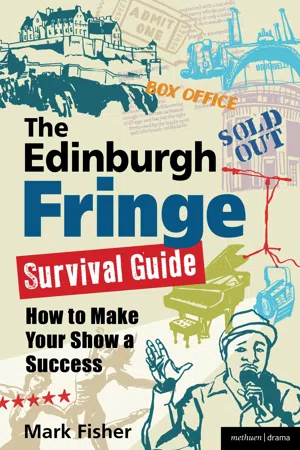
The Edinburgh Fringe Survival Guide draws on the experiences of the festival's leading figures - their disasters as well as their triumphs - to take you step by step through the process of making your show a success in the Scottish capital.
From choosing a venue to keeping on top of the budget, from sorting out accommodation to securing the best press coverage, from generating word of mouth to making the most of a hit, this unique practical guide for performers, directors and producers helps you get your show the audience it deserves.
Among those sharing their expert advice are playwright Simon Stephens, comedian Phil Nichol, actor Siobhan Redmond, producer Guy Masterson, Tiger Lillies front manMartyn Jacques, theatre critic Lyn Gardner, Foster's Edinburgh Comedy Award director Nica Burns, as well as the directors of all the major Fringe venues, top press officers, international promoters and insiders from the Fringe Society itself.
The foreword is written by playwright Mark Ravenhill.
- 288 pages
- English
- ePUB (mobile friendly)
- Available on iOS & Android
eBook - ePub
About this book
Information
1. The City and its Festivals
Welcome to the Greatest Show on Earth
The Edinburgh festival fringe likes statistics. As each festival approaches, you will hear all manner of head-spinning facts. If you are putting on a show, you will learn there are perhaps 2,500 companies doing exactly the same thing. You will be one of 21,000 participants and collectively you will be giving 40,000 performances. Throw in the cultural tourists who flock to the Scottish capital with the express purpose of seeing shows and you will be responsible for doubling the city’s population. Your efforts, along with those of the Edinburgh International Festival, the Edinburgh International Book Festival, the Edinburgh Mela, the Royal Edinburgh Military Tattoo, the Edinburgh Art Festival and the Edinburgh Jazz and Blues Festival (now starting in July), will bring over £200m to the local economy.
You will read these statistics and you will get a sense of something big, exciting and a little bit unusual. Nothing, however, will prepare you for what these numbers mean in practice. ‘It’s like sex, it’s like having children; there’s no way to explain it to anybody,’ says John Clancy, a visitor to the Fringe as director, playwright and producer since 2000. Clancy is a founding artistic director of the New York International Fringe Festival so he knows the territory, but that event, despite being the largest multi-arts festival in North America, fields only a tenth as many companies as Edinburgh. ‘The Edinburgh Fringe is the arts Olympics of the world,’ he says.
Even in the thick of the action, you will find it difficult to get the measure of the event. If you stop for a drink in one of the popular venues – perhaps at the Pleasance Courtyard or the Urban Garden at C Venue – it will feel as if you are at the heart of the festival. All around you will be audiences, performers, technicians, reviewers, promoters and people handing out flyers advertising their shows. Within spitting distance will be more performances than you could see, even if you did nothing else for a fortnight. Yet even then, you should remember that all over this city are people thinking they too are at the centre of the Fringe universe, whether they are seeing back-to-back dance at Dance Base, round-the-clock theatre at the Traverse, non-stop comedy at the Stand Comedy Club, nightly folk songs at the Acoustic Music Centre at St Bride’s or all-day student theatre at the Bedlam. ‘Embarrassingly, in my first three years working at the Pleasance, I didn’t see a single show outside of the Pleasance,’ says one box-office worker at one of the biggest multiplex venues. ‘And I probably didn’t see even ten per cent of what was on there.’
In 2010, first-time Fringe-goer Matthew Somerville, a web developer from Birmingham, managed to see 136 shows in just under four weeks. Despite this awesome achievement, he calculated he had seen only 5.54 per cent of what was on offer. The phenomenon is no more manageable for a dedicated theatre critic such as the Guardian’s Lyn Gardner, who sees as many shows as anyone yet still returns to London hungry for more. ‘Even when I’ve done a year when I have consistently seen five, six, seven shows every single day over a period of three weeks, I always leave Edinburgh knowing there are shows I would have liked to have seen,’ she says.
Some venues present only one show, others programme a dizzying number. ‘We create something twice the size of the Edinburgh International Festival,’ says William Burdett-Coutts, talking not about the whole Fringe but about his one organisation, Assembly. His programme routinely exceeds 130 shows and plays to 290,000 people: the equivalent of the BBC Proms. ‘People outside of Edinburgh just don’t get the scale of it at all,’ he says. ‘The Fringe is an incredible seedbed of opportunity.’
Assume nothing
When you perform in your home town or university, you will take certain things for granted. The start time will be 7.30 p.m., the room will be available all day for setting up and a predictable number of people will turn up to see the show. On the Edinburgh Fringe, there is no such certainty. If your show is scheduled to start at noon, it will not be the first performance of the day. Neither will it be the only show starting at noon; on a typical weekday, your potential audience might have fifty productions to choose from between 12 p.m. and 1 p.m. And that is in the theatre programme alone. Starting around 1 p.m. will be fifty more – not to mention around ten dance, five music and forty comedy shows, in a city not short of restaurants, museums and tourist attractions to lure people away. With such fierce competition for spectators – even when the city is full of spectators – it is common for performances to go ahead with the audience numbering in single figures.
Until you see this for yourself – see what it means to have every basement, lecture hall, Masonic lodge and back room turned into a performing space; to have your way blocked on the Royal Mile because of the sheer volume of people; to come out of a show at 10 p.m. knowing there is still time to catch a couple more before bedtime – it is impossible to appreciate the scale, relentlessness and energy of the Edinburgh Fringe. Today, there are fringes all over the world, in Dublin, Adelaide, New York and Johannesburg. Each has its own qualities, but none even remotely compares to the all-consuming intensity of this three-week event in August. ‘When I think of “fringe”, I think of the Halifax Fringe, which is a very small festival that has never included itself on the Canadian fringe circuit,’ says Anthony Black of Nova Scotia’s 2b Theatre Company:
Obviously the Edinburgh Fringe is huge, but it’s just mayhem. When I arrived I was amazed at how many people were around, anxious at not getting any reviewers and anxious at not getting any audience.
‘Until you get here you have no idea,’ says Black’s producer Sarah Rogers of Montreal theatre agent Menno Plukker:
We arrived here on 2 August and you could see the company were looking round thinking, ‘What’s the big deal?’ But the population just surged in a day and a half and by 4 August we couldn’t move. It’s been a challenge just seeing how big it is. For the company, it’s become a great challenge, like a puzzle that they have to solve.
If you are a first-timer, there are still many things you can do to increase the odds of success. Reading this book is one of them. Finding a Fringe veteran to help you is another. Keeping in close contact with the staff at the Fringe Office should be a given. The more information you can gather in advance, the more realistic you will be about the adventure that awaits you and the more enjoyable time you will have in the world’s greatest arts festival. ‘Coming from Sweden, the thought of Edinburgh is quite intimidating,’ says first-time visitor Emil Lager of physical theatre company Scandimaniacs.
When you get here it’s like being on a bus where you feel alone but you discover everyone else feels alone too. That’s the feeling.
So climb aboard the bus, befriend your fellow passengers and enjoy the ride. Even if it’s standing room only, you’ll have a thrilling journey.
In the beginning
Because of the unprecedented size of the Edinburgh Festival Fringe, it is easy to assume it is the central event in the city’s summer calendar. Technically, this is not the case. The clue is in the name. It is the fringe of the Edinburgh International Festival, sometimes referred to as the ‘official’ festival, an event that began on 24 August 1947 as a gesture of renewal and reconciliation for a Europe still reeling from the devastation of the Second World War. Inviting companies such as Glyndebourne Opera, the Hallé Orchestra and Sadler’s Wells Ballet, the Edinburgh International Festival was founded on high-minded ideals. The city’s Lord Provost wrote that he hoped the new festival would give audiences ‘a sense of peace and inspiration with which to refresh their souls and reaffirm their belief in things other than material’.
These were rousing principles and they caught the imaginations of more than just the artists who had been invited by artistic director Rudolph Bing to perform in the inaugural programme. In that same year, eight companies who had not received a call from Bing decided they would come anyway. Companies including the radical Glasgow Unity Theatre, the amateur Christine Orr Players from Edinburgh and the Manchester Marionette Theatre took over four theatres not being used by the International Festival – plus Dunfermline Abbey 17 miles away – and presented a programme that included Shakespeare’s Macbeth, Gorky’s The Lower Depths and Bridie’s The Anatomist. Inadvertently, they established the core principle of open access that characterises the Fringe to this day. While the director of the Edinburgh International Festival continues to invite the world’s great orchestras, opera companies and theatre troupes, aided by a public subsidy covering about half of its £9.5m budget, the chief executive of the Edinburgh Festival Fringe issues no invitations. Anyone who can afford it is free to perform. You do not need to wait to be asked.
Initially, this spontaneous artistic movement was known, rather clumsily, as ‘Festival adjuncts’ or the ‘semi-official’ festival, but in 1948, Robert Kemp, a journalist on the Scotsman newspaper, wrote that ‘round the fringe of official Festival drama there seems to be more private enterprise than before’ and the name we know today was coined. Although the word ‘fringe’ has connotations of being alternative, underground and low-budget, it need not be any of these things. Just as the first programme in 1947 featured two plays by T. S. Eliot by the professional Pilgrim Players from London’s Mercury Theatre as well as Thunder Rock (a wartime allegory by Robert Ardrey) by local amateurs the Edinburgh People’s Theatre (a Fringe regular to this day), today’s line-up is a broad church that embraces television comedians, leading classical actors, commercial musicals, student revues, Edinburgh amdram companies, African dancers, Korean musicians and experimental theatre-makers from Eastern Europe.
A select number of artists including Steven Berkoff, Anthony Neilson, David Greig, Frank Woodley and Martyn Jacques have had work in both the Fringe and the International Festival; indeed, since 2007, the International Festival has offered a prize that allows Fringe companies to present works-in-progress as part of its programme. In other words, a company’s presence on the Fringe tells you nothing about its quality, professionalism or ambition, merely that it is appearing in Edinburgh under its own steam as part of a vast, unregulated artistic explosion.
Even though the Fringe has eclipsed the International Festival in size several times over and even though, since 1998, the Fringe has started and finished a week earlier, there remains an important symbolic connection between the two events. One provides vitality, exuberance and a maverick energy; the other celebrates world-class accomplishment and artistic innovation. They are two sides of the same coin and it is part of the explanation for the Fringe’s rapid expansion.
After the spontaneous invention of the Fringe in 1947, the idea caught on. From 8 companies in the first year, the total rose to 19 in 1959. Ten years after that, it had risen to 57 and, after another ten years, it was at 324. Two years later, in 1981, it shot up to 494. At this stage, people thought the city had reached saturation point, especially as the numbers stabilised for a few years. But they were wrong. In the 1999 Fringe, more than 600 companies gave over 15,000 performances. In 2010, more than 1,900 companies gave over 40,000 performances. You can only imagine how that would have made a certain Gerard Slevin feel: in 1961, the theatre director complained that the Fringe had grown too big and made a serious proposal that it would be ‘much better if only ten halls were licensed’.
Throw in the Military Tattoo, initiated in 1950 and playing to a total audience of over 200,000 each year on the esplanade of Edinburgh Castle, the Jazz and Blues Festival, which has been on the go since 1980 (but moved into July in 2011), the International Book Festival, increasing steadily in size since 1983, and the Art Festival, launched in 2004, and you start to get an inkling of the cultural magnet the city becomes every summer. The moving of the Edinburgh International Film Festival back to June in 2008 after sixty-one years scarcely makes the city feel any less busy.
A capital atmosphere
Once bitten by the Fringe bug, it is very hard to resist. The cultural and social riches are just too tempting. ‘I was there this year with the intention of popping in for a couple of nights, going Munroe-bagging for a week, then coming back for a couple of nights,’ says comedian Ed Byrne, a frequent visitor since the early 1990s. ‘I did it exactly the other way around: three or four jaunts into the Highlands and the rest of the time in Edinburgh. There are all these people there who I only get to see in Edinburgh. People from all over the world that I haven’t seen for years and won’t see again until the next festival.’
Historically, you can reel off the famous names who have got their first break in Edinburgh or simply performed there for the love of it once their reputation was sealed. They include Rowan Atkinson, Steven Berkoff, Jo Brand, Billy Connolly, Ben Elton, Eddie Izzard, Sir Derek Jacobi, Tadeusz Kantor, Jude Law, Dannii Minogue, Michael Palin, Christian Slater and Tom Stoppard. It was here we first saw global hits including Stomp, Black Watch and Jerry Springer: The Opera. However impressive this may be, it is not in the nature of the Fringe to trade on past glories. It is a festival that hungers for the new, thriving on the unexpected and the unpredictable, making every one of its participants feel their contribution is valuable. For this reason, the Fringe is forever reinventing itself and its energy constantly shifting. ‘For something that is fairly old and huge, the Fringe is incredibly light on its feet,’ says the Fringe’s chief executive Kath Mainland. ‘Things will develop in response to something else.’
It means the Fringe has its own micro-culture with a set of impresarios, performers and faces-about-town who are celebrities nowhere else but in this one city for this one month. The spotlight falls on the directors of the biggest venues, such as Karen Koren of the Gilded Balloon, William Burdett-Coutts of Assembly, Anthony Alderson of the Pleasance and Charlie Wood and Ed Bartlam of the Underbelly. It falls on the generation responsible for key moments in Fringe history, people such as Richard Demarco (a conduit for avant-garde Eastern European theatre and art through his own gallery), Jim Haynes (co-founder of the Traverse Theatre) and Christopher Richardson (founder of the Pleasance), as well as their modern-day equivalents. It falls on a select group of comedians who rarely trouble the headlines for the rest of the year but have steadfastly built up a following here. It even falls on a handful of prominent critics who, after eleven months in the cultural wilderness, find an uncommonly engaged audience hanging on their every word.
‘It’s an extraordinary festival,’ says producer Kate McGrath, director of Fuel:
I have an emotional relationship with it, not just because I am from Edinburgh and have been there probably every year of my life, but also because I’ve seen incredible work there, I’ve had amazing experiences of things that we’ve done going well and it feels as though everything is possible.
Director Toby Gough agrees. Despite working all over the world, from Cuba to Malawi, he cannot resist being at the Fringe in August. ‘I haven’t seen the passion that you can find at the Edinburgh festival anywhere else in the world,’ he says. ‘People are risking everything to get here and making huge personal sacrifices, because they are believing in their work and they are saying that Edinburgh is where the benchmark for new work is being set.’
You can perform in places that are more economically viable, where there are decent get-in times and a fraction of the competition, but no arts event on the planet will give you such a buzz. Even people whose fame and reputation is assured are not immune to the Fringe’s charms. ‘I’ve become Edinburgh’s publicity agent,’ says magician Paul Daniels, who first performed on the Fringe in 2003, long after establishing himself as a household name on television. ‘I tell everybody, “You’ve got to be in it.”’
Finding your way around
Quite why Edinburgh has been the site of such an artistic flowering is open for speculation. The city itself has something to do with it. Built around a volcanic rock at the top of which sits the castle with buildings dating back to the twelfth century, it is one of the most beautiful cities in Europe. The medieval atmosphere of the Old Town, with its warren of closes, cobbled streets and tottering tenements, plays against the cool Georgian elegance of the New Town, laid out in neat parallel roads. Meanwhile the imposing silhouette of Arthur’s Seat – the 832-foot peak to the east of the city centre – and the occasional views across to Fife remind you of a world beyond the city. As well as being picturesque, it is also compact. Usually home to a population of less than half a million, it is built on a human scale. Not only does that mean it is easy to get around, but also that the Fringe has an uncommonly visible presence on the streets. Whether you are an arts lover or not, you always know when the Fringe is in full swing.
‘Edinburgh has that unique alchemy,’ says Eugene Downes, chief executive of Culture Ireland, who uses the city’s festivals to promote his nation’s artists:
Seamus Heaney may bump into two Irish visual artists or a young comedy dance troupe on George Street. It’s the serendipity of these radically different kinds of artists and work all co-existing which gives Edinburgh its special magic.
Edinburgh is a compact city and the majority of Fringe venues are within walking distance of the centre. It is relatively easy to orientate yourself, although you can be confused by the different levels of the Old Town, which is built on a steep-sided volcanic hill. Roads that look close together on a map can actually be at very different heights. Apart from that, the venue map in the Fringe Programme should be all you need to get your bearings.
The two most familiar roads run west to east in parallel. In the Old Town is the Royal Mile which connects Edinburgh Castle with the Palace of Holyroodhouse, official residence of the Queen. Like several Edinburgh roads, the Royal Mile is known by di...
Table of contents
- Cover
- Title Page
- Dedication
- Epigraph
- Contents
- Foreword by Playwright Mark Ravenhill
- 1 The City and its Festivals
- 2 The Fringe Office
- 3 The Timing
- 4 The Motivation
- 5 The Show
- 6 The Venue
- 7 The Accommodation
- 8 The Law
- 9 The Marketing Campaign
- 10 The Media Campaign
- 11 The Awards
- 12 The Show Must Go On
- 13 The Next Step
- 14 The Money
- 15 The Coda
- Acknowledgements
- A Note on the Author
- Imprint
Trusted by 375,005 students
Access to over 1.5 million titles for a fair monthly price.
Study more efficiently using our study tools.
Frequently asked questions
Yes, you can cancel anytime from the Subscription tab in your account settings on the Perlego website. Your subscription will stay active until the end of your current billing period. Learn how to cancel your subscription
No, books cannot be downloaded as external files, such as PDFs, for use outside of Perlego. However, you can download books within the Perlego app for offline reading on mobile or tablet. Learn how to download books offline
Perlego offers two plans: Essential and Complete
- Essential is ideal for learners and professionals who enjoy exploring a wide range of subjects. Access the Essential Library with 800,000+ trusted titles and best-sellers across business, personal growth, and the humanities. Includes unlimited reading time and Standard Read Aloud voice.
- Complete: Perfect for advanced learners and researchers needing full, unrestricted access. Unlock 1.5M+ books across hundreds of subjects, including academic and specialized titles. The Complete Plan also includes advanced features like Premium Read Aloud and Research Assistant.
We are an online textbook subscription service, where you can get access to an entire online library for less than the price of a single book per month. With over 1.5 million books across 990+ topics, we’ve got you covered! Learn about our mission
Look out for the read-aloud symbol on your next book to see if you can listen to it. The read-aloud tool reads text aloud for you, highlighting the text as it is being read. You can pause it, speed it up and slow it down. Learn more about Read Aloud
Yes! You can use the Perlego app on both iOS and Android devices to read anytime, anywhere — even offline. Perfect for commutes or when you’re on the go.
Please note we cannot support devices running on iOS 13 and Android 7 or earlier. Learn more about using the app
Please note we cannot support devices running on iOS 13 and Android 7 or earlier. Learn more about using the app
Yes, you can access The Edinburgh Fringe Survival Guide by Mark Fisher in PDF and/or ePUB format, as well as other popular books in Media & Performing Arts & Performing Arts. We have over 1.5 million books available in our catalogue for you to explore.