Oliver Double writes a lively history of the traditions of British stand-up comedy - from its roots in music hall and variety to today's club and alternative comedy scene - and also engages in a serious exploration of what it is like to be a comedian onstage in front of a sometimes adoring and sometimes hostile audience. He looks critically at the work of such stand-up stars as Frankie Howerd, Les Dawson, Billy Connolly, Victoria Wood, Ben Elton and Eddie Izzard. And he looks at himself as a performer.
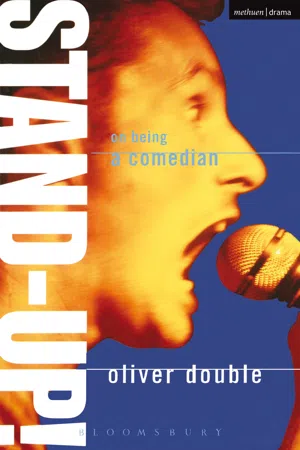
- 256 pages
- English
- ePUB (mobile friendly)
- Available on iOS & Android
eBook - ePub
About this book
Stand-Up! is the first book to both analyse the background of stand-up comedy and take us inside the world of being a solo comedian
Information
Chapter One
Standing Up
The experience
I hear the sound of my own name getting applause and a bit of cheering and I’m on. I walk over to the microphone, timing it so I get there before the applause runs out. The expectation is bad enough as it is. Underneath the blurry glare of the lights there’s a whole load of faces looking up at me, wanting to laugh but not knowing if I’m funny yet. I hit them with my first big gag, and bang! They laugh. I relax. The nerves drain away, and I’m a comedian again.
The good feeling that buoys me up and makes it feel like I’m floating can’t be tied down with words, I’m giving the audience the pleasure of my company, and they’re loving it. It’s my thoughts, my pet theories, my idea of what’s funny, and each time I give them the option, they laugh. Every punchline gets another life-enhancing woof which pumps me up with more and more energy. Even the bar staff are laughing. I’m surfing on a wave of goodwill.
Everything falls into place. The new material works perfectly. It’s such a joy to do new stuff when it works. It’s a bit like feeling my way in the dark, and when the laughs come, whoom!, the lights come on, revealing a surprise party in my honour. Somehow, I manage to breathe new life into those tired old gags that are limping a bit and really should have been sent off to the Old Jokes’ Home a few gigs ago. I find a new way of putting them over, twist the delivery slightly, and suddenly they’re as fresh as the day I first cracked them.
Better than that though, I’m improvising. New punchlines for old routines suddenly strike me. The idea comes into my head, and without a second thought it tumbles out of my mouth, and there’s a laugh. I say things about what’s going on in the room, how the jokes are going down, people in the audience, and the things I say get laughs. This is instant comedy, with a butterfly lifespan. These jokes exist for a moment, then they’re gone. If you repeated them to somebody outside of the gig, you’d just get a blank stare. The strange thing about improvised stuff is that it just comes to me. It pops into my head unbidden. It is like the comedy god speaking through me. Somebody heckles, and there’s a put-down coming out of my mouth before I can think about it. The audience cheers.
Before I know it, I’m into my last routine. There’s something almost trance-like about a good gig, because time goes so quickly. I completely lose any sense that I’m in the odd situation of being stared at by a hundred strangers. It’s like being deeply engrossed in a conversation. Things that I say onstage on the spur of the moment are quickly forgotten. Only when somebody comes up to me afterwards and refers to them do I remember having said them at all.
There’s a huge roar when I leave the stage, and I feel triumphant. For the rest of the evening, people smile at me as I pass. Somebody buys me a drink. Somebody shakes my hand and tells me I’m great. Sometimes audience approval gets a bit ridiculous. I once did a gig in a tiny room above a Central London pub, and went down so well that when the final act failed to show up, the audience spontaneously started shouting for me to come back onto the stage. I had no material left to give them, so I impressed them by doing ten press-ups, then left the stage to another cheer.
Best of all, I get paid. I’ve just had the best night of my life, and now someone’s counting ten-pound notes into my hand. I feed my wallet until it’s satisfyingly fat, and leave the venue lighting up the night with my glow.
Sadly, it’s not always like that, though. Sometimes it’s like this –
The sound of my name being announced is like the order for the firing squad to go ahead and pull the trigger. The faces looking up at me are oddly disconcerting. I’m getting the sort of looks I got when I dropped my lunch down myself in the school dinner hall and everybody turned and stared. My first big joke comes and goes with little more than a bemused chuckle. I start to panic: that was one of my strongest gags. If they didn’t like that, what are they going to make of some of the rubbish that’s coming up?
Instantly my mouth is as dry as a desert. My brain goes numb. As the responses get weaker and more irritated, I begin to feel like the unfunniest man in the world. My jokes are like a list of casualties after a horrific terrorist bombing. I try to cling onto a scrap of hope. There’s a couple of strong jokes coming up which might just drag the audience onto my side. This could be the turning point, but instead, the strong jokes come out sad and limp, getting not so much as a chortle. Now there’s no chance. It’s downhill all the way.
Nothing works. My poor, dry mouth is losing the capacity to speak English, translating the last three words of every punchline into some obscure Eastern European dialect. I can’t move properly. In my mandolin song, my fingers turn into great useless, blobby pork sausages that actively search for the wrong notes. My props run away and hide in the darkest corners of the stage. Once, at a university gig in Salford, I made the mistake of putting all my props on a table at the side of the stage. I found myself increasingly unable to click with the audience, and stopped being able to move properly. In one routine, I had to bend down suddenly, and, sure enough, I smacked nose-first into the table and blood started gushing from both nostrils.
The fact that I’m stuck to this rotten script seems inescapable, because my brain is too numb to try and improvise. Finally, in desperation, I try to force out some spontaneous comments, but they’re stiff and shaky. Somebody heckles and gets a bigger laugh than I’ve had all night. I reel out an instant heckle put-down, but all I get is a sea of sneers and the odd pitying snigger.
Time goes so very slowly. I’m acutely aware of myself and of the difficult situation I am in. Every mistake, every garbled line hits me like a slap around the face. I try to hold myself together so the whole thing doesn’t visibly fall apart. All I want is for this to be over. The audience looks at me as if they’re a bank queue, and I’m at the counter trying to pay in a hundred pounds in small change. They’re impatient, they’re irritated, they just want me to finish what I’m doing as quickly as possible, then get lost.
After a lifetime’s struggle, I get off the stage to a damp smattering of lame claps. Offstage, people avoid eye contact. The promoter tries to be supportive, but you can see his brain ticking away as he hands over the cash: ‘That’s the last time I’ll be booking him, thank you very much.’ I walk out into the cold, harsh night to the sound of the fulsome laughter which the next act is getting. For the rest of the night, my brain gives me increasingly intense flashbacks of some of the worst moments.
The challenge
This is what my best and worst experiences of doing stand-up comedy have been like. Usually, it’s somewhere between these two poles, a little worse than the first but a lot better than the second. Whatever happens, stand-up is an intense form of entertainment for the comic. I would define stand-up comedy as a single performer standing in front of an audience, talking to them with the specific intention of making them laugh. The two key features in this definition present a hefty challenge:
1. A single performer As a stand-up, you’re very much on your own. You can’t rely on anybody else to help you out if things get sticky. If you triumph, you can hog all the praise for yourself, but if you fail, that great, stinking pile of shame falls on your head and your head alone.
2. The specific intention of making them laugh Your job is to make the audience laugh. What you do is defined by your ability to create a specific response in a roomful of people. The challenge you set yourself is so difficult, it requires a degree of arrogance. If you call yourself a stand-up comic, what you are saying is, ‘I can go into a room full of randomly assorted strangers and make them react exactly how I want them to.’ If the audience doesn’t laugh, you’ve quite simply failed. The content of your act is irrelevant. You may have been inventive, imaginative, intelligent, but if they didn’t laugh, you’re a failure. In this sense, stand-up is harder than stage acting, because a quiet audience in the theatre doesn’t necessarily mean that individual members of the audience haven’t enjoyed the play. If a stand-up comic goes down to silence, you can be fairly sure that not a single person in the room has had a good time. The stand-up’s problems are also compounded by the fact that the job is dynamic and interactive. If a comedy film isn’t getting the laughs in the cinema, the celluloid will keep rolling through the projector completely unaffected by its failure. The stand-up feeds on audience response, and if the laughs don’t come, he or she will tense up, the delivery will lose its edge, the whole performance will get worse, and so the audience will laugh less and less.
The ego
Given all this, it is no surprise that stand-up comedy is an ego-ridden profession. When I first started, a good gig would send me floating off on a warm cloud of delirious happiness for at least a week. A bad gig would give me an eye-stinging feeling of being alone and unloved, which would last for about the same length of time. With experience, the intensity of these reactions has faded, although the bad ones have retained some of their emotional kick. I will celebrate a good gig with nothing more extravagant than an upwards tweak of the volume knob on my car stereo on the way home. As I’ve described, time zooms by when I’m doing well on stage, and the laughs and the applause and everything I did that was good quickly evaporate from my memory. The bad gigs still stay around to haunt me, sometimes for a couple of days. I mull over all mistakes, and work out ways of avoiding those pitfalls in the future. The idea that everybody who saw me that night has gone away with the idea that I am a no-hoper sometimes pops into my head and refuses to leave.
The least pleasant side of the ego problems that go with the job of stand-up is the competitiveness. Stand-ups don’t just want to go down well, they want to go down better than anybody else on the bill. I’ve never been a particularly competitive person, but stand-up forces you to watch the opposition. This is a terrible admission, and I may be the only comic to think like this, but there’s something fantastic about watching another act going down badly. Part of me is sympathetic, but deep down there’s a bit of evil glee. There’s a lump of pure selfishness in me that is thinking, ‘Ha! I went down really well, and he’s dying on his arse! I’m brilliant and he’s rubbish!’ At its least heinous, this is the product of insecurity, the need for reassurance, the need to know that I’m not the only person in the world capable of going down that badly. At worst, it is pure, insane egomania, the desire to be enthroned as absolute dictator of the comedy universe, and to see all my challengers viciously struck down.
The boring bits
Being a stand-up isn’t just a seething mass of ego-trips and jealousy, though. There’s also a lot of boredom involved. Whether on public transport (battling against late trains and overpriced refreshments) or in a car (hurtling down endless stretches of bland, grey motorway) getting to the gig always means a struggle against tedium. It’s not much better when you get to the venue, as there’s inevitably time to kill before the show starts. Usually, this involves a bit of small talk with the person who runs the club. This comes in two flavours. There’s conversations with the promoters I’ve already worked for, which might go something like this:
PROMOTER: Oh hi there, how’s it going? (Translation: How have the gigs been going recently? Not been dying too much, have you?)
ME; Not bad, not bad. Yeah, things’ve been going pretty well recently, actually. (What, don’t you trust me or something? I’m a good act, you don’t need to worry on my account.)
PROMOTER: Have you been busy? (I’m not the only one stupid enough to book you, am I?)
ME: Reasonably, yeah. Yeah, actually I had a really hectic week last week, ’cos I was in Leicester on Wednesday, my own club on Thursday, Manchester on Friday and Saturday, then I had to go down to Bath on Sunday. (Look, I told you, you can trust me. I do get other gigs, and I run my own as well.)
PROMOTER: So are you still in … Sheffield, is it? (The only thing I really know about you is where you live … and I’m not even one-hundred-per-cent sure about that.)
ME: Oh yeah. I don’t really have any plans to move in the near future. (Why are you asking me these stupid questions?)
Then there’s the conversations with promoters I’ve never met before, usually people who have never seen me work. They might go something more like this:
ME: Hi, I’m Oliver Double, I’m supposed to be doing a gig for you tonight. (Translation; Hi, I’m really funny, believe you me!)
PROMOTER: Oh right, nice to meet you. Do you want somewhere to dump your bags? (Oh, thank God for that, at least one of the acts has turned up on time.)
ME: Yeah, that’d be great. (I’m glad you asked that, my arms are killing me.)
PROMOTER: Just put them through here. So, do you make a living doing this, or do you have a day job as well? (You can make people laugh, can you? Tell me you can. Please tell me you can.)
ME: No, this is my main thing, this is all I do really. (Hey, trust me, I’m a professional.)
PROMOTER: And does it normally go pretty well? (Are you sure you’re not just completely hopeless?)
ME: Well it seems to, yeah. (Oh for God’s sake! Look, I’m going to be good tonight, OK? Probably.)
One of the questions that promoters I haven’t worked for before tend to ask me is, ‘Have you been doing this long?’ I usually keep things a bit vague when they ask this. On the one hand, I want to reassure them, but on the other, I don’t want them to think I’ve been around too long to be still doing gigs on this level. Sometimes, it’s best to deliberately wind them up. On one occasion, when a promoter asked me, ‘Have you been doing this long?’ I feigned wide-eyed innocence and came back with, ‘Well actually, this is the first gig I’ve ever done.’
After the show, if you’ve got there by train, there is the prospect of staying the night on somebody’s couch, and a good night’s sleep is by no means guaranteed. I once found myself without a bed for the night after a show in Chester, and one of the other acts kindly offered to help me out. Just as we got to his door, he turned around and said, ‘How are you with dogs?’
‘Oh, well … not terribly keen actually,’ I replied, a bit sheepishly.
‘I’d just better go and lock Benny in the back room then, or he’ll be all over you,’ he said.
It turned out that Benny was a Staffordshire bull terrier, and as I settled down, fully clothed, under the blanket on the sofa, I started to read the local newspaper that’d been left lying across the floor. The main headline was about a local girl who had been mauled by such a dog that very day. I tried to settle down for the night, but the noise of Benny hurling himself against the door was curiously unsettling. It sounded like somebody was trying to batter their way in with a sack of potatoes. The fact that I needed to go to the lavatory didn’t help much, but a full bladder was far less threatening than an encounter with Benny on the way to the toilet.
Then there are the times when there isn’t even a couch to bed down on. On one occasion, I missed the last train from Derby by a minute, and had to spend the night on a bench in the waiting room. Luckily there was some heating on, but my night’s sleep was not improved by the fact that somebody else had already bedded down on the other bench. All night, he kept making scary strangled-chicken noises in his sleep.
Another time, in Walsall, the venue I was playing at had sorted out a bed and breakfast for me, but when I turned up at the place where it was supposed to be, it was nowhere to be seen. After desperately wandering the streets for a couple of hours trying to find somewhere that was open, I eventually went to the police station to ask for advice, and luckily, they managed to find a B&B that would take me in for the night. The next morning, without prompting, the landlady served me up a massive breakfast of bacon, eggs, liver, mushrooms, beans and lard-rich fried bread. Being a vegetarian, this posed a bit of a dilemma. I was the only guest there that morning, so it would have been conspicuously rude to push half of the food to the side of the plate, but on the other hand, I have a moral objection to eating meat. As it turned out, the bacon was really nice.
In any event, whether you spend the night away or manage to make it home, the chances are that you won’t be able to get to sleep straight away. The adrenalin continues to pump around your body long after the show is over, and gives you plenty of time for watching some mind-rotting late-night television. I remember coming across American Gladiators and World Wrestling Federation for the first time, and slouching there with slack-jawed amazement that TV could be so brainless. There’s also an ultra-low budget cookery show called Get Stuffed, in which student types make recipes in their own kitchens, filmed on a hand-held domestic camcorder. It lasts about five minutes, and they show several episodes per night. You know you’ve got a serious late-night TV habit when you start waiting up for the last episode.
Another post-gig hazard is the friendly punter. The classic unwanted friendly punter experience is when somebody comes up to you after a show and says, ‘Here’s a joke you could use, mate.’ The joke that follows is always something completely depraved, usually involving two naked nuns and a Nazi stormtrooper. What amazes me is the idea that I can have given the impression that I would want to hear such a joke, let alone consider telling it. Then again, the capacity people have to misunderstand comedy is extraordinary. I used to do a routine which looked at why we are disgusted by menstrual blood, getting a few gross laughs along the way. In it, I specifically said that the taboos which surround menstruation are ‘stupid’, because ‘they make women embarrassed about the normal functions of their bodies’. In spite of this, I’ve had grinning lads come up to me after a gig and say, ‘The periods stuff was really good, ’cos you really embarrassed some of the girls.’
Sometimes people make comments which bring home to me just how little they understand of the whole business of stand-up. One is: ‘When you’re up there on the stage, how do you think of things to say?’ The idea that a comic stands in front of the microphone without any kind of prepared material and just says the first thing that comes into his or her head is touchingly naive. Then there are comments which damn with faint praise. People will say things like, ‘You’re so brave, I don’t know how you can stand up there in front of all those people,’ or, ‘I don’t know how you remember all those things you have to say.’ Personally, I would much rather people praised me for being funny, than for being brave or having a good memory.
In the end though, these people are only trying to be friendly, and there are times when a cheery-faced punter is the one glimmer of light in a dark and savage evening. After a hellish gig, in which your chances of being funny are torn asunder by barrages of hate-filled heckling, it is almost inevitable that a couple of peop...
Table of contents
- Cover Page
- Title Page
- Contents
- Chapter One Standing Up
- Chapter Two Variety
- Chapter Three Funny in Theory
- Chapter Four The Clubs
- Chapter Five The Confidence Trick
- Chapter Six Misfits
- Chapter Seven The Right Circumstances
- Chapter Eight Alternative Comedy
- Chapter Nine What’s the Secret of Great Comedy?
- Bibliography
- Acknowledgements
- Imprint
Trusted by 375,005 students
Access to over 1.5 million titles for a fair monthly price.
Study more efficiently using our study tools.
Frequently asked questions
Yes, you can cancel anytime from the Subscription tab in your account settings on the Perlego website. Your subscription will stay active until the end of your current billing period. Learn how to cancel your subscription
No, books cannot be downloaded as external files, such as PDFs, for use outside of Perlego. However, you can download books within the Perlego app for offline reading on mobile or tablet. Learn how to download books offline
We are an online textbook subscription service, where you can get access to an entire online library for less than the price of a single book per month. With over 1.5 million books across 990+ topics, we’ve got you covered! Learn about our mission
Look out for the read-aloud symbol on your next book to see if you can listen to it. The read-aloud tool reads text aloud for you, highlighting the text as it is being read. You can pause it, speed it up and slow it down. Learn more about Read Aloud
Yes! You can use the Perlego app on both iOS and Android devices to read anytime, anywhere — even offline. Perfect for commutes or when you’re on the go.
Please note we cannot support devices running on iOS 13 and Android 7 or earlier. Learn more about using the app
Please note we cannot support devices running on iOS 13 and Android 7 or earlier. Learn more about using the app
Yes, you can access Stand Up by Oliver Double in PDF and/or ePUB format, as well as other popular books in Medien & darstellende Kunst & Schauspielerei & Vorsprechen. We have over 1.5 million books available in our catalogue for you to explore.