- 208 pages
- English
- ePUB (mobile friendly)
- Available on iOS & Android
eBook - ePub
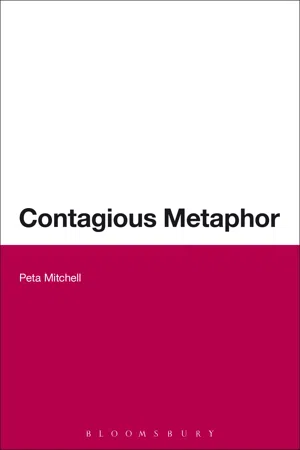
Contagious Metaphor
About this book
The metaphor of contagion pervades critical discourse across the humanities, the medical sciences, and the social sciences. It appears in such terms as 'social contagion' in psychology, 'financial contagion' in economics, 'viral marketing' in business, and even 'cultural contagion' in anthropology. In the twenty-first century, contagion, or 'thought contagion' has become a byword for creativity and a fundamental process by which knowledge and ideas are communicated and taken up, and resonates with André Siegfried's observation that 'there is a striking parallel between the spreading of germs and the spreading of ideas'. In Contagious Metaphor, Peta Mitchell offers an innovative, interdisciplinary study of the metaphor of contagion and its relationship to the workings of language. Examining both metaphors of contagion and metaphor as contagion, Contagious Metaphor suggests a framework through which the emergence and often epidemic-like reproduction of metaphor can be better understood.
Information
1
Contagious Metaphor
Metaphoricity is the logic of contamination and the contamination of logic.
Jacques Derrida, Dissemination. 1981 [1972].1
Metaphor is a metaphor is a metaphor is a metaphor.
Dennis Sobolev, ‘Metaphor Revisited’. 2008.2
Since the late 1990s, a strikingly interdisciplinary body of scholarship has grown up around the concept of ‘contagion’ and its relationship to society, culture and thought. The emergence of this body of scholarship, which, for the sake of brevity, I will term cultural studies of contagion, can in part be traced to developments in the field of medical history. Although medical history is as old as medicine itself, historian John C. Burnham points to the influence of the ‘New History’ movement in the 1960s and 1970s in opening the field to distinctly sociocultural and historical perspectives. According to Burnham, the ‘cross-fertilisation’ between medicine and medical history began a century ago, in the early twentieth century (1999, p. 273). This process, he continues, ‘intensified’ in the 1970s as ‘medical practitioners and academics writing medical history . . . expanded into each other’s disciplinary territory’, so much so that, by the turn of the twenty-first century, ‘intellectual, technical, social, and cultural questions enlivened all of medical history’ (1999, p. 273).
In the development of this interdisciplinary field of medical history, the history of disease has played a prominent role. Henry E. Sigerist – a medical historian who, according to Elizabeth Fee, ‘did more than any other individual to establish, promote, and popularize the history of medicine in America’ (1989, p. 127) – mapped out this role for the history of disease in a seminal 1938 essay titled ‘The History of Medical History’. In this essay, Sigerist maintains that the history of disease must be the ‘starting point’ of medical history, and the ‘first set of problems [medical history must] attack’ (1938, pp. 173, 171).
The reason for its importance is twofold. First, Sigerist argues, contemporary medicine can and does benefit from an understanding of the history of disease (1938, p. 173). Second, and significantly for this study, he stresses that the analysis of disease necessarily leads on to sociological analysis: ‘Once we are familiar with the incidence of disease at a given period’, Sigerist explains, ‘we want to know how society reacted against disease, what was done to restore and protect health’ (1938, p. 174). Further, he adds, ‘[w]hen we study the history of disease we will soon find that its incidence is determined primarily by the economic and social conditions of a society’ (1938, p. 179; emph. in original). The history of disease, therefore, requires an interdisciplinary outlook and an understanding of economic, social and cultural history. ‘It is not enough’, Sigerist argues,
to know how to prevent disease; we must be able to apply our knowledge, and whether we succeed or fail in this endeavor depends on endless non-medical factors such as the attitude of society toward the human body, its valuation of health and disease, its educational ideal, and many other philosophic, religious, social, and economic factors. . . . The history of preventive medicine is most intimately connected with the general history of civilization. (Sigerist 1938, p. 177; emph. added)
Burnham, like Sigerist, identifies the history of disease as one of medical history’s earliest and most significant strands, and one that especially benefited from the interdisciplinarity produced by the incursion of social historians into medicine in the 1970s (1999, pp. 257, 271). Burnham cites Caroline Hannaway as one medical historian who, in the late 1980s, ‘praised the ways in which historians, virtually none of whom were medically trained, construed disease to raise questions – ranging from biology and geography to the patients’ subjective experience of disease and illness – about the relationship of medicine to the surrounding culture’ (1999, p. 271). By the late 1990s, a number of major studies exemplified this approach to the history of disease, notable among them Charles E. Rosenberg’s Explaining Epidemics and Other Studies in the History of Medicine (1992), Terence Ranger and Paul Slack’s edited collection Epidemics and Ideas: Essays on the Historical Perception of Pestilence (1992), Sheldon Watts’s Epidemics and History: Disease, Power and Imperialism (1997) and Rosenberg and Janet Golden’s edited collection Framing Disease: Studies in Cultural History (1997). The influence of these studies extended beyond medicine and history and into literary and cultural studies, where socio-historical approaches to disease were making their presence felt in works of interdisciplinary criticism, such as Athena Vrettos’s Somatic Fictions: Imagining Illness in Victorian Culture (1995), Linda and Michael Hutcheon’s Opera: Desire, Disease, Death (1996) and Alan Bewell’s Romanticism and Colonial Disease (1999).
As the above titles suggest, the focus of these studies was more broadly on the concepts of disease or epidemic than on contagion. ‘Contagion’ was certainly a key term in many if not all of these studies, but, unlike ‘disease’ and ‘epidemic’, it did not emerge as a focal point for social/medical history until the late 1990s, when it, too, began appearing in the titles of major studies.3 The emergence of ‘contagion’ as a keyword at the turn of the twenty-first century was not, however, limited to the discipline of medical history. Indeed, the language of epidemiology was spreading through disciplines as diverse as psychology, economics and literary and cultural studies. The early 1990s saw psychologists Elaine Hatfield, John T. Cacioppo and Richard L. Rapson (1994) building upon a much earlier epidemiological tradition in psychology (which I explore in Chapters 3 and 4), by positing ‘emotional contagion’ as a basic human mechanism. Around the same time, academic discussion of Dawkins’s meme theory (the focus of Chapter 5) was shifting from genetic analogies to epidemiological ones: ‘memetics’ became cast as a theory of ‘thought contagion’. And in economic discourse, perhaps the most salient – in a political sense – of all contemporary uses of the contagion metaphor was beginning to appear. According to economist Sebastian Edwards, the term ‘contagion’ rarely appeared in the economic literature prior to 1990, and yet ‘surged’ in the latter part of the same decade (2000, p. 873). Since that time, the phrase ‘financial contagion’ has multiplied in both academic and public discourse about finance and economics at a seemingly exponential rate.
Literary and cultural studies were similarly already showing signs of having caught the ‘contagion’ infection in the 1990s,4 but it was not until the early 2000s that a distinctive, interdisciplinary cultural studies of contagion appeared, which attempted to draw together these strands of cultural, historical, literary and sociological analyses. Exemplary of this shift was Alison Bashford and Claire Hooker’s edited collection, Contagion: Historical and Cultural Studies (2001b), closely followed by two notable special journal issues: American Literary History’s ‘Contagion and Culture’ issue of 2002 and Literature and Medicine’s ‘Contagion and Infection’ issue of 2003. The year 2005 again saw a proliferation of essay collections contribute to this developing cultural studies of contagion, notably Claire L. Carlin’s Imagining Contagion in Early Modern Europe (2005); Mirjam Schaub, Nicola Suthor and Erika Fischer-Lichte’s Ansteckung: Zur Körperlichkeit eines ästhetischen Prinzips (2005); and Fibreculture Journal’s ‘Contagion’ issue, which provided a springboard for an incipient viral network theory.
Moreover, as Priscilla Wald has recently pointed out in Contagious: Cultures, Carriers, and the Outbreak Narrative (2008), popular culture was also not immune to the mid 1990s spread of contagion. Accounts of ‘emerging infections’, such as HIV in the 1980s, she argues, ‘put the vocabulary of disease outbreaks into circulation’, leading to a spate of mid 1990s films and popular novels that featured storylines about contagious disease outbreaks (2008, p. 2). A rich year for outbreak narratives, 1995 alone saw the release of Wolfgang Petersen’s Outbreak and Terry Gilliam’s 12 Monkeys, along with the publication of Robin Cook’s Contagion and Patrick Lynch’s Carriers.
The very public ‘noise’ around emerging diseases, such as HIV in the 1980s and SARS in the early 2000s, can go some way to explaining the remarkable cross-disciplinary discursive flowering of contagion in the last two decades, but it cannot explain everything. As Wald puts it,
Contagion is more than an epidemiological fact. It is also a foundational concept in the study of religion and of society, with a long history of explaining how beliefs circulate in social interactions. The concept of contagion evolved throughout the twentieth century through the commingling of theories about microbes and attitudes about social change. Communicable disease compels attention – for scientists and the lay public alike – not only because of the devastation it can cause but also because the circulation of microbes materializes the transmission of ideas. (Wald 2008, p. 2)
Medical historian Margaret Pelling suggests that contagion’s irruption in contemporary discourse is due ‘in part to the social, political and moral climate induced by the recrudescence, in the latter twentieth century, of significant infectious disease’ (2001, p. 16). And yet, she adds, ‘it is historically inadequate’ to think of contagion as ‘purely medical’, for ‘ideas of contagion’ have always been ‘inseparable from notions of individual morality, social responsibility, and collective action’. The ongoing significance of contagion, its ‘wide currency in a range of areas of thought and practice’, Pelling stresses, is particularly ‘reflected in an accretion of metaphor and analogy’ (2001, pp. 16–17).
Contagion as metaphor
We cannot, therefore, properly consider the contagion phenomenon without considering the mechanics and implications of metaphor. Taken as a whole, cultural studies of contagion have certainly been attentive to the question of figurative language. In their introduction to Contagion: Historical and Cultural Studies, for instance, Bashford and Hooker maintain they ‘are deeply interested in the metaphoric reach of contagion’, for what is fascinating about contagion is its ‘capacity . . . to simultaneously function as deeply resonant metaphor for the circulation of social, moral or political dangers through a population, and as visceral, horrible infection’ (2001a, p. 5).
Further, the aforementioned special issues of American Literary History and Literature and Medicine each devoted an article to the question of contagion and metaphor. In her essay titled ‘Contagion as Metaphor’ for American Literary History, Cynthia J. Davis draws attention to the ‘seductive’ nature of contagion. Contagion, Davis points out, has a peculiar ability to be both content and method, ‘both disease and the process of its spread’ (2002, p. 830). For this reason, she argues, contagion has offered itself as a compelling analogy or metaphorical shortcut for explaining processes of cultural as well as disease transmission. And yet, Davis asks, can the analogy hold? ‘Is contagion’, she asks, ‘an appropriate metaphor for culture?’ (2002, p. 830).
Davis’s question is one that is often repeated, if not explicitly then implicitly, in the literature on cultural contagion. Here, however, Davis is posing the question as a direct engagement with an earlier, seminal work on metaphors of disease, namely Susan Sontag’s Illness as Metaphor. In her influential polemic, first published in the late 1970s, Sontag warns against the potentially dehumanizing and deleterious effects of disease metaphors. In Sontag’s reading, these metaphors tend to ‘mythicize’ disease by connecting the physical to the moral and by figuring illness as a mysterious and malevolent ‘predator’ (1983 [1978], pp. 10–11). ‘Any disease’, she argues, ‘that is treated as a mystery and acutely enough feared will be felt to be morally, if not literally contagious’, and, particularly in the case of cancer, the very real effects of these metaphors can be felt in the fact that ‘a surprisingly large number of people with cancer find themselves being shunned by relatives and friends . . . as if cancer, like TB, were an infectious disease’ (1983 [1978], p. 10). Ultimately, Sontag claims, using cancer as a metaphor is not currently ‘morally permissible’ (1983 [1978], p. 89). Sontag does, however, foresee a future in which cancer may be ‘partly de-mythicized’, at which point it may be possible to use cancer metaphors ‘without implying either a fatalistic diagnosis or a rousing call to fight by any means whatever a lethal, insidious enemy’ (1983 [1978], p. 89).
In her response to Sontag, Davis both heeds and reiterates her call for a critical and ethical approach to figurative language. Although Davis concedes that ‘it may not be possible to think without metaphors’, she asserts that we should not use them unconsciously. Roping in some disease metaphors for rhetorical effect, Davis writes, we should ‘think about’ the metaphors we use and ‘where necessary, identify more benign replacements for the most malignant ones’ (2002, p. 832). In his essay titled ‘Afterword: Infection as Metaphor’ for Literature and Medicine, Arnold Weinstein also engages with Sontag’s critique of disease metaphors. Yet, unlike Davis and Sontag, he appears to relish metaphor’s ambivalence. Weinstein acknowledges Sontag’s caution, but argues that ‘illness cannot, pace Sontag, be cleanly separated from its metaphors, desirable as that might be’ (2003, p. 107). Rather, he suggests,
from a literary or even a social perspective, it is wiser to acknowledge that such metaphors have proven irresistible to societies under stress. They are able to catalyze mass social responses that become nightmarishly purgative for the state, a kind of macrocosmic mockery of the desired “cleansing” effect that Aristotle designated by the notion, catharsis. (Weinstein 2003, p. 104)
To take Weinstein’s point further, if contagion metaphors have historically irrupted at times of social tumult or stress, the question of the metaphors’ moral ‘appropriateness’ becomes, perhaps, less interesting than others that emerge when we take seriously contagion’s repeated intrusions in the social field.
Contagious Metaphor is certainly not the first or the only study devoted to cultural aspects of contagion, and neither is it the first to draw attention to metaphors of contagion. What this study does do, however, is begin the work of tracing the genealogy of contagion metaphor in order to explain its contemporary pervasiveness. To some degree, it has a similar aim to philosopher Hans Blumenberg’s project of ‘metaphorology’, which considers certain so-called absolute metaphors to be ‘foundational elements of philosophical language, “translations” that resist being converted back into authenticity and logicality’ (2010 [1960], p. 3). Anthony Reynolds describes Blumenberg’s metaphorology as an approach to philoso...
Table of contents
- Cover-Page
- Half-Title
- Series
- Title
- Copyright
- Dedication
- Contents
- Acknowledgements
- Introduction: Due Preparations
- 1 Contagious Metaphor
- 2 Pestilence and Poison Winds: Literary Contagions and the Endurance of Miasma Theory
- 3 The French fin de siècle and the Birth of Social Contagion Theory
- 4 The Contagion of Example
- 5 Infectious Ideas: Richard Dawkins, Meme Theory and the Politics of Metaphor
- 6 Networks of Contagion
- Notes
- Bibliography
- Index
Trusted by 375,005 students
Access to over 1.5 million titles for a fair monthly price.
Study more efficiently using our study tools.
Frequently asked questions
Yes, you can cancel anytime from the Subscription tab in your account settings on the Perlego website. Your subscription will stay active until the end of your current billing period. Learn how to cancel your subscription
No, books cannot be downloaded as external files, such as PDFs, for use outside of Perlego. However, you can download books within the Perlego app for offline reading on mobile or tablet. Learn how to download books offline
Perlego offers two plans: Essential and Complete
- Essential is ideal for learners and professionals who enjoy exploring a wide range of subjects. Access the Essential Library with 800,000+ trusted titles and best-sellers across business, personal growth, and the humanities. Includes unlimited reading time and Standard Read Aloud voice.
- Complete: Perfect for advanced learners and researchers needing full, unrestricted access. Unlock 1.5M+ books across hundreds of subjects, including academic and specialized titles. The Complete Plan also includes advanced features like Premium Read Aloud and Research Assistant.
We are an online textbook subscription service, where you can get access to an entire online library for less than the price of a single book per month. With over 1.5 million books across 990+ topics, we’ve got you covered! Learn about our mission
Look out for the read-aloud symbol on your next book to see if you can listen to it. The read-aloud tool reads text aloud for you, highlighting the text as it is being read. You can pause it, speed it up and slow it down. Learn more about Read Aloud
Yes! You can use the Perlego app on both iOS and Android devices to read anytime, anywhere — even offline. Perfect for commutes or when you’re on the go.
Please note we cannot support devices running on iOS 13 and Android 7 or earlier. Learn more about using the app
Please note we cannot support devices running on iOS 13 and Android 7 or earlier. Learn more about using the app
Yes, you can access Contagious Metaphor by Peta Mitchell in PDF and/or ePUB format, as well as other popular books in Literature & Literary Criticism Theory. We have over 1.5 million books available in our catalogue for you to explore.