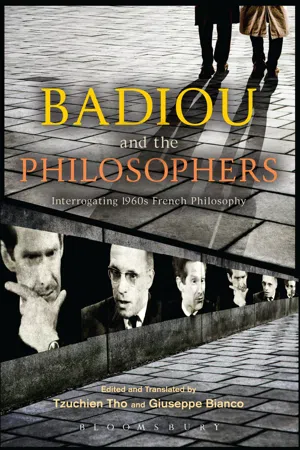
Between 1965 and 1968, the celebrated French philosopher Alain Badiou hosted a televised series in which he interviewed some of the most influential contemporary philosophers of the period, including Michel Foucault, Paul Ricoeur, Michel Henry and Michel Serres. This book presents the first English-language translation of those interviews.
Although Badiou had yet to publish the books that would go on to mark him out as the leading thinker of his generation (Being and Event and Logics of Worlds), his unique approach and highly original ideas are present in each discussion and the interviews present his philosophical origins in a lively and engaging context. More importantly these highly accessible and entertaining interviews provide a snapshot of French philosophy in the 1960s, setting the scene for the very public and political context of philosophy in the period immediately preceding the events of May '68, where philosophy played a crucial role. The book includes a new essay by Badiou in which he reflects on the project 30 years on.
eBook - ePub
Badiou and the Philosophers
Interrogating 1960s French Philosophy
- 192 pages
- English
- ePUB (mobile friendly)
- Available on iOS & Android
eBook - ePub
Badiou and the Philosophers
Interrogating 1960s French Philosophy
About this book
Information
chapter one
Philosophy and its history
First broadcast: 9 January 1965
Alain Badiou: Jean Hyppolite, I would like to start by asking the following question: Why is there a history of philosophy and what is the specificity of this history?
Jean Hyppolite: Well, I think we can’t, at least not today, philosophize without the history of philosophy,1 that is, the history of the great philosophical works and the great systems of the past. When you want to initiate someone into philosophy, since you are a philosophy teacher as I am, you need to put them in contact with the philosophers of the past. This is exactly as if one wanted to learn poetry, there is only one way: read the poets. Only that this history does not resemble, for example, the history of mathematics, which dissolves into contemporary mathematics, for example we know how the imaginary number was established, we know this because we understand certain structures today and, in brief, the history of mathematicians and of mathematics is nothing but a series of anecdotes in relation to a foundation which is completely current. We cannot take up all the philosophers of the past and somehow reduce them into a current philosophy which would forget succession in order to maintain a history of repetition.
AB: On this point, should we conclude that philosophy is closer to poetry, for example, than mathematics?
JH: What interests mathematicians is the rigor of form. This is a formalism that has nothing to do with what the philosophers sometimes call form: philosophers also want to prove, philosophers also want rigor. Yet mathematicians attain a formal system, a systematicity. A system of philosophy will never arrive at this even if the organization of a work, the way in which it links up its evidence, is fundamental. However, with the poet, for I have not responded for the poet, with the poet, this is what we have in common: the aim of the poet is also not mathematical formalism but something different. The aim of the poet is the beautiful and the aim of the philosophy is the truth.2
AB: This history of philosophy, which is neither the history of the beauty of systems, nor the anecdotal history of philosophers, I suppose … [JH: surely not!] What is it then finally?
JH: Well, it is, one needs to add, neither the history of scientists nor the history of science. It is not the history of science, it is different. We need to assert that philosophy exists. This first point means, for us, doesn’t it, that philosophers exist: Plato, Descartes, Spinoza, Leibniz, Kant, are philosophers.
AB: But then there are philosophers such as Malebranche who reject the importance of history of philosophy, and those like Hegel, who absorb it and ends up being dissolved in it. Is it not already to make an affirmation of a type of philosophy to say, as you do, to first state the necessity of the history of philosophy?
JH: I think that all philosophy that we know, in the end, since the philosophy of the Pre-socratics until our philosophy, until Kant, marks an irreversible movement. It flows in an irreversible direction, just like time, just like filled time, like a full time, and this irreversibility makes it such that philosophy is a question for itself, metaphysics is a question for itself. Since Kant, in particular, something occurred and which makes it such that metaphysics has without doubt become: what is metaphysics? It is no longer a question of doing metaphysics, a theory of being or a theology, it is a question of asking what this metaphysics is, and in what measure it is possible.3
AB: But this question of critique is it not, in some respects, the announcement of the end of philosophy?4
JH: An end … of metaphysics?
AB: And maybe even of philosophy?
JH: Ah! For the salt of the earth that would be lost! You know quite well! […] Simply put, if you like, the metaphysicians of the past worked at a theory of being and in general they also worked at a theology. It is this theology that is not our question today, this does not mean that the problem of being, the problem of metaphysics itself has ceased, has been accomplished. This perhaps means that a system such as that of Spinoza or a system such as … Descartes, who was not that systematic but even a system like that of Descartes is impossible today even though we absolutely have the need to read Descartes and Spinoza in order to do philosophy.
AB: But even so I would like to ask you about the nature of this need. If the question itself, or rather a formulation of the philosophical question has been modified, if it means the possibility of a metaphysics and not on the possibility of constructing a metaphysical system, we can ask ourselves what is the properly philosophical interest of studying the Pre-critical authors, after all?
JH: That’s it! Should we begin philosophy with Kant and not to go all the way back to Plato, for example?
AB: This seems to me a bit of what results from what you say.
JH: It is perhaps difficult to understand what I am saying. I mean to say that the philosophical systems of the past represent a first degree of thinking, if I dare say. This is not thinking itself but gives us a sort of existent metaphysical thinking with this double character and this double character is the link between a matter and a form. I mean the thought of a philosopher is a thought that wants to think being, that wants to think content, unlike mathematical thought, for example, and it is at the same time a thinking that wants to be rigorous and not arbitrary. For them, the knowledge of knowledge and the knowledge of being are coupled together. Simply put, the philosopher of the past does not pose this question of its possibility, or at least, it is only posed implicitly. We are the ones who unearth these latent questions today in these philosophers.
AB: I will summarize a bit of what you have said and I may end up caricaturing it a little. Philosophy is a project of thinking being in the current terms of its becoming and has become the thinking of this thinking, that is to say, the attempt to give a foundation, in a critical manner, the very possibility of a thinking of being. This movement is basically, for you, the very movement of the history of philosophy. So I would like to ask again, in sum, a question that I have already asked: is this history in a sense that would not be purely metaphorical or analogical? What is actually historical about this history?
JH: You have summarized my thinking in a way that I do not accept, when you say to me (but maybe I really did said this after all!) that we went from the thinking of being to the thinking of the thinking of being. Is this what you said?
AB: Yes …
JH: This would mean that current philosophy is a purely critical philosophy which examines thoughts which are thoughts of being but that no longer aims to reach being, and absolutely no longer aims to reach content.
AB: Yet you were the one who said that that the question “W...
Table of contents
- Also available from Bloomsbury
- Title
- Copyright
- Contents
- Acknowledgments
- Editors' and translator's introduction
- 1 Philosophy and its history (with Jean Hyppolite)
- 2 Philosophy and science (with Georges Canguilhem)
- 3 Philosophy and sociology (with Raymond Aron)
- 4 Philosophy and psychology (with Michel Foucault)
- 5 Philosophy and language (with Paul Ricœur)
- 6 Philosophy and truth (with Georges Canguilhem, Dina Dreyfus, Michel Foucault, Jean Hyppolite, and Paul Ricœur)
- 7 Philosophy and ethics (with Michel Henry
- 8 Model and structure (with Michel Serres)
- 9 Teaching philosophy through television (with excerpts from Jean Hyppolite, Georges Canguilhem, Raymond Aron, Michel Foucault, and Paul Ricœur. Alain Badiou by telephone and Dina Dreyfus in the studio)
- Appendices:
- B The critical value of images Alain Badiou (1993)
- Index
Trusted by 375,005 students
Access to over 1.5 million titles for a fair monthly price.
Study more efficiently using our study tools.
Frequently asked questions
Yes, you can cancel anytime from the Subscription tab in your account settings on the Perlego website. Your subscription will stay active until the end of your current billing period. Learn how to cancel your subscription
No, books cannot be downloaded as external files, such as PDFs, for use outside of Perlego. However, you can download books within the Perlego app for offline reading on mobile or tablet. Learn how to download books offline
Perlego offers two plans: Essential and Complete
- Essential is ideal for learners and professionals who enjoy exploring a wide range of subjects. Access the Essential Library with 800,000+ trusted titles and best-sellers across business, personal growth, and the humanities. Includes unlimited reading time and Standard Read Aloud voice.
- Complete: Perfect for advanced learners and researchers needing full, unrestricted access. Unlock 1.5M+ books across hundreds of subjects, including academic and specialized titles. The Complete Plan also includes advanced features like Premium Read Aloud and Research Assistant.
We are an online textbook subscription service, where you can get access to an entire online library for less than the price of a single book per month. With over 1.5 million books across 990+ topics, we’ve got you covered! Learn about our mission
Look out for the read-aloud symbol on your next book to see if you can listen to it. The read-aloud tool reads text aloud for you, highlighting the text as it is being read. You can pause it, speed it up and slow it down. Learn more about Read Aloud
Yes! You can use the Perlego app on both iOS and Android devices to read anytime, anywhere — even offline. Perfect for commutes or when you’re on the go.
Please note we cannot support devices running on iOS 13 and Android 7 or earlier. Learn more about using the app
Please note we cannot support devices running on iOS 13 and Android 7 or earlier. Learn more about using the app
Yes, you can access Badiou and the Philosophers by Tzuchien Tho, Giuseppe Bianco, Tzuchien Tho,Giuseppe Bianco in PDF and/or ePUB format, as well as other popular books in Filosofía & Filosofía moderna. We have over 1.5 million books available in our catalogue for you to explore.