Doing Philosophy provides a practical guide to studying philosophy for undergraduate students. The book presents strategies for developing the necessary skills that will allow students to get the most out of this fascinating subject. It examines what it means to think, read, discuss and write philosophically, giving advice on:
Reading and analysing philosophical texts
Preparing for and participating in seminars
Choosing essay topics
Constructing arguments and avoiding plagiarism
Using libraries, the internet and other resources
Technical terms, forms of expression and logical notation The second edition is fully revised and expanded throughout, packed with practical exercises, useful examples and fully up-to-date resources. It also features for the first time a full companion website with additional resources and a range of pedagogical tools and activities designed for students and lecturers to use both in the classroom and in seminar preparation.
Concise and accessible, Doing Philosophy equips the student with the tools needed to successfully engage in discussing, reading and writing philosophy.
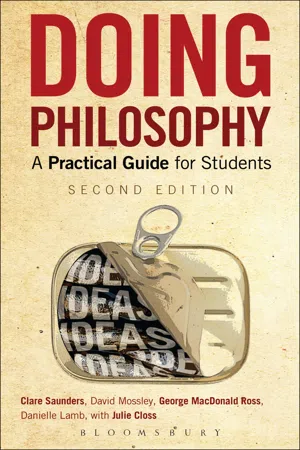
eBook - ePub
Doing Philosophy
A Practical Guide for Students
- 192 pages
- English
- ePUB (mobile friendly)
- Available on iOS & Android
eBook - ePub
Doing Philosophy
A Practical Guide for Students
About this book
Information
1
Studying philosophy
What is philosophy?
Philosophy is not quite like any other subject. Even professional philosophers find it notoriously difficult to define philosophy, and often shy away from stating what ‘philosophy is’ in favour of giving examples of the sorts of things that philosophers do. The dictionary definition of ‘philosophy’ (and the literal translation of the Greek origins of the word) is ‘the love of wisdom’, which covers just about everything; and indeed philosophy encompasses the study of science, and art and language – for just about any subject you can think of, there will be a ‘philosophy of’ that subject.
So, what sets philosophy apart from other disciplines? Although philosophy does have its own unique areas of enquiry, one of its most distinctive features is not so much what you study as how you study it – and it is this which makes the experience of studying philosophy quite different from that of any other subject. In philosophy, we learn to identify, and think carefully about, our most basic ideas and theories – those that support all the questing for knowledge we do in other subject areas. It has been characterized as ‘conceptual plumbing’ or ‘conceptual engineering’.1 We look behind our everyday concerns to examine the systems and structures which support our thinking (and which ordinarily we take for granted), and to test their soundness.
This distinctive approach means it is often easier to capture the nature of philosophy by providing examples of ‘doing philosophy’ rather than defining its field of study. This helps us to appreciate more fully how – even when the object of our study is common to more than one discipline – philosophy has a distinctive contribution to make to our knowledge and understanding of the world.
Case study
Liz has been caught shoplifting from her local department store, for the third time in as many weeks. The police are called; she is arrested and charged with theft. When her case comes to court, her lawyer argues in her defence that Liz is a kleptomaniac.
Why is this claim relevant, and what difference should it make to the case?
An example such as this might be discussed in a number of university disciplines:
•In law, you might explore whether Liz’s kleptomania should be taken into account when deciding upon an appropriate criminal sentence.
•In psychology, you might investigate whether kleptomania amounts to a mental illness, and how it can be treated effectively.
However, in philosophy we explore the underlying questions raised by the case regarding human free will and responsibility.
Kleptomania is defined as ‘an irresistible tendency to theft’ – if Liz is a kleptomaniac, is she compelled to steal? What, exactly, does it mean to be ‘compelled’ in this context? How is it different from being ordered at gunpoint to steal?
If Liz’s kleptomania is truly a compulsive behaviour, then she could not have acted otherwise – but if this is the case, then she did not choose to act as she did. Are we responsible for actions we do not choose? I do not choose to suffer from influenza and thus to drain resources from others (my family and friends, the health service) during my illness – and I am not held to blame for this. In what ways, if any, is Liz’s situation different?
By asking, and seeking to answer, these underlying questions, philosophy helps us to understand Liz’s case differently; but it also does much more. Philosophy encourages and enables us to explore the bigger picture behind the particularities of Liz’s situation – to examine the ideas and principles which underpin this case: about human freedom and responsibility for our actions, and the connection between these two notions.
It is from the philosophical perspective that we might ask (for example): ‘If I am genetically predisposed towards risk-taking, aggressive behaviour, should I be held responsible for this?’ – or, at the limit: ‘If science will ultimately be able to provide a complete explanation of all my behaviour, then am I truly free?’
These philosophical questions are also crucial for us to address in order to provide a basis for tackling the practical issues raised within our other investigations. We need to develop our understanding of what it is to be responsible for our actions before we can make informed judgements about many issues – for example, regarding who is able to make autonomous decisions: children, adults with learning disabilities, those under the influence of drugs?
So this case study helps us to capture how philosophy is not just concerned with grand abstract theories; it also has real implications for everyday living.
What philosophers think about
While the study of philosophy and the skills it entails can be applied to any subject area, there are some philosophical questions that drive a great deal of enquiry. These questions are:
•What is there?
•What can be known?
•How should a life be lived?
•What is good reasoning?
As you might expect, this list is not uncontroversial and some philosophers would say that we should include other questions, or that we should dismiss some of those proposed as meaningless. However, most philosophers working today would recognize the value of these questions as being at the core of what philosophy is about, and they provide a basic overview of the kinds of issues you will study as a philosophy student.
What is there?
This is the basis of a branch of philosophy called metaphysics. While a physicist could tell us something about the nature of physical reality, and a sociologist about the nature of human societies, a metaphysician looks at the fundamental concepts and theories that inform how we can even ask questions in physics and sociology, or even in day-to-day life for that matter. What is an individual thing? How do parts make a whole? What are the properties of things? What is an event? How do causes work? But we can ask metaphysical questions about other fields of enquiry. What are numbers? What is a person? Do theoretical unobservable entities like quarks really exist? Are parts of a society real? Can a universe of only empty space make sense? These are all metaphysical questions too, when posed in the context of philosophical enquiry.
Some philosophers have asked about the very nature of being itself, trying to discover whether there is anything meaningful to be said about how we, as enquirers capable of reflecting on our own existence, relate to reality. Others have asked why there is something rather than nothing, while others have used metaphysical concepts to probe the concepts and nature of God and gods, minds, time, art, history and anthills, indeed all aspects of human experience and enquiry. Finally, there have been philosophers who have argued that metaphysical musings are meaningless, or at best of little value, while others have sought to demonstrate that all enquiry requires a metaphysics. The history of metaphysics is rich, and a lifetime’s study in itself.
What can be known?
This is a core question for epistemology, the study of knowledge. Other basic questions are: What is knowledge? How is knowledge different from belief? Can we know anything without experience? Can we even be said to know anything at all? This is the great problem of scepticism that has arisen many times in the history of philosophy, and in different guises. As with metaphysics, we can ask about the status of knowledge in other fields. What is the nature of scientific knowledge? How do we have knowledge in mathematics? What is religious belief? What knowledge can we have of other minds? And so on. We can turn this line of questioning in on philosophy itself and ask about the status of philosophical knowledge. Epistemological questions have also been at the heart of philosophy for the vast majority of its history. Technical treatments of epistemology abound in philosophy, and once the surface is scratched, getting to grips with epistemological issues can be extremely fruitful and engaging.
How should a life be lived?
The problems raised by ethics are, perhaps, more familiar to us in everyday life than those of metaphysics or epistemology. We might ask ourselves whether fighting a particular war is justifiable, or if lying is always wrong. We may have personal experience of very difficult moral choices over euthanasia, abortion, social and political equality, the treatment of non-human animals, what to eat, sexual behaviour and so on. Philosophy addresses itself to these questions of value to try to find frameworks that could help us to make better choices, and it also looks at the deeper issues of morality in itself. What should constitute human flourishing overall? What is the basis of ethical behaviour? What is it to be virtuous? Does the good of the many outweigh the good of the few or the one? Do we have moral duties to others? What is the relationship between secular and religious values?
Additionally, along this line of questioning we might also encounter political philosophical enquiry about the nature of society and the values we would like it to reflect. Is it more important that individuals are free to act as they would wish, or that society is ordered and fair? Should there be positive redistribution of wealth to the poor? What sort of society would we devise if we did not know the role we would have in it? What is a law?
Moral philosophy and ethics are key topics in philosophy and, it could be argued, the most likely to generate debate and controversy with non-philosophers. And looking at value more generally, we can include questions about the status of our aesthetic experiences and the nature of art in an investigation of how we should have a valuable life, a life worth living. Aesthetics, the philosophy of art in its broadest terms, has never been far from the concerns of philosophers. We can also ask metaphysical and epistemological questions about values, ethics and aesthetics.
What is good reasoning?
Clear and critical thinking is crucial to success in philosophy, so it will come as no surprise that questions about reasoning are part of the philosophical landscape too. What does all good reasoning have in common? Is rationality something fixed in our brains? Is reasoning the same at all times and places? What is truth? These are some basic questions. Logic is often the first thing that comes to mind when we think about reasoning, and logic has developed into a highly specialized field that informs much contemporary technology directly or indirectly, in computer architecture, for example. But formal logic, using symbolism to represent argument forms, is only part of the story, and philosophers have always been concerned to find ways of defining good thinking more generally. Unlike psychological approaches that are descriptive, philosophical explorations of critical thinking tend to be about finding and defining the best strategies in a way that distinguishes good thinking from bad.
We can take these ideas further because there is a connection with philosophers’ thoughts on the nature and role of language in our thinking. Philosophers have asked about how meaning relates to truth and the world. Philosophy of language is a largely modern branch of philosophy that looks at how language works, has meaning, refers to the world and limits or structures our experiences of the world – issues that touch every other question we ask in philosophy.
Of course, for any issue you address in philosophy there will be a different mixture of metaphysical, epistemological, ethical and broadly logical topics to consider. This very brief survey will give you an idea of what is to come in your studies.
Analytic and European philosophy
Within Western philosophy there is an historical divide between two very broad approaches to philosophy. This division is largely the product of developments in the twentieth century. The two approaches are identified by different names by different authors, but are often called analytic (sometimes Anglophone) philosophy and European (or continental) philosophy. The broad differences in approach represented by these umbrella terms have shaped much of Western philosophy during the last 100 years or so.
Both analytic and European philosophy have their origins in the philosophy of the nineteenth century and debates about the roles of language, thought, meaning and experience in how we understand the world. Both are continuations of the great themes of philosophy from the earliest Greek thinkers. However, at the beginning of the twentieth century some noted philosophers, including Gottlob Frege (1848–1925) and Bertrand Russell (1872–1970), impressed by progress being made in the mathematical sciences, brought to philosophy a new kind of clarity and rigour by applying the results of exciting research in formal logic to natural language and forms of thought. They regarded the central work of philosophy to be the analysis of concepts in order to uncover their logical relationships with each other and the world. They also showed that it was impossible for philosophy to ignore the advances in the sciences that were beginning to reveal a very different physical world than that normally grasped by common sense and everyday experience. The work of Frege and Russell launched the approach that became known as analytic philosophy. In the following decades analytic philosophers brought the same sorts of analysis they had generated for meaning and language to all other issues in philosophy. Within this approach some noted schools of thought developed, such as logical positivism, logical empiricism and ‘ordinary language’ philosophy. Over time what constitutes analytic philosophy has become more diffuse because formal definitions tend to have philosophical problems in themselves. However, it remains the case that the majority of philosophy taught in the United Kingdom, North America and Scandinavia is derived from and continues this approach as the bedrock of philosophy.
At the same time as these developments in twentieth-century philosophy in the English-speaking world, philosophers in continental Europe developed away from idealism in different directions. Key thinkers here drew on the earlier work of Søren Kierkegaard (1813–55) and Friedrich Nietzsche (1844–1900). The centres for these developments were in France and Germany, hence the labels ‘European’ and ‘continental’. The emphasis was on the role of the human agent in acting on and in the world, and it was from this perspective that issues of ethics and meaning were addressed. Questions about the meaning of life and the nature of existence came to the fore, particularly after the horrors of two world wars, and schools of thoughts such as existentialism in the 1940s and 1950s presented an approach to philosophy that challenged prevailing ways of thinking and living at the time. Many people are first attracted to philosophy through the more engaging aspects of European philosophy, and it can be disappointing to discover that in many departments Jean-Paul Sartre (1905–80), or more recent forms of postmodern philosophy, are not taught at all. This situation is changing and some ...
Table of contents
- Cover
- Half-Title
- Introduction
- 1 Studying philosophy
- 2 Reading philosophy
- 3 Taking notes
- 4 Discussion
- 5 Writing philosophy
- 6 Resources
- Index
Trusted by 375,005 students
Access to over 1.5 million titles for a fair monthly price.
Study more efficiently using our study tools.
Frequently asked questions
Yes, you can cancel anytime from the Subscription tab in your account settings on the Perlego website. Your subscription will stay active until the end of your current billing period. Learn how to cancel your subscription
No, books cannot be downloaded as external files, such as PDFs, for use outside of Perlego. However, you can download books within the Perlego app for offline reading on mobile or tablet. Learn how to download books offline
Perlego offers two plans: Essential and Complete
- Essential is ideal for learners and professionals who enjoy exploring a wide range of subjects. Access the Essential Library with 800,000+ trusted titles and best-sellers across business, personal growth, and the humanities. Includes unlimited reading time and Standard Read Aloud voice.
- Complete: Perfect for advanced learners and researchers needing full, unrestricted access. Unlock 1.5M+ books across hundreds of subjects, including academic and specialized titles. The Complete Plan also includes advanced features like Premium Read Aloud and Research Assistant.
We are an online textbook subscription service, where you can get access to an entire online library for less than the price of a single book per month. With over 1.5 million books across 990+ topics, we’ve got you covered! Learn about our mission
Look out for the read-aloud symbol on your next book to see if you can listen to it. The read-aloud tool reads text aloud for you, highlighting the text as it is being read. You can pause it, speed it up and slow it down. Learn more about Read Aloud
Yes! You can use the Perlego app on both iOS and Android devices to read anytime, anywhere — even offline. Perfect for commutes or when you’re on the go.
Please note we cannot support devices running on iOS 13 and Android 7 or earlier. Learn more about using the app
Please note we cannot support devices running on iOS 13 and Android 7 or earlier. Learn more about using the app
Yes, you can access Doing Philosophy by Danielle Lamb,David Mossley,George MacDonald Ross,Clare Saunders in PDF and/or ePUB format, as well as other popular books in Philosophy & Philosophy History & Theory. We have over 1.5 million books available in our catalogue for you to explore.