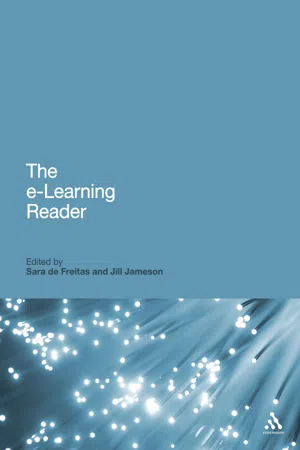
- 368 pages
- English
- ePUB (mobile friendly)
- Available on iOS & Android
eBook - ePub
The e-Learning Reader
About this book
Technological advancements have revolutionised the field of learning in the past twenty years and are continuing to push the boundaries of institutions towards new forms of knowledge construction, social interaction and meaning making. This book examines the key debates that have shaped that technological journey, from ancient to modern times, and draws together meaningful articles to provide an expert guide for e-learning practitioners, research staff, students and industrial trainees. The e-Learning Reader provides a scholarly collection of key texts which examine the concept and practice of e-learning in education and training. The book brings together a series of formative historical and recent articles which frame the debate on e-learning, drawing together new comments from leading experts in the field of e-learning.
Information
Part I: e-Learning from Perspectives of Experiential Learning and Play
Introduction
The preceding overview by Mayes and de Freitas (2004) suggests a possible conceptual basis for grouping e-Learning theories, frameworks and models into three perspectives: associative, cognitive and situative. These perspectives are based on well-established distinct traditional strands in psychology that frame our understanding of how we learn. These perspectives allow us to group learning theory in a different way from the usual historical ordering of theory, allowing us to identify areas of gaps and inconsistencies.
However, it is difficult to harmonise the epistemological tradition completely with these more psychological perspectives. Ultimately, as a result, learning theory has been disconnected from deeper philosophical traditions. This is partly due to a disconnection between theory and practice: that is, the application of learning theory is rather more centred on sets of practices that focus on the individual or group. Here, then, is some sort of explanation for the re-emphasis on social interactions for supporting learning, as we see in the situative learning approaches and theories.
However, there is an argument for reorganising learning theory according to wider historical philosophical traditions, including epistemology. But would this mean realigning theory away from the individual and group? Would this mean a de-emphasis on social interactive learning? This section outlines some of this debate through the lens of constructivism. At the heart of this are, perhaps, the debates around constructivist epistemology. These take a diametrically opposed view to objectivism (and positivism) in the sense that constructivism expounds that scientific knowledge is constructed by scientists (learners) and is not inherent in the world. What this means for learning theory applied in practice is a move away from a notional objectivity and mind-independent ontological validity. Learning, according to this, is not a set of texts or curricula that can be imparted through instruction: in practice, in this view learning (and epistemology) do not have an ‘essence’, a truth or a defined objectivity, but meanings are individually constructed by learners. The over-emphasis in learning theories towards meaning construction then is perhaps a result of the influence of phenomenology and its philosophical inquiry into lived experience and the human lifecycle upon our understanding of philosophy.
Within learning theory, constructivism is a theory of knowledge that expounds that humans produce knowledge (and meaning) from their experience. In this section, the concepts around constructivism, cognitivism and situated cognition are introduced and explored in relation to perspectives of experiential learning and play through the seminal work of Piaget and his theories relating to assimilation and accommodation: the processes whereby individuals integrate their experience into their ‘world view’. The notions underpinning these approaches to learning as ‘experiential’ and as ‘play’ centre upon the individual and the idea that learning can be constructed as part of wider human understanding. Theories that are included here have an emphasis upon understanding more about the ‘how’ of learning, the underpinning processes in common relating to learners, such as the stages of development. Dewey’s work centres upon experience as well and how to frame this experience within experimentation techniques, trial and error. The emphasis upon the social constructivist line advocated by Vygotsky and others outlines knowledge as a product of the social and cultural construction of human understanding. The focus upon experience is taken up again by Kolb in his work on experiential learning.
So, there is a tension between, on the one hand, the epistemological position of phenomenology that knowledge derives from being and understanding in the human lifecycle and, on the other, the positivist epistemological position that the only verifiable knowledge is based on sense objects in the real world. These two broad standpoints view learning in completely different ways. The one (the positivist tradition) adheres to the notion that objective truth or essence is existent and is therefore consistent with learning as being an acquisition of knowledge which resonates with notions of curriculum and set texts. The other (in a variety of ways, including constructivist, social constructivist and phenomenological approaches) centres upon a notion that knowledge is constructed, is consistent with an empowerment of the learner, and implies a move away from a fixed curriculum and into more practice-centred individual or social group approaches. Overall, these changes in approaches to learning as reflected through deeper conceptual shifts imply that there is a significant connection and resonance between philosophical traditions and different applications of learning theory. Understanding these positions therefore provides a key to understanding not only learning but also, arguably, the changes that have occurred across education as a whole.
While throughout history the importance of learning as both experience and as play has never been understated, our lack of knowledge about how we think has prevented a deeper understanding about how we learn, and it is upon the ‘how’ of learning that constructivism ultimately focuses. In the future, new capabilities for understanding the ‘how’ of learning will centre upon new techniques such as neuroimaging: in this emerging field, it is envisaged that we will begin to understand a lot more about these sophisticated processes, and therefore begin to be able to design learning that more accurately reflects the processes of thought.
Democracy and Education (1916) by J. Dewey
Experience as Experimentation
It has already been intimated that sensational empiricism represents neither the idea of experience justified by modern psychology nor the idea of knowledge suggested by modern scientific procedure. With respect to the former, it omits the primary position of active response which puts things to use and which learns about them through discovering the consequences that result from use. It would seem as if five minutes’ unprejudiced observation of the way an infant gains knowledge would have sufficed to overthrow the notion that he is passively engaged in receiving impressions of isolated ready-made qualities of sound, color, hardness, etc. For it would be seen that the infant reacts to stimuli by activities of handling, reaching, etc., in order to see what results follow upon motor response to a sensory stimulation; it would be seen that what is learned are not isolated qualities, but the behavior which may be expected from a thing, and the changes in things and persons which an activity may be expected to produce. In other words, what he learns are connections. Even such qualities as red color, sound of a high pitch, have to be discriminated and identified on the basis of the activities they call forth and the consequences these activities effect. We learn what things are hard and what are soft by finding out through active experimentation what they respectively will do and what can be done and what cannot be done with them. In like fashion, children learn about persons by finding out what responsive activities these persons exact and what these persons will do in reply to the children’s activities. And the combination of what things do to us (not in impressing qualities on a passive mind) in modifying our actions, furthering some of them and resisting and checking others, and what we can do to them in producing new changes constitutes experience. The methods of science by which the revolution in our knowledge of the world dating from the seventeenth century was brought about teach the same lesson. For these methods are nothing but experimentation carried out under conditions of deliberate control. To the Greeks, it seemed absurd that such an activity as, say, the cobbler punching holes in leather, or using wax and needle and thread, could give an adequate knowledge of the world. It seemed almost axiomatic that for true knowledge we must have recourse to concepts coming from a reason above experience. But the introduction of the experimental method signified precisely that such operations, carried on under conditions of control, are just the ways in which fruitful ideas about nature are obtained and tested. In other words, it is only needed to conduct such an operation as the pouring of an acid on a metal for the purpose of getting knowledge instead of for the purpose of getting a trade result, in order to lay hold of the principle upon which the science of nature was henceforth to depend. Sense perceptions were indeed indispensable, but there was less reliance upon sense perceptions in their natural or customary form than in the older science. They were no longer regarded as containing within themselves some ‘form’ or ‘species’ of universal kind in a disguised mask of sense which could be stripped off by rational thought. On the contrary, the first thing was to alter and extend the data of sense perception: to act upon the given objects of sense by the lens of the telescope and microscope, and by all sorts of experimental devices. To accomplish this in a way which would arouse new ideas (hypotheses, theories) required even more general ideas (like those of mathematics) than were at the command of ancient science. But these general conceptions were no longer taken to give knowledge in themselves. They were implements for instituting, conducting, interpreting experimental inquiries and formulating their results.
The logical outcome is a new philosophy of experience and knowledge, a philosophy which no longer puts experience in opposition to rational knowledge and explanation. Experience is no longer a mere summarizing of what has been done in a more or less chance way in the past; it is a deliberate control of what is done with reference to making what happens to us and what we do to things as fertile as possible of suggestions (of suggested meanings) and a means for trying out the validity of the suggestions. When trying, or experimenting, ceases to be blinded by impulse or custom, when it is guided by an aim and conducted by measure and method, it becomes reasonable – rational. When what we suffer from things, what we undergo at their hands, ceases to be a matter of chance circumstance, when it is transformed into a consequence of our own prior purposive endeavors, it becomes rationally significant – enlightening and instructive. The antithesis of empiricism and rationalism loses the support of the human situation which once gave it meaning and relative justification.
The bearing of this change upon the opposition of purely practical and purely intellectual studies is self-evident. The distinction is not intrinsic but is dependent upon conditions, and upon conditions which can be regulated. Practical activities may be intellectually narrow and trivial; they will be so in so far as they are routine, carried on under the dictates of authority, and having in view merely some external result. But childhood and youth, the period of schooling, is just the time when it is possible to carry them on in a different spirit. It is inexpedient to repeat the discussions of our previous chapters on thinking and on the evolution of educative subject matter from childlike work and play to logically organized subject matter. The discussions of this chapter and the prior one should, however, give an added meaning to those results.
(i) Experience itself primarily consists of the active relations subsisting between a human being and his natural and social surroundings. In some cases, the initiative in activity is on the side of the environment; the human being undergoes or suffers certain checkings and deflections of endeavors. In other cases, the behavior of surrounding things and persons carries to a successful issue the active tendencies of the individual, so that in the end what the individual undergoes are consequences which he has himself tried to produce. In just the degree in which connections are established between what happens to a person and what he does in response, and between what he does to his environment and what it does in response to him, his acts and the things about him acquire meaning. He learns to understand both himself and the world of men and things. Purposive education or schooling should present such an environment that this interaction will effect acquisition of those meanings which are so important that they become, in turn, instruments of further learnings (ante, Ch. XI). As has been repeatedly pointed out, activity out of school is carried on under conditions which have not been deliberately adapted to promoting the function of understanding and formation of effective intellectual dispositions. The results are vital and genuine as far as they go, but they are limited by all kinds of circumstances. Some powers are left quite undeveloped and undirected; others get only occasional and whimsical stimulations; others are formed into habits of a routine skill at the expense of aims and resourceful initiative and inventiveness. It is not the business of the school to transport youth from an environment of activity into one of cramped study of the records of other men’s learning; but to transport them from an environment of relatively chance activities (accidental in the relation they bear to insight and thought) into one of activities selected with reference to guidance of learning. A slight inspection of the improved methods which have already shown themselves effective in education will reveal that they have laid hold, more or less consciously, upon the fact that ‘intellectual’ studies instead of being opposed to active pursuits represent an intellectualizing of practical pursuits. It remains to grasp the principle with greater firmness.
(ii) The changes which are taking place in the content of social life tremendously facilitate selection of the sort of activities which will intellectualize the play and work of the school. When one bears in mind the social environment of the Greeks and the people of the Middle Ages, where such practical activities as could be successfully carried on were mostly of a routine and external sort and even servile in nature, one is not surprised that educators turned their backs upon them as unfitted to cultivate intelligence. But now that even the occupations of the household, agriculture, and manufacturing as well as transportation and intercourse are instinct with applied science, the case stands otherwise. It is true that many of those who now engage in them are not aware of the intellectual content upon which their personal actions depend. But this fact only gives an added reason why schooling should use these pursuits so as to enable the coming generation to acquire a comprehension now too generally lacking, and thus enable persons to carry on their pursuits intelligently instead of blindly.
(iii) The most direct blow at the traditional separation of doing and knowing and at the traditional prestige of purely ‘intellectual’ studies, however, has been given by the progress of experimental science. If this progress has demonstrated anything, it is that there is no such thing as genuine knowledge and fruitful understanding except as the offspring of doing. The analysis and rearrangement of facts which is indispensable to the growth of knowledge and power of explanation and right classification cannot be attained purely mentally – just inside the head. Men have to do something to the things when they wish to find out something; they have to alter conditions. This is the lesson of the laboratory method, and the lesson which all education has to learn. The laboratory is a discovery of the condition under which labor may become intellectually fruitful and not merely externally productive. If, in too many cases at present, it results only in the acquisition of an additional mode of technical skill, that is because it still remains too largely but an isolated resource, not resorted to until pupils are mostly too old to get the full advantage of it, and even then is surrounded by other studies where traditional methods isolate intellect from activity.
Experience and Education (1938) by J. Dewey
The Need of a Theory of Experience
In short, the point I am making is that rejection of the philosophy and practice of traditional education sets a new type of difficult educational problem for those who believe in the new type of education. We shall operate blindly and in confusion until we recognise this fact; until we thoroughly appreciate that departure from the old solves no problems. What is said in the following pages is, accordingly, intended to indicate some of the main problems with which the newer education is confronted and to suggest the main lines along which their solution is to be sought. I assume that amid all uncertainties there is one permanent frame of reference: namely, the organic connection between education and personal experience; or, some kind of empirical and experimental philosophy. But experience and experiment are not self-explanatory ideas. Rather, their meaning is part of the problem to be explored. To know the meaning of empiricism we need to understand what experience is.
The belief that all genuine education comes about through experience does not ...
Table of contents
- Cover
- The e-Learning Reader
- Contents
- Foreword by Etienne Wenger
- Acknowledgements
- Introduction
- An Overview of e-Learning (2004) by T. Mayes and S. de Freitas
- Part I: e-Learning from Perspectives of Experiential Learning and Play
- Part II: e-Learning from Perspectives of Developmental Learning
- Part III: e-Learning from Perspectives of Instructional Design
- Part IV: e-Learning from Perspectives of Cognitive Learning Tools
- Part V: e-Learning from Perspectives of Social Interaction
- Conclusion
- References
- Copyright_Permissions
- Index
Trusted by 375,005 students
Access to over 1.5 million titles for a fair monthly price.
Study more efficiently using our study tools.
Frequently asked questions
Yes, you can cancel anytime from the Subscription tab in your account settings on the Perlego website. Your subscription will stay active until the end of your current billing period. Learn how to cancel your subscription
No, books cannot be downloaded as external files, such as PDFs, for use outside of Perlego. However, you can download books within the Perlego app for offline reading on mobile or tablet. Learn how to download books offline
Perlego offers two plans: Essential and Complete
- Essential is ideal for learners and professionals who enjoy exploring a wide range of subjects. Access the Essential Library with 800,000+ trusted titles and best-sellers across business, personal growth, and the humanities. Includes unlimited reading time and Standard Read Aloud voice.
- Complete: Perfect for advanced learners and researchers needing full, unrestricted access. Unlock 1.5M+ books across hundreds of subjects, including academic and specialized titles. The Complete Plan also includes advanced features like Premium Read Aloud and Research Assistant.
We are an online textbook subscription service, where you can get access to an entire online library for less than the price of a single book per month. With over 1.5 million books across 990+ topics, we’ve got you covered! Learn about our mission
Look out for the read-aloud symbol on your next book to see if you can listen to it. The read-aloud tool reads text aloud for you, highlighting the text as it is being read. You can pause it, speed it up and slow it down. Learn more about Read Aloud
Yes! You can use the Perlego app on both iOS and Android devices to read anytime, anywhere — even offline. Perfect for commutes or when you’re on the go.
Please note we cannot support devices running on iOS 13 and Android 7 or earlier. Learn more about using the app
Please note we cannot support devices running on iOS 13 and Android 7 or earlier. Learn more about using the app
Yes, you can access The e-Learning Reader by Sara de Freitas, Jill Jameson, Sara de Freitas,Jill Jameson in PDF and/or ePUB format, as well as other popular books in Education & Education General. We have over 1.5 million books available in our catalogue for you to explore.