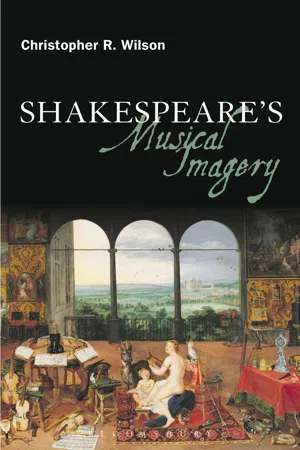
Music pervades Shakespeare's
work. In addition to vocal songs and numerous instrumental cues there are
thousands of references to music throughout the plays and many of the poems.
This book discusses Shakespeare's musical imagery according to categories defined
by occurrence in the plays and poems. In turn, these categories depend on their
early modern usage and significance. Thus, instruments such as lute and viol
deserve special attention just as Renaissance ideas relating to musical
philosophy and pedagogical theory need contextual explanation. The objective is
to locate Shakespeare's musical imagery, reference and metaphor in its
immediate context in a play or poem and explain its meaning. Discussion and
explanation of the musical imagery suggests a range of possible dramatic and
poetic purposes these musical references serve.
- 272 pages
- English
- ePUB (mobile friendly)
- Available on iOS & Android
eBook - ePub
Shakespeare’s Musical Imagery
About this book
Information
Chapter 1
‘By the sweet power of music’: Consonance and harmony
It is not possible to be certain why, in early modern culture, musical consonances (concords) were pleasing and dissonances (discords) were unpleasing or, to put it another way, consonances were ‘sweet’, dissonances were ‘harsh’. But there can be no doubt that psychological implications in the use of both the terms as language and their audible application carried aesthetic preferences relating to an emotional response.20 In his translation of Andreas Ornithoparcus’ Musice active micrologus (1517), John Dowland writes:
Consonance (which otherwise we call Concordance) is the agreeing of two unlike Voyces placed together: Or is (as Tinctor writeth) the mixture of divers Sounds, sweetly pleasing the eares. Or according to Stapulensis lib.3 it is the mixture of an high, and lowe sound, coming to the eares sweetly, and uniformely. (Micrologus, 1609, p. 79)
In the anonymous The Pathway to Musicke (1596), the author attempts, in keeping with several contemporary English treatises, to differentiate between consonance and dissonance in aesthetic comparators, namely that concords were ‘sweetly sounding unto the eare’ whereas dissonances were sounds ‘naturally offending unto the eare’ (p. [39]). Thomas Morley, the most significant of the late sixteenth-century English theorists, regarded concord as ‘a mixt sound compact of divers voices, entring with delight in the eare, and is eyther perfect or unperfect’ (A Plaine and Easie Introduction to Practicall Musicke, 1597, p. 70). Discord, Morley sees as the antonym to concord with its corresponding characteristics: ‘it is a mixt sound compact of divers sounds naturallie offending the eare, and therefore commonlie excluded from musicke’ (p. 71).
Several writers, including the author of The Pathway to Musicke and Thomas Morley, attempted to define consonance and dissonance. Those definitions depended essentially on the theory of Gioseffo Zarlino presented in his Istitutioni harmoniche (1558) which, in turn, owed its origins to Pythagoras and his theory of mathematical ratios for identifying musical intervals.21 The Pythagorean consonances were identified as the octave, the fifth and the fourth. Zarlino extended the theory of consonance to include thirds and sixths by incorporating the senario (the first six numbers of the numerical ratios). Consequently, major and minor thirds and the major sixth became theorized as acceptable consonances even though, in practice, they had been used by composers since the middle of the fifteenth century. By the end of the sixteenth century, the senario began to be replaced by other physical identifiers. Sound, it was argued, comprised a variety of vibrations and interacting pulses. This resulted in the ‘coincidence theory’ of consonance; that is, the most sympathetic vibrations produced consonance. The most consonant interval was therefore the octave, followed by the fifth, the fourth and then the thirds. In practice, this did not differ from the senario; in theory, the fourth was still classified as a consonance whereas in practice it was a dissonance.22 The concordance of intervals was codified according to coincidence of periods of vibration by Giovanni Battista Benedetti in his Diversarum Speculationum Mathematicarum et Physicorum Liber of 1585. Later theorists tended to move away from mathematical definitions to empirical observations for identifying the properties of consonances, one of the most important of which was pleasingness. According to Palisca, this ‘separation of the subjective and objective qualities of intervals has characterised modern thought since that time’.23 And yet an aesthetic application of ‘pleasingness’ raises more doubts than it resolves. Who is to say what is pleasing? Shakespeare, as we hope to suggest, purports that the ‘beauty’ of musical expression is in the eye (or rather the ear) of the beholder.
Commentators agree that there are two psychoacoustic factors concerning our understanding and reception of consonance (and therefore dissonance):
‘Sensory consonance’ refers to the immediate perceptual impression of a sound as being pleasant or unpleasant; it may be judged for sounds presented in isolation (without a musical context) and by people without musical training. ‘Musical consonance’ is related to judgements of the pleasantness or unpleasantness of sounds presented in a musical context; it depends strongly on musical experience and training, as well as on sensory consonance. These two aspects of consonance are difficult to separate, and in many situations judgements of consonance depend on an interaction of sensory processes and musical experience.24
The significance of sensory factors will vary from one cultural environment to another, depending on musical experience and expectation. The audience at an early production of a Shakespeare play would have a commonality of auditory experience which could relate to what Shakespeare meant by consonance and dissonance.25
In considering the imaginative power of music’s words, this chapter will focus on one aspect of perhaps the most recurrent feature of Shakespeare’s music imagery, that is ‘harmony’, in particular concordance or consonance. It will suggest, therefore, that Shakespeare’s references to musical terms, concepts and ideas are a way of explaining his characters’ emotional states and reactions, and notions of harmony and discord in a wider vocabulary.
The concordant power of music finds revelation in recurring references and themes in Shakespeare. One of the most common yet sometimes evasive is the term ‘sweet music’ (or ‘sweet melody’, ‘sweet air’, ‘sweet sound’, ‘sweet harmony’).26 On a sensory level, ‘sweet’ can be translated into modern parlance as ‘pleasant’, as in The Tempest ‘sounds and sweet airs, that give delight’ (3.2.131). But in a number of instances a more specific musical explanation can be applied which gives the term extra meaning.27
Shakespeare invariably invokes the affective power of music. Hence ‘sweet music’ gives delight or pleasure, depending of course on circumstances. But on a more influential level it leads to concord or ‘harmony’. In some cases, particularly in the pre-1600 plays, this is engendered by the ‘music of the spheres’.28 The neo-Platonic theories, Elizabethans argued, were transmitted through the five books relating to the philosophy of music, the De Institutione Musica (printed in 1491–92) by the sixth-century Roman philosopher and mathematician, Boëthius. In practice, various writers reinterpreted the theory through Western, notably Christianized, vantage points to such an extent that in the late sixteenth century the theory began to lose its potency. Following Copernicus, earth-centric theory is questioned and celestial harmony is made to work astrologically. The first category of speculative music, Musica Mundana, as Boëthius termed it, was part of the cosmic order of the heavens, with the stars and planets in allegorical ‘harmony’ or concordant music. How music contributed to the motion of the spheres is discussed in Dowland’s translation of Ornithoparcus:
When God … had devised to make this world moveable, it was necessary, that he should governe it by some active and mooving power, for no bodies but those which have a soul, can move themselves … Now that motion … is not without sound: for it must needs be that a sound be made of the very wheeling of the Orbes … The like sayd Boëtius, how can this quick-moving frame of the world whirle about with a dumb and silent motion? From this turning of the heaven, there cannot be removed a certain order of Harmonie. And nature will … that extremities must need sound deepe on the one side, & sharp on the other. (Micrologus, 1609, p. 1)
Put more simply, as the anonymous madrigal lyric observes:
Music divine, proceeding from above,
Whose sacred subject oftentimes is love,
In this appears her heavenly harmony,
Where tuneful concords sweetly do agree
(Tomkins, Songs, 1622, no. 24)
In The Merchant of Venice, ‘Soft stillness and the night/Become the touches [i.e. sounds]29 of sweet harmony.’ This ‘harmony’ is the ‘music of the spheres’ and cannot be ‘heard’ by mere mortals, as Lorenzo intimates:30
Such harmony is in immortal souls,
But whilst this muddy vesture of decay
Doth grossly close it in, we cannot hear it. (MV 5.1.62–4)
Consequently, it is necessary to ‘awake’ Portia with actual (performed) music: ‘With sweetest touches pierce your mistress’ ear/And draw her home with music’ (5.1.66).
The combination of sweet music and heavenly music is alluded to, ironically, in The Taming of the Shrew. The Lord commands his huntsmen to:
Carry him [Christopher Sly] gently to my fairest chamber,
And hang it round with all my wanton pictures.
Balm his foul head in warm distilled waters,
And burn sweet wood to make the lodging sweet.
Procure me music ready when he wakes
To make a dulcet and a heavenly sound. (Ind. 1.42–7)
The al...
Table of contents
- Cover
- Contents
- Preface and acknowledgements
- Introduction: 'Music to hear': The scope of Shakespeare's musical imagery
- 1. 'By the sweet power of music': Consonance and harmony
- 2. 'And doleful dumps the mind oppress': Passionate words
- 3. 'A delightful measure or a dance': Dance music
- 4. 'Braying trumpets and loud churlish drums': The music of war
- 5. 'A rhyme is but a ballad': Popular song
- 6. 'Suppose the singing birds musicians': Birdsong
- 7. 'Orpheus with his lute': Symbolic persons
- 8. 'Gamut I am, the ground of all accord': Music theory and pedagogy
- 9. 'A thousand twangling instruments': Art and country instruments
- Epilogue: 'A swanlike end, fading in music'
- Notes
- Bibliography
Trusted by 375,005 students
Access to over 1.5 million titles for a fair monthly price.
Study more efficiently using our study tools.
Frequently asked questions
Yes, you can cancel anytime from the Subscription tab in your account settings on the Perlego website. Your subscription will stay active until the end of your current billing period. Learn how to cancel your subscription
No, books cannot be downloaded as external files, such as PDFs, for use outside of Perlego. However, you can download books within the Perlego app for offline reading on mobile or tablet. Learn how to download books offline
Perlego offers two plans: Essential and Complete
- Essential is ideal for learners and professionals who enjoy exploring a wide range of subjects. Access the Essential Library with 800,000+ trusted titles and best-sellers across business, personal growth, and the humanities. Includes unlimited reading time and Standard Read Aloud voice.
- Complete: Perfect for advanced learners and researchers needing full, unrestricted access. Unlock 1.5M+ books across hundreds of subjects, including academic and specialized titles. The Complete Plan also includes advanced features like Premium Read Aloud and Research Assistant.
We are an online textbook subscription service, where you can get access to an entire online library for less than the price of a single book per month. With over 1.5 million books across 990+ topics, we’ve got you covered! Learn about our mission
Look out for the read-aloud symbol on your next book to see if you can listen to it. The read-aloud tool reads text aloud for you, highlighting the text as it is being read. You can pause it, speed it up and slow it down. Learn more about Read Aloud
Yes! You can use the Perlego app on both iOS and Android devices to read anytime, anywhere — even offline. Perfect for commutes or when you’re on the go.
Please note we cannot support devices running on iOS 13 and Android 7 or earlier. Learn more about using the app
Please note we cannot support devices running on iOS 13 and Android 7 or earlier. Learn more about using the app
Yes, you can access Shakespeare’s Musical Imagery by Christopher R. Wilson in PDF and/or ePUB format, as well as other popular books in Literature & Literary Criticism. We have over 1.5 million books available in our catalogue for you to explore.