eBook - ePub
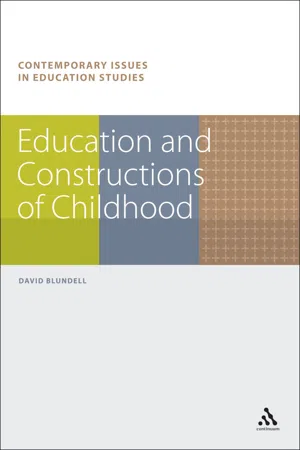
Education and Constructions of Childhood
- 224 pages
- English
- ePUB (mobile friendly)
- Available on iOS & Android
eBook - ePub
Education and Constructions of Childhood
About this book
Education and Constructions of Childhood considers the social construction of childhood through the institutions of education and schooling. Grounded in a strong conceptual, theoretical framework, this accessible text will guide the reader through this evolving area. Reflective exercises, chapter summaries and useful websites will encourage and support student learning and the application of new concepts.
Education and Constructions of Childhood is essential reading for undergraduate and postgraduate students on Education Studies and related courses.
Information
Part 1
Education and the Construction
of the Child
of the Child
1
Lightening Our Darkness: Renaissance, Reformation and Enlightenment
Chapter Outline
Introduction
Phillipe Aries and an emerging idea of childhood
The Protestant Revolution: Calvinism, childhood and redemption through learning
Descartes and Newton – the individual in a mechanical universe
Locke on children and their education
Schooling and children’s lives in early Modern England
Rousseau, Emile and the Enlightenment Child
Rousseau’s educational scheme
Rousseau’s contemporary influence
Conclusion
Further reading
Introduction
The rebirth, or Renaissance, that brought the Mediaeval period to an end and was precursor to the Age of Enlightenment and the Modern era, also generated a new interest in children and produced ideas about the Child and childhood that continue to shape educational provision. This chapter explores the proposition that many of the meanings we attach to childhood have their origins in this era, and that childhood should be seen as a socially constructed phenomenon rooted in historical and cultural circumstance.
Phillipe Aries and an emerging idea of childhood
An early contribution to the critical study of childhood was made by Phillipe Aries, a French polymath and cultural historian, who published the seminal L’Enfant et laFamiliale Sous l’Ancien Regime in 1960 (translated as Centuries of Childhood in 1962). Aries made the provocative proposal that in the mediaeval era the idea of childhood neither existed nor made any sense because it had no use. A large part of the evidence for this came from Aries’ study of mediaeval paintings:
Mediaeval art until about the twelfth century did not know childhood or did not attempt to portray it. It is hard to believe that this neglect was due to incompetence or incapacity; it seems more probable that there was no place for childhood in the mediaeval world. (Aries, 1962, p. 31)
Aries goes on to chart how we get from this period where childhood was not depicted or recognized to the near ubiquitous images of children found in our twenty-first century family albums, advertisements and televisions (see Holland, 2004, for full treatment of this).
Despite the absence of childhood as a theme in early Mediaeval painting, Aries’ survey recognizes that around the thirteenth century three new and distinct types of representation appear embodying childlike figures. These were: the clergeons (or little priests) who made responses during mass and were depicted as youthful angels, the infant Jesus depicted as a child rather than as a shrunken adult and, the depiction of a man at the point of death, whose soul is exhaled from his body as a small child. The depiction of the young Christ as a little man in early Mediaeval painting seems to confirm Aries’ (1962) assertion that childhood went unrecognized. However, despite the frequency with which Aries’ claim has been repeated, Pollock (1983) sounded a note of caution, stating that the saviour of the world is hardly any ordinary child and His conscious depiction as a little man, may be more expressive of the stress placed on His divinity than of contemporary attitudes to children.
It should be said that other historians challenge the claims made by Aries, feeling that they make better headlines than scholarly history. Among them are Pollock (1983), Heywood (2001) and Cunningham (1995 and 2006). Rosenthal et al. (2007), published the outcomes of an influential colloquium on mediaeval childhood, including a paper by Barron demonstrating that children were highly visible if court records from London concerning their deaths, derelict status as orphans and disputes around apprenticeship are to be believed. It is also worth noting that the popular culture of the time seemed to have clear notions about children and young people and their moral status. Here is a proverb from 1303 (Apperson, 1993):
Gyue thy chylde when he wyl kraue,
And they whelpe whyl hyt wyl haue,
Than mayst thou make you a stounde
A foule chylde and a feyre hounde. (1303)
Translated as:
Give a child all he shall crave,
And a dog while his tail doth wave;
And you’ll have
A fair dog and a foul knave.
To understand this apparent change in the visibility of children, or at least, their emergent portrayal as children in late Mediaeval art, it is important to understand seismic shifts in philosophical, doctrinal and scientific outlook that were simultaneously underway, owing in large part to the writings of St Thomas Aquinas (1225–74). Aquinas was a philosopher–priest who was instrumental in rediscovering the work of the ancient pre-Christian Greek philosophers, especially Aristotle (see Russell, 1979), and reconciling their writings with Christian doctrine (Hankins, 2007). The medieval world was aware that there had once been a great civilization in antiquity, but the works produced by it were largely unknown in Europe. However, they were in wide circulation among scholars throughout the Muslim world and were a cornerstone upon which Arabic mathematics, science and cosmology were constructed. When the Muslim scholar Ibn-Rushd (1126–98), who went by the nom de plume ‘Averroes’, deferentially claimed in the preface to his own work on physics that ‘The author of this book is Aristotle’, we are given some indication of the esteem in which these works were held outside Europe (Lewis, 1982; Tarnas, 1991; see also Braudel and Mayne, 1993, pp. 80–3 and 366;). As trade expanded between the Christian and the Arabic Muslim worlds across the Mediterranean, so ideas were also exchanged and Italy became focal for the European Renaissance (or rebirth) of learning. A rediscovery of Aristotle and his works on science and scientific methods was central to this rebirth and, in particular, a rekindled interest in examining the external natural world. Until Aquinas, Church doctrine had been dominated by the work of St Augustine of Hippo (who as we shall see later was central to the promulgation of a doctrine of Original Sin that was so significant in forming attitudes to human nature and particularly the moral status of children). Augustine saw the world of nature as ‘fallen’ and full of sinful distractions for those who earnestly sought spiritual understanding (Tarnas, 1991). Undoubtedly this view chimed with a world where everyday life was precarious and nature capriciously manifested itself in dangers, disasters and destruction. However, with increasing trade and wealth through the thirteenth century, outlooks were changing. Aquinas’ contribution was to suggest that far from being in opposition to understanding spiritual truth, nature demonstrated God’s providence and in its everyday beauties we could glimpse something of divine beauty (Tarnas, 1991). This redirected gaze, from the contemplative internal world of prayer and meditation to the external world, encouraged closer scrutiny of that world and this is undoubtedly evidenced in the increasingly lifelike depiction of flowers, trees, animals and landscapes found in contemporary painting and as decoration to the great gothic cathedrals that were rebuilt across Europe at this time (Rice, 2009). But more significantly here, whereas the infant Christ is depicted as a little man in early thirteenth century paintings of Madonna and child, he becomes a bouncing baby when Raphael paints him 200 years later. Aquinas was not alone in expressing a new reading of nature; others, including a little-known theologian and mystic named Meister Eckhart (c. 1260–1328) went further and risked trial for heresy when he claimed that nature was not a source of sinful distraction, but was an ‘original blessing’ from God, being intrinsically virtuous rather than marred by sin (Keen, 1989). These assertions – that there are sermons about God’s providence to be found in nature – represent a first step towards our contemporary, secularized Western world view underpinned by a faith in empirical science and where human experience becomes the measure of all things. However, more directly, they led to the suggestion that if nature was not fallen, then children might also not be born burdened by Original Sin, indeed that they might possess original virtue and be morally blameless – a point that finds full expression 400 years later in Rousseau’s Emile.
The gradual appearance of children as children rather than as shrunken, stylized adults in paintings is, therefore, suggestive of changes both in their visibility and moral status. But for Aries it is education (and particularly the establishment of institutions at the University of Paris expressly intended for young people) that begins to consolidate the idea that children and young people are fundamentally different from adults and require organization and regulation in and through quite specific institutional spaces and provision (Aries, 1962, pp. 151–70).
Reflection:
Can you think of any examples where age is important in shaping the day-to-day organizational practices or the spatial arrangements of educational institutions? Could this be different?
This growing recognition of the importance of a good childhood finds expression in the work of the humanist Dutch scholar Desiderius Erasmus who, again, made the connection with education in his De pueris institudiendis (The Liberal Education of Children) published in 1529, where he championed education as the medium through which the young could be moulded and peaceful dispositions could be developed. As a humanist scholar, Erasmus was also at the centre of fierce debates around individual reason, authority and faith raging between Protestant reformers and Church traditionalists that crystallized in the Reformation and the displacement of the Catholic faith across much of northern Europe. Protestant values and beliefs would, in turn, reinforce the centrality of children and proper Christian education to debates concerning human nature, redemption and divine authority.
The Protestant Revolution: Calvinism, childhood and redemption through learning
The outward facing view on the world that accompanied the rediscovery of classical Greek scholars and ushered in the Renaissance, generated not just wealth through trade, but with it a new, non-aristocratic class of landowners and merchants eager to secure their own interests. Furthermore, the exercise of reason proposed by secular scholars such as Erasmus was consistent with a growing intolerance of established Church authority and the arbitrary exercise of its powers. Therefore, in renouncing his priesthood and nailing a written challenge to Church authority to the church door at Wittenberg on 31 October 1517 a hitherto unknown priest named Martin Luther catalysed a revolution that would transform Europe and continue to challenge the monopoly of the Catholic Church in Western spiritual and political life (MacCulloch, 2009).
Besides the global significance of the Protestant revolution, there were very specific implications for children and their education. Central to this were continuing discussions and disparities in interpretation of the doctrine of Original Sin that had been promulgated by the Catholic Church since the time of St Augustine, and especially, how children could be redeemed from it. In Judaeo-Christian doctrine the moment of the Fall from Grace occasioned by Adam and Eve’s disobedience in eating the fruit of the ‘Tree of the Knowledge of Good and Evil’ and their subsequent expulsion from the Garden of Eden on account of it, represents the ‘hinge-point’ in the moral evolution of humankind. For this was when the whole of creation, including humankind, became ‘fallen’; and according to St Augustine (354–430 AD), all humankind became inheritors of this ‘original sin’ at birth. In his ‘Confessions’, Augustine illustrates this inherent propensity for sinfulness through ‘the abominable things I did’ and ‘sins of the flesh which defiled my soul’ during his own childhood and youth (Book 2) and challenges the presumption of childhood innocence (Book 1) (transl. Pine-Coffin, 1961). However, while Christianity taught that redemption from both this fallen state and subsequent damnation, was possible through the death and resurrection of Jesus Christ, Protestants and Catholics disputed how this redemption and release from the burden of Original Sin could be achieved (Ford, 1999).
Catholic doctrine taught that the new-born child could be released from the burden of Original Sin by the sacrament of infant baptism – a symbolic burial and resurrection with Christ that matches his own death and resurrection. However, the Protestant reformers of the sixteenth and seventeenth centuries saw things differently. Protestants placed emphasis on redemption as a personal transaction with God. For them salvation followed a personal realization of sinfulness; moreover, that as a gift from God, no earthly actions, ecclesiastical authority or ritual could in themselves achieve the salvation sought by the repentant sinner. In the allegorical ‘A Pilgrim’s Progress’ (published in 1678), the puritan dissenter John Bunyan (Bunyan, 1678 and Owens (ed.), 2008) shows how salvation for the main character, named Christian, is preceded by a personal realization deriving from his direct reading of the Bible: as he read, he wept and trembled: and not being able longer to contain, he brake out with a lamentable cry; saying, what shall I do? ( Bunyan, 1678). Christian sees that his sins are literally and figuratively a heavy burden on his back and are responsible for the misery he feels.
The power ascribed to the written word and its capacity to deliver self-knowledge as a first step to redemption is vital to understanding the place of education and literacy in the Protestant imagination and the role that a proper Christian childhood plays in the production of the complete human subject. For Protestants, redemption came through knowledge and understanding, not through the sacraments of the Church per se. This knowledge and understanding was specifically inscribed in ‘The Catechism’, which:
. . . was a question-and-answer way of instilling Christian doctrine. For Protestants it was not enough that a child could repeat the words of the Lord’s Prayer or the Creed. The child needed to have an inward understanding that would lead to a realization of the need for salvation. (Cunningham, 2006, p. 65)
Thus, Catechism and the learning by heart that followed from it became the vital route to saving the child’s soul and a central condition for a Christian childhood:
In religious families, exercises in godliness loomed large, driven by the parental urgency to bring the child to a sense of its sin and of the necessity of faith. With child death all too common, there could be no delay in starting the teaching. (Cunningham, 2006, p. 66)
The acquisition of divine knowledge therefore became a central responsibility placed upon parents and in turn a requirement of the child of God; thus infant baptism – as the point of redemption – is replaced by an extended period of education, realization and then redemption and thus Protestant childhood is invented. Moreover, this childhood is affirmed withi...
Table of contents
- Cover
- Half-Title
- Introduction
- Part 1 EDUCATION AND THE CONSTRUCTION OF THE CHILD
- Part 2 MASS SCHOOLING AND MODERN CHILDHOOD
- Part 3 SCHOOLING IN THE CENTURY OF THE CHILD AND BEYOND
- Bibliography
- Index
Trusted by 375,005 students
Access to over 1.5 million titles for a fair monthly price.
Study more efficiently using our study tools.
Frequently asked questions
Yes, you can cancel anytime from the Subscription tab in your account settings on the Perlego website. Your subscription will stay active until the end of your current billing period. Learn how to cancel your subscription
No, books cannot be downloaded as external files, such as PDFs, for use outside of Perlego. However, you can download books within the Perlego app for offline reading on mobile or tablet. Learn how to download books offline
Perlego offers two plans: Essential and Complete
- Essential is ideal for learners and professionals who enjoy exploring a wide range of subjects. Access the Essential Library with 800,000+ trusted titles and best-sellers across business, personal growth, and the humanities. Includes unlimited reading time and Standard Read Aloud voice.
- Complete: Perfect for advanced learners and researchers needing full, unrestricted access. Unlock 1.5M+ books across hundreds of subjects, including academic and specialized titles. The Complete Plan also includes advanced features like Premium Read Aloud and Research Assistant.
We are an online textbook subscription service, where you can get access to an entire online library for less than the price of a single book per month. With over 1.5 million books across 990+ topics, we’ve got you covered! Learn about our mission
Look out for the read-aloud symbol on your next book to see if you can listen to it. The read-aloud tool reads text aloud for you, highlighting the text as it is being read. You can pause it, speed it up and slow it down. Learn more about Read Aloud
Yes! You can use the Perlego app on both iOS and Android devices to read anytime, anywhere — even offline. Perfect for commutes or when you’re on the go.
Please note we cannot support devices running on iOS 13 and Android 7 or earlier. Learn more about using the app
Please note we cannot support devices running on iOS 13 and Android 7 or earlier. Learn more about using the app
Yes, you can access Education and Constructions of Childhood by David Blundell, Richard Race, Simon Pratt-Adams, Richard Race,Simon Pratt-Adams in PDF and/or ePUB format, as well as other popular books in Education & Education General. We have over 1.5 million books available in our catalogue for you to explore.