This is the first study to examine the rise and fall of a medieval religious group, the Order of Apostles, that began with orthodox support but ended in the fires of heresy. Originating in 1260 in Parma the group was founded by Gerard Segarelli who believed that a life of apostolic poverty was the true path of Christian devotion. Segarelli was initially supported by the Church but as his cohort grew in number and fame he was charged with heresy by the powerful Franciscans, was tried, and burnt as a heretic. The Order's control was assumed by Fra Dolcino who led the Apostles into direct opposition to the Roman Church and was himself executed in 1307.
This is an important study presenting new findings in the history of medieval heresy, as well as placing the Order of Apostles within the larger context of political, economic and social history. By examining the rise and fall of the Apostles Pierce shows the dramatic consequences of the transformation of European society during the high Middle Ages.
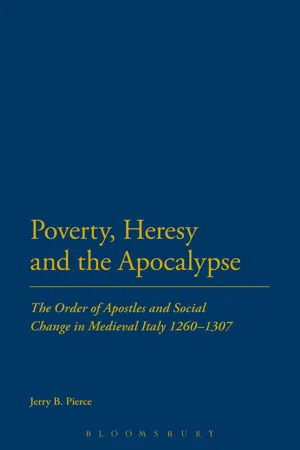
eBook - ePub
Poverty, Heresy, and the Apocalypse
The Order of Apostles and Social Change in Medieval Italy 1260-1307
- 224 pages
- English
- ePUB (mobile friendly)
- Available on iOS & Android
eBook - ePub
Poverty, Heresy, and the Apocalypse
The Order of Apostles and Social Change in Medieval Italy 1260-1307
1
Tell Fra Dolcino to Prepare Himself
For all his contributions to Italian language and culture, one thing Dante Alighieri is not usually acknowledged for is the immortalizing of an obscure heretical sect called the Order of the Apostles that might have remained “lost” had it not been for six lines penned in the first quarter of the fourteenth century in his Divine Comedy:
Then you, who will perhaps soon see the sun,
tell Fra Dolcino, if he has no desire
to join me here quickly,
to provide himself with food
lest when the snows besiege him,
it bring the Novarese the victory that otherwise they would not find too easy.1
Dante placed this warning in the mouth of the Prophet Muhammad, who himself was suffering eternal torment among the sowers of schism and scandal in the eighth circle of hell. Muhammad’s warning was directed to a fellow schismatic and declared heretic, Dolcino of Novara, who, at the time of Dante’s writing, was fighting a losing battle against an army of papal crusaders in the Italian Alps, north of Vercelli. Dante’s mention of Dolcino preserved at least some memory of this heretical group in a work that would become a classic in the western literary tradition.
Despite his immortality in the Divine Comedy, if you were to ask virtually any medievalist about Fra Dolcino and his followers, you may be met with a blank stare. Until, that is, you connect Fra Dolcino to Umberto Eco’s novel, The Name of the Rose or the 1986 movie of the same name starring Sean Connery and Christian Slater. Then the response is typically, “Oh, those heretics.” This response is based on a view of Dolcino and the Order of Apostles (also known as the Apostolics, the Pseudo-Apostles, or the Dolcinites) that has suffered from inquisitorial bias and some poetic license for sensationalism. If one were to follow Umberto Eco’s vivid descriptions of the vile heretic in his novel, one would conclude that these heretics were nothing more than rabble-rousing, bloodthirsty cutthroats, hiding behind a veil of feigned sanctity. Accordingly, the story of Dolcino is “the story of a man who did insane things,” who “committed many acts of violence,” a story that “teaches how the love of penance and the desire to purify the world can produce bloodshed and slaughter.”2 Dolcino and his Apostles “burned and looted because [they] had proclaimed poverty the universal law,” and they “killed to punish, to purify the impure through blood.” They even “had to kill the innocent as well; . . . to establish justice and happiness [they] had to shed a little blood.”3 Although Eco’s rendering of Dolcino and his followers is grossly exaggerated (he simply took ecclesiastical and inquisitorial documents at face value), his interpretation is merely one in a long line of misconceptions about the origins, mission, and significance of the Order of Apostles.
A BRIEF HISTORY
The Order of Apostles originated in 1260 in Parma, after Gerard Segarelli, a seemingly illiterate peasant who was inspired to follow the apostolic life, was denied entrance into the Franciscan Order. Not letting this setback stop him, Segarelli followed his own path, let his beard and hair grow long, clothed himself in a rough, woolen habit (strikingly similar to the Franciscan attire), then sold all his belongings and gave the money away. Segarelli began to wander about Parma and the surrounding area, exhorting his listeners to embrace the twin ideals of poverty and penance with his famous cry of penitençá gite, a vernacular variant on the Latin phrase penitentiam agite (“Do ye penance!”). He soon attracted a number of followers, both men and women, often of high social standing, and the Order grew and spread throughout central and northern Italy. It even enjoyed the support of prominent bishops in Parma, Ravenna, and other Italian cities. For close to 40 years, the Order prospered and grew, but Segarelli refused to take a leadership role in the movement, which may have allowed some of his followers enough independence to develop a notion that their apostolic way of life was not only biblically sanctioned, but in fact superior to that of other ecclesiastics, especially the Franciscans, who had become visibly wealthy and elitist. Under later inquisitorial questioning, some members of the Order admitted that while the Franciscans were referred to as fraters minores (lesser brothers) the Apostles called themselves fraters minimi (the least brothers), indicating the extent to which they saw themselves as a purer example of apostolic holiness.
It was through their claim to the “mantle” of the original apostles, the righteousness and piety exhibited by Jesus’ earliest disciples, that the Order saw itself as the true heir to the legacy of Jesus, first as an alternative to the Roman Church and later as a successor. Ideas such as these inevitably led to conflict with ecclesiastical authorities who first attempted to pressure the Order to disband and seek admission with other “established” Orders. When this “encouragement” failed, Pope Nicholas IV placed a papal ban on the Apostles and began an inquisitorial process against them to get to the bottom of their beliefs. The result was the arrest, imprisonment, and even execution of some members for disobedience. The turning point in the Order’s history came with the arrest and deposition of Segarelli who, refusing to renounce his adherence to the ideals of poverty, was burnt as a heretic in July 1300.
The increasing hostility of ecclesiastical authorities accelerated the growing conviction among members of the Order that the authority that had been conferred upon the church by Christ was now utterly void. According to the Apostles, the church was no longer a useful institution, having moved too far beyond its original functions. Since the pope and his cardinals, and even the mendicant orders, had strayed from the apostolic ideal of the primitive church, the Apostles did not believe themselves subject to ecclesiastical censure. Following Norman Cohn’s assertion that institutional persecution fosters apocalypticism in marginalized groups, the trials and subsequent execution of members of the Order of Apostles, including its founder Gerard Segarelli, stimulated the group’s latent apocalyptic mentality.4 Going beyond its self-legitimization through its claimed association with Christ and his apostles, the Order also placed itself in an apocalyptic time frame that further validated, in its members own minds, its rebellious actions defending the faithful from a church that they designated an agent of Antichrist.
Rather than fading away, the Order of Apostles came under the leadership of Fra Dolcino, a charismatic visionary who eventually preached violent rebellion against a church he saw as oppressive and morally bankrupt. Convinced that the Roman Church had become corrupt precisely because of its political power, wealth, and apparent desire for total dominance, Dolcino wrote a series of three letters to his followers, beginning in 1300, which claimed that this corruption was a key sign that the apocalypse was near. His radical stance naturally earned him the ire of the church, which responded with inquisitorial proceedings. Fueled by his apocalyptic visions pitting good versus evil, Dolcino fled from his perceived persecution, first in Parma, then in Trent, and finally in his native Valsesia. It was there that Dolcino ultimately instigated an armed revolt against the church which lasted several years and required a series of crusades to be put down. Most of his followers were killed in the ensuing battles, while Dolcino and the key leaders of the movement were captured, brutally tortured, and then finally executed in 1307.
Research on Dolcino, especially since the late nineteenth century, has typically been far more cursory than the previous summary. In fact, it often relies on, and indeed perpetuates, stereotypes similar to those found in Eco’s fictional treatment. In doing so, these authors routinely gloss over the overwhelmingly peaceful nature of the Apostles (under both Segarelli and Dolcino) and instead focus on the group’s violent demise, an approach that leaves many aspects of this group unexamined and unexplained, particularly its members’ fervent belief in absolute class and gender equality. Academic carelessness has not been the only impediment to understanding the history of the Order. Ideologically driven histories abound, from the rationalistic nineteenth-century historian Henry Charles Lea to the Marxist approach of S. D. Skaskin in the mid-twentieth century.5 Analyses such as these often place the movement within a specific context that minimizes some aspects, such as Segarelli’s genuine piety, or unnecessarily concentrates on others, such as Dolcino’s violent preaching. Fortunately for the study of the history of the Order of Apostles, some solid scholarship does exist, most notably by the Italian scholars Raniero Orioli, Grado Merlo, and Corrado Mornese.
ORIGINAL BIAS
Many accounts of the Order of Apostles have relied uncritically on the earliest and, perhaps, most slanted sources of evidence, the late thirteenth-century Cronica of Salimbene of Parma (a Franciscan chronicler, and rival, from the same town as Segarelli), the eyewitness, anonymous Historia fratris Dulcini heresiarche, and the early fourteenth-century De secta illorum qui se dicunt esse de Ordine Apostolorum of Bernard Gui, a Dominican inquisitor in Toulouse.6 These texts present the closest thing to firsthand accounts for the origins, spread, and destruction of the Order. The main reason that these texts pose a problem for the history of the Order is that all three have been quoted nearly verbatim. Thus their authors’ biases have remained intact, preserved through the centuries, and embedded in their narratives.
Salimbene’s negative portrayal of the early years of the Apostles and their founder stems from his own privileged standing within the established Franciscan order. Salimbene saw the success of the Order of Apostles as a direct threat to his own because the widespread communal support that the Apostles received indicated that the community likely valued them more than the Franciscans, a consequence, by the mid-thirteenth century, of the extent to which Francis’ followers had deviated from his original conception of his order. More importantly, such community support meant that Segarelli’s Order received donations that Salimbene believed would otherwise have come to the Franciscans. Salimbene’s hostility to the “upstart” Segarelli therefore colored his portrayal of the group’s origin and thus the Cronica presents the founder of the Apostles as a bumbling and illiterate peasant, devoid of any authentic religious fervor, who naively thinks that he can imitate both St Francis and the Apostles without any formal education. Salimbene’s history of the early years of the Order of Apostles unjustly stigmatizes both the Order and especially Segarelli as misguided rural fools who engage in absurd literalist biblical recreations because they are too ignorant to know any better.7 Based on such intramendicant rivalry, Salimbene’s contribution must be seen as an inaccurate, even malicious, characterization of the Apostles that must be filtered of invective to discern a more accurate history of Segarelli’s Order. Yet, later scholarship has overwhelmingly and uncritically relied upon Salimbene’s partisan account, continually presenting his biases regarding the Order as fact. Such accounts have thus singled out the rural, uneducated, and spontaneous elements that then represent the Apostles as uneducated imposters.
A similar firsthand account is the anonymous Historia fratris Dulcini heresiarche, written during and immediately after the capture and execution of Dolcino in 1307. The title’s reference to Dolcino as a “heresiarch” clearly indicates the Historia’s openly partisan nature. He colors his narrative with prejudicial terms, calling the Apostles’ deeds “abominable and heinous” and their teachings “accursed and in every way contrary to the norm of orthodox faith,” while the Apostles themselves he calls “pestiferous dogs.”8 These stigmatizations occur regularly throughout the work. Like Salimbene, the author of the Historia, referred to as l’Anonimo Sincrono (literally, the Contemporary Anonymous), was someone who favored the status quo of ecclesiastical hegemony and felt directly threatened by the beliefs and actions of the Apostles who, he feared, sought to overturn the ruling hierarchy. The Historia repeatedly states that Dolcino promoted false doctrines in the hopes of luring good Christians away from the faith and to promote his own wicked agenda. Whereas Salimbene referred to Segarelli and his followers as fools and fornicators, the Anonimo Sincrono describes Dolcino’s Apostles as threats to society, as demonic dogs stalking and infecting their prey with heresy. Additionally, the Historia exaggerates not only the number of Dolcino’s followers while in Valsesia, but also their actions, by relating tales of Apostles plundering and rampaging up and down the valleys, laying waste to anything and anyone in their path. These contemporary descriptions account, in part, for the negative and inaccurate portrayal of the Apostles as violent that is found in the works of many later historians.
The third widely quoted source for the history of the Apostles is the inquisitorial record collected by the Dominican inquisitor Bernard Gui, De secta illorum qui se dicunt esse de Ordine Apostolorum (“The Sect of Those Who Say They Are Apostles”). This history of the Order, which mostly chronicles the apocalyptic thought and rebellion of Dolcino, is an inherently hostile source, penned by one who was sworn to defend the Catholic faith against the diabolical influence of heretics. Writing at least a decade after Dolcino’s execution in 1307, Gui collected three of Dolcino’s letters, a series of papal bulls and a possible eyewitness account, and then added his own summary of the group’s rise and fall. Gui’s history repeats Salimbene’s charge that Segarelli was an illiterate peasant, accuses Dolcino of being the bastard son of a priest from Novara, highlights Dolcino’s apocal...
Table of contents
- Cover
- Half-Title
- Introduction
- 1 Tell Fra Dolcino to Prepare Himself
- 2 Changing Society and Economy: 1000–1250
- 3 Vying for Power: The Changing Political Landscape
- 4 Church Reform and its Aftermath
- 5 Gerard Segarelli’s Vita Apostolica
- 6 Rivalry and Slander
- 7 Descent into Heresy
- 8 Apocalyptic Catastrophe
- 9 In the Valley of Heresy
- Conclusion
- Epilogue: Stones of Remembrance
- Notes
- Bibliography
- Index
Frequently asked questions
Yes, you can cancel anytime from the Subscription tab in your account settings on the Perlego website. Your subscription will stay active until the end of your current billing period. Learn how to cancel your subscription
No, books cannot be downloaded as external files, such as PDFs, for use outside of Perlego. However, you can download books within the Perlego app for offline reading on mobile or tablet. Learn how to download books offline
We are an online textbook subscription service, where you can get access to an entire online library for less than the price of a single book per month. With over 1.5 million books across 990+ topics, we’ve got you covered! Learn about our mission
Look out for the read-aloud symbol on your next book to see if you can listen to it. The read-aloud tool reads text aloud for you, highlighting the text as it is being read. You can pause it, speed it up and slow it down. Learn more about Read Aloud
Yes! You can use the Perlego app on both iOS and Android devices to read anytime, anywhere — even offline. Perfect for commutes or when you’re on the go.
Please note we cannot support devices running on iOS 13 and Android 7 or earlier. Learn more about using the app
Please note we cannot support devices running on iOS 13 and Android 7 or earlier. Learn more about using the app
Yes, you can access Poverty, Heresy, and the Apocalypse by Jerry B Pierce in PDF and/or ePUB format, as well as other popular books in History & European Medieval History. We have over 1.5 million books available in our catalogue for you to explore.