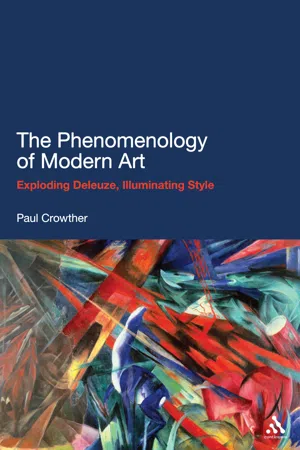
As a philosophical approach, phenomenology is concerned with structure in how phenomena are experienced. The Phenomenology of Modern Art uses phenomenological insights to explain the significance of style in modern art, most notably in Impressionism, Expressionism, Cezanne and Cubism, Duchampian conceptualism and abstract art.
Paul Crowther explores this thematic approach in a new way, addressing specific visual artworks and tendencies in detail and introduces a new methodology - post-analytic phenomenology. It is this more critical, post-analytic orientation that allows the book to utilise some unexpected phenomenological resources. Gilles Deleuze, rarely associated with phenomenology, in fact employs an overriding phenomenological orientation in his focus on modern art. Crowther uses Deleuze's important phenomenological insights as a starting point and goes on to develop arguments found in two other thinkers, Nietzsche and Merleau-Ponty, as well as addressing those figures and tendencies in relation to whom twentieth-century critical appropriations of Kant have been most influential. Accompanied by illustrations, the book offers the first sustained phenomenological approach to modern art.
- 296 pages
- English
- ePUB (mobile friendly)
- Available on iOS & Android
eBook - ePub
About this book
Information
Chapter One
Releasing Style from Sensation: Deleuze, Francis Bacon and Modern Painting
Introduction
The great merit of Deleuze’s approach is that it is phenomenological in an important fourfold sense. It attempts to integrate closely, the ontological structures of painting qua painting, perception of these structures, our affective response to them, and the way in which painting focuses these aspects in its historical development.
In his study of Bacon, Deleuze frequently notes phenomenology’s explanatory restrictiveness.1 However, the fourfold emphasis just described is one that gives his approach a phenomenological authority in relation to modern painting, irrespective of his reservations concerning phenomenology as a method.
Now, while Deleuze’s interpretation of Bacon and theory of modern painting is extremely rich, it also contains a great deal of material that is used in an essentialist and hierarchical way, without the appropriate justification. Indeed, this relates to various other grey areas in his theory, and to suspicions concerning how far his general theory is, in effect, a disguised teleology designed to present the achievements of Cezanne and Bacon as its great outcome.
Generally speaking, Deleuze’s philosophy of painting is a kind of phenomenology in denial. The real potential of his ideas emerges only if the denial is exploded, and his ideas developed more critically.
In this chapter, therefore, Part One will expound the key features of Deleuze’s analysis of Francis Bacon. Part Two will consider the general theory of painting and the privileging of modern work that he formulates on the basis of his approach to Bacon. Part Three addresses in detail Deleuze’s complex notion of sensation – a notion that is foregrounded, especially, in his advocacy of colourism. In Part Four, the essentialist and partial character of Deleuze’s theories will be identified and criticized at length. The Conclusion will extract the very important and valid insights that would otherwise be lost in Deleuze’s denial of phenomenology.
Part One
For Deleuze, ‘The task of painting is defined as the attempt to render visible forces that are not themselves visible’.2 In relation to Bacon, this takes a specific form: The human figure dominates his oeuvre, and is presented as a focus of physical forces that are made visible through their effects on the body. In his work, flesh appears ‘shaken’ – as something descended from the bones. The face gives way to the head.
It is argued by Deleuze that the apparent violence of Bacon’s images is not due to their content, but rather, to considerations of ‘sensation’, that gravitate around issues of colour, line, and expression. Bacon’s ‘Figures’, indeed, are not tortured and wracked bodies, but ordinary ones, presented under conditions of constraint and discomfort – as visible things subjected to the effects of different forces.
Deleuze capitalizes ‘Figure’ in relation to Bacon and other major artists, because it is the first key structural feature of painting. It should be emphasized, however, that it involves more than the factors just described. Of equal importance is the Figure’s relation to a second pictorial structure, consisting of a ground from which the Figure appears to detach itself.
In Bacon’s work, this ‘material structure’ (as Deleuze terms it, most frequently) consists of large fields of colour presented in a shallow, ‘post-cubist’ depth. These areas are themselves divided into sections, or traversed by tubes or thin rails, or sliced by a band or largish stripe. They form, in effect, an ‘armature’ or ‘bone structure’.3
Figure and material structure in Bacon draw life from one another. As Deleuze puts it, ‘But if these fields of color press toward the Figure, the Figure in turn presses outward, trying to pass and dissolve through the fields.’4 For Deleuze, Bacon continues and develops a break with figuration that is actually based on elevating the Figure into prominence while maintaining a sense of the ground as the matrix from which the colour articulation of the Figure emerges. This is anticipated in Michelangelo, but is manifest, especially, in key moderns such as Van Gogh, and Gauguin, and more fully in Cezanne. Bacon, however, expresses the relation in a highly distinctive way that cannot be identified with any ‘ism’.
In respect of this, we are told that,
It is the confrontation of the figure and the field, their solitary wrestling in shallow depth, that rips the painting away from all narrative but also from all symbolization. When narrative or symbolic, figuration obtains only the bogus violence of the represented or the signified; it expresses none of the violence of sensation – in other words, of the act of painting.5
This non-narrative aspect of painting is accompanied by a third pictorial structure that is extremely characteristic of Bacon. Deleuze calls it the ‘contour’. It consists of round or oval areas – within the painting’s edges, or even seeming to continue beyond it. These delimit the figure through an ‘operative field’ where the figure is explored ‘upon itself’ or even within this ‘place’.6 It is a zone of reciprocal visual exchange between the Figure and the material structure. These three key structural features are mediated and merged by two more specific formal devices of special significance to Bacon.
The first of these is what Deleuze calls the ‘diagram’ –a notion that is (as we shall see in much more detail later on) of great import for painting as such, but which Bacon uses, again, in a highly distinctive way. It consists of ‘local scrubbing’ –where paint is brushed or rubbed across an area, and ‘asignifying traits’ – free marks that appear to have no reference to figurative function (and which, of course, are one of the effects of local scrubbing).
The other merging device involves what Deleuze calls ‘attendants’. The role of these forms – be they human or simulacra (such as photographs hung on a wall or railing) –is to not to be an internal spectator for the Figure, but to act as a reference point for the colour variations through which the Figure is achieved. The attendants help integrate Figure and field in strictly visual terms (and are important, especially, for the many Bacon triptychs).
It is the relation between the three structural features and the two key mediating factors which explains, further, why Deleuze capitalizes the term ‘Figure’ when discussing Bacon and other artists. The Figure is not some symbolic feature – a mere ‘figure’ represented against a ground. Rather it is a visual feature or ‘trait’ achieved through colour articulation of the ground – an articulation that suspends our simple narrative sense of what is represented, in favour of extreme attentiveness to how it is represented. As Deleuze puts it, ‘Painting has to extract the Figure from the figurative.’7
Given these points, it is worth focusing, now, on Deleuze’s more detailed consideration of Bacon’s treatment of the body as Figure. A key concept used is that of ‘deformation’. Deleuze claims that,
What makes deformation a destiny is that the body has a necessary relation with the material structure: not only does the material structure curl around it, but the body must return to the material structure and dissipate into it, thereby passing through or into . . . prostheses, instruments, [e.g. umbrellas] which constitute passages and states that are real, physical, and effective, and which are sensations and not imaginings.8
At the heart of this deformation is painting’s attempt to make the invisible forces that determine the body’s character and configuration, present to vision. These forces include time, pressure, inertia, weight, attraction, gravitation, germination.9
Deleuze suggests that the expression of these involves deformation rather than transformation, because while the latter can be dynamic, the former is always bodily and static and happens at one place. Examples of this are offered.
for both Bacon and Cezanne, the deformation is obtained in the Form at rest; and at the same time, the whole material environment, the structure, begins to stir: ‘walls twitch and slide, chairs bend or rear up a little, cloths curl like burning paper. . .’ [quoting D. H. Lawrence.] Everything is now related to forces, everything is force. It is force that constitutes deformation as an act of painting: it lends itself neither to a transformation of form, nor to a decomposition of elements.10
In terms of this we might consider Bacon’s Four Studies for a Self-Portrait of 1967. Here any suggestion of movement or process is derived not from motion itself, but from forces of dilation, contraction, flattening, and elongation. This achieves a kind of ‘dismantling’ of the face (Deleuze’s own term) through which the character of the head is made visible. However, the dismantling is not a visual analysis, but one arising from the face subjected to pressures. Indeed, (though Deleuze himself does not say this, explicitly) the smeared areas of local scrubbing around the mouths exemplify both a material deformation of the painted surface and, through this action by the painter, the suggestion of forces that would distend a face by impacting upon it.
Of equal importance, is force exerted outwards by the body itself. This involves one of the most imaginative features of Deleuze’s reading of Bacon. It interprets the painter as rendering visible the body’s attempt to escape from itself – using one of its organs to rejoin the field or material structure.
In the Figure at a Washbasin of 1976 (Museo de Arte Contemporaneo, Caracas), for example, ‘the body-Figure exerts an intense motionless effort on itself in order to escape down the blackness of the drain’.11 Here, Deleuze claims that the round shape of the washbasin bowl is a ‘place’ –a replication of the ‘contour’. However, it is not the material structure of the painting that curls round the contour, so as to envelop the Figure, rather the visual thrust of the Figure is one that appears intent on pressing – mouth first – through the bowl into some darker, narrower depth, leading back into the material structure. And, in this, the figure’s own shadow seems to be a co-conspirator, in that it too appears to be detaching itself from the body.
The body’s striving to escape from itself is more than just a feature of how Bacon’s Figures appear. It is an expression of something of more general significance, namely ‘the body without organs’. This term is derived from Artaud, and is used in much of Deleuze’s previous work (albeit with very different emphases).12 In the present context, Deleuze stresses that it subverts the notion of ‘organism’ and characterizes the limit of the lived body. Here are some of his descriptions of it:
The body without organs is opposed less to organs than to that organization of organs we call an organism. It is an intense and intensive body. It is traversed by a wave that traces waves or thresholds in the body according to the variation of amplitude.13
the body without organs is flesh and nerve; a wave flows through it and traces levels upon it; a sensation is produced when the wave encounters the forces acting on the body . . .14It is a whole nonorganic life, for the organism is not life, it is what imprisons life. The body is completely living, yet nonorganic.15
These extremely cryptic remarks might be made sense of as follows. The human animal has a body sense that hinges on sensations, potential acts, and states, which – even if they are based on the activity of a specific organ (such as the mouth) at a specific time – nevertheless give way, subsequently, to the acts of other organs, and their relevant sensation.
Indeed, what is at issue here is not the phenomenological unity of the body as a unified sensori-motor cognitive field, rather it is a sense of life that is immanent to the cognitive functions that grow around it. The body without organs is the flow, and projected flow of sensation, that can be known through the different levels of intensity, that its various shifts and motions occasion, or might occasion.
In this, sensation is registered through specific organs, but is not tied to any one of them except temporarily. It is this shifting, transitional nature of (as it were) organ assignment, that leads Deleuze to suggest that the body without organs is sometimes felt as an ‘indeterminate polyvalent organ’.16
This provides the key link to painting. We are told that painting,
invests the eye through color and line. But it does not treat the eye as a fixed organ. It liberates lines and colours from their representative function, but at the same time it also liberates the eye from its adherence to the organism, from its character as a fixed and qualified organ: the eye becomes virtually the polyvalent indeterminate organ that ...
Table of contents
- Cover
- Half-Title
- Introduction: The Interpretation of Modern Art
- Chapter One: Releasing Style from Sensation: Deleuze, Francis Bacon and Modern Painting
- Chapter Two: Origins of Modernism and the Avant-Gardee
- Chapter Three: Nietzsche and the Varieties of Expressionism
- Chapter Four: Merleau-Ponty’s Cezanne
- Chapter Five: Interpreting Cubist Space: From Kant to Phenomenology
- Chapter Six: Duchamp, Kant, and Conceptual Phenomena
- Chapter Seven: Greenberg’s Kant and Modernist Painting
- Chapter Eight: Deleuze and the Interpretation of Abstract Art
- Chapter Nine: Plane Truths: Hans Hofmann, Modern Art and the Meaning of Abstraction
- Notes
- Bibliography
- Index
Trusted by 375,005 students
Access to over 1.5 million titles for a fair monthly price.
Study more efficiently using our study tools.
Frequently asked questions
Yes, you can cancel anytime from the Subscription tab in your account settings on the Perlego website. Your subscription will stay active until the end of your current billing period. Learn how to cancel your subscription
No, books cannot be downloaded as external files, such as PDFs, for use outside of Perlego. However, you can download books within the Perlego app for offline reading on mobile or tablet. Learn how to download books offline
Perlego offers two plans: Essential and Complete
- Essential is ideal for learners and professionals who enjoy exploring a wide range of subjects. Access the Essential Library with 800,000+ trusted titles and best-sellers across business, personal growth, and the humanities. Includes unlimited reading time and Standard Read Aloud voice.
- Complete: Perfect for advanced learners and researchers needing full, unrestricted access. Unlock 1.5M+ books across hundreds of subjects, including academic and specialized titles. The Complete Plan also includes advanced features like Premium Read Aloud and Research Assistant.
We are an online textbook subscription service, where you can get access to an entire online library for less than the price of a single book per month. With over 1.5 million books across 990+ topics, we’ve got you covered! Learn about our mission
Look out for the read-aloud symbol on your next book to see if you can listen to it. The read-aloud tool reads text aloud for you, highlighting the text as it is being read. You can pause it, speed it up and slow it down. Learn more about Read Aloud
Yes! You can use the Perlego app on both iOS and Android devices to read anytime, anywhere — even offline. Perfect for commutes or when you’re on the go.
Please note we cannot support devices running on iOS 13 and Android 7 or earlier. Learn more about using the app
Please note we cannot support devices running on iOS 13 and Android 7 or earlier. Learn more about using the app
Yes, you can access The Phenomenology of Modern Art by Paul Crowther in PDF and/or ePUB format, as well as other popular books in Philosophy & Aesthetics in Philosophy. We have over 1.5 million books available in our catalogue for you to explore.