How is hostage space constructed? In this age-long procedure found in conflicts around the world, strange forms of terror and intimacy arise, particularly in the contemporary Islamic cultures of Chechnya, Albania, and Bosnia. This book investigates the modes of desire and politics found in kidnapping, in order to reveal the voices of victims and kidnappers that often remain closed up.
Dejan Lukic explores the spaces where hostages and hostage takers come into contact - spaces of accident, sacrifice, hope, and catastrophe - or, in other words, the spaces that announce utopias bound to fail. In this book, the figures of the victim, the terrorist, the sovereign, the resistance fighter and the witness – among others – emerge with a new face; one that will contribute to our understandings of what it means to act politically and ethically today.
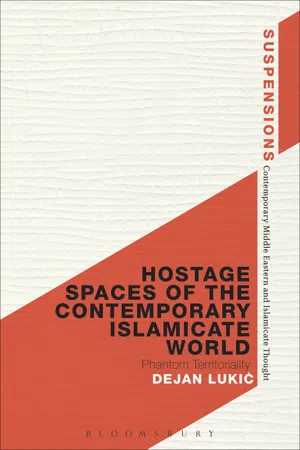
- 208 pages
- English
- ePUB (mobile friendly)
- Available on iOS & Android
eBook - ePub
About this book
Information
1
“Being on the lookout,” the animal
Territory
To occupy, to impose the occupation, to devour space, and oneself with it. To what extent is this statement true of the hostage taker? Hostage taking implies a simultaneous occupation of space (be it inside or outside, private or public, a transportation vehicle or a patch of land) and the inhabitants of that space. The people who are seized receive a new function: they are the fulfillment or failure of a given condition, which means that both the hostage taker and the hostages change their states of being. They change these states together, through imposition. The degrees of their humanity are altered simultaneously through the imposition of fear, threath, stealth, camouflage, etc. This change is possible only because there is, in the first place, an exchange of affects between the hostage taker and the hostages; we could say that the room in which they find themselves trembles. It is this change, this trembling, that affects their very status as humans.
The relationship to a territory and the occupation of a territory is properly animalistic. As a result, the hostage taker only enacts and makes visible the primordial identification of the animal through the specific parameters of space. It is the violence enacted upon the territory that makes the action terroristic. The bodies of the hostages are thus only perceived as territories of the enemy that one can occupy as well. The implicit ontology of the hostage taker lies in his relationship to the space that he occupies and the limited panorama that this occupation provides for his survival. The spatial configuration of the territory he occupies, then, imposes a new definition upon the hostage taker in the same way that he imposes himself on the space and its inhabitants. Namely, the hostage taker is a “being on the lookout.”1 Being on the lookout means being in tension, being intense and without rest, always looking over one’s shoulder. This is the same ontology of the animal that is nothing but a constant tension with the world, a high-strung sensuous apprehension of its environment, one that mirrors the animalistic nature of the hostage taker, or better still, the modality within the human which ties him to a certain vector of space. Every animal is, in this sense, properly political because it is tied to a particular territory and its atmospheric conditions.
Being on the lookout means looking after one’s properties (bodily and territorial). How then does the hostage taker construct the property of a territory? He imprisons it. The hostage taker deterritorializes himself by occupying a territory and thereby making it hostile against the world—including oneself. In other words, the hostage taker reorganizes a territory’s properties (who does this territory belong to?) in the process of seizing everyone present.
Being an animal: being a hostage of one’s own affective powers. But from where does this primordial tension with the world come? It comes from the experience of one’s body as separate from the rest of the world; it comes with being embodied and with one’s feet firmly on the ground, with possessing a ground, and eventually anxiously defending it. Occupying also translates into defending a territory. Here is the first encounter with the notion of the political. Here the occupation of the territory implies a hostility from the outside, the enemy that is (always) to come.
In this location that is an encounter, the meeting point where the bodies collide, the “here” of the hostage space, is where the desire for justice, the resistance to stately power, and the theopolitical vision turn into pure actions. This is where we encounter a hostage taker above all else. First, he belongs to a specific territory (that of the nation-state) and second, he intrudes upon the personal territory of the other and violently overtakes it. The hostage taker overtakes the bodies of others in order to undermine the geopolitics of the other. Thus, the enemy is constructed through the relationship and violation of the relationship to a particular territory. Indeed, if we examine the root of the word “hostage,” “host,” a range of intertwined meanings opens up. Most importantly, in Latin hospes means a guest. So, on the one hand, a host is a person who receives guests (the hospitable aspect of hostaging); on the other, a host is also a person whose immune system has been invaded by a pathogenic organism (the immunological aspect). But other surprises encroach upon the meaning of the word: hostis also meant “stranger, or enemy” and in medieval times, an “army”; and, finally, hostia meant “victim.” A whole conceptual universe unfurls here. The terror of the hostage taker lies precisely in the fact that he overpowers the confines of these words. She is the uninvited guest who turns the host into a victim and herself into an adversary. We also see that at the root (if such a thing exists) of this notion of the stranger lies the simultaneous emergence of the enemy. The hostage taker is therefore an executioner of failed hospitality, which is nothing but the failed attempt to turn the outsider into an insider, to turn the “animal” into a “human,” through procedures of capturing and, sometimes, killing.
For these reasons the concept of territory precedes the concept of the political. And further, in this highly political act of the hostage taking, I see two domains that tacitly encompass the concept of the political: animality and territoriality. In general, animality, territoriality, and the political form a complicated trinity which is hard to divest into constituent parts. This is why the figure of the hostage taker is significant, since he brings these foundational molecules of the political to the fore. There are therefore a politics of the animal and of territory that are not necessarily tied to the idea of the state (even though it is hard now to imagine mountains in Bosnia as not being Bosnian, or the Adriatic coast in Albania as not Albanian).
Ideas too are territories. One traverses them, defends them, develops trajectories, borders, gates, passwords, violent implementations, official legitimations, stately and disciplinary powers. One also escapes them, uses them as a rope through which one descends from the cell in the castle of dominant discourses. The hostage taker, in fact, tells us a story of suspension, rather than descent, a suspension that is both a theoretical and physical levitation (negatively manifested in the explosion of the body), therefore never completely resolving the problem of belonging, never completely climbing up or completely going down into the underground.
The hostage taker becomes an animal, literally turning into an animal of prey that uses stealth and surprise to impose terror. But he is already brought to the condition of a powerless or wild animal by humiliation on the part of the dominant state or global economics, which intertwine in their imposition of powers (the so-called neoliberal power that encompasses and expands from the West).2 “They” are like wild animals; this is the repressed secret of the West. It is secret because it simmers below the surface of democratic humanism, a dirty little secret that constantly leaks out. The hostage taker is thus reduced to the state (if not the shape) of the animal already. Strategically, then, he intensifies this definition toward its most absurd and fatalistic consequences. The man and the woman of irregular war—terrorism—are undoubtedly related to the animal, both in its physical dispositions and its political standing. While naming one an “animal” imprisons him in the cosmology of the other, ascribing oneself to the animal produces opposition to this enslavement—opposition that becomes libratory.
The discussion of belonging to a territory, national or ethnic,3 thus has to proceed from the discussion on animality. The affair of belonging is of course a profound process of domestication, of a sense of security, protection, and so on. The emergence of empires and states, and their dissipation through contemporary neoliberal networks, must be tied to the process of domestication (evolutionary biology has to be coupled with domesticatory ontology). It is important to note that the supposed “wildness” of the hostage taker is only momentary. Ultimately, this phenomenon can be traced back to a failure of the idea of freedom, since freedom is already tied to another belonging (to one’s ethnicity or religious brotherhood, or in light of this essay, to the space of Islamic cosmology). Throughout, I will consistently reiterate this ensuing failure inscribed in the act of hostage taking.
The entire world for humans operates through the interaction of the inside with the outside; the hostage taker maximizes this experience when she overtakes a small particle of space thereby establishing herself as a sovereign of this temporary territory. The hostage taker, in this precise action, expresses her own maltreatment—being treated like a mere animal—by embodying this animality to its extreme, and by using all the technologies and magicalities of warfare, from camouflage to explosive devices to cell phones to religious cries (relating one’s body to the architecture of the divine). The animal and the territory are inseparable, just as Bataille famously says that “every animal is in the world like water in water.”4 In other words, the animal exists immanently in the world, without separation from its environment, without the infinite human problem of the inside and the outside (inside the house or outside of it, inside the state or outside of it, inside the law or outside of it, inside one’s skin or outside of it). And yet the animal is locked in a permanent impulse to hide and surprise, displaying that its world is immanent but circumscribed by the outline of a territory.
Before proceeding, let us return to a more thoroughgoing treatment of domestication since it is essential for understanding this disruptive practice. On October 23, 2003 Dubrovka Theater in Moscow was seized by 30 to 40 Chechens who were part of the Islamist militant separatist movement in Chechnya.5 (This event is also known as “Nord-Ost siege” after the name of the musical that was performed in the theater that day, thus giving the entire event of terror a sense of performativity, or of a perverse spectacle with its own “musicality.”) After two and a half days, the theater was raided by Russian forces after they released an unknown chemical agent into the ventilation system. This resulted in the death of 170 people (including 39 hostage takers). In the years that followed, there were a number of theater reenactments, the simulation of its intensities, of the Dubrovka Theater hostage crisis. I mention here only one that went beyond the benign ethical invocations of devastation that this event indisputably produced. In 2008, “La Fura dels Baus,” a Catalan theater troupe, aestheticized the events of the Dubrovka Theater through the architecture of the stage, physical attractiveness of actors and costumes, and general excitement that was raised by the slight imposition on the audience to participate in the act.6 I say “aestheticized” not to belittle the conceptual quality of the performance; every documentary image that emerged from the Dubrovka crisis had a certain aesthetics of horror inscribed in itself. The problem lies elsewhere, in the domestication of the event that occurs in its aftermath: the staging itself puts it into the sphere of something consumable, always safe (despite the minimal provocations by the actors), and in the end educational. The inconsumable aspect of hostage taking stays in the domain of what is unsaid, or in the domain of expectation: that of the lookout. Hostage taking is preceded by the lookout and succeeded by the cry: these are its opening and closing acts. What happens in-between cannot be reenacted nor witnessed. For this reason the ethically problematic proposition is nevertheless accurate: the real siege is the real avant-garde, where the terrorist manifesto is taken on its word, where word and image are not representations but pure experiences.
Another definition that underlies the constellation of this conflict: the hostage taker is one anomalous segment of the figure of the terrorist, which is a segment of the figure of the partisan, which is the segment of the very experience of irregularity. If the body of terrorism, or of what is conceived as the enemy, were that of a starfish, a hostage taker would be one granule of that expansive architecture of plates found on the surface of this animal. One could say that the hostage taker is nothing but a special irregularity, a violent imposition of the irregular. While these notions are primarily political, they can also be approached from the standpoint of pure territoriality. The very idea of the political is of course directly tied to the idea of the territory, and by extension to planetary surfaces and depths (in terms of the economics of oil, for example). This equation is not surprising. But there is another more startling one at work (even though it is basic): politics-territory-animal. This is the equation in which the hostage taker should be situated, as a small actor in the theater of the animo-political—one that disturbs the surface of the state (through abduction of its citizens) while also helping it solidify in unprecedented ways.
In every respect, the hostage taker works through the primacy of the act, through an immediacy that at the same time looks beyond the present moment. Even more, the act itself is aligned with the word; that is the threats are always real, they are never lies, nor are they semi-truths mediated by the political apparatus. What the hostage taker says he will do, he does. From this perspective, the policy of the state (no negotiations with terrorists) makes no sense, since there is nothing else to do but negotiate if one wants to save the hostages. When it comes to militant acts of hostage taking in the contemporary Muslim landscape, the adherence to the given word (which consists of the threat and the execution of it) is one of the most overlooked instances in the analysis of terrorism. This is also why hostage taking in the domain of the political contains a resemblance to theological values. It is an act tied to the word where the promise (of killing) has divine concreteness. One can trust the hostage taker fully. This is not to support the insensitivities of the popular view of the Muslim terrorist who kills in the name of his God, a claim that shows complete ignorance.7 But, then again, this ignorance hides the accuracy that should be extracted from it: the accuracy of the immediacy that exists between the act and the word, which finds one of its rare manifestations in the act of hostage taking.
Barayev
Movsar Barayev has been a “being on the lookout” since the first day he can remember. A nephew of the famous Chechen militant clan leader Arbi Barayev (an experienced hostage taker who both executed and freed his hostages in the late 1990s), Movsar became the leader of the Special Purpose Islamic Regiment (spelled in capital letters, just as all other military-legalistic detachments of the state), also known as al-Jihad-Fisi-Sabililah.8 Regiment that is a rule, of special purpose and meaning. What is implied in this name is the physicality of an act; the regiment has a purpose which propels it into action, into necessary destruction. Becoming a regiment is also already an act of forming a pack or a group with specific goals. An important aspect in this formation of violence that is manifested in militant regiments is the problem of the animal and the hermeneutics of the sovereign, one based on cruelty, provoked by humiliation, and enacted with fatalism. The Special Purpose Islamic Regiment is one of the most notorious hostage-taking groups in recent history. Their operations are of course tied as much to rumors as they are to empirical facts. Here is one of these facts: October 23, 2002, it was Movsar and his 40 militants who occupied Dubrovka Theater in Moscow.9
Movsar took his militancy to its final extreme, to death without compromise. For this a special type of ruthlessness is necessary, a capacity for cruelty, but one that comes from where? From the love of one’s nation? From one’s alliance to Islamic cosmology? The everyday itself is a threshold, such that even the banal aspects of the everyday are contaminated with the eruptive possibility of militant subjectivity.
The hostage taker complicates this episode of the overtaken theater further, since it is with this act that he creates a bubble inside the homogenous territory of the state, a bubble that will eventually explode; an immanence within immanence constituted by a new law that operates on a small territory (of the kidnapped airplane, or an overtaken village in Bosnia, or a theater building in Moscow). For a brief moment he forms his own microstate of terror inside the dominant space of the nation. This is a bubble that is absolutely enclosed, and not only politically. In this way, hostage taking is an intensification and maximization of the feeling of enclosure imposed both onto the dominant party but also onto oneself. The bubble of the hostage space is so insulated that it feels like another form of earth, with everything outside hostile to its existence. The bubble that becomes a new earth, a situation that signals the geographical aspect of hostage taking and terrorism, is suspended in an antagonistic universe. The event in Dubrovka Theater, the act itself, is nothing but a reaction to an initial indifference of the Russian state toward minorities that turns into hostility (the historical suppression by the Soviet and Russian state of the Chechen minority).10 It is this indifference turned hostility that gives birth to Movsar Barayev and to the many manifestations of Barayev throughout the contemporary Islamicate world.
Camouflage
Irregular soldier, Islamic militant, hostage taker: each has a new relationship with his own skin. Namely, the way one dresses spans civil clothing, military outfit, and something in between. Camouflage is another way to develop a relationship with the territory, to resemble it, and to become imperceptible, all for the benefit of a more effective attack. Camouflage is perhaps the most obvious characteristic of the animal that any soldier appropriates, for every animal besides the domesticated one relies on the properties of mimicry that lead to some form of camouflage. The history and evolution of uniforms attests to this association, pointing not just to the fact of animality but also to a delirious nonutilitarian history when war was still “bracketed” and not absolute.11 The armies of the Ottoman Empire certainly did not have the same preoccupation with imperceptibility as the Islamic Regiment of the Special Meaning. Hence, the becoming-animal of the human in war has been well documented but not sufficiently theorized.12 In war studies and in anthropological accounts of traditional societies, we read about the importance of the animal for the experience of becoming a warrior, but there is very little analysis in terms of what this metamorphosis (even if it is just temporary) entails, what becomings it produces (namely, how it turns the human into an animal or how it questions the static identity of the human).
It is impossible to ignore here the immense contribution of Deleuze and Guattari’s concept of the war machine to the question of irregular combat, terrorism, and ho...
Table of contents
- Cover
- Half-Title
- 1 “Being on the Lookout,” the Animal
- 2 Biopotentiality and the Enemy
- 3 Architectonics of the Hostage Space
- 4 The Movement of the Black Stone
- 5 Delirium of Air
- 6 The New Weapon
- 7 Sovereign, of the Outside
- 8 Taking, Seizing, the Event
- 9 Cry, the Inhuman
- Notes
- Bibliography
- Index
Trusted by 375,005 students
Access to over 1.5 million titles for a fair monthly price.
Study more efficiently using our study tools.
Frequently asked questions
Yes, you can cancel anytime from the Subscription tab in your account settings on the Perlego website. Your subscription will stay active until the end of your current billing period. Learn how to cancel your subscription
No, books cannot be downloaded as external files, such as PDFs, for use outside of Perlego. However, you can download books within the Perlego app for offline reading on mobile or tablet. Learn how to download books offline
Perlego offers two plans: Essential and Complete
- Essential is ideal for learners and professionals who enjoy exploring a wide range of subjects. Access the Essential Library with 800,000+ trusted titles and best-sellers across business, personal growth, and the humanities. Includes unlimited reading time and Standard Read Aloud voice.
- Complete: Perfect for advanced learners and researchers needing full, unrestricted access. Unlock 1.5M+ books across hundreds of subjects, including academic and specialized titles. The Complete Plan also includes advanced features like Premium Read Aloud and Research Assistant.
We are an online textbook subscription service, where you can get access to an entire online library for less than the price of a single book per month. With over 1.5 million books across 990+ topics, we’ve got you covered! Learn about our mission
Look out for the read-aloud symbol on your next book to see if you can listen to it. The read-aloud tool reads text aloud for you, highlighting the text as it is being read. You can pause it, speed it up and slow it down. Learn more about Read Aloud
Yes! You can use the Perlego app on both iOS and Android devices to read anytime, anywhere — even offline. Perfect for commutes or when you’re on the go.
Please note we cannot support devices running on iOS 13 and Android 7 or earlier. Learn more about using the app
Please note we cannot support devices running on iOS 13 and Android 7 or earlier. Learn more about using the app
Yes, you can access Hostage Spaces of the Contemporary Islamicate World by Dejan Lukic in PDF and/or ePUB format, as well as other popular books in Theology & Religion & Islamic Theology. We have over 1.5 million books available in our catalogue for you to explore.