A Battle for Neutral Europe describes and analyses the forgotten story of the British government's cultural propaganda organization, the British Council, in its campaign to win the hearts and minds of people in neutral Europe during the Second World War. The book draws on a range of previously unused material from archives from across Europe and private memoirs to provide a unique insight into the work of the leading British artists, scientists, musicians and other cultural figures who travelled to Spain, Portugal, Sweden and Turkey at great personal risk to promote British life and thought in a time of war.
Edward Corse shows how the British Council played a subtle but crucial role in Britain's war effort and draws together the lessons of the British Council experience to produce a new model of cultural propaganda.
eBook - ePub
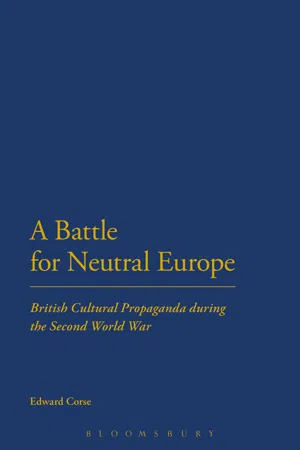
A Battle for Neutral Europe
British Cultural Propaganda during the Second World War
- 240 pages
- English
- ePUB (mobile friendly)
- Available on iOS & Android
eBook - ePub
About this book
Information
1
Introduction
When research for this book began in the summer of 2007, the British Council was an organization that many people in Britain had never heard about. It was far better known outside Britain through its activities of teaching the English language and promoting British culture abroad so much so that, in many places, it was, and remains, the most tangible British asset overseas – rivalled only by the British Broadcasting Corporation (BBC). Since the summer of 2007, however, the British Council has become much more of a household name within Britain as well, but not in ways the British Council would have chosen. In December 2007, the Russian Government demanded the closure of the Council’s offices in Yekaterinburg and St Petersburg, claiming that the Council had not paid adequate taxes. The closures were widely suspected, in Britain at least, to be part of the wider diplomatic tension between Britain and Russia at the time. This tension had stemmed from the murder of Alexander Litvinenko in London in November 2006, the refusal of the Russian Government to extradite the KGB agent Andrei Lugovoi, who was suspected of murdering Litvinenko, and the ensuing expulsion of diplomats from the two countries’ respective Embassies. The British Council suddenly became much better known across Britain as its name and role became displayed on the front pages of British newspapers and in the headlines of television news.1 Just over a year later, events in February 2009 provided a similar story of the British Council’s staff and offices being threatened because of a wider tension between Britain and a foreign country – this time Iran (though compared to the events in 2011 appeared quite a small affair).2 The British Council’s premises in Kabul in Afghanistan were also attacked in August 2011 making, again, front page news.3 The events in Russia, Iran and Afghanistan in the early twenty-first century demonstrate some of the many tensions in the British Council’s role which have been present ever since it was established in 1934, and these tensions will become familiar in the following chapters.
In this book, the British Council’s role and activities in neutral Europe during Second World War will be examined in detail. The British Council’s broad aim is worth stating at the outset – which was to promote British life and thought abroad. In 1935, it published an official statement of its aims and objectives, which will be examined in more detail later:
To promote abroad a wider appreciation of British culture and civilisation, by encouraging the study and use of the English language, and thereby, to extend a knowledge of British literature and of the British contributions to music and the fine arts, the sciences, philosophic thought and political practice. To encourage both cultural and educational interchanges between the United Kingdom and other countries and, as regards the latter, to assist the free flow of students from overseas to British seats of learning, technical institutions and factories, and of the United Kingdom in the reverse direction. To provide opportunities for maintenance and strengthening the bonds of the British cultural tradition throughout the self-governing Dominions. To ensure continuity of British Education in the Crown Colonies and Dependencies.4
As a shorthand, the term ‘cultural propaganda’ has often been associated with its work, as it attempted to promote British culture through institutions and other media to foreign countries.
The first time that an in-depth study on the British Council had been undertaken was in the 1980s by Philip Taylor in his The Projection of Britain, which considered the role of pre-Second World War British Council. Taylor’s work, referenced particularly in the ‘Learning from the past’ chapter of this book, was ground-breaking in its attempt to understand why the Council was established, what its role was meant to be and how it operated within the machinery of the British Government.5
Shortly after Taylor’s study, D. W. Ellwood and Diana Eastment focused on the war period itself with a similar scope to Taylor’s work, centering on the operations of the Council in a British organizational context and then, in 1984, Frances Donaldson wrote the British Council’s official history covering the first 50 years of its existence.6 All of these studies focused primarily on the plans that the Council drew up for implementing its work, agreements reached between various Government bodies, the struggle that the Council faced to secure funding and the struggle for recognition against the view promoted by certain influential individuals – primarily Lord Beaverbrook – that its work was a waste of money.
Other studies conducted by authors overseas have focused on particular countries and aspects of the British Council’s work during Second World War, such as Jacqueline Hurtley’s José Janés: editor de literatura inglesa, Jean-François Berdah’s La ‘Propaganda’ Cultural Británica en España durante la Segunda Guerra Mundial a través de la acción del ‘British Council’ and Samuel Llano’s Starkie y el British Council en España. Interestingly, they have relied heavily on British sources from the National Archives in Kew, rather than files from the local country’s national archives.7 Studies of related organizations, such as Ian McLaine’s Ministry of Morale – studying the work of the Ministry of Information – do not mention the British Council’s work, largely because the focus has been on home front propaganda rather than on work overseas.8
All of these aspects of study are important – the value for money of all public sector organizations is particularly pertinent in today’s political climate – but none of the studies above really focused on the propaganda work of the British Council itself, how it operated on the ground, or how that propaganda work was received – particularly across all of the European countries that the Council operated in. For example, Ellwood concluded, without detailed analysis in his chapter on the British Council’s wartime work, that
Turkey took the largest single slice of the Council’s budget, and in fact it seems reasonable to suggest that nowhere outside the Empire itself was so much British influence concentrated in any one spot for such a sustained length of time. And all to very little avail. Neither the threat of Hitler nor the blustering of Churchill nor the systematic blandishments of the British Council were enough to get the Turks’ co-operation when it mattered.9
It is this lack of understanding of the achievements and importance of the British Council’s cultural propaganda work that this book attempts to challenge and overturn. The British Council’s work was about creating long-term sympathy and spreading British influence among the neutral elites. It was not, as Ellwood suggested, about bringing those neutral countries into the military war, but instead was about aiming to create enough sympathy in those countries primarily to prevent them from joining the Axis and to increase knowledge of Britain’s culture and values.
This book, by contrast, focuses on the propaganda work of the Council and has reached out beyond the National Archives (though highly important) to examine the private papers of individuals such as the correspondence of Sir Malcolm Robertson (Chairman of the British Council, 1941–1945) in the archives of Churchill College at the University of Cambridge, the diaries of John Steegman at King’s College, Cambridge, the Hyman Kreitman Archive Centre at Tate Britain and the Royal Institution’s archive in Albermarle Street in London for the papers of Sir Lawrence Bragg. Also examined have been Spanish, Portuguese and Swedish newspapers at the British Library’s Newspaper Archive at Colindale, London, as well as archival material from the Ministerio de Asuntos Exteriores y de Cooperación and the Archivo General de la Administración in Madrid and the Riksarkivet in Stockholm to gauge the ‘view from the other side’. Not until now has the ‘view from the other side’ been examined at all. Access to the Swedish secret police file on Ronald Bottrall, the British Council’s representative in Sweden, has uncovered a number of interesting, previously unknown, points. For example, this has shown that the Swedish secret police followed Ronald Bottrall and other British Council personnel, that the Swedes were aware of the German view of the Council being used as a centre for the secret services, as well as uncovering the anti-Semitic prejudices in their descriptions of Bottrall himself. On the Spanish side, access to the previously unseen files has shown how the Spanish Foreign Ministry agonized over whether to allow Walter Starkie, the British Council’s representative in Spain, to be appointed and to travel to Madrid. They needed the recommendation of the Duque de Alba, the Spanish Ambassador in London, to invite him and there were attempts by Ramón Serrano Suñer, the Spanish Foreign Minister, to prevent any publicity about the Council during his tenure of the post of Foreign Minister.
Archival material has been analysed in conjunction with published memoirs such as those written by Michael Grant, the British Council’s representative in Turkey during the war period, and Peter Tennant, the British press attaché in Stockholm, as well as my own correspondence with people who were involved with the Council’s work at the time, and relatives and friends of the main actors in this book. This broad basis for the book, particularly on primary sources, I believe makes this book robust and substantial, and enables the model of cultural propaganda, developed in the final chapter, to be built on a strong foundation.
The contribution of this book will not be limited to showing how the British Council operated and the analysis of the Council’s work in Europe in isolation, but it will also demonstrate how the British Council’s cultural propaganda work can be put within a wider context. This will range from putting the Council’s work on a higher level of importance within the wider framework of propaganda carried out by Britain during Second World War, but also by attempting to examine the Council’s work in the context of existing propaganda and social transmission theories. This book will not only examine the work of Jacques Ellul and Leonard Doob, in particular, in terms of propaganda analysis – pre- and sub-propaganda, sociological propaganda and rumour spreading – but will also look at theories outside the discipline of academic history, to identify and examine linkages with meme theory, the Zahavi Handicap Principle and the Reputation Reflex, the social cognitivism work of Rosaria Conte and the ‘soft power’ theory of Joseph S. Nye.10 It will show that the cultural propaganda work of the British Council, seen in this wider academic context, was far more important for Britain’s war effort, through effective and profound influence of the elites of neutral countries, than it has been given credit. The techniques it employed – particularly word-of-mouth propaganda in the margins of cultural events – were perhaps the most effective form of propaganda deployed by Britain to neutral Europe during the war. This book will also put the British Council’s work in a wider context of the history and development of communications around the world – particularly its place in the growing role of cultural diplomacy during the twentieth century.
I will first consider the Council’s work from a conceptual point of view – what cultural propaganda is (with an examination of previous research on cultural propaganda), what the British Council’s aims were, what broad constraints the Council faced and how it planned to operate. Second, how the Council interacted with other British organizations and individuals will be discussed – for example, its interaction with other Government Departments (the Foreign Office and Ministry of Information, in particular) and British cultural figures and how its institutions and personnel interacted with British Embassies on the ground. Third, the book will look at the cultural propaganda work of the Council itself and consider what techniques the Council employed when promoting British culture. This will focus on the exhibitions the Council organized, the touring lecturers who were sent out to foreign countries, as well as the ways in which the Council achieved its aim of sympathy creation among neutral peoples. Next, the book will, for the first time, examine how the Council was viewed by people in the countries where it operated – whether it was viewed as a haven for pro-British elites, how it compared with other belligerents’ cultural work and how the changing course of the war affected how the Council was treated. Lastly, the book will be summarized with an assessment of the level of success that the Council was able to obtain, with an attempt to draw together a model of cultural propaganda that can be applied to other situations and time periods.
Before the main arguments of the book begin, it is worth taking a moment to understand two aspects over the next two chapters. First, it is important to consider propaganda and cultural transmission theories and how these might help in understanding the work of the British Council in Second World War – this is covered in the following chapter titled ‘Cultural propaganda theories and definitions’. Second, it is vital to understand the British Council’s history from 1934 to the outbreak of Second World War – its antecedents and foreign competitors, why the Council was established and what it hoped to achieve – these points are covered in the chapter titled ‘Learning from the past’.
2
Cultural Propaganda Theories and Definitions
The British Council’s view
A key point that will appear many times in this book regarding the British Council’s work and its method of operation, was its aim of being notably different in tone and forcefulness compared with other types of propaganda – particularly propaganda from other countries. The Council often shied away from using the word ‘propaganda’, as the word already had negative connotations associated with it stemming from First World War, the Bolshevik Revolution and Nazi and Fascist use of the word in the 1930s. The word ‘propaganda’ in the English language had (and still has) a much darker undertone than it does in the Spanish, Italian and Portuguese languages (where it translates more neutrally as ‘publicity’ or ‘promotion’), and this difference in definition should always be kept in mind when analysing the use of the word. This difference has roots all the way back to the effects of the Protestant Reformation, when the word ‘propaganda’ was first used in a positive sense in 1622 by the Roman Catholic Church for propagating the Catholic faith.1 The fact that Spain, Italy and Portugal are primarily Catholic countries and that Britain has had a history over the past few hundred years of being anti-Catholic, or at least being suspicious of Catholicism, accounts in large part to the different understandings of what the word ‘propaganda’ means. The Council’s 1935 statement of aims and objectives outlined in the previous chapter avoided the use of the term ‘propaganda’ and Sir Malcolm Robertson, the British Council’s chairman from 1941 to 1945 (and Member of Parliament (MP) for the Mitcham Division of Surrey), was one of the greatest advocates of avoiding the use of the word propaganda altogether to describe its work. For example, in 1943, he was furious with HM Treasury for viewing the Council’s work as propaganda and wrote to a fellow MP:
The Treasury’s idea that the British Council is ‘itself a part of the immediate “propaganda offensive”’ is complete anathema to me. ‘Propaganda’ is exactly and precisely what we are not doing. Our aims are essentially long-term. We are endeavouring at long last to explain abroad the British attitude towards life and we are urging other nations to explain to us their attitude towards life. The general idea is solely to build us the basis for a real understanding of the peoples by the peoples of the world.2
It, of course, all depends on how one defines the word ‘propaganda’ whether the British Council’s work can fit into its definition. It is somewhat futile, therefore, to argue for or against whether the Council’s work can be described as propaganda or not, because the definition of the word is relatively loose. In this book, the word propaganda is used in very broad terms to cover any attempt to influence others and reinforce or change opinions of other people. The British Council’s work clearly falls into this broad definition of propaganda. Robertson himself had previously accepted, in 1942, that the work of the Council in supplying articles on British culture to the neutral press could be seen as propaganda but not
in the generally accepted derogatory sense of that word. They [the articles] aim at holding up a mirror to British ways of life and thought, and are making overseas readers better acquainted with the ‘make-up’ of the British people. Whenever possible, these articles are accompanied by sets of first-class illustrations, since the picture makes an almost greater appeal to the imaginations than the written word, especially when readers are comparatively unfamiliar with the subject discussed in print.3
What is clear from Robertson’s statem...
Table of contents
- Cover-Page
- Half-Title
- Title
- Copyright
- Contents
- List of Figures
- List of Tables
- List of Abbreviations
- Acknowledgements
- 1 Introduction
- 2 Cultural Propaganda Theories and Definitions
- 3 Learning from the Past
- 4 At Home: The British Council’s Relationships with Other Organizations
- 5 On the Front Line: Cultural Propaganda in Action
- 6 The View from the Other Side
- 7 Lessons for the Future: Towards a Model of Cultural Propaganda
- Notes
- Bibliography
- Index
Trusted by 375,005 students
Access to over 1.5 million titles for a fair monthly price.
Study more efficiently using our study tools.
Frequently asked questions
Yes, you can cancel anytime from the Subscription tab in your account settings on the Perlego website. Your subscription will stay active until the end of your current billing period. Learn how to cancel your subscription
No, books cannot be downloaded as external files, such as PDFs, for use outside of Perlego. However, you can download books within the Perlego app for offline reading on mobile or tablet. Learn how to download books offline
Perlego offers two plans: Essential and Complete
- Essential is ideal for learners and professionals who enjoy exploring a wide range of subjects. Access the Essential Library with 800,000+ trusted titles and best-sellers across business, personal growth, and the humanities. Includes unlimited reading time and Standard Read Aloud voice.
- Complete: Perfect for advanced learners and researchers needing full, unrestricted access. Unlock 1.5M+ books across hundreds of subjects, including academic and specialized titles. The Complete Plan also includes advanced features like Premium Read Aloud and Research Assistant.
We are an online textbook subscription service, where you can get access to an entire online library for less than the price of a single book per month. With over 1.5 million books across 990+ topics, we’ve got you covered! Learn about our mission
Look out for the read-aloud symbol on your next book to see if you can listen to it. The read-aloud tool reads text aloud for you, highlighting the text as it is being read. You can pause it, speed it up and slow it down. Learn more about Read Aloud
Yes! You can use the Perlego app on both iOS and Android devices to read anytime, anywhere — even offline. Perfect for commutes or when you’re on the go.
Please note we cannot support devices running on iOS 13 and Android 7 or earlier. Learn more about using the app
Please note we cannot support devices running on iOS 13 and Android 7 or earlier. Learn more about using the app
Yes, you can access A Battle for Neutral Europe by Edward Corse in PDF and/or ePUB format, as well as other popular books in History & World War II. We have over 1.5 million books available in our catalogue for you to explore.